-
-
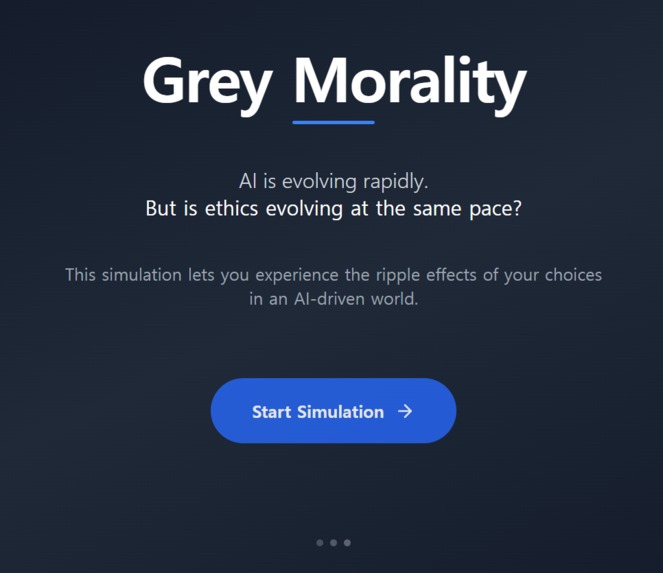
main
-
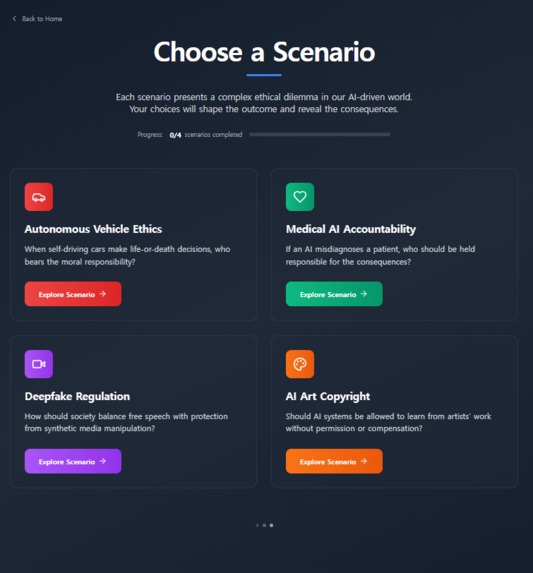
scenario
Inspiration
AI is becoming part of everyday life—but ethical thinking around it is still catching up.
We use smart systems every day, yet rarely consider their unseen impacts:
Who makes the decisions? Who takes responsibility?
Grey Morality was inspired by this gap.
We wanted to create an experience where users can explore the ethical complexity of AI in a thoughtful and engaging way—
not by reading about dilemmas, but by stepping into them.
Instead of giving answers, we designed a system that shows the consequences of decisions—
letting users reflect on how technology, ethics, and society shape each other in real time.
It’s not about blame.
It’s about awareness, nuance, and learning through experience.
What it does
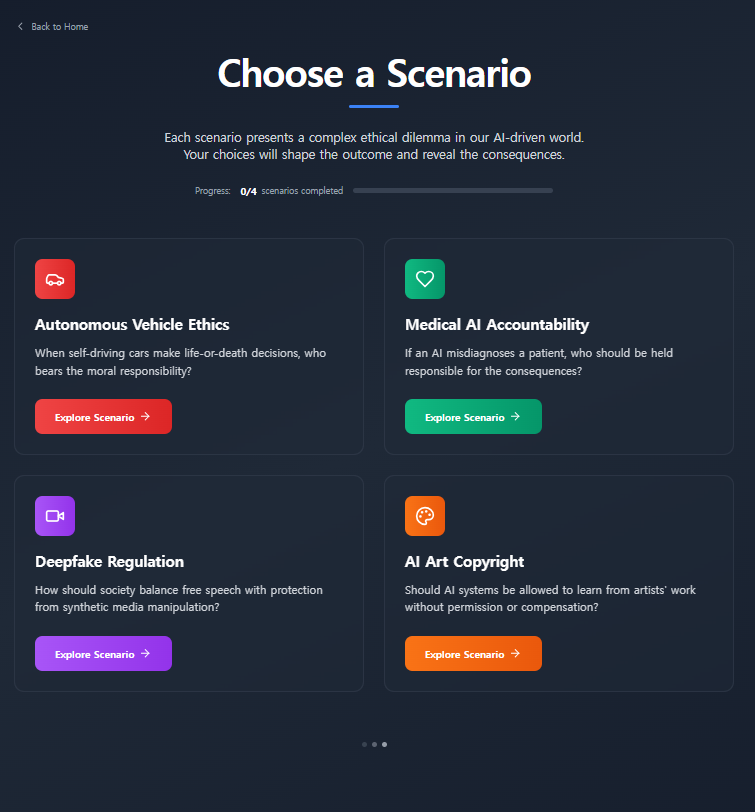
Grey Morality is an interactive ethics simulation where users take on the roles of AI developers, policymakers, or tech executives and confront real-world moral dilemmas across four key domains:
- Autonomous vehicle crashes
- Medical AI misdiagnosis
- Deepfake regulation
- AI-generated art & copyright
Each session randomly presents one of 5–10 realistic, high-stakes micro-scenarios per domain.
Users must make tough decisions—often with incomplete information and no clear right answer.
After making a choice, they receive:
- A thoughtful ethical reflection (powered by GPT or fallback logic)
- A dynamic Social Impact Meter showing shifts in trust, safety, and corporate reputation
- A personalized Societal Ripple Report that visualizes their evolving ethical worldview
How we built it
The entire project was built on Bolt.new with no separate backend. Key implementations include:
- Modular structure with fully separated scenario pages (via /pages/scenarios)
- Centralized state management across routes to retain user decisions
- Random sub-scenario logic for variability across sessions
- GPT-4 integration via fallback-safe custom useGPTReflection hook
- Reusable components for impact visualization and progress tracking
- Responsive design with TailwindCSS and smooth animations
- Personalized final report generated based on decision patterns and ethical type Everything—from state, routing, prompts, to UI—lives inside the Bolt environment.
Challenges We Ran Into
Designing this project forced us to face both technical and philosophical challenges.
On the design side, creating morally ambiguous scenarios was deceptively difficult. Every choice had to feel plausible, uncomfortable, and free from obvious moral bias. We constantly iterated to strike a balance where no answer felt entirely right — yet all answers had tangible consequences.
A key emotional challenge was addressing the gray zones of AI ethics. Unlike traditional game logic, these scenarios have no "correct" resolution. Navigating this ambiguity without setting artificial moral standards made us realize how little agreement there is in society about what AI should or shouldn't do.
We also struggled to ensure users wouldn’t feel judged. While we wanted their choices to matter, we didn’t want players to feel punished — just made to reflect. Designing that emotional tone was surprisingly tricky.
On the technical front:
- We integrated GPT with a fallback system based on environment-specific API logic
- Preserved state across randomized scenario routing
- Refactored a monolithic
App.tsx(over 2000 lines) into a modular structure within Bolt's constraints
Through it all, the hardest challenge might have been accepting that ambiguity — not clarity — was our product.
Accomplishments that we're proud of
- Turned a conceptual idea into a fully playable, ethically-driven simulation platform
- Delivered a complete Bolt-based web app with no external servers or backend
- Designed a seamless UX that encourages reflection without feeling preachy
- Integrated GPT with a robust fallback system, ensuring consistent value even without API access
- Balanced emotionally engaging storytelling with technically randomized logic and state management
What we learned
When we started building Grey Morality, we thought the hardest part would be the technology.
integrating GPT, managing random state, structuring components in Bolt without a backend.
But we were wrong.
The hardest part was designing a question with no answer and making people care about it.
How do you create scenarios where no choice feels clean?
How do you push users to think deeply without making them feel guilty or judged?
We learned that ethical ambiguity isn’t a matter of adding “gray areas.”
It’s about crafting decisions that feel real, uncomfortable, and defensible from multiple viewpoints.
That took more time than any line of code.
Technically, we discovered that GPT is only as strong as its context.
The same model felt either profound or generic—depending entirely on how well we framed the scenario, the user’s role, and their previous choices.
This taught us that AI isn’t the answer, it’s a mirror.
And designing that mirror took precision.
Working within Bolt’s environment challenged us to rethink how we structure everything.
We broke down a 2000+ line monolith into dynamic modules, separated prompt logic from rendering, and created fallback systems robust enough to deliver impact even without live API access.
But perhaps the biggest lesson was this:
The most powerful way to teach is to let someone feel the weight of their own decisions.
Information fades. Experience lingers.
And if someone walks away not with a “fact” but with a question they can’t shake off we’ve done our job.
What's next for Grey Morality
Grey Morality was always meant to be more than a one-time simulation.
We see it evolving into a platform for conversation, education, and reflection around the ethics of AI.
Here's where we're headed next:
- New domains, cultural contexts, and edge-case dilemmas
- Teacher/classroom mode for guided discussion and debate
- Scenario generator that adapts to each user's past choices and ethical leanings
- Internationalization and inclusive UX for broader global accessibility
- Partnerships with AI ethics organizations to bring Grey Morality into classrooms and workshops
We believe one thing above all:
AI ethics isn't an abstract topic—it's a lived reality we're already part of.
And the more we understand it, the more human-centered our future technologies can become.


Log in or sign up for Devpost to join the conversation.