Inspiration
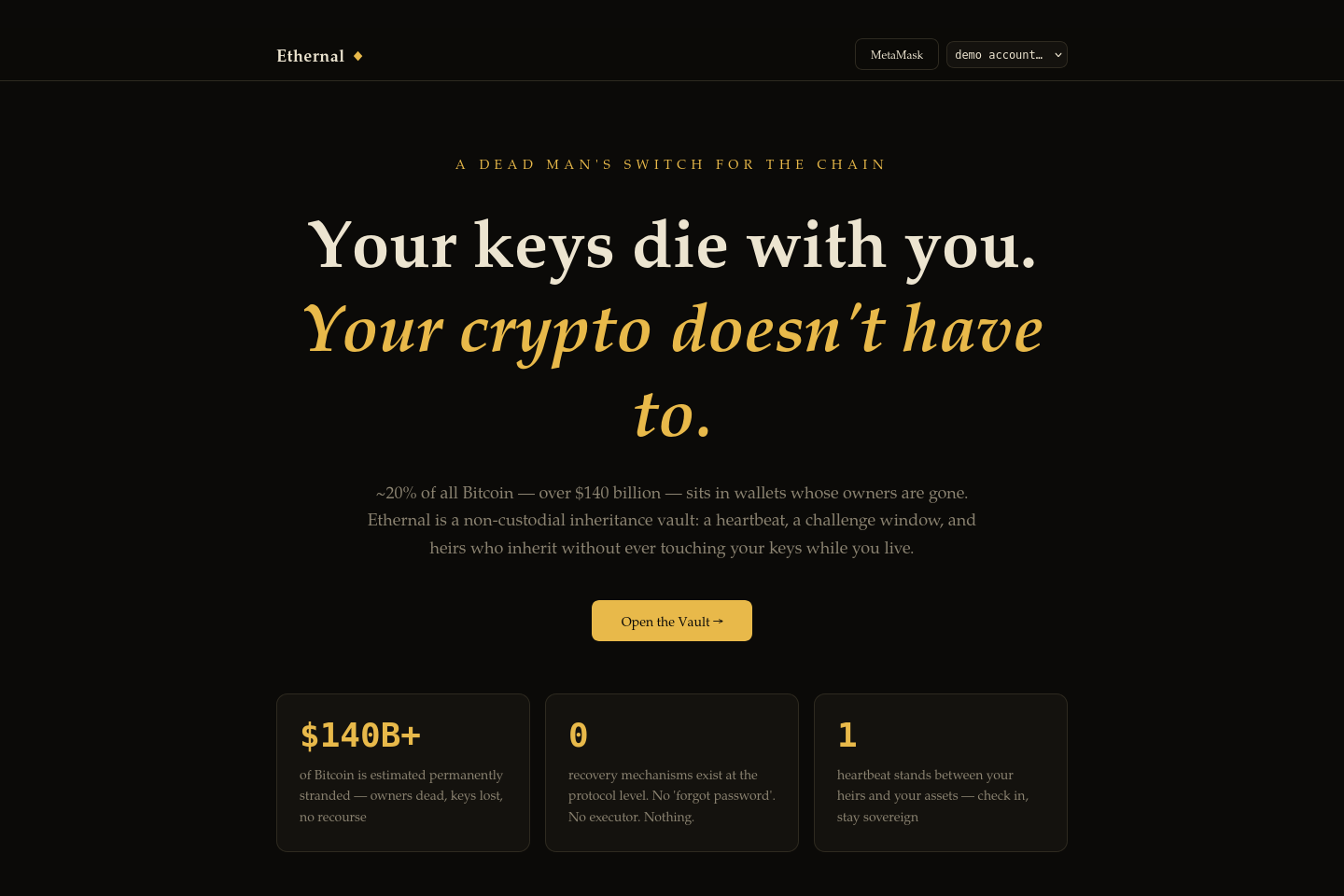
Blockchains never solved inheritance. Roughly 20% of all Bitcoin — over $140B — sits in wallets whose owners died or lost access. There is no protocol-level recovery path: no "forgot password," no executor, no estate process.
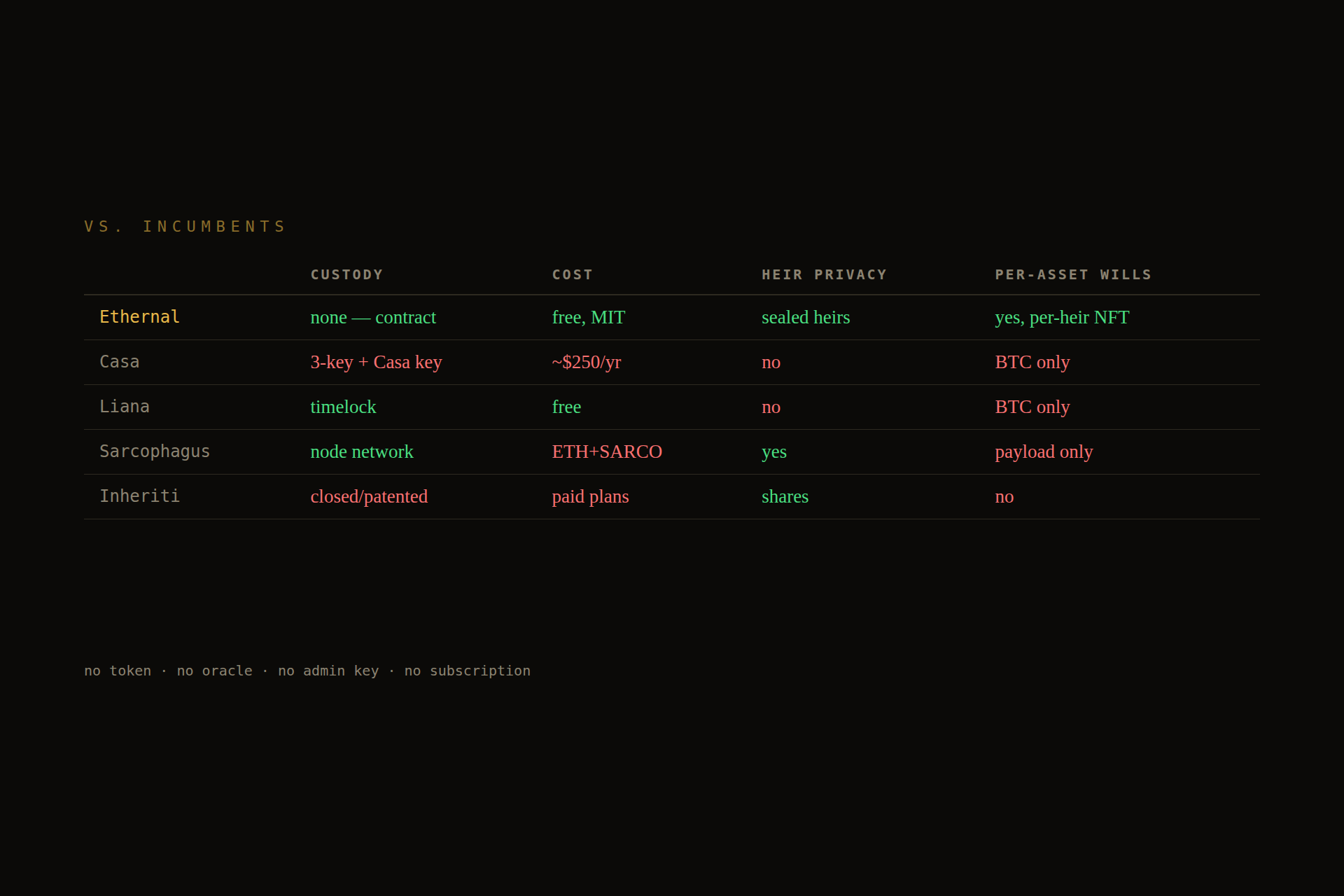
Every existing answer asks you to give up the thing self-custody is for. Custodial exchanges will pass assets to a family, but only because they hold the keys. Paper wills leak seed phrases to anyone who opens the drawer. Multisig inheritance setups require heirs who are already crypto-native. Casa charges ~$250/year and holds a key; Inheriti is closed and patented; Sarcophagus requires you to buy a token to write a will.
We asked: can the contract itself be the executor — contestable, private, and free?
What it does
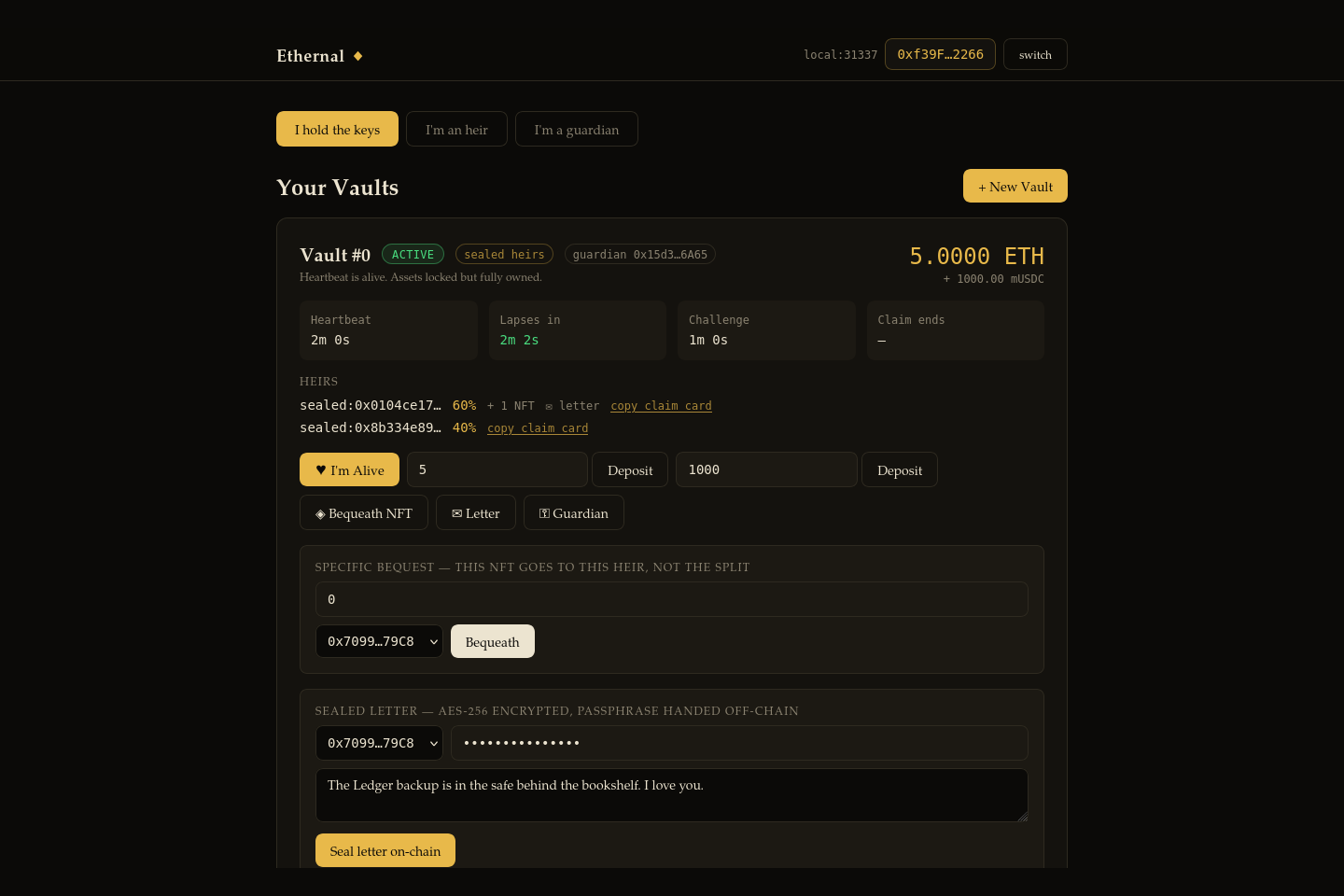
Ethernal is a dead man's switch implemented as a smart-contract vault:
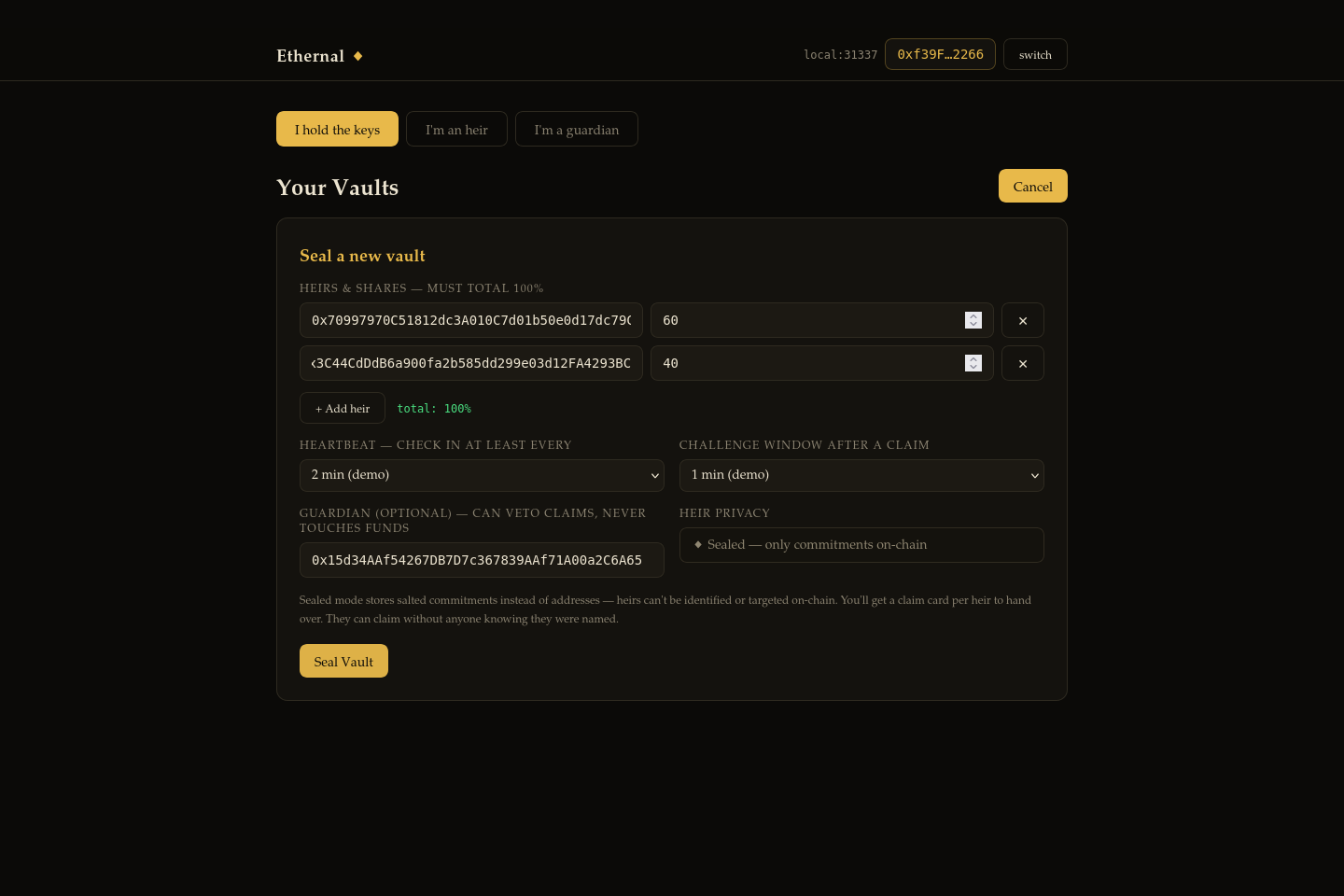
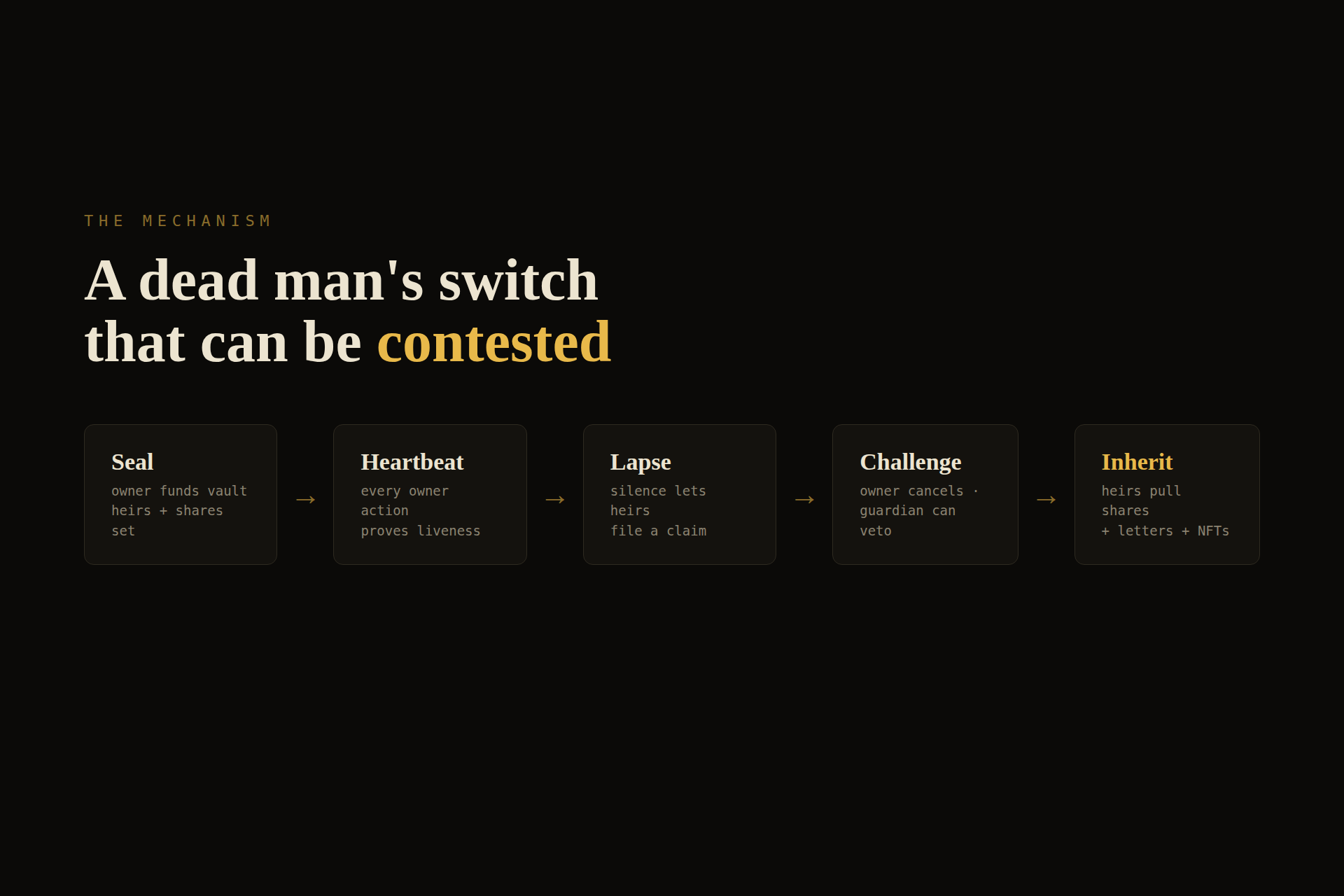
- Seal — the owner deposits ETH/ERC-20s into a personal vault and registers heirs with exact percentage shares. Heirs can be sealed: only salted
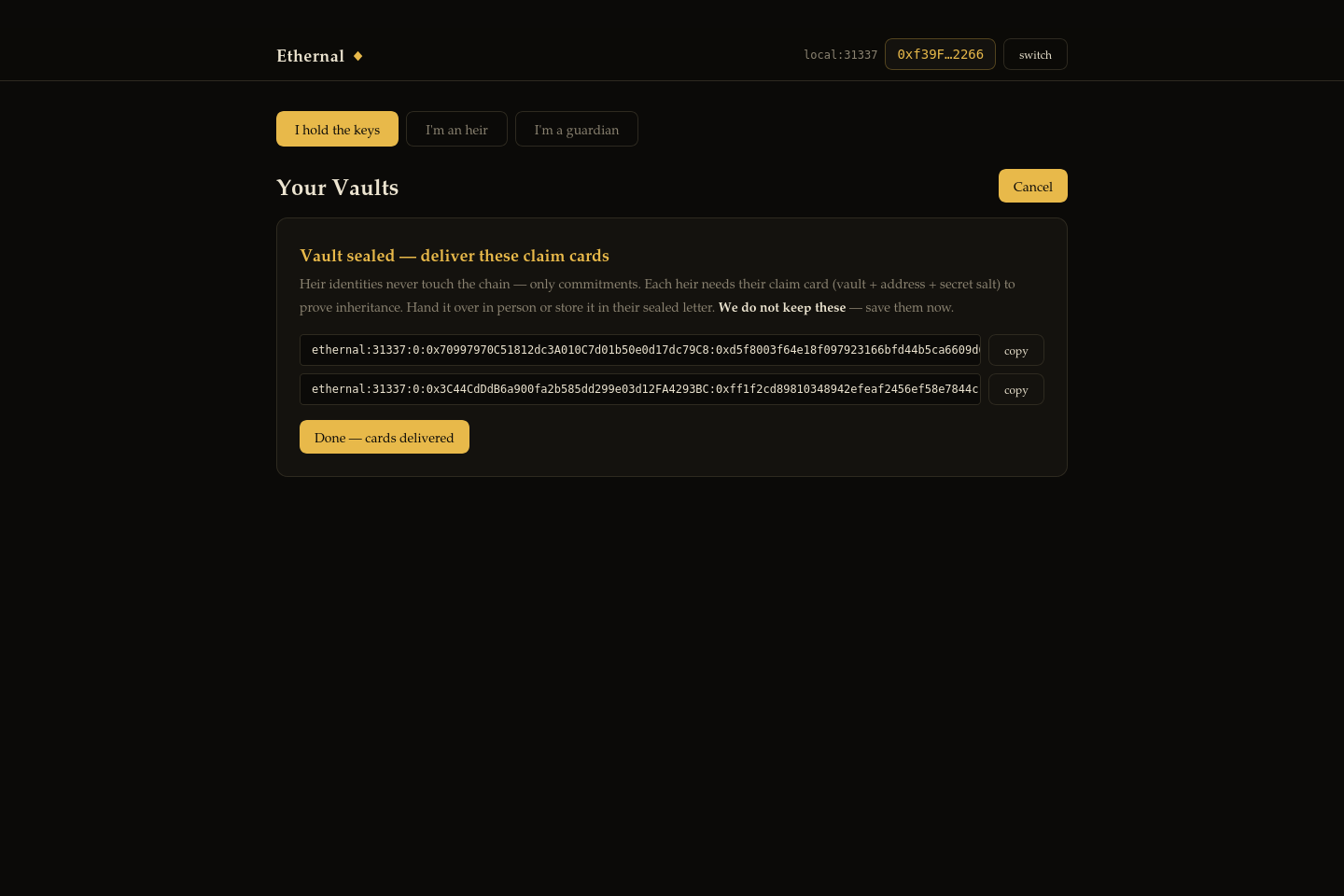
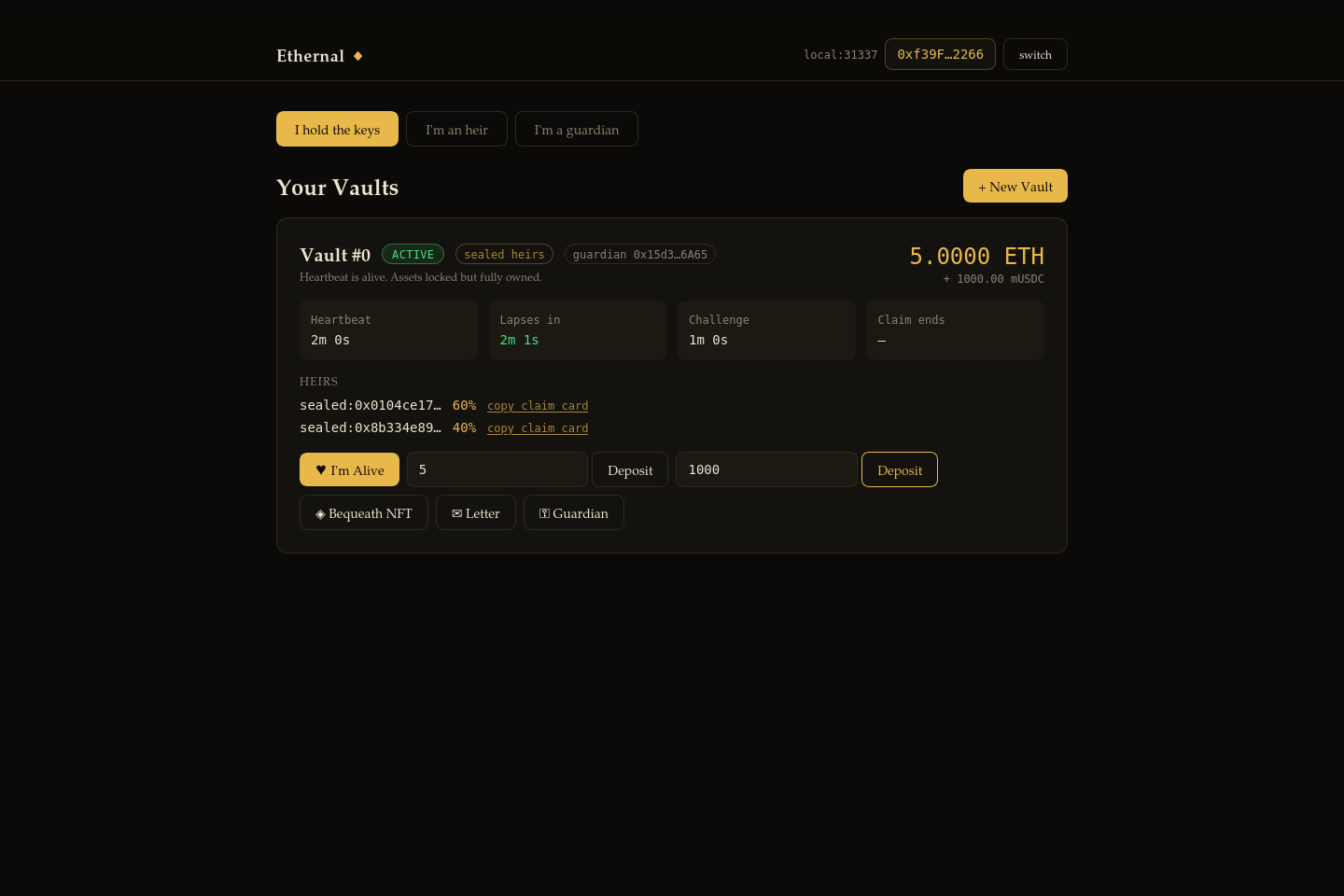
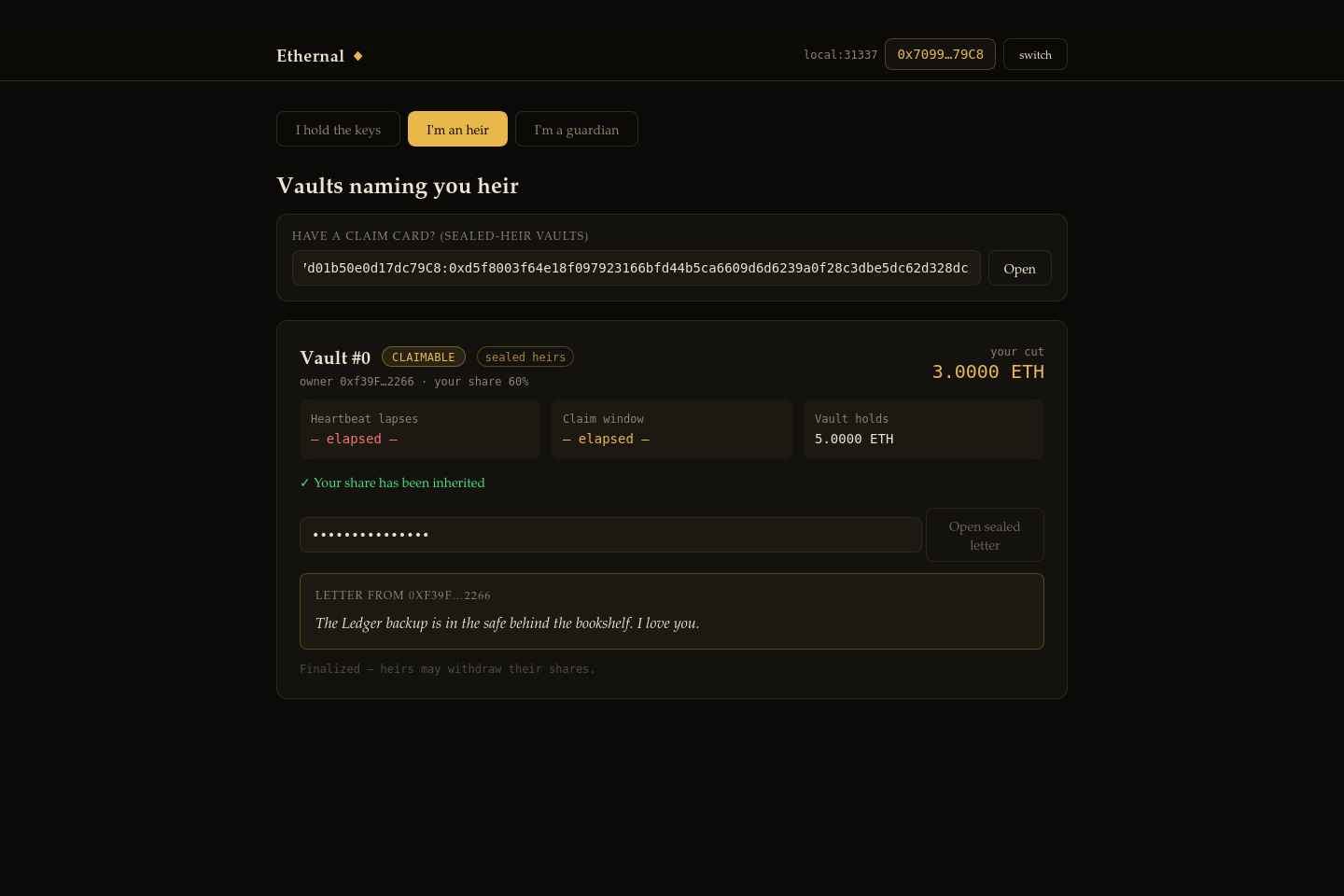
keccak256commitments go on-chain, so nobody can see or target them. Each sealed heir gets a physical claim card — the only thing they need. - Heartbeat — every owner action (deposit, withdraw, edit heirs, seal a letter) proves liveness. No ritual check-ins.
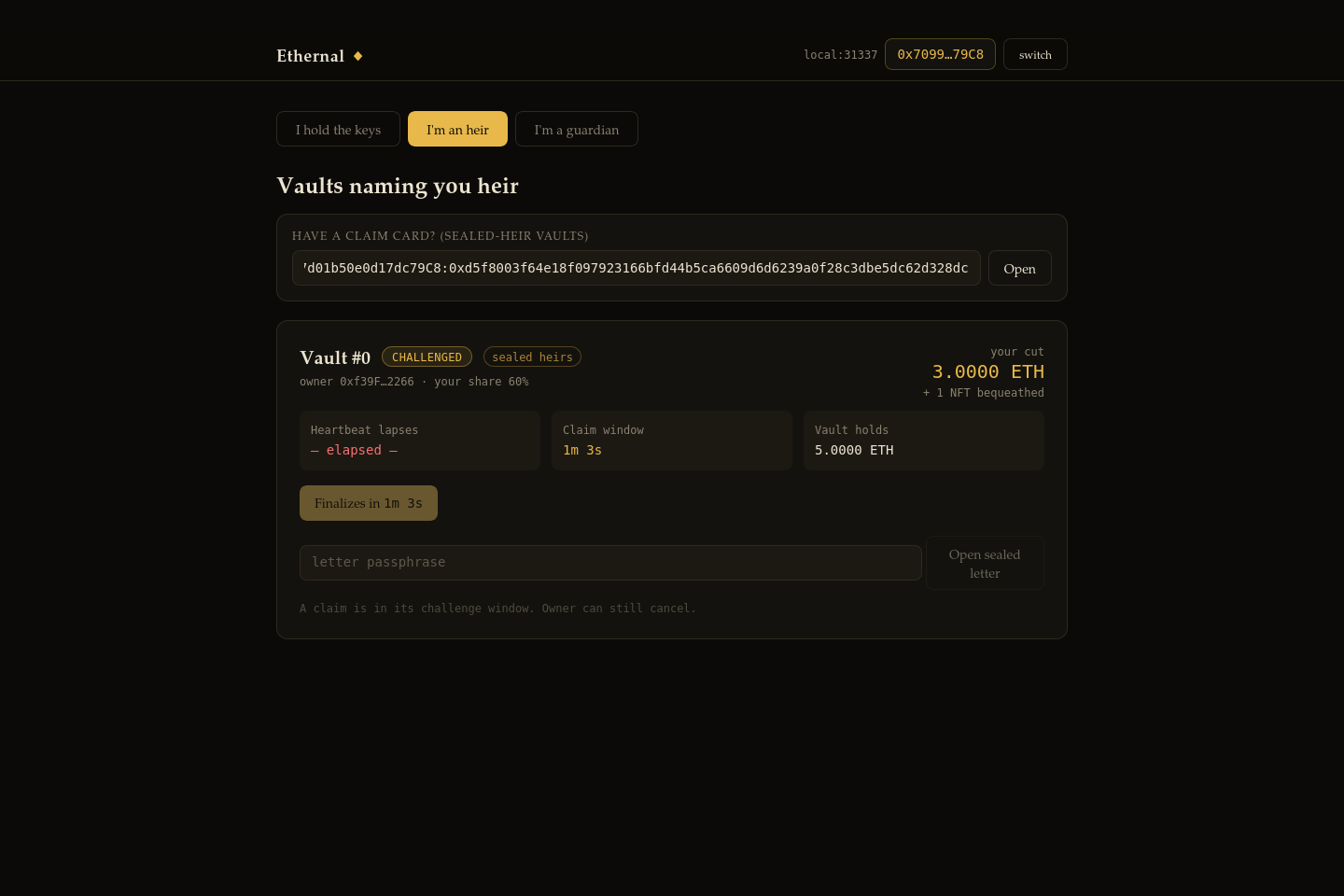
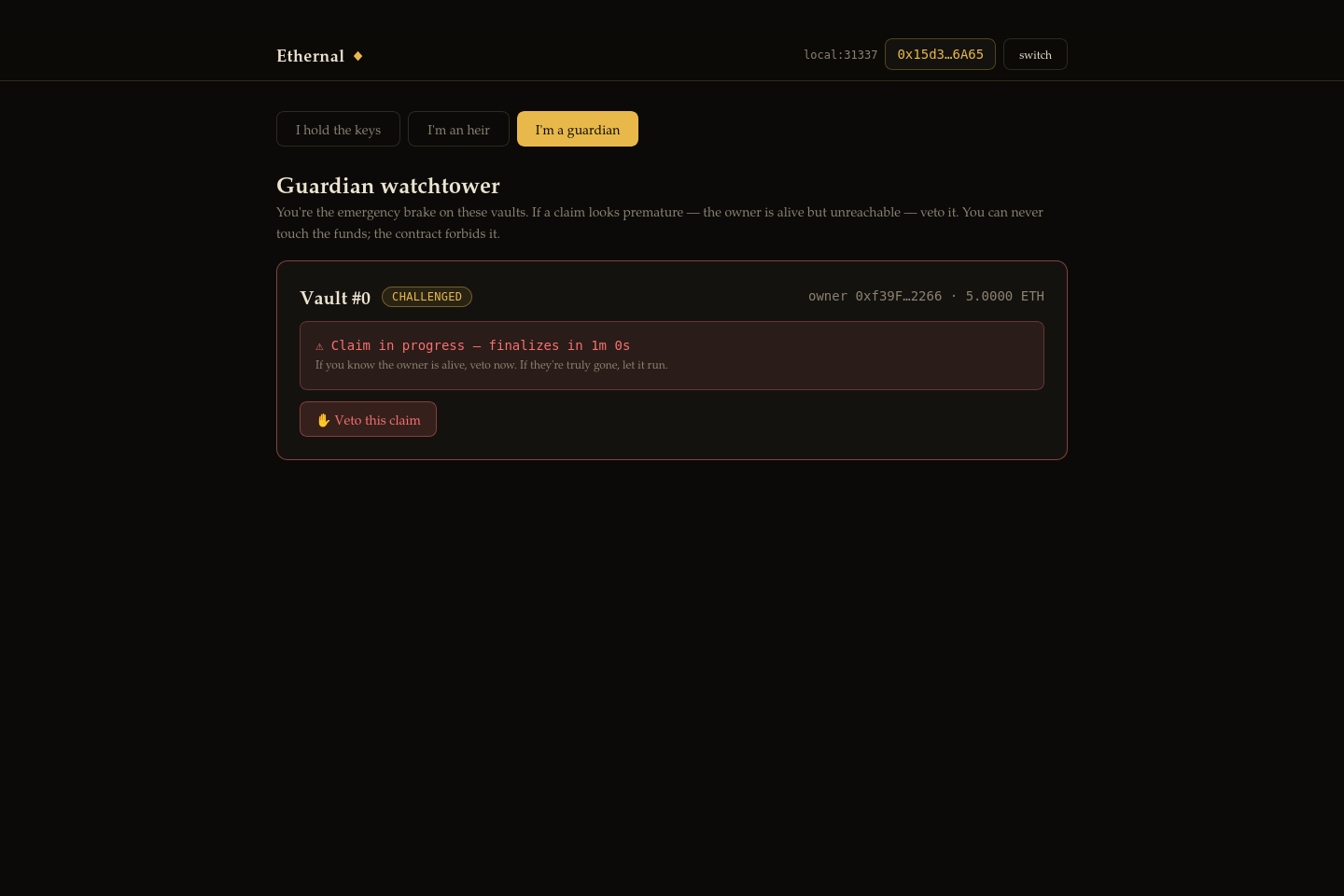
- Lapse → challenge — if the heartbeat lapses, an heir files a claim, opening a challenge window where the owner cancels with one action — and an optional guardian can veto. A guardian can never touch funds; the contract forbids it. Claims are contestable, never instant — a long vacation can't drain your vault.
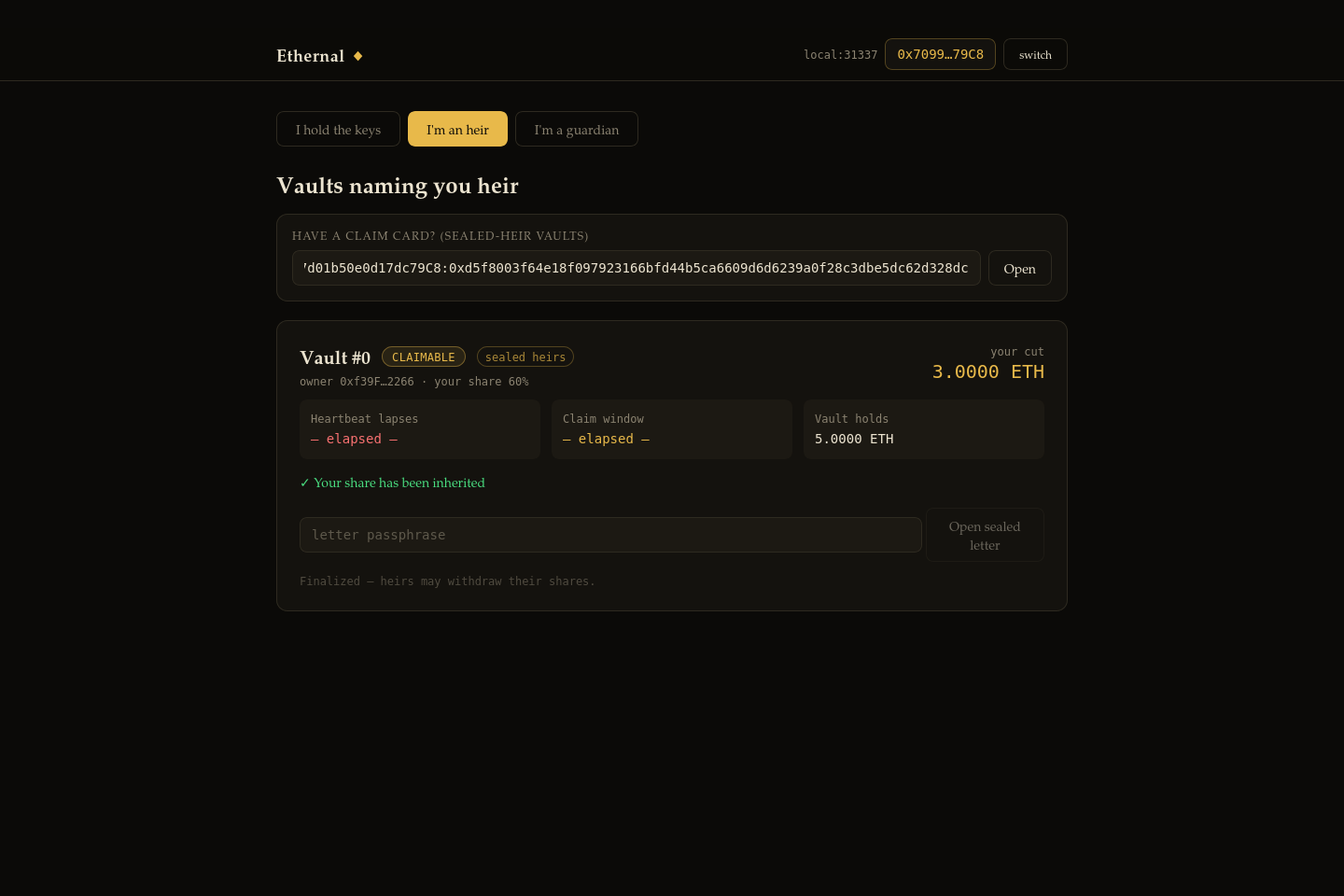
- Inherit — an uncontested claim finalizes; each heir pulls their share of ETH and every ERC-20, plus any specific NFT bequests ("my Azuki goes to Alice") and their sealed letter — an AES-256 message decrypted only with a passphrase whispered off-chain.
How we built it
- Contract: Solidity 0.8.24 on Hardhat 2 — a single dependency-free contract using checks-effects-interactions, custom errors, full event coverage, and pull-based payouts computed on frozen claim balances (so late claims can't dilute early ones).
- Privacy: sealed heirs are
keccak256(heir, salt)commitments; claim cards encodechainId:vaultId:heir:salt. Letters use AES-256-GCM via WebCrypto with PBKDF2 keys — ciphertext on-chain, passphrase off-chain. - Frontend: Vite + React 19 + TypeScript + Tailwind 4 + ethers v6 — three role portals (owner / heir / guardian watchtower), dark countdown-first UI where every contract state is a visible badge.
- Verification: 14 contract tests covering the full lifecycle and edge cases, plus a 21-check headless-Firefox Playwright suite that clicks through the entire flow with screenshots.
Challenges we ran into
- The premature-payout problem. A naive dead man's switch has a fatal flaw: "silent" ≠ "dead". The challenge period — plus the guardian veto — turns a binary trigger into a contestable process without adding custody.
- Heir privacy vs. UX. Public heir addresses are convenient but create a phishable target list ("you're heir to 100 ETH — click here"). Sealed commitments fix that but make heirs undiscoverable; claim cards restore the UX without losing privacy — and both modes coexist per vault.
- Fair share math. If heirs claim at different times, naive proportional math lets early withdrawals shrink everyone else's cut. Shares are computed against the balance frozen at finalization — our tests caught this before anyone lost money.
- Honest demo-ability. Inheritance runs on months; demos run on minutes. The contract supports heartbeats down to 60s and the UI reads chain time (not wall clock) so countdowns stay truthful under time-travel test RPCs.
Accomplishments that we're proud of
- A genuinely non-custodial executor: no admin key, no oracle, no keeper, no token, no subscription — MIT and auditable in one file.
- Features no incumbent ships together: sealed heirs + guardian veto + per-asset NFT bequests + encrypted last letters.
- The whole lifecycle is demoable end-to-end in under five minutes — including the veto-and-retry path.
- 14/14 contract tests, 21/21 browser E2E checks, and a narrated demo video — every claim in this submission was executed, not asserted.
What we learned
- The best inheritance UX is invisible: making every owner action a heartbeat (borrowing Liana's timelock insight, generalized to any interaction) removed the one chore users would forget.
- "Private heirs" is the difference between a will and a doxxing list — and it's just a salt and a hash away.
- Contestability beats speed for irreversible operations: a challenge window is cheaper than a lawsuit.
What's next for Ethernal
- Deploys: Sepolia + low-fee L2s; claim-card PDF/print export for real-world handover.
- Liveness signals: ERC-4337 session heartbeats and activity-based liveness (any on-chain action counts).
- Notifications: keeper/watchtower alerts when a vault approaches lapse or enters challenge.
- Estates: multi-vault bundles, contingent heirs, and M-of-N guardian attestations as an alternative trigger.
Built With
- ethereum
- ethers.js
- hardhat
- react
- smart-contracts
- solidity
- tailwindcss
- typescript
- vite
- web3

Log in or sign up for Devpost to join the conversation.