-
-
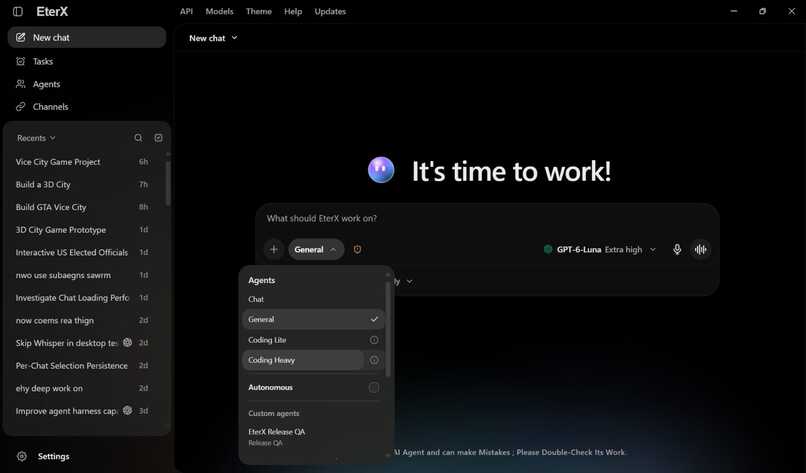
Choose agent modes for different workflows, with focused tools and capabilities to help manage token usage.
-
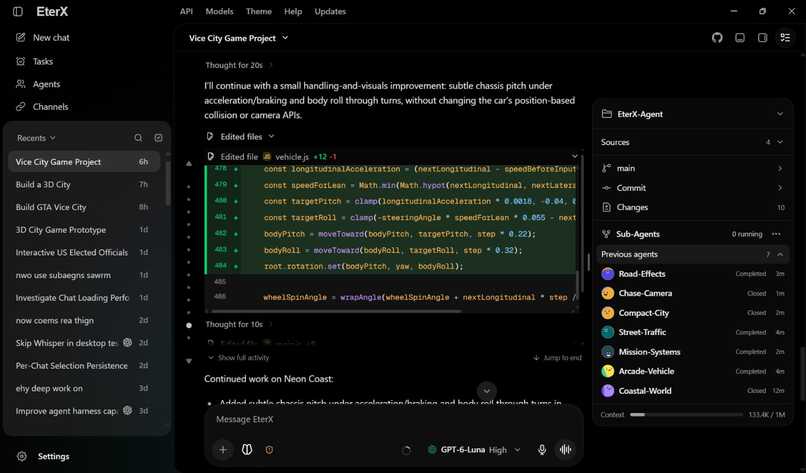
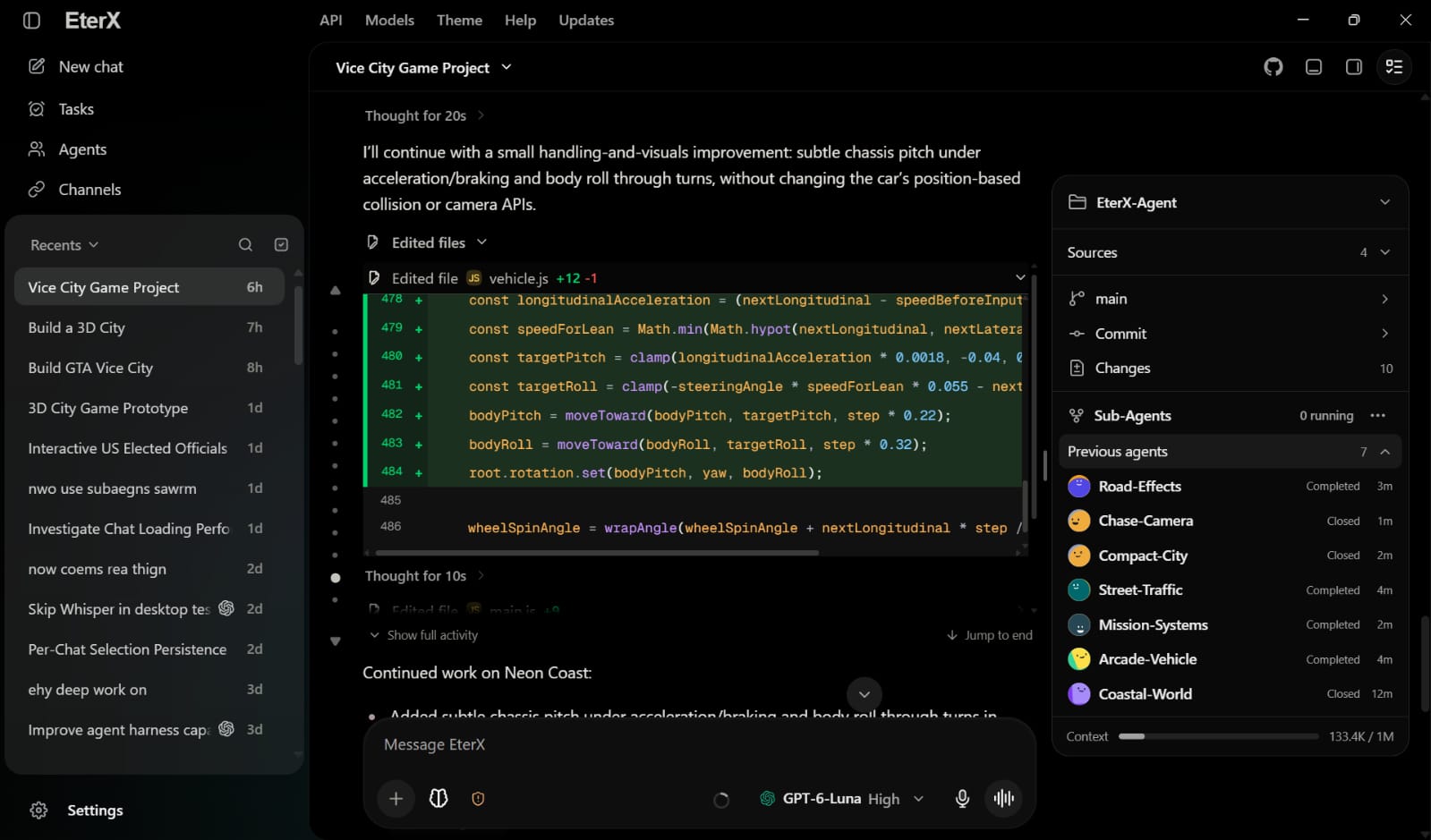
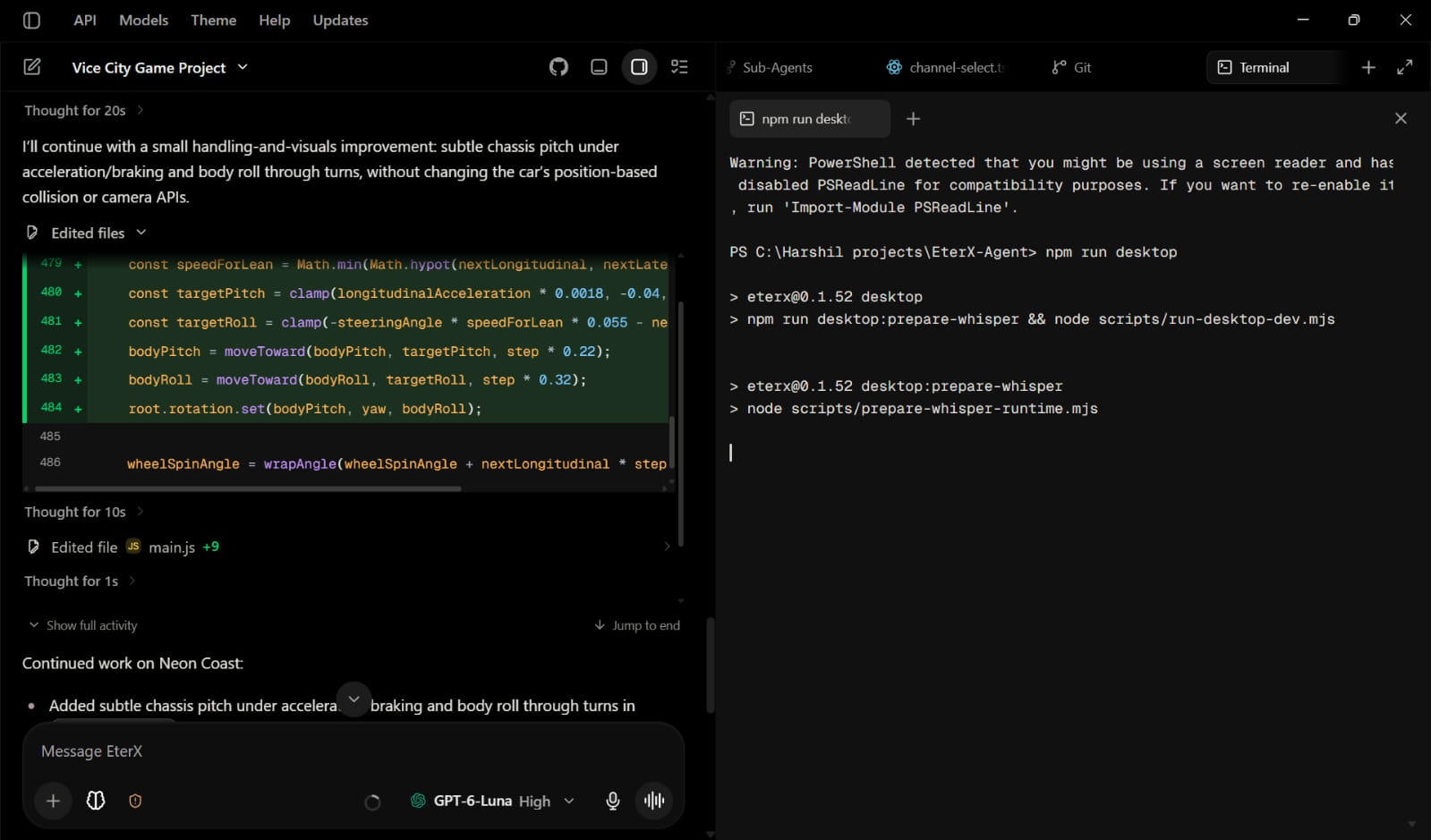
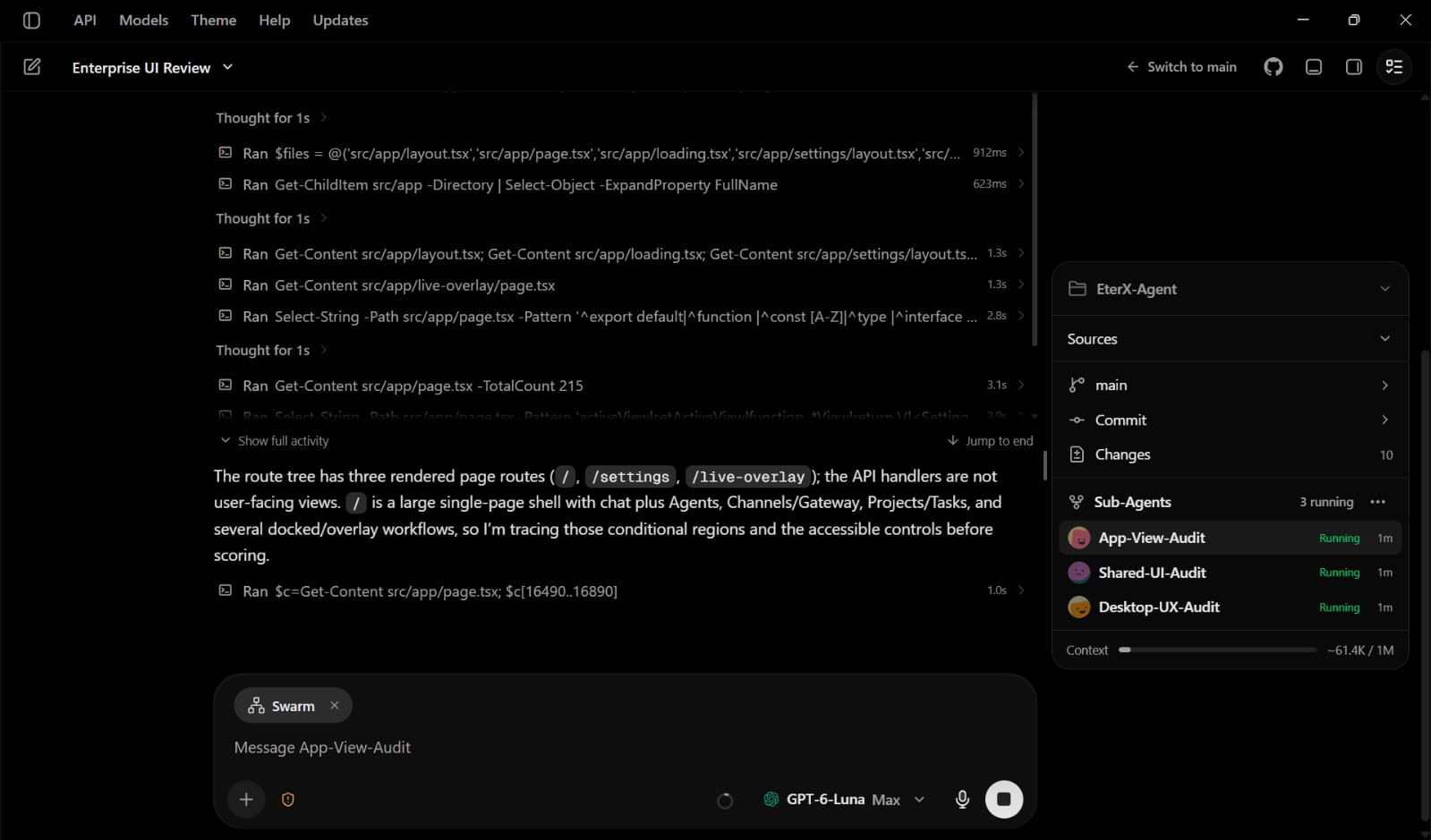
A closer look at the coding workspace, with file changes, Git status, and sub-agent progress in one place.
-
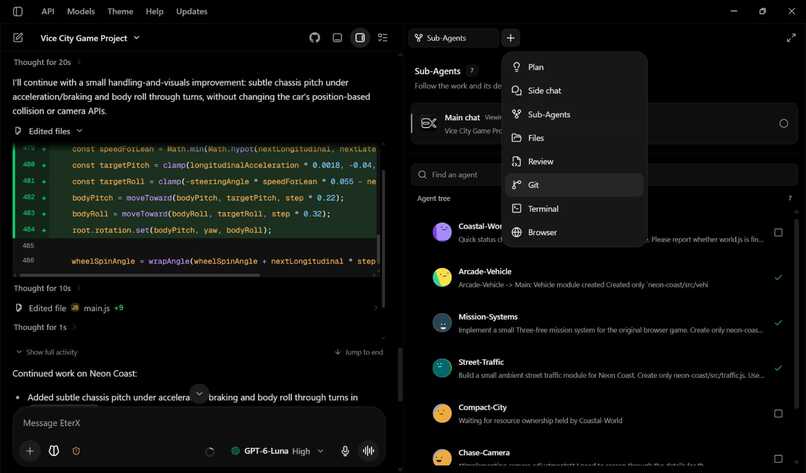
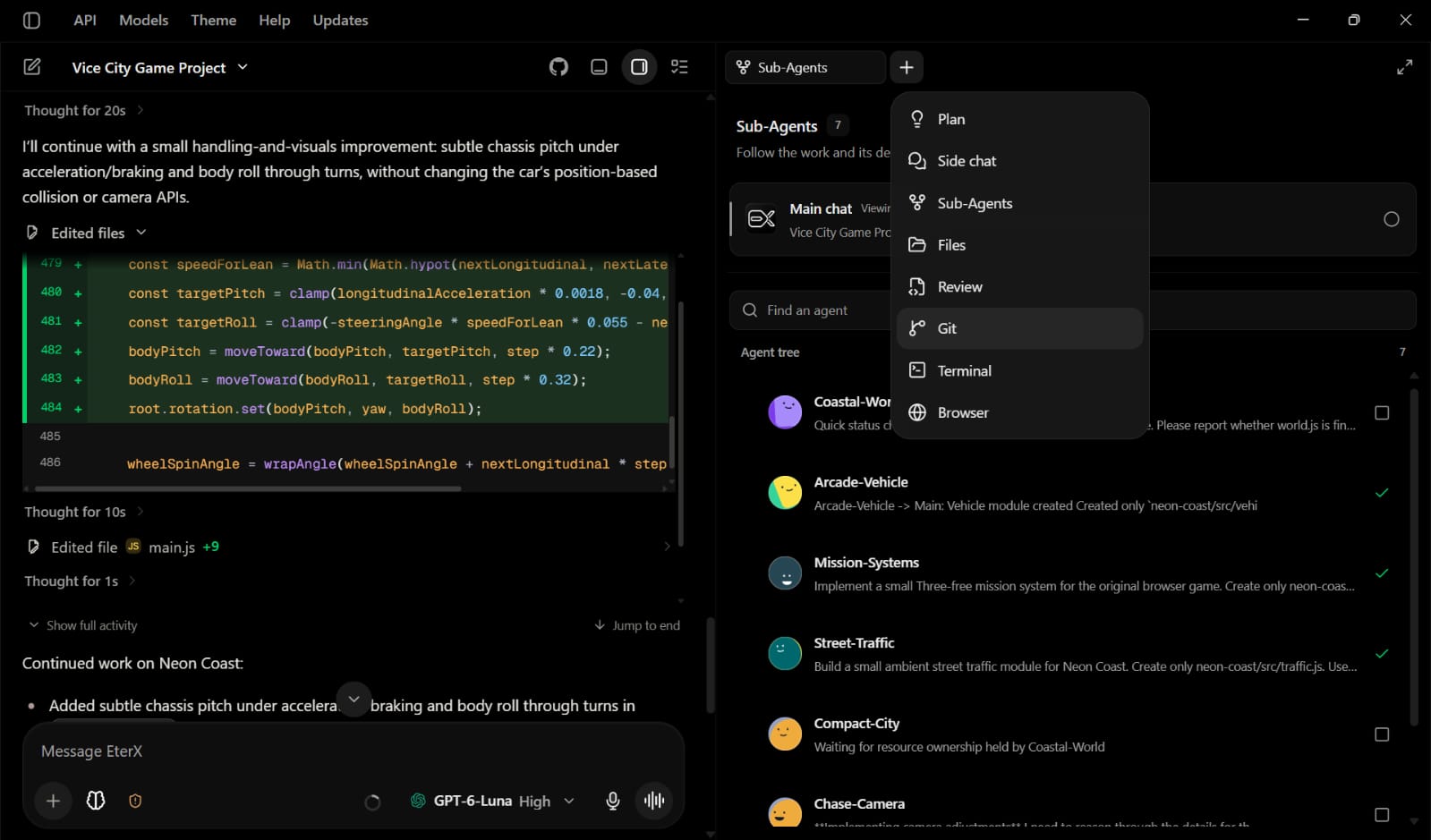
Multiple agents working on different parts of a game project, with their tasks and progress visible in one view.
-
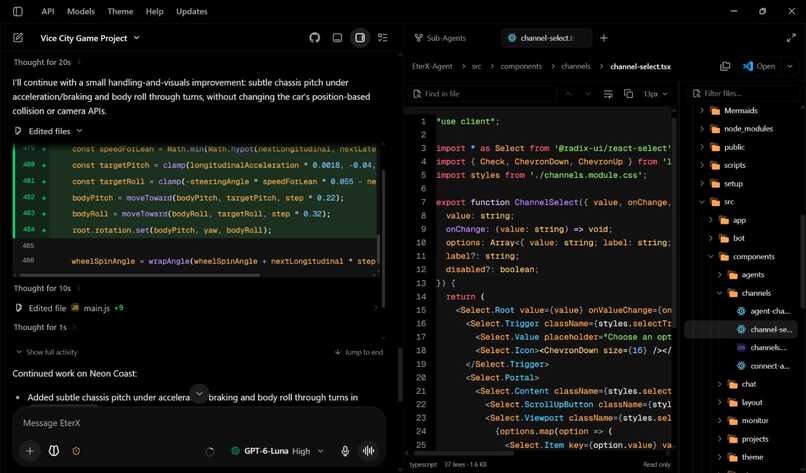
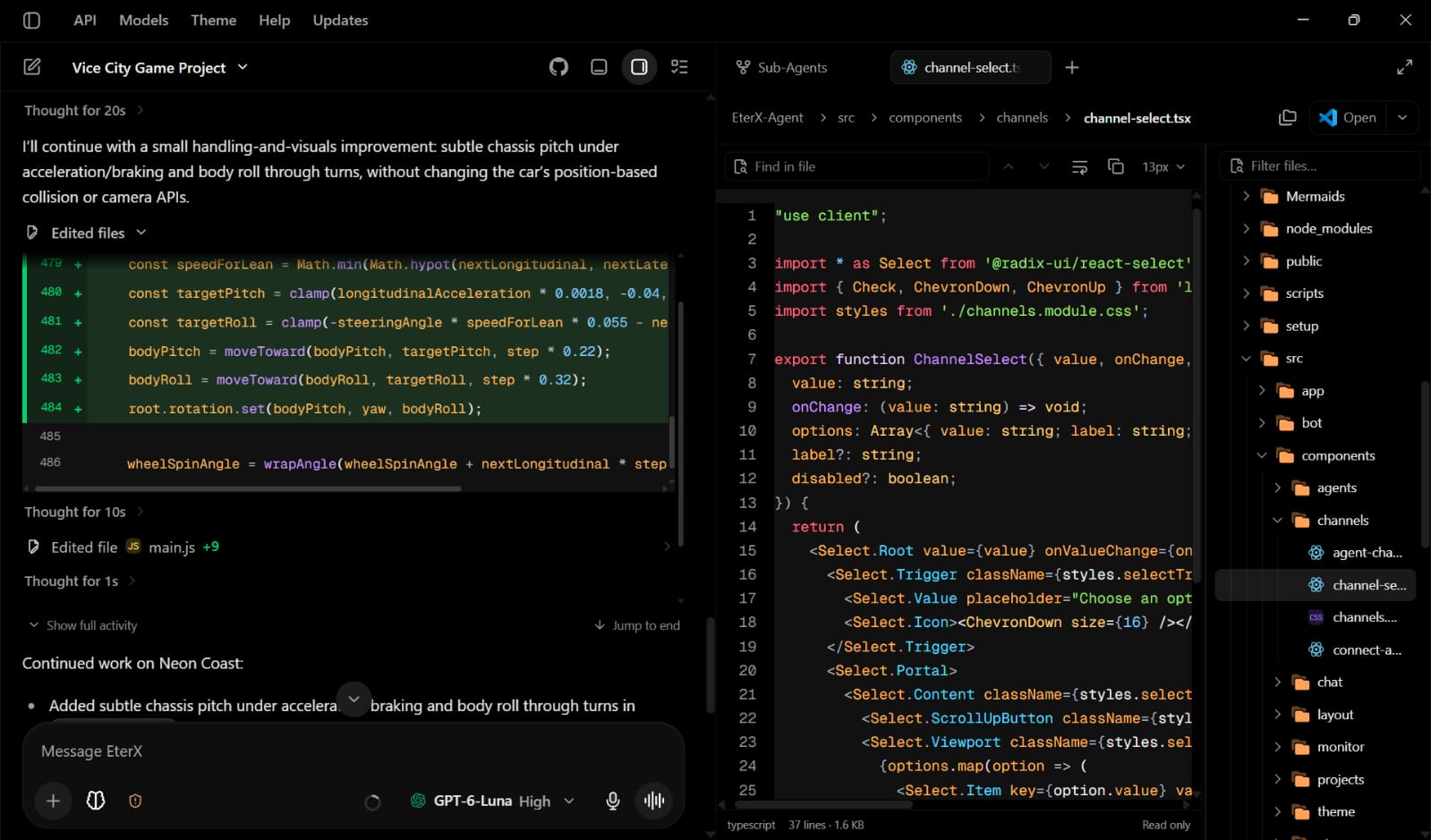
Browse project files and inspect source code without leaving the workspace or interrupting the agent.
-
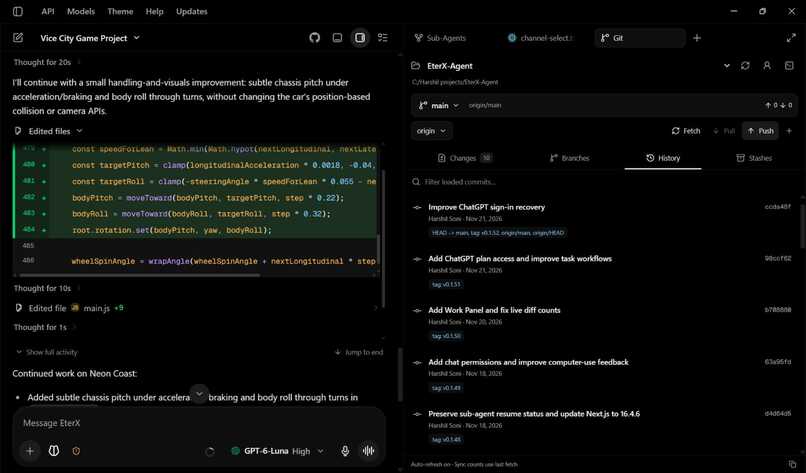
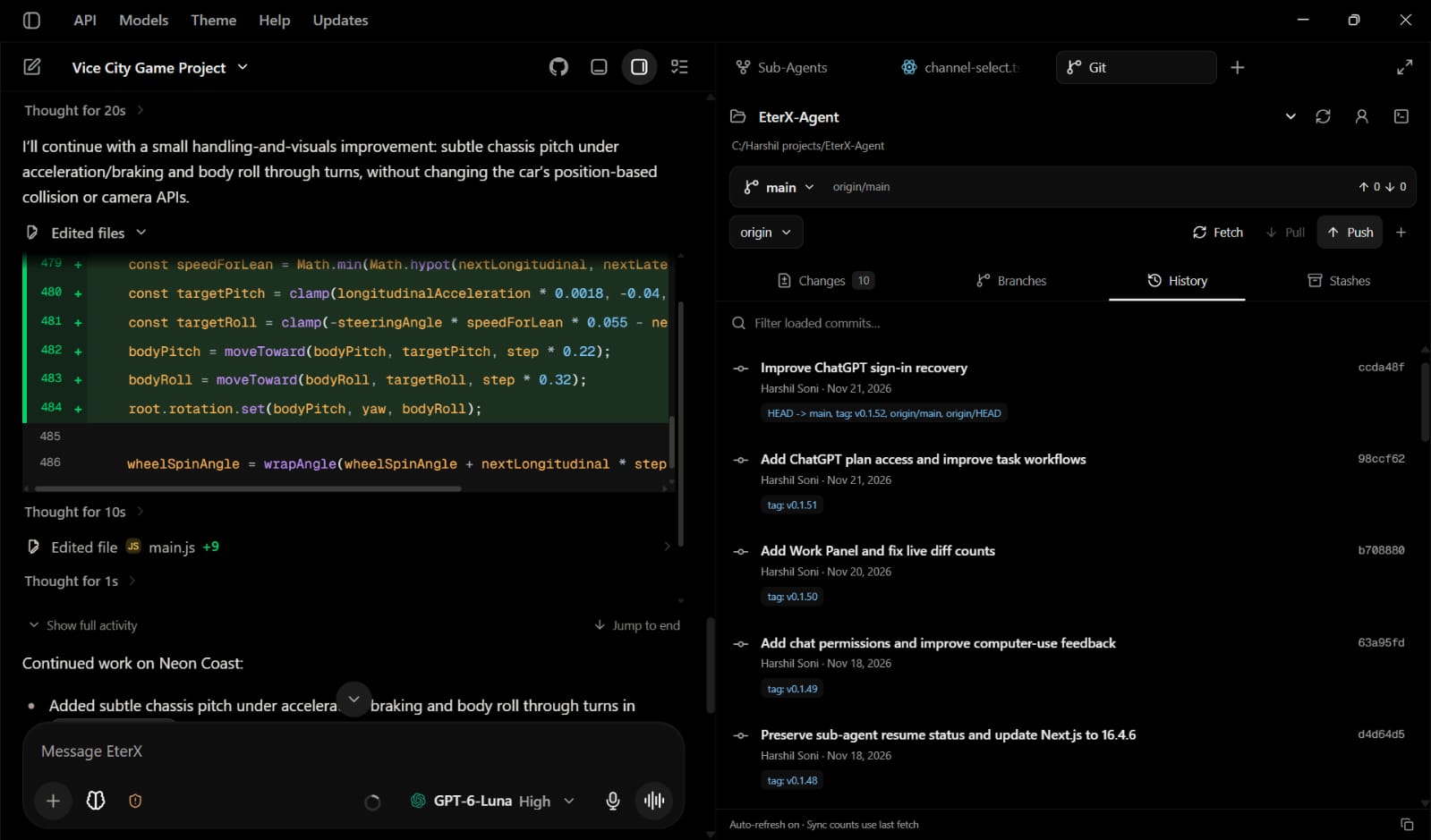
View commits, track changes, and manage repository history directly inside EterX.
-
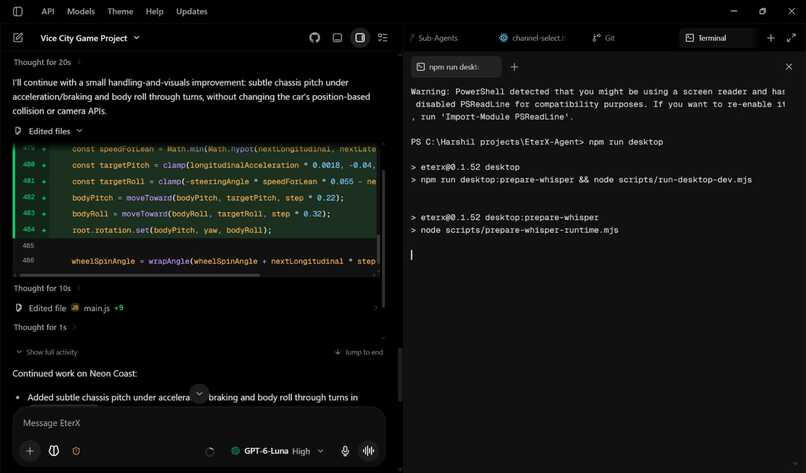
Run commands and work with your development environment alongside the agent.
-
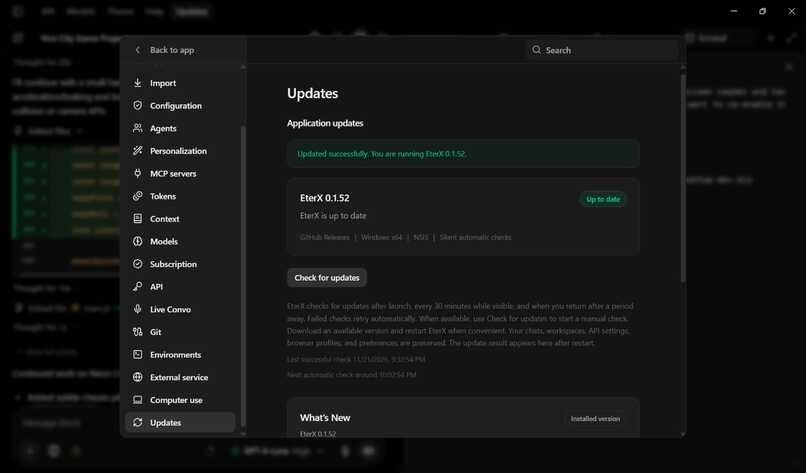
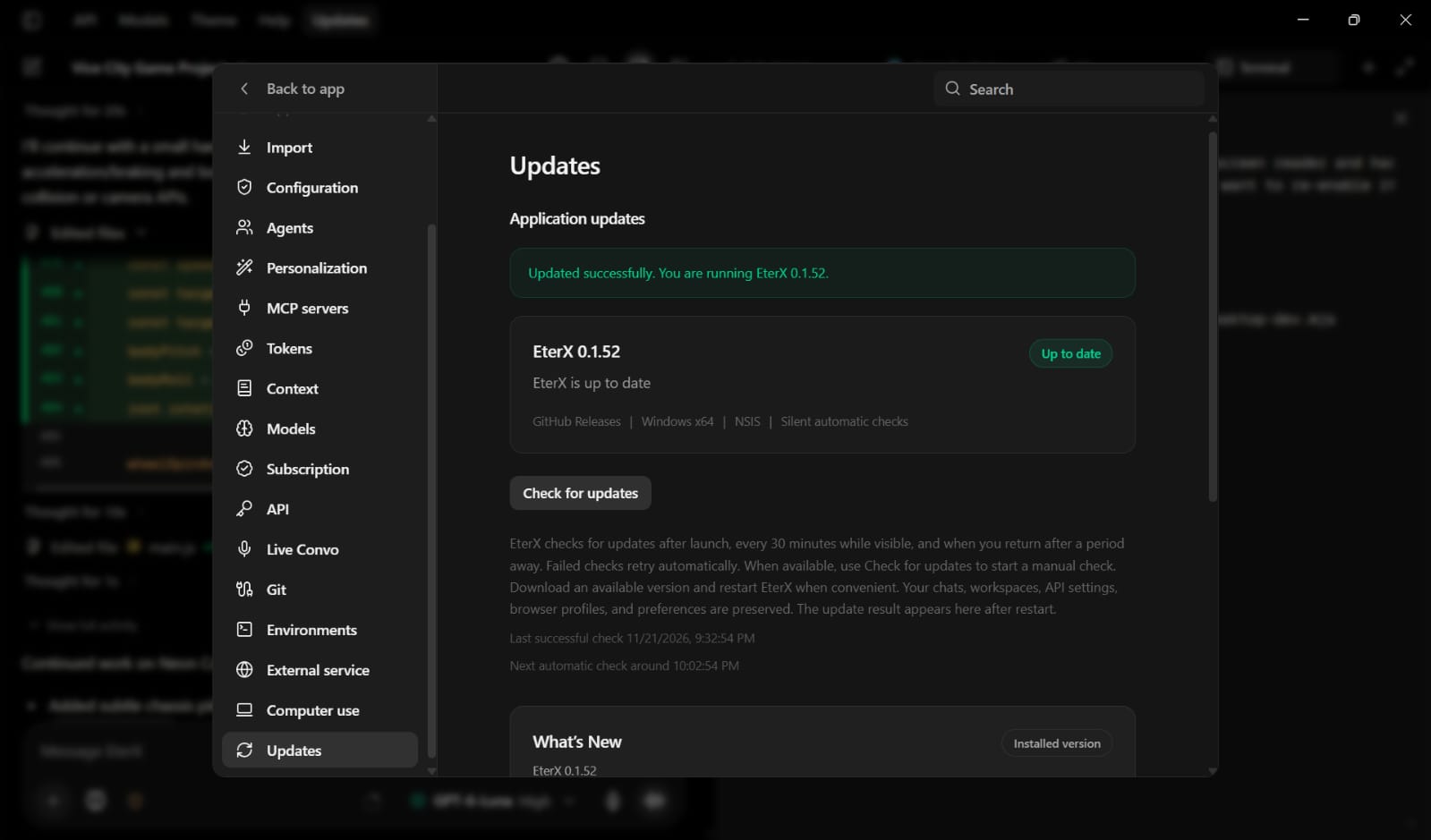
Manage application settings and updates from one place, with the latest installed version .
-
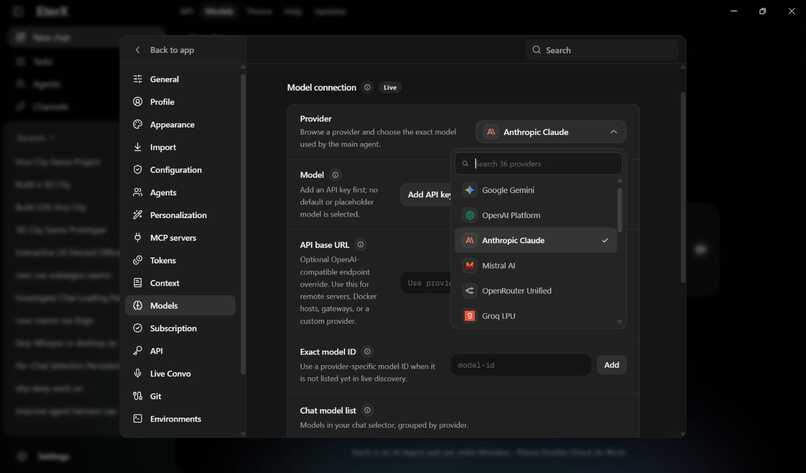
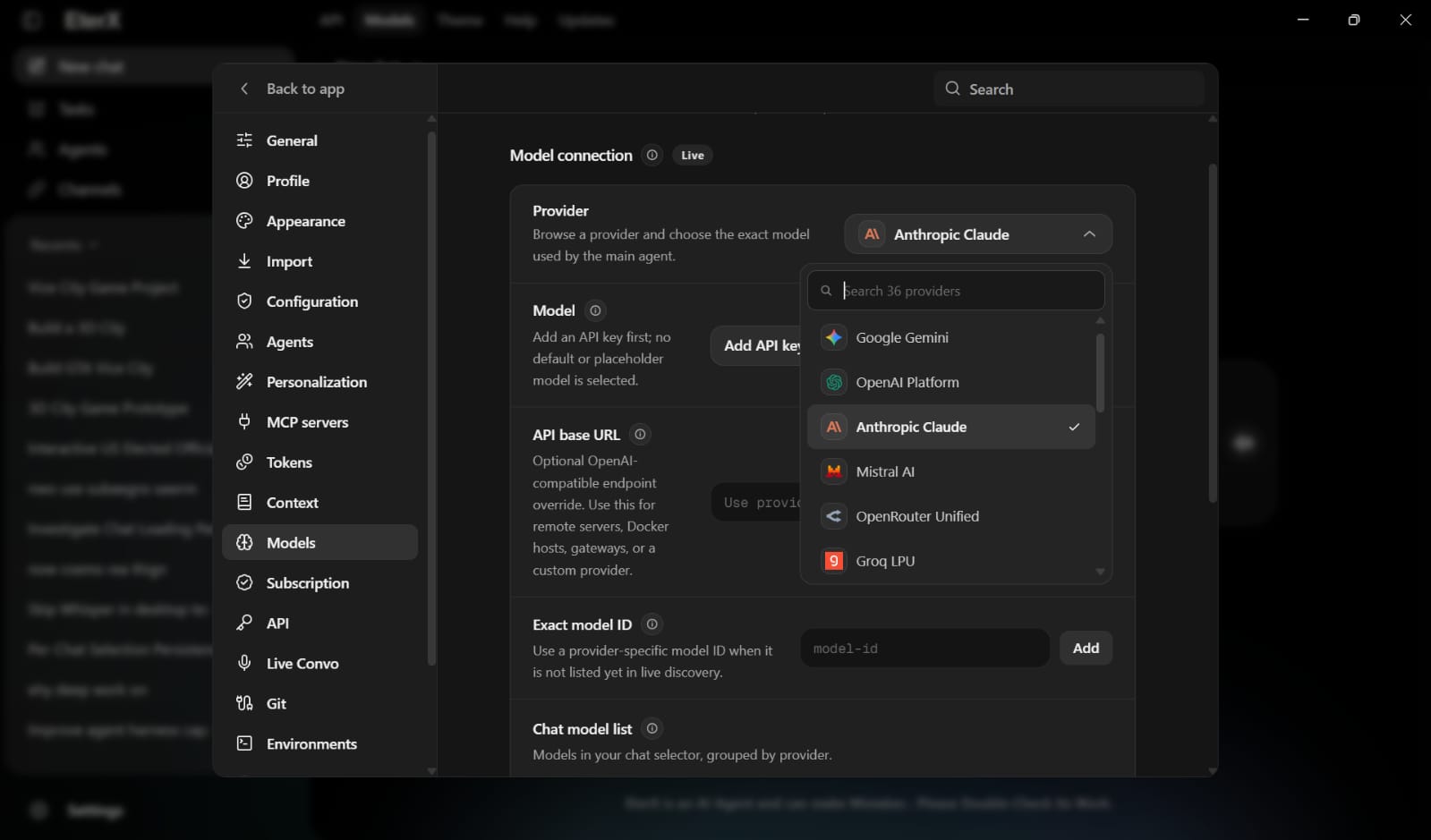
Connect to over 30 AI providers, choose your preferred models, and configure API access .
-
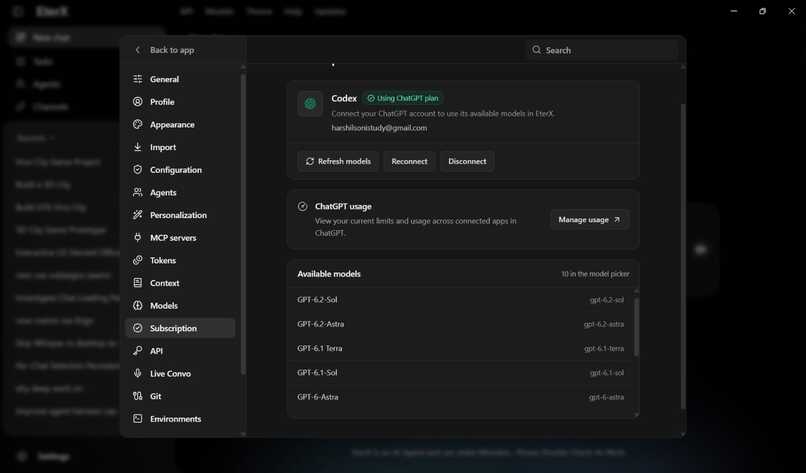
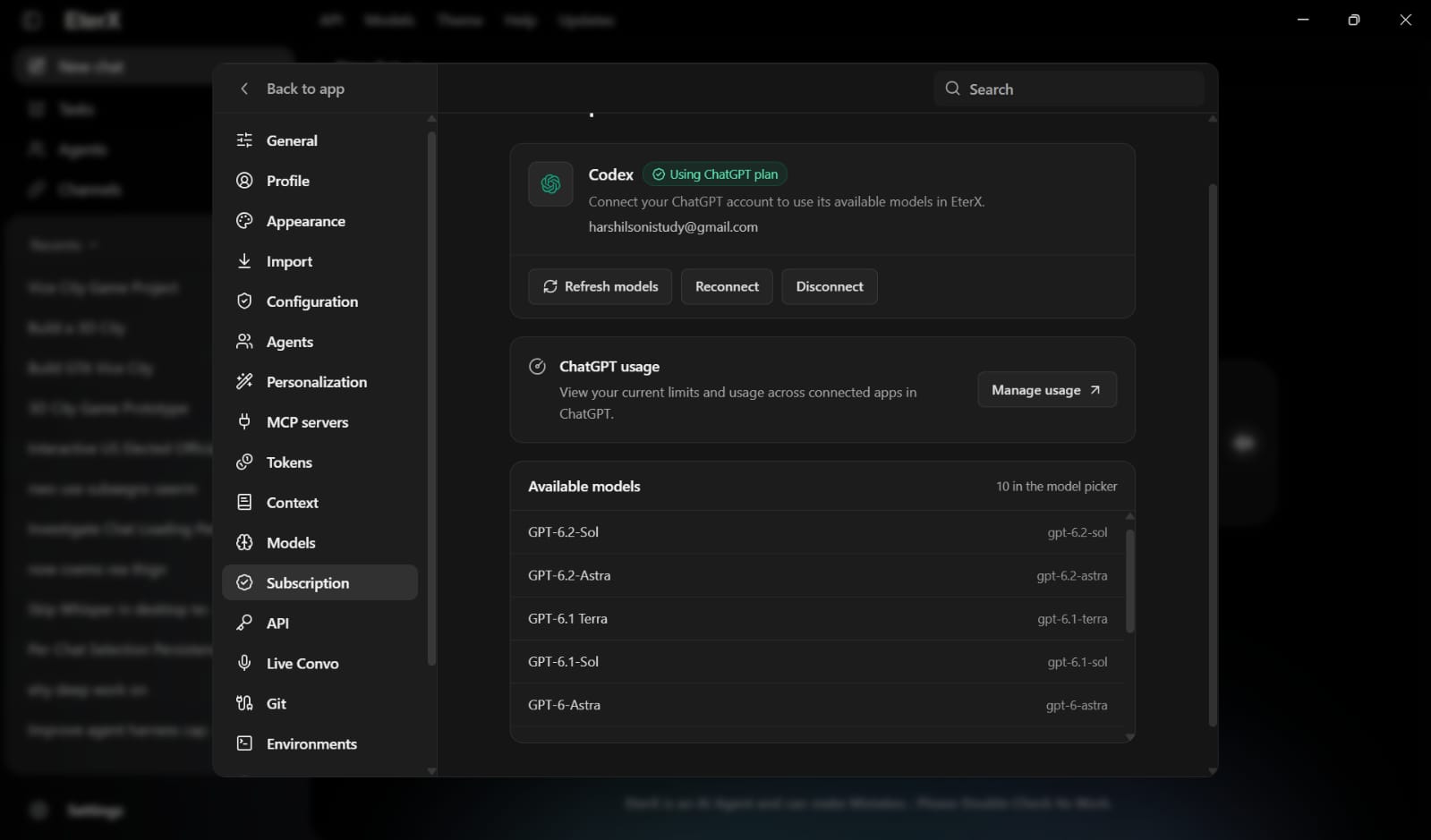
Connect your ChatGPT account and use the models available through your plan directly in EterX.
-
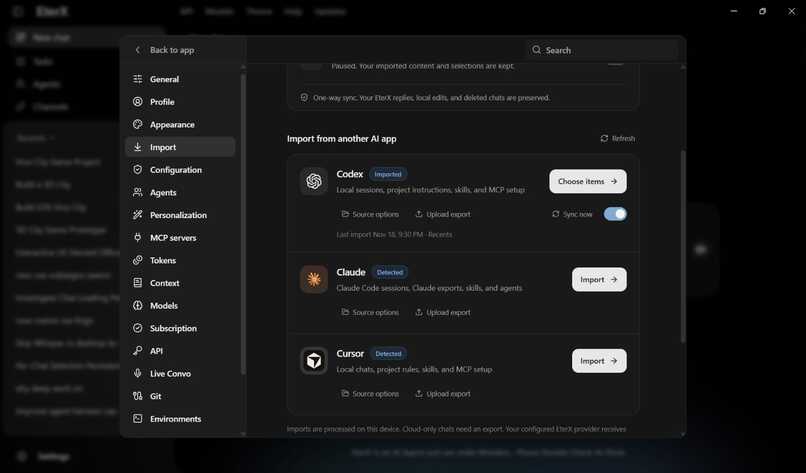
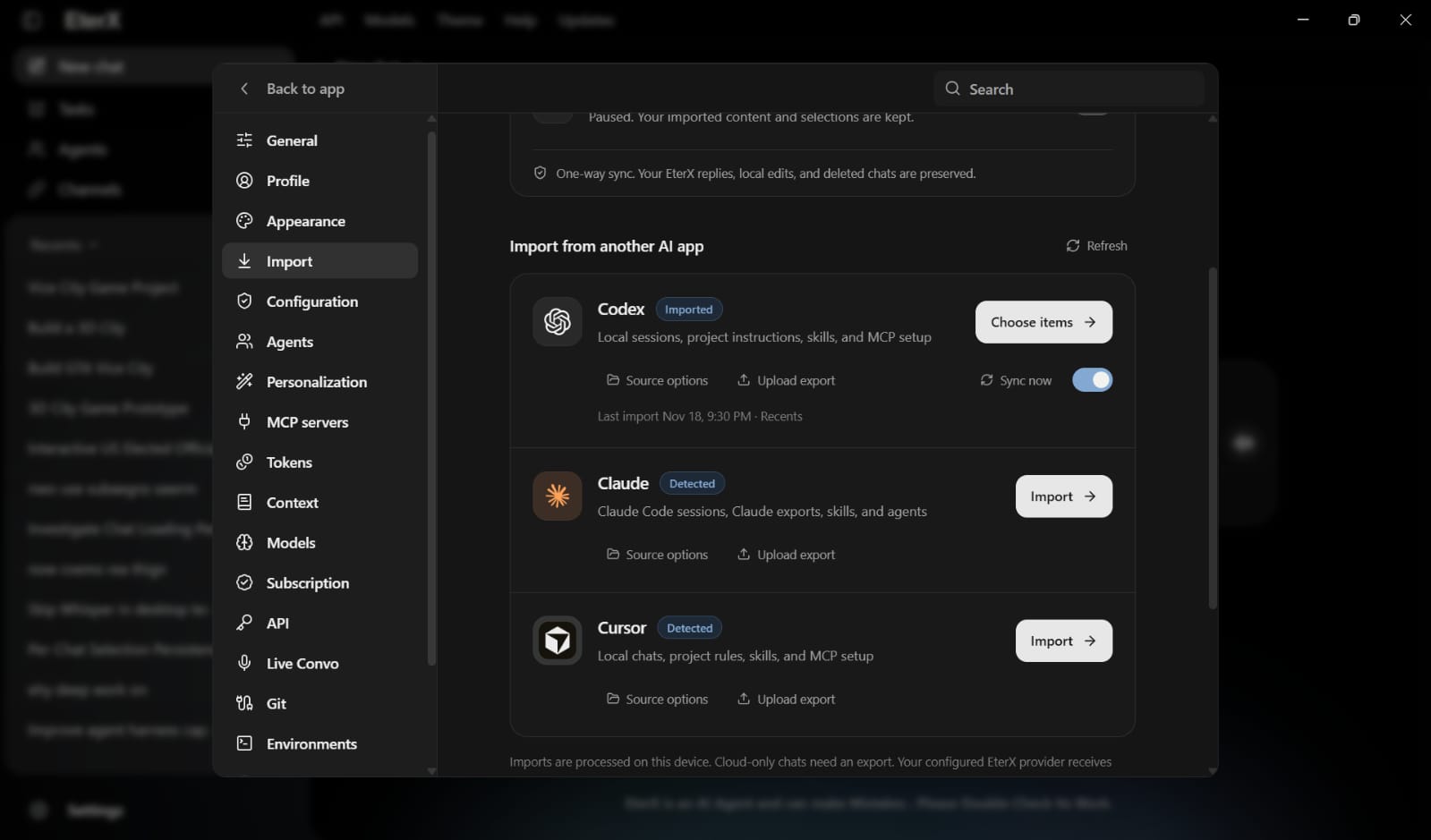
Bring your existing sessions, project settings, and workflows from Codex, Claude Code, or Cursor into EterX.
-
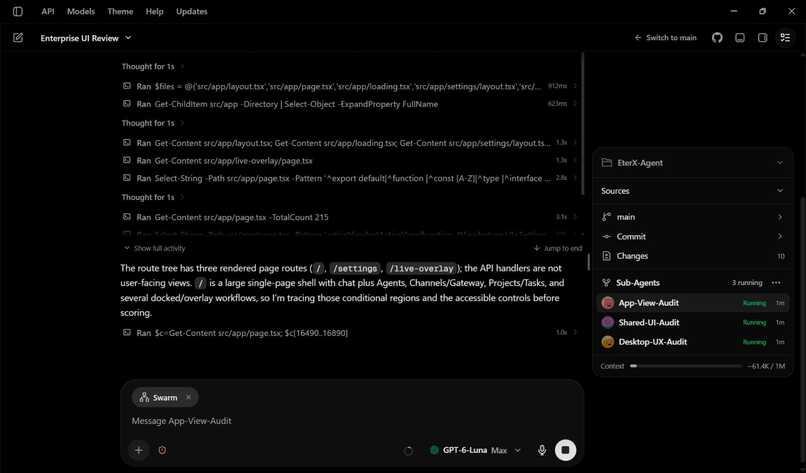
Multiple sub-agents reviewing different parts of a project in parallel, with live progress visible in the workspace.
-
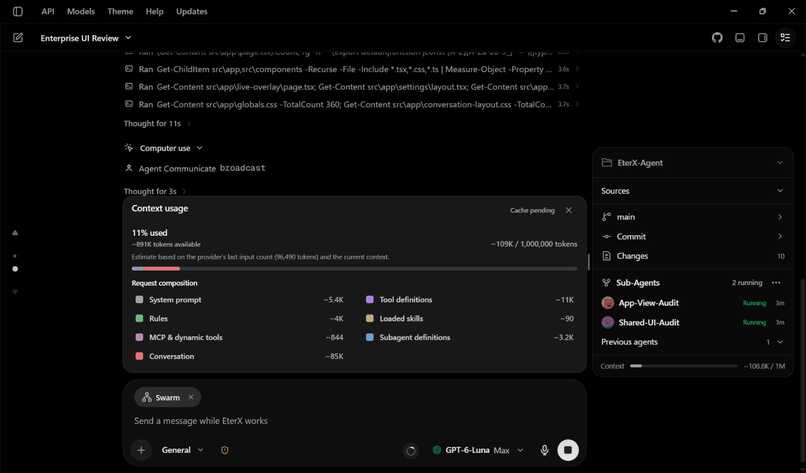
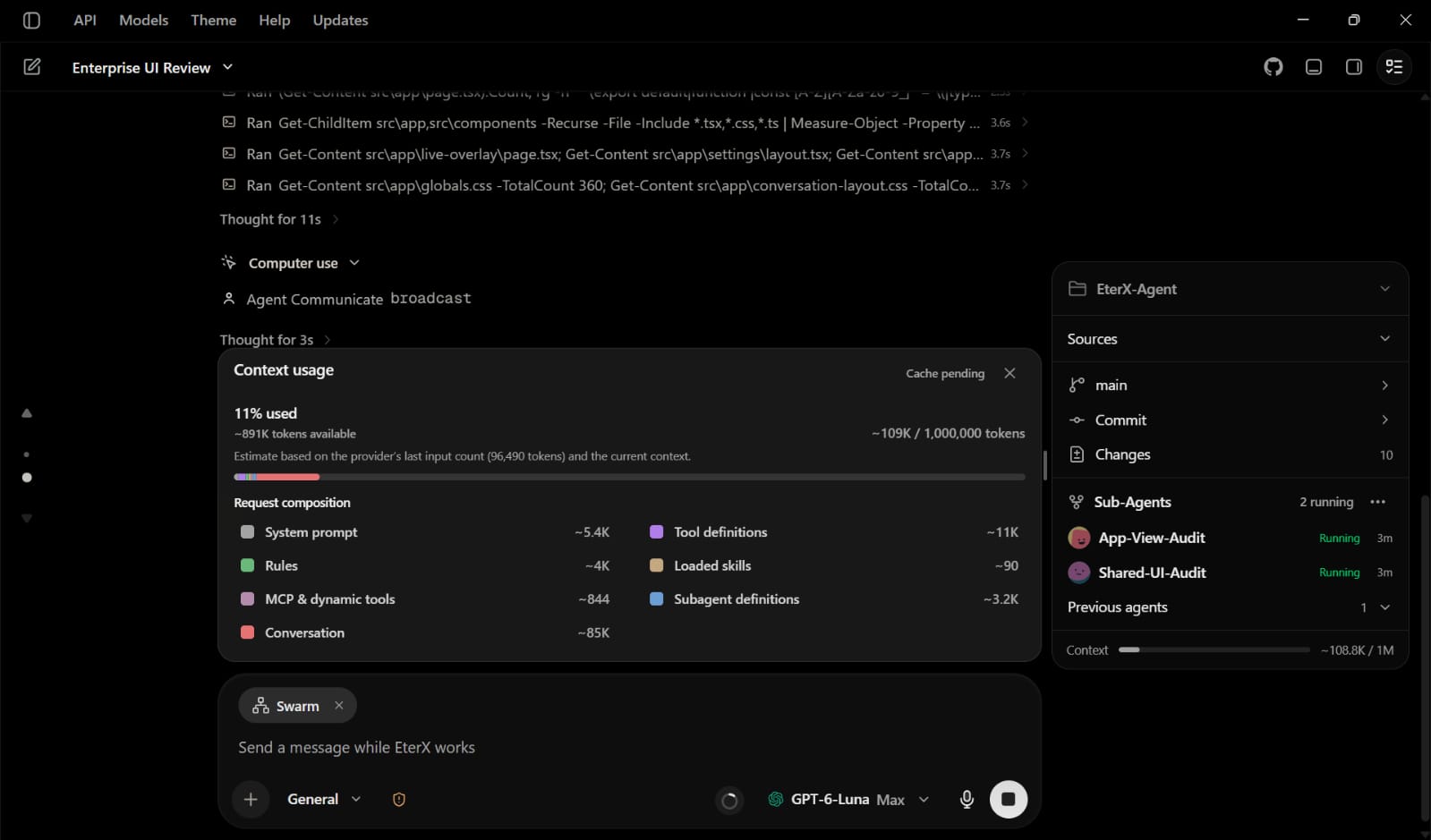
See how the context window is being used, including conversations, tools, rules, and sub-agent definitions.
-
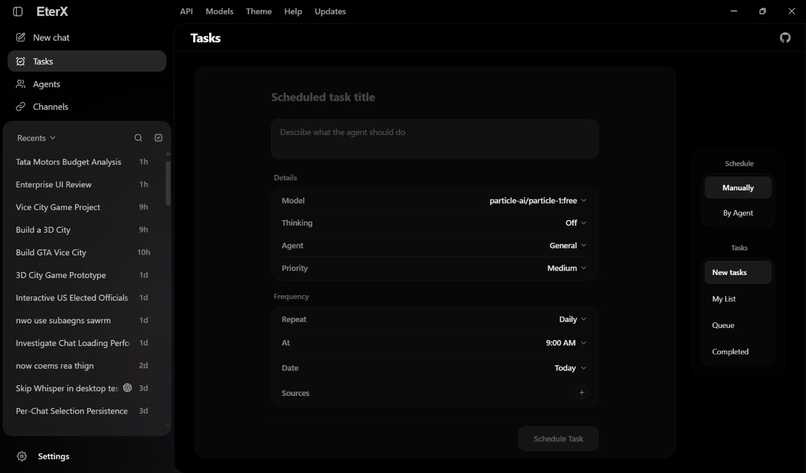
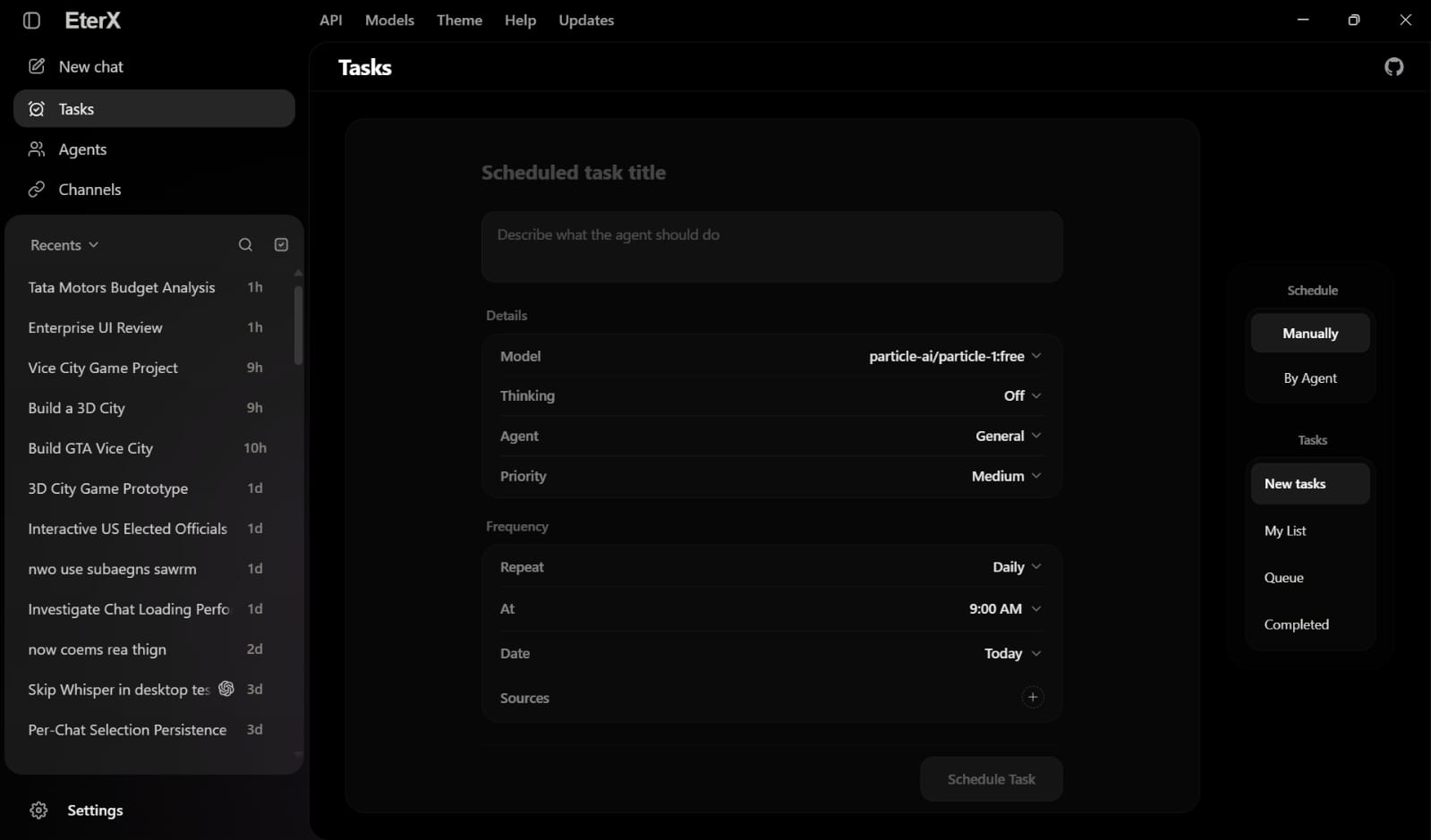
Schedule recurring agent tasks with your preferred model, agent type, priority, and timing.
-
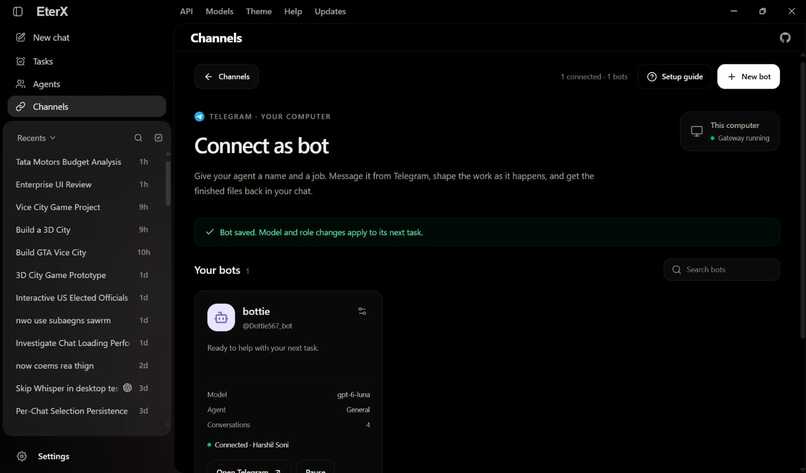
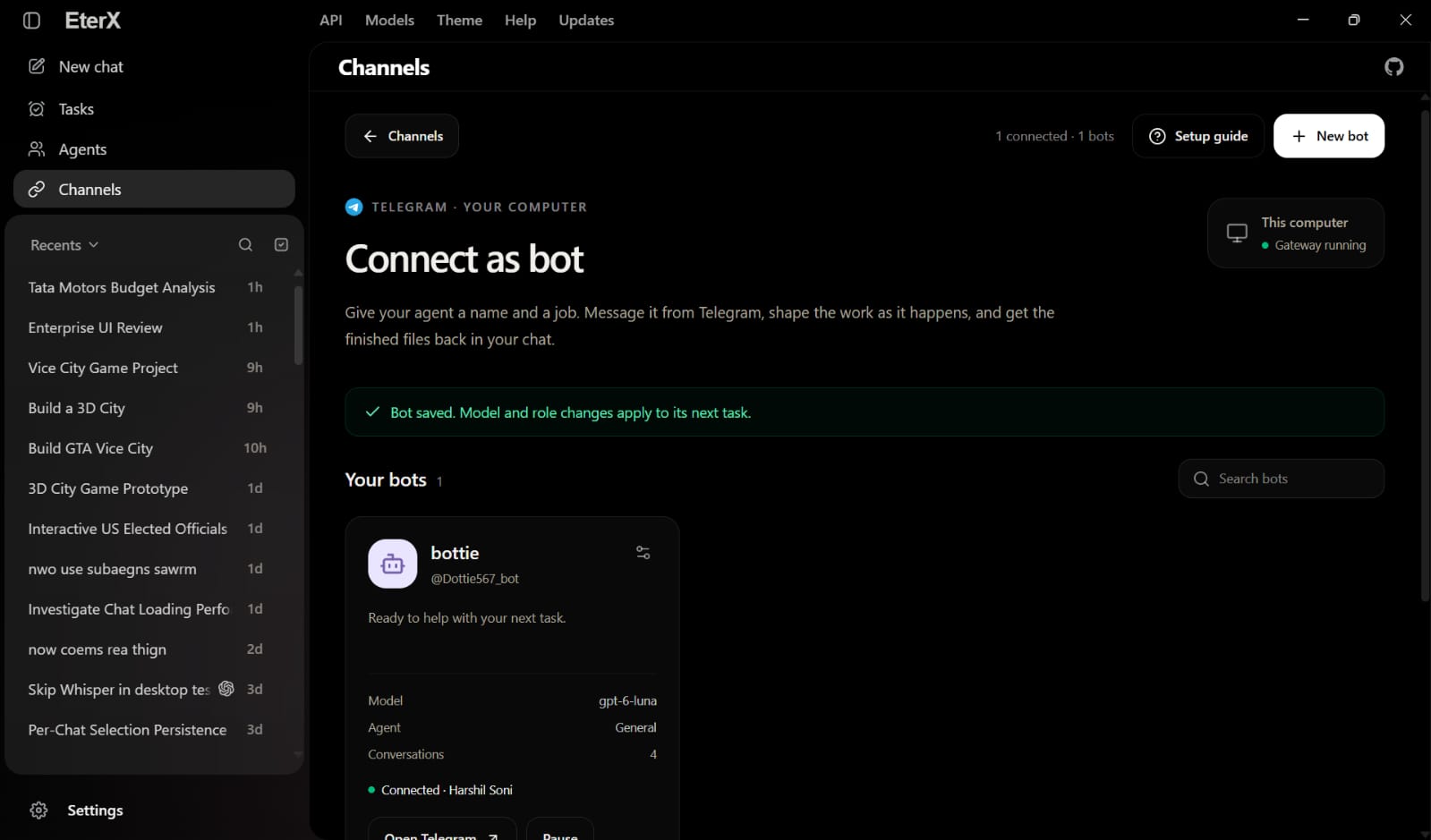
Connect your EterX agent to Telegram to send tasks, follow progress, and receive completed work through chat.
-
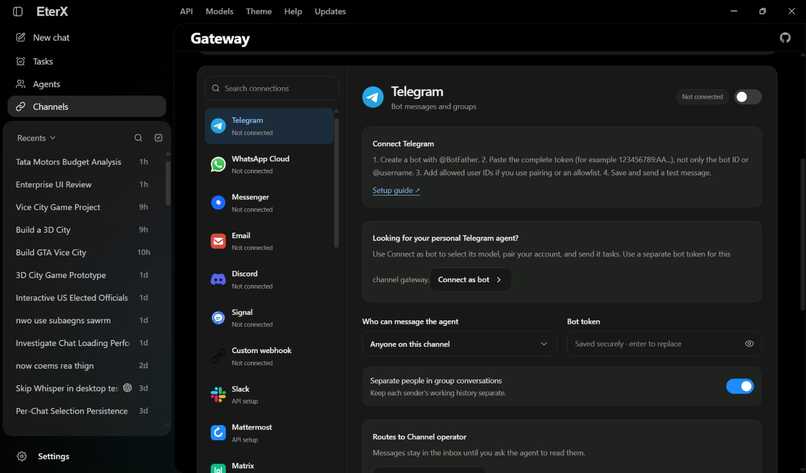
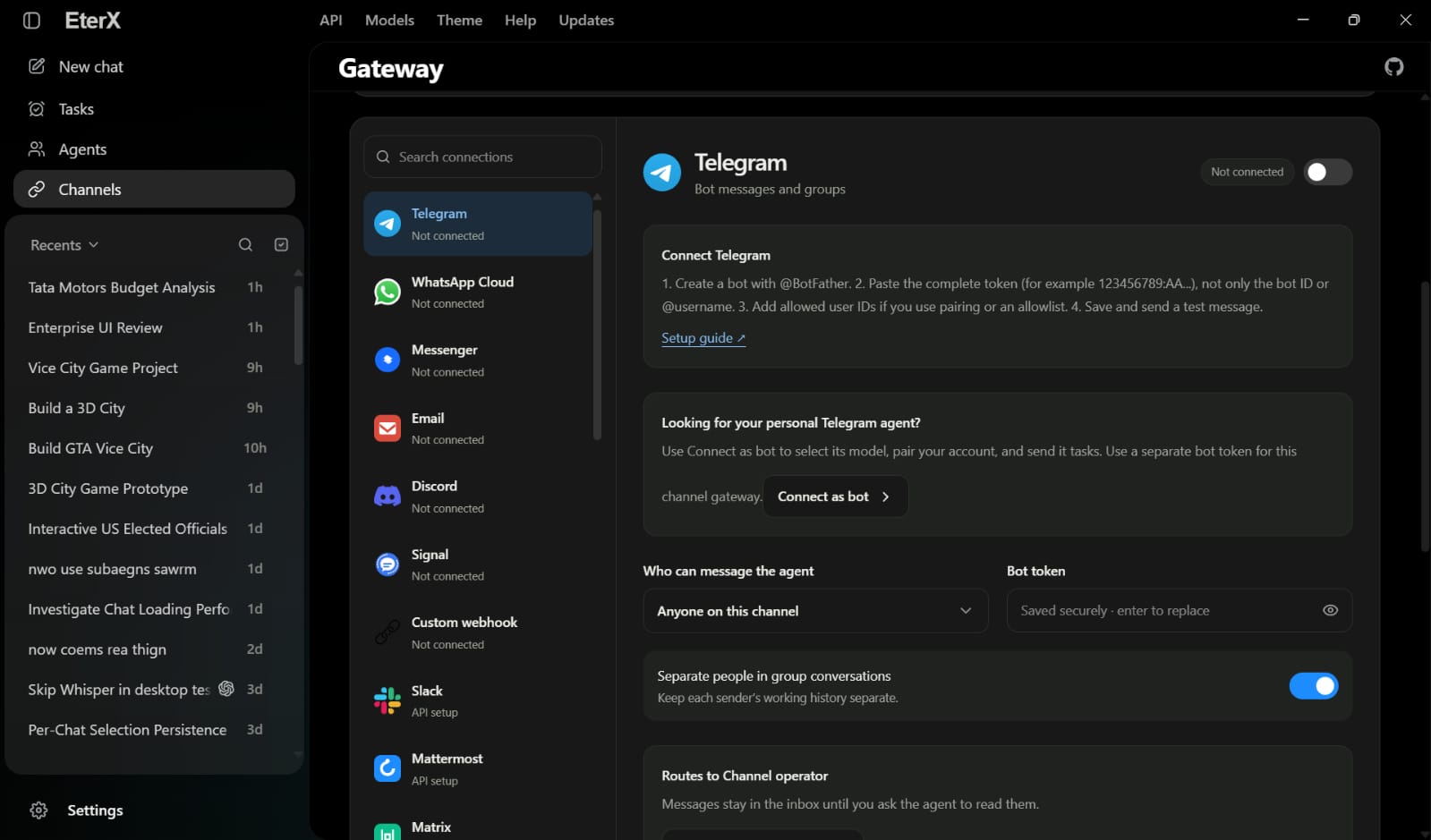
Configure integrations with messaging platforms including Telegram, WhatsApp, Discord, and Slack.
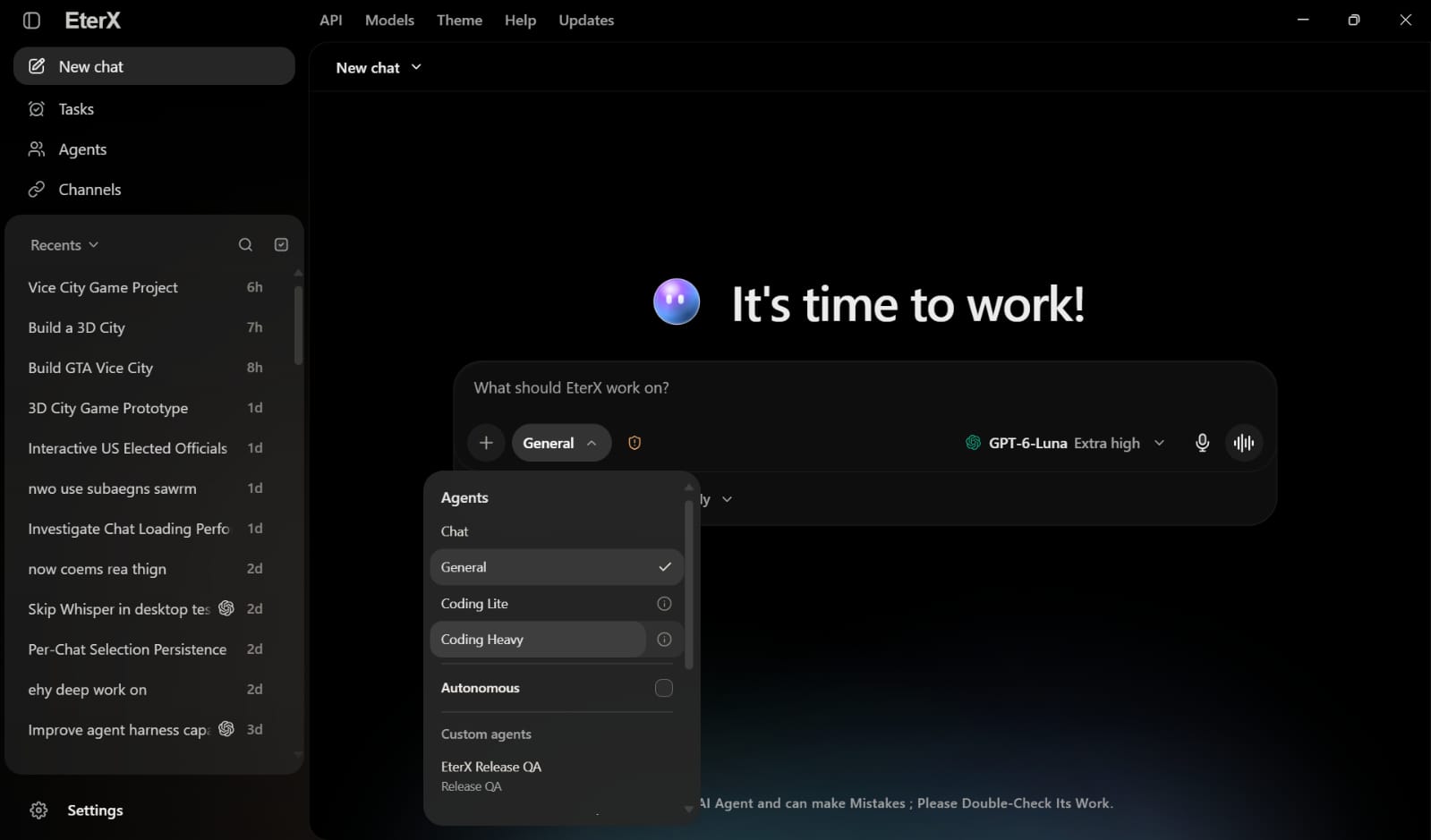
EterX — An Open-Source Workspace for AI Agents
Inspiration
It started with a simple chatbot. Building my first AI-powered application made me curious about what would happen if AI could do more than answer questions.
What if AI agents could independently tackle real-world tasks, collaborate with other agents, and work on entire projects?
Existing AI tools often involve switching between different interfaces, managing API keys, and manually coordinating tasks. I wanted to bring these capabilities into one unified desktop environment.
That's how EterX began.
What It Does
EterX is an open-source desktop application that provides a unified workspace for AI agents to work on real-world tasks and projects.
Instead of interacting with AI through isolated conversations, users can work with agents capable of coordinating and executing tasks.
Key capabilities include:
- Multi-Agent Collaboration: A main AI agent can delegate tasks to specialized sub-agents, enabling coordinated workflows.
- Flexible Model Access: Sign in using an existing AI subscription (e.g., ChatGPT) or connect AI models through their APIs.
- Unified Workspace: Manage AI-powered tasks and projects from a single desktop application.
- Context Management: Use conversation compaction to manage longer-running tasks, with an experimental Synapse Graph option for exploring connections between older information.
- Open-Source Foundation: Built with an emphasis on transparency, flexibility, and community-driven improvement.
The goal is to make powerful AI agents more accessible, autonomous, and practical for real-world work.
How I Built It
I developed EterX through continuous experimentation, starting with basic AI interactions and gradually progressing toward a multi-agent architecture.
The system uses a primary agent responsible for coordinating tasks and delegating work to sub-agents.
I also explored how agents could maintain useful context during long-running operations. This led me to experiment with Synapse Graph, a graph-based approach to connecting historical context.
After testing different approaches, I chose context compaction as the default because it addressed the immediate problem more directly, while keeping Synapse Graph available as an experimental option.
Throughout development, I focused on making the desktop experience practical beyond my own development environment.
Challenges I Faced
One of the biggest challenges was ensuring that the system worked reliably outside my own testing scenarios.
When my sister tested EterX, she asked multiple sub-agents to represent different countries and debate one another. This unexpected use case revealed communication problems between agents that my earlier tests had missed.
Cross-platform installation presented another challenge. Without direct access to a Mac, I relied on remote testing, debugging terminal errors, updating the code, and rebuilding the application repeatedly.
Testing also consumed API credits, which made balancing development costs and comprehensive testing difficult.
These experiences taught me that making something work in a controlled environment is very different from making it reliable for real users.
Accomplishments I'm Proud Of
- Building an open-source desktop workspace focused on real-world AI agent workflows.
- Implementing a multi-agent architecture with task delegation.
- Supporting flexible access to AI models through subscriptions or APIs.
- Exploring alternative approaches to long-term agent context management.
- Testing and improving the application using feedback from someone other than its developer.
What I Learned
Building EterX taught me that great software isn't just about adding features.
It's about reliability, usability, and understanding how people interact with technology.
I learned to approach development more systematically, test unexpected scenarios, and prioritize practical solutions over unnecessary complexity.
Most importantly, I learned that a product shouldn't require its creator to be standing beside the user to make it work.
What's Next for EterX?
My vision is to continue developing EterX into a powerful, accessible, and increasingly autonomous workspace for AI agents.
Future priorities include:
- Advanced Agent Tools: Expanding the tools and capabilities available to AI agents so they can handle more complex tasks with greater independence.
- Autonomous Coding Workspace: Improving EterX's coding environment to support more advanced software development workflows, including autonomous coding, debugging, testing, and project-level execution.
- Greater Agent Autonomy: Enabling agents to plan, coordinate, execute, and verify multi-step tasks with less manual intervention.
- Multi-Agent Coordination: Improving communication, task delegation, and reliability across multiple agents working together.
- Model and Provider Support: Expanding compatibility with AI models, subscriptions, and API providers.
- Payments and Integrations: Exploring integrated payment capabilities and additional services to support more complete agent-driven workflows.
- Context and Memory: Improving long-running task execution and continuing to evaluate experimental memory systems.
- Developer Experience: Making installation, onboarding, and everyday workflows more intuitive and reliable.
- Open-Source Community: Encouraging contributions and building an ecosystem of developers around EterX.
The long-term goal is to make EterX a comprehensive, agent-driven development and productivity environment where AI agents can use tools, collaborate, and autonomously execute increasingly complex real-world projects.
Built With
- anthropic-api
- electron
- framer-motion
- github-actions
- google-gemini
- javascript
- lucide-react
- model-context-protocol
- monaco-editor
- next.js
- node.js
- ollama
- openai-api
- openrouter
- playwright
- radix-ui
- react
- tailwind-css
- tavily
- typescript
- websockets
- xterm.js
- zustand

