-
-
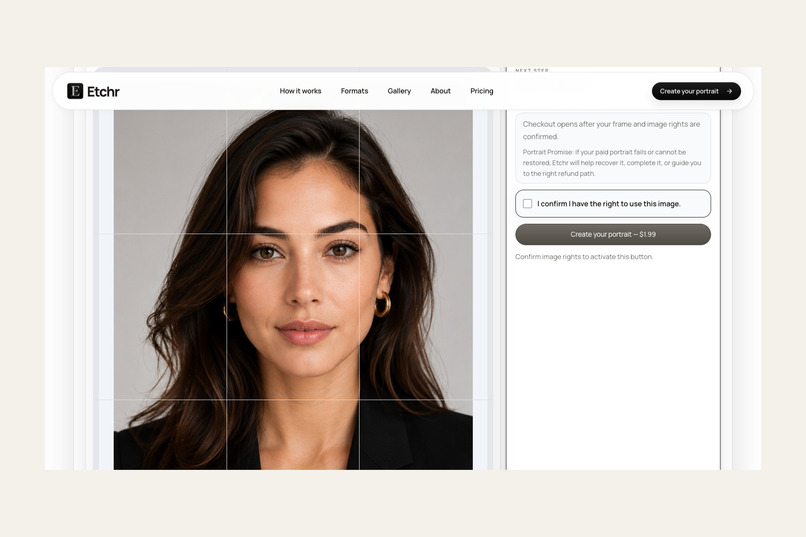
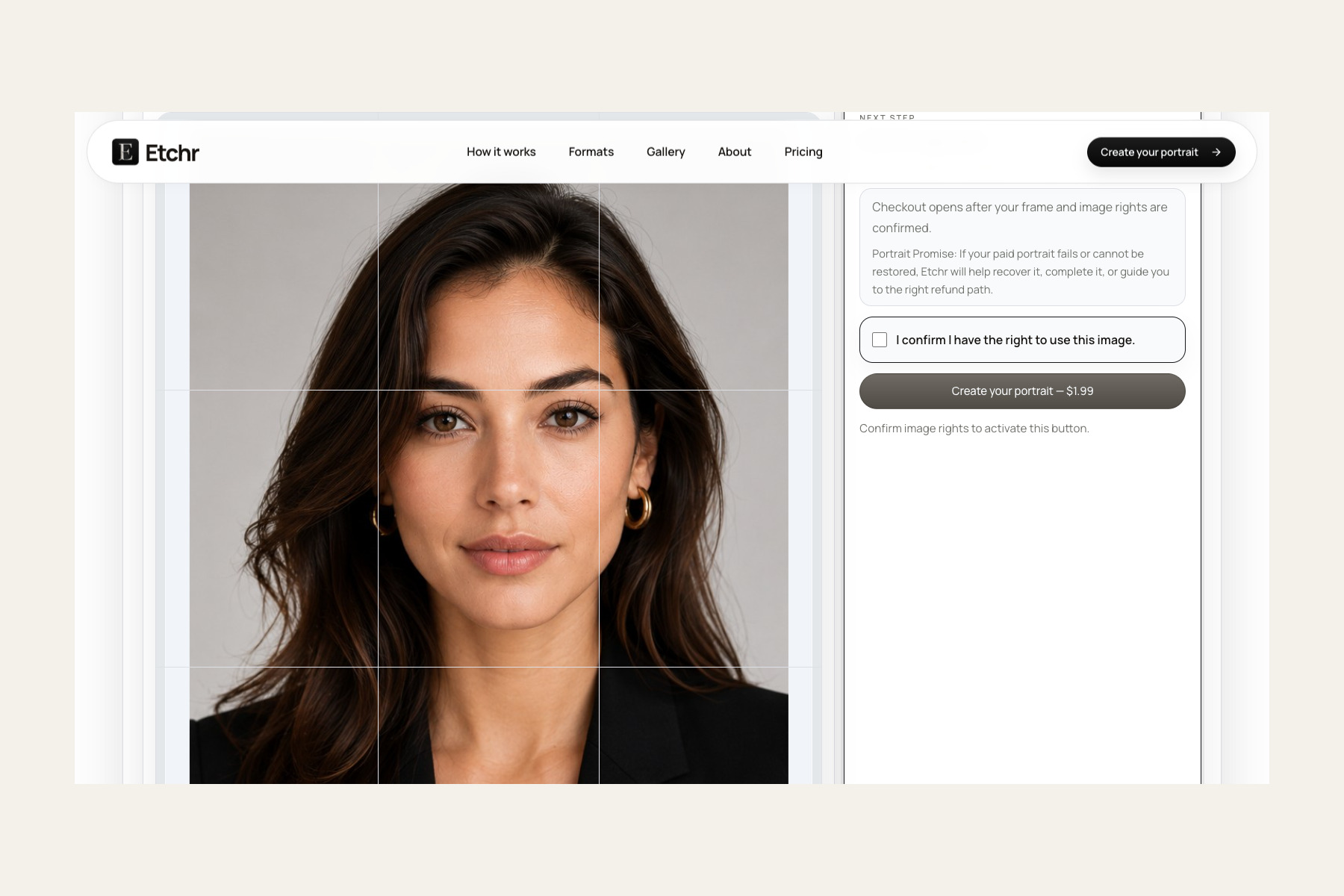
Upload one photograph, frame it precisely, confirm image rights, and let Etchr handle the craftsmanship.
-
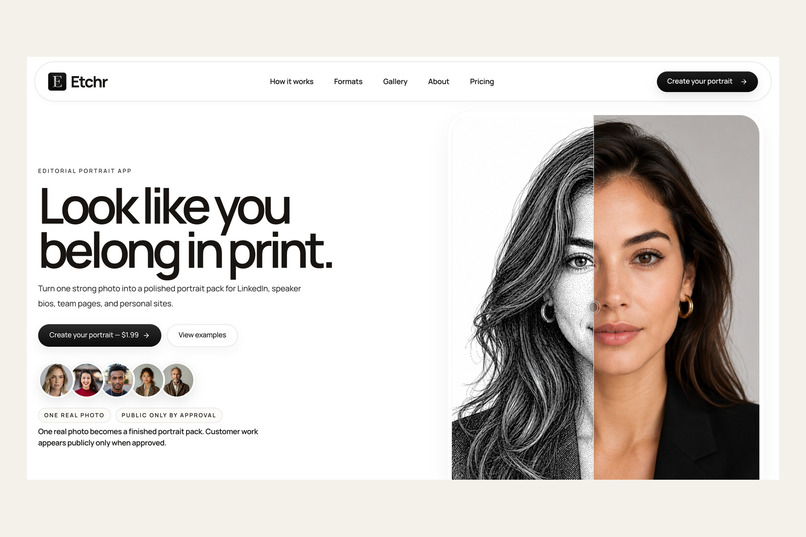
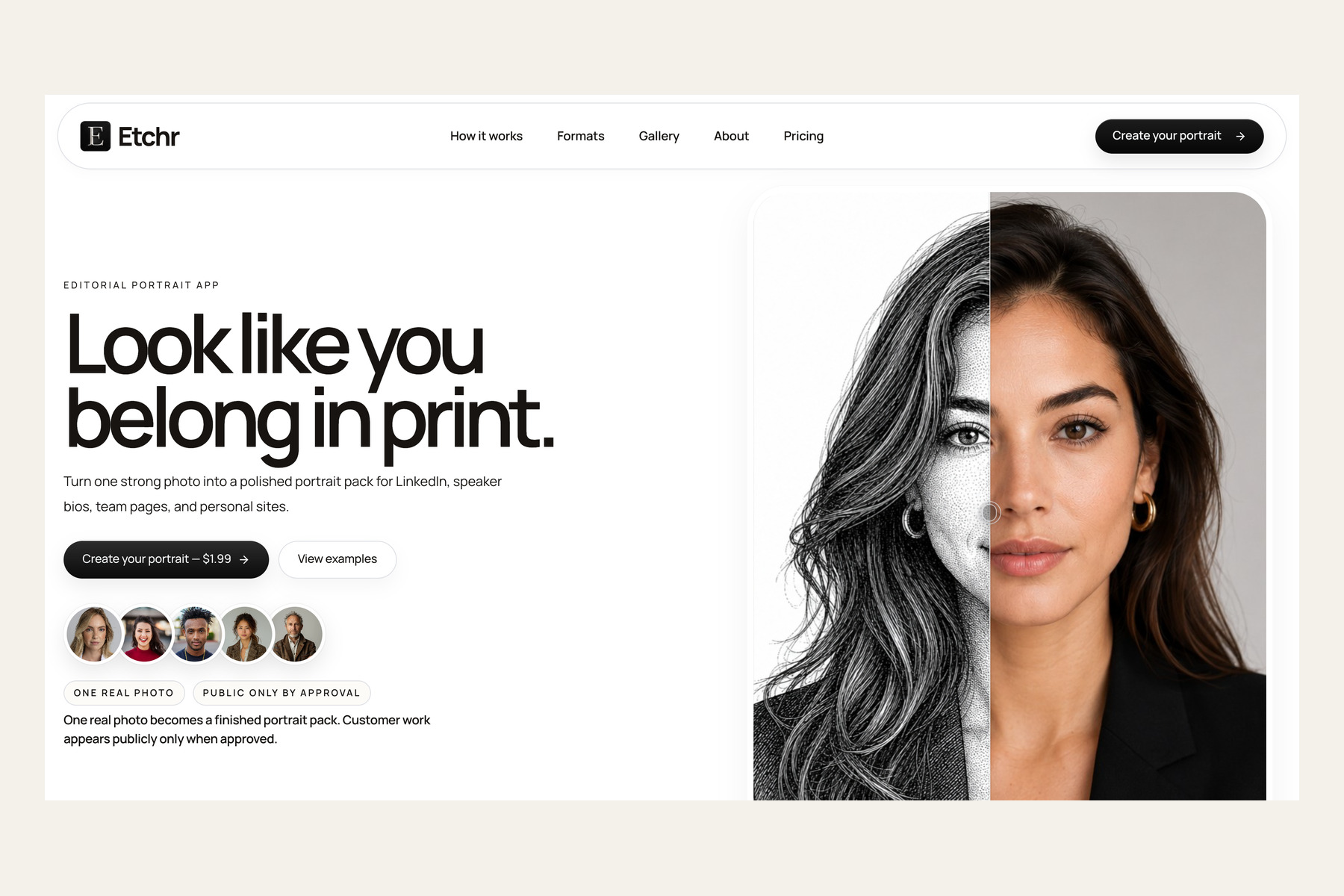
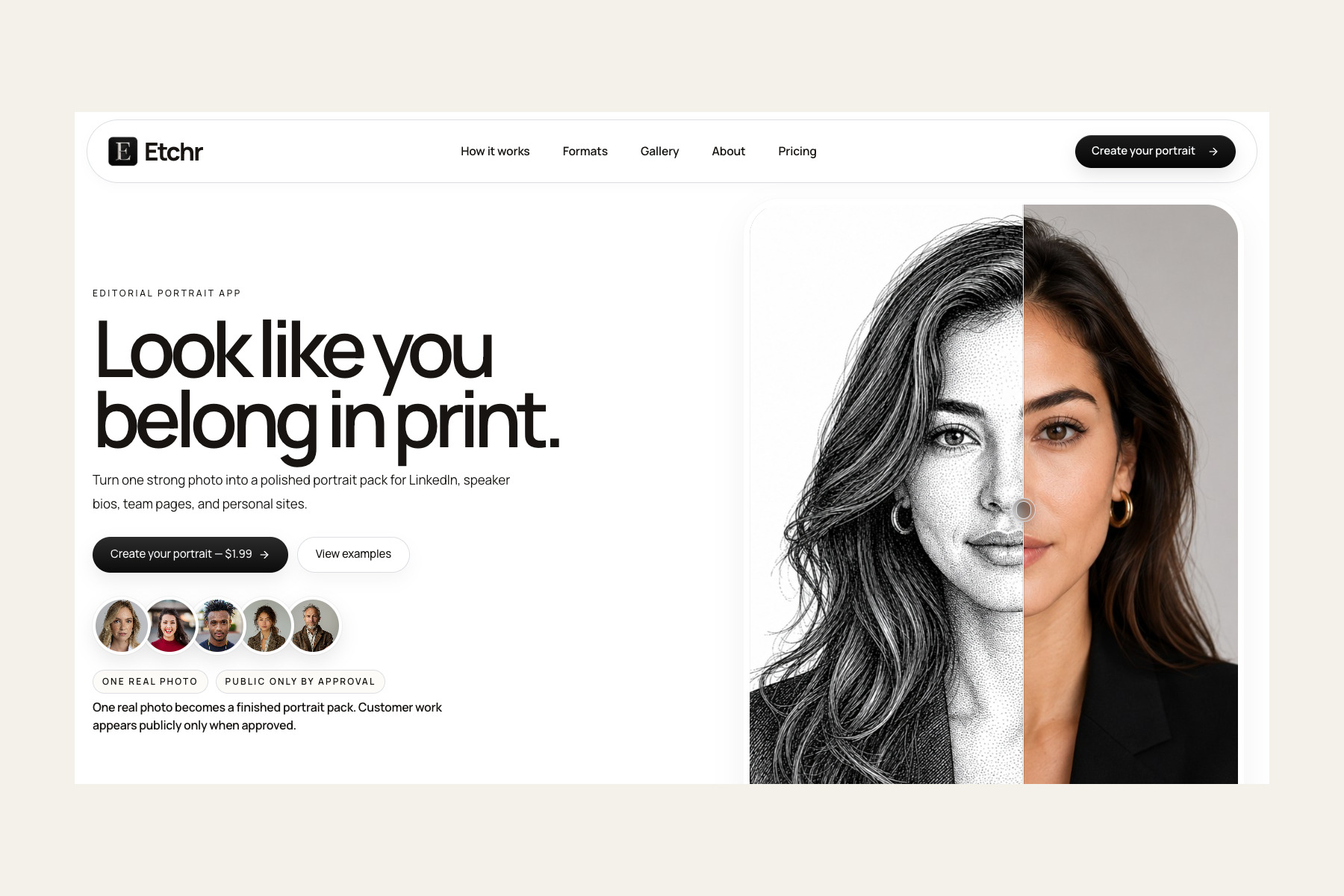
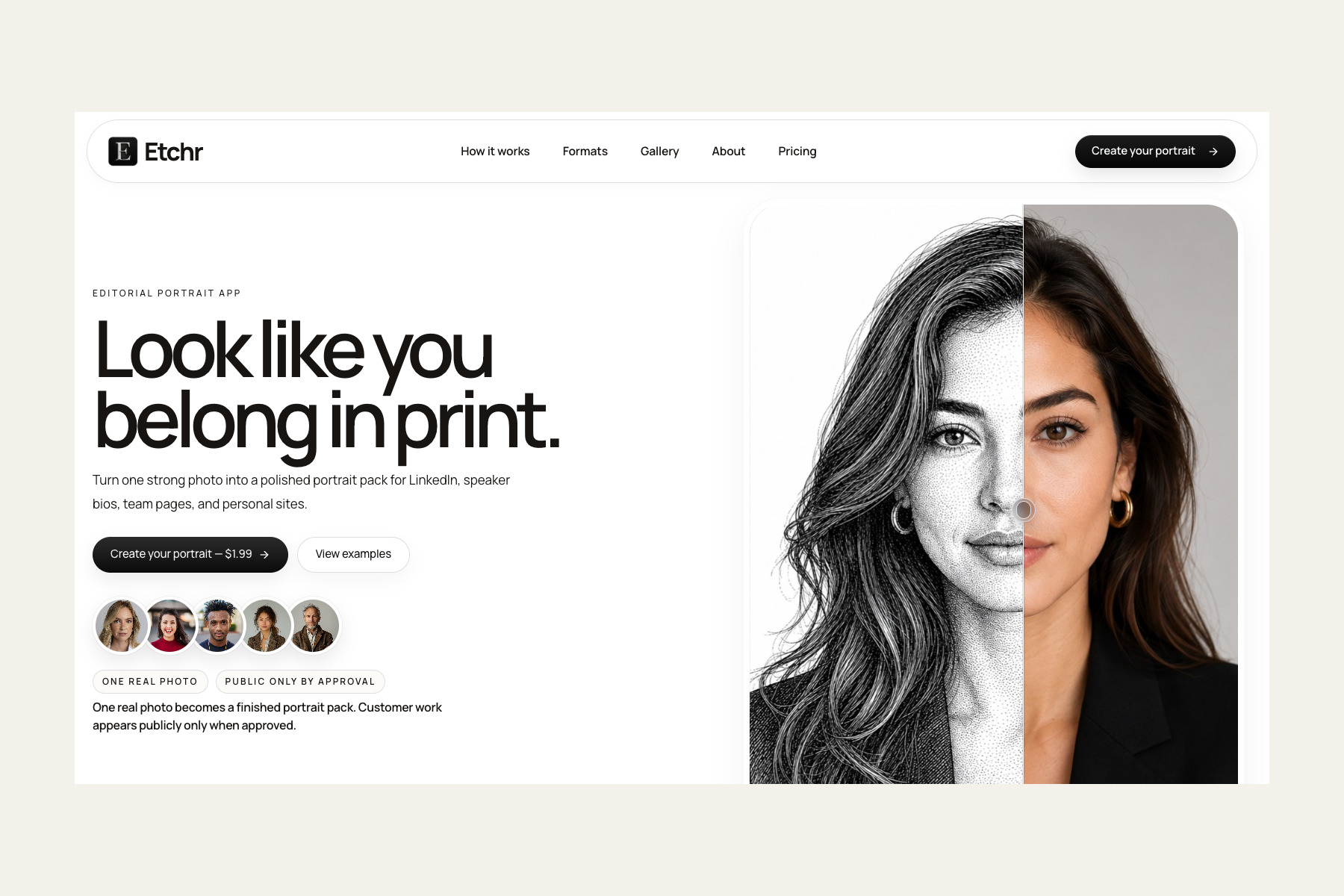
Etchr turns one real photograph into a refined editorial portrait that still looks unmistakably like you.
-
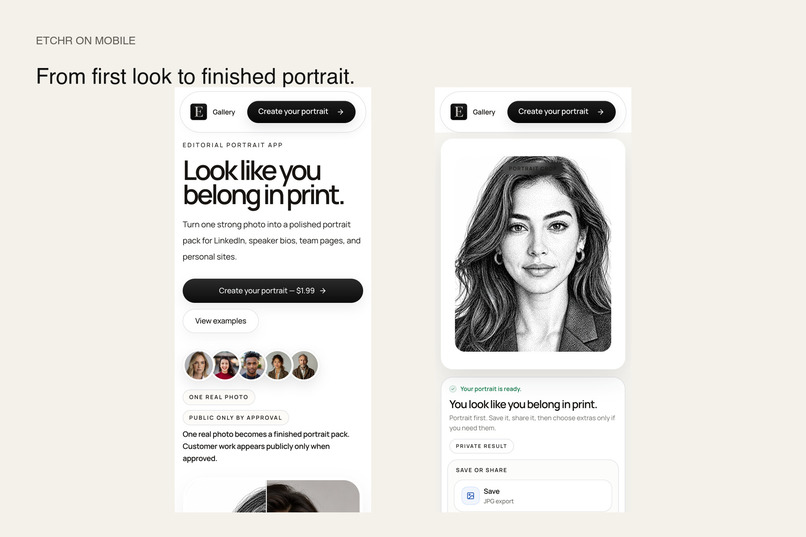
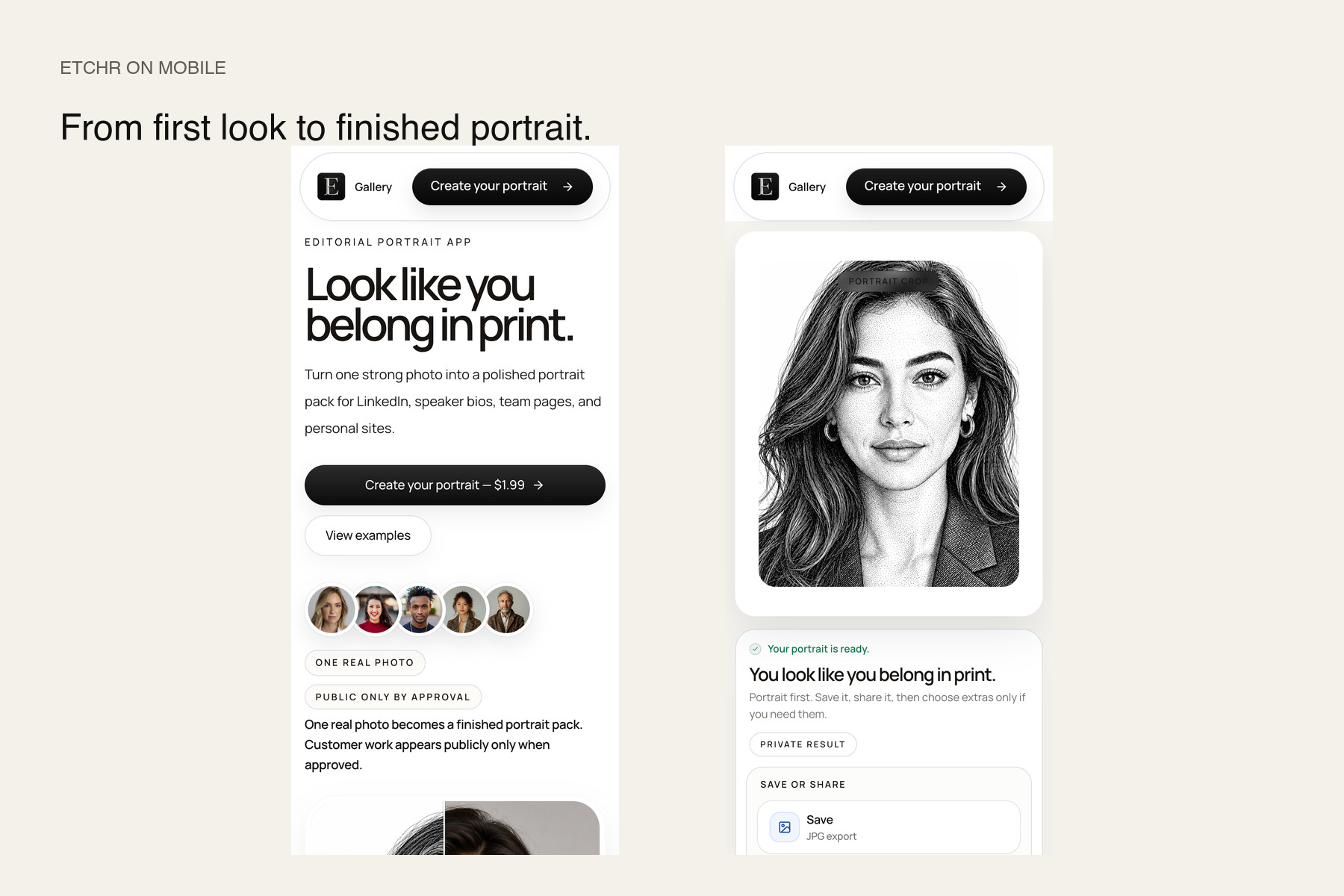
The complete Etchr experience—from first look to finished portrait—designed to work naturally on mobile.
-
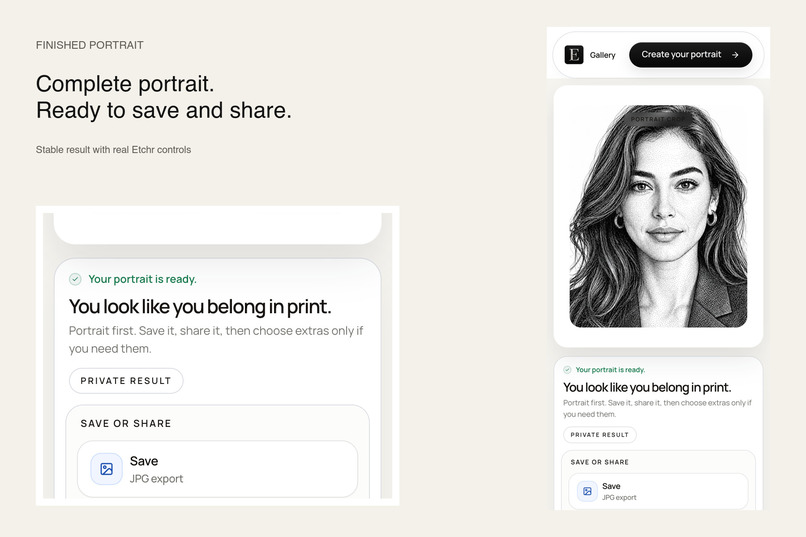
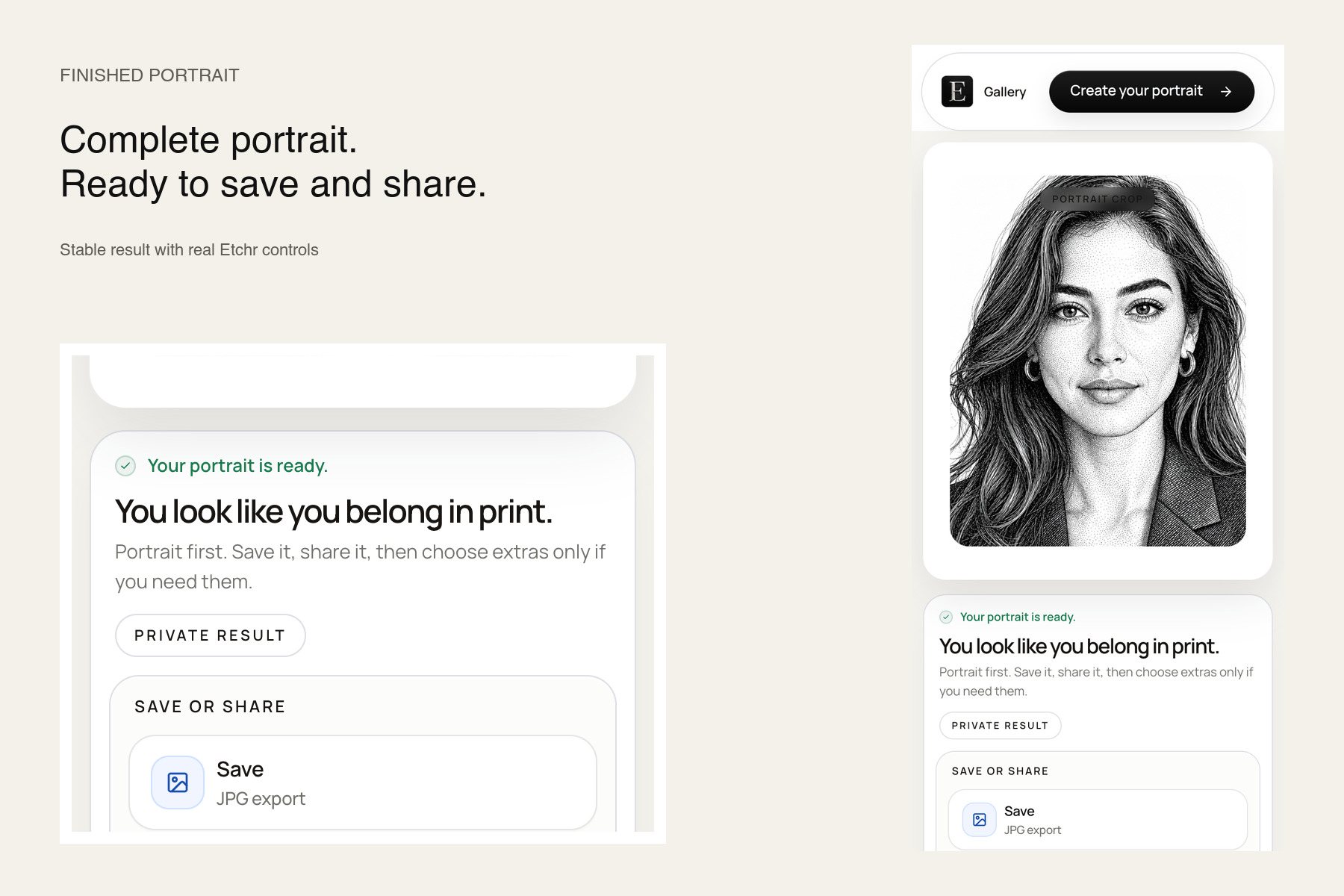
A private finished portrait with simple controls to save, share, and prepare it for real-world use.
-
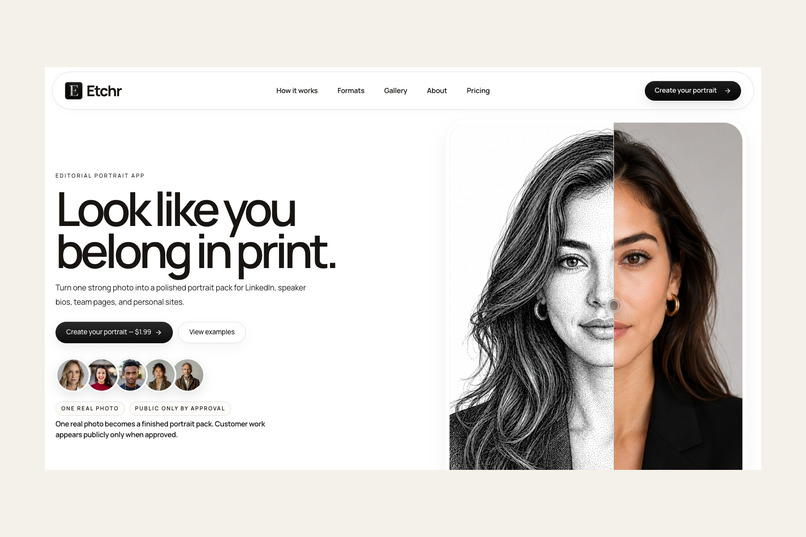
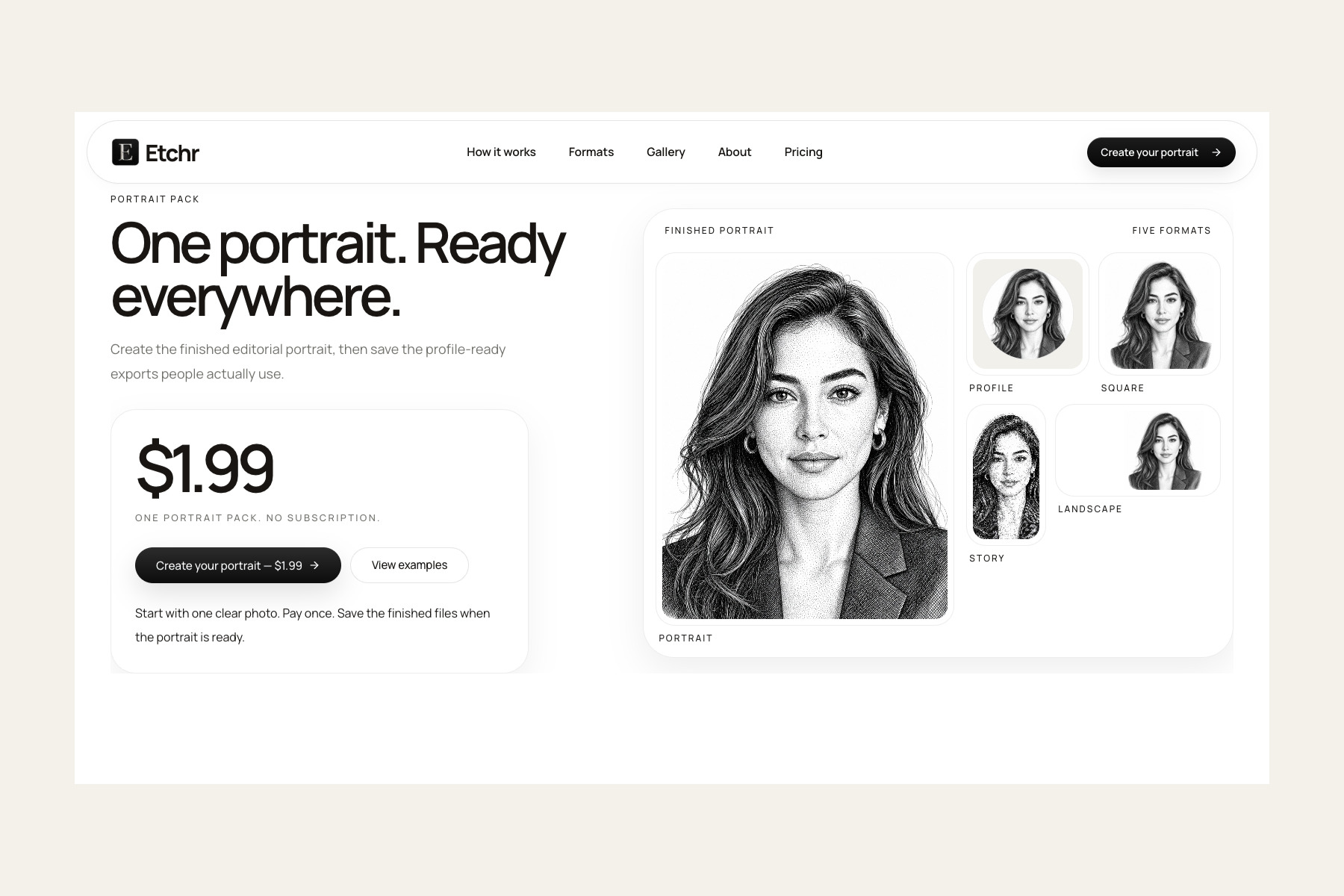
One strong photo. One polished editorial portrait. Five practical formats, ready for the places your image represents you.
-
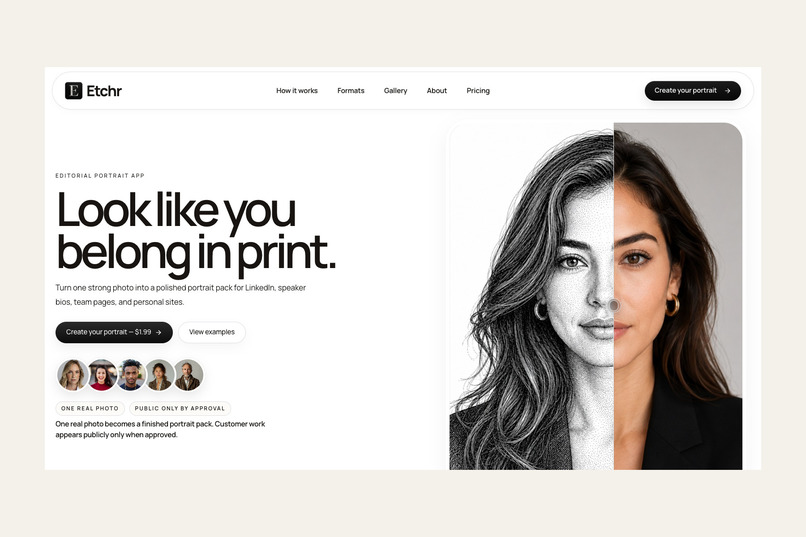
Canonical facial registration keeps the subject visually stationary while the photograph becomes an editorial portrait.
-
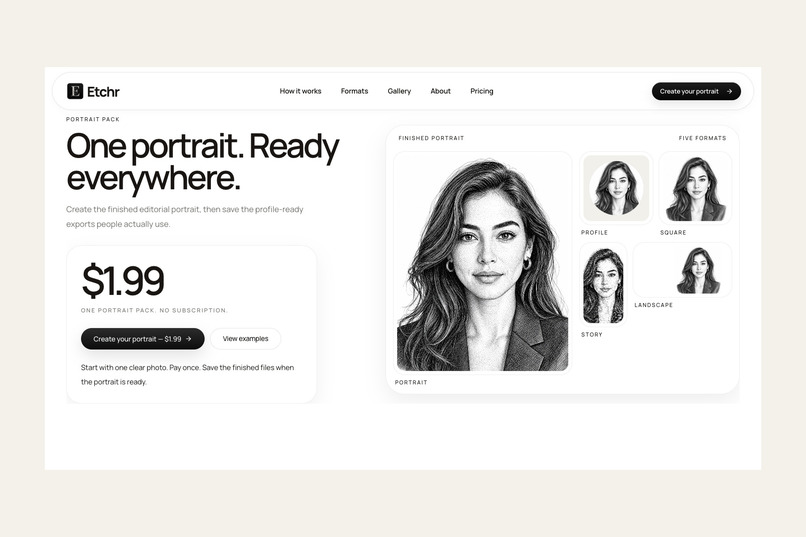
One finished portrait becomes five profile-ready formats for LinkedIn, social profiles, speaker bios, and personal sites.
-
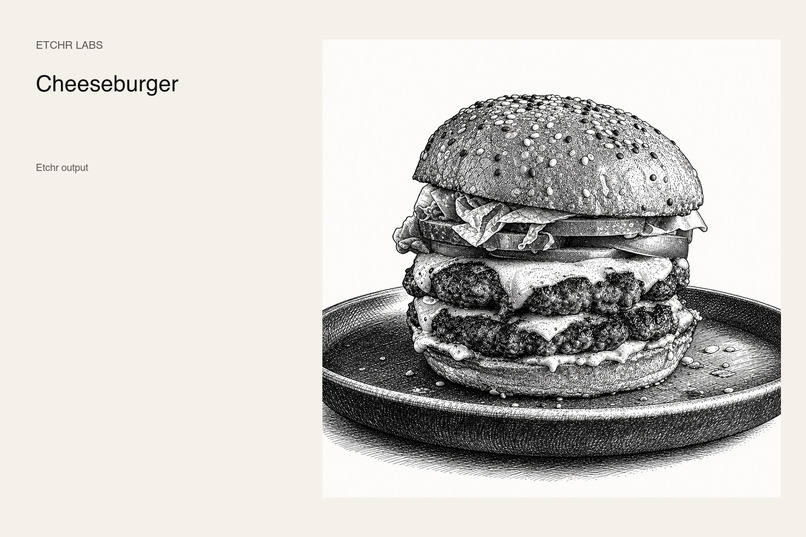
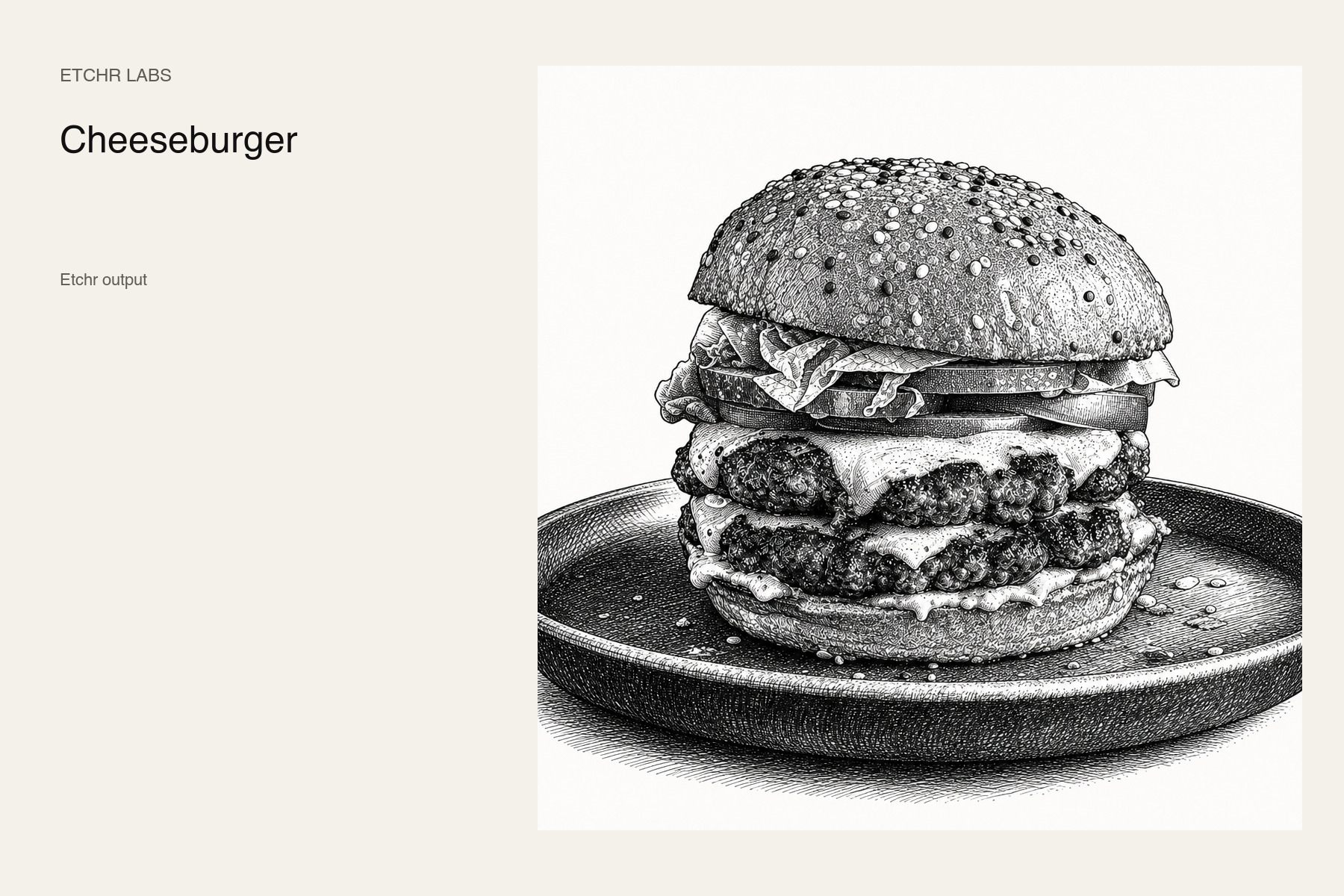
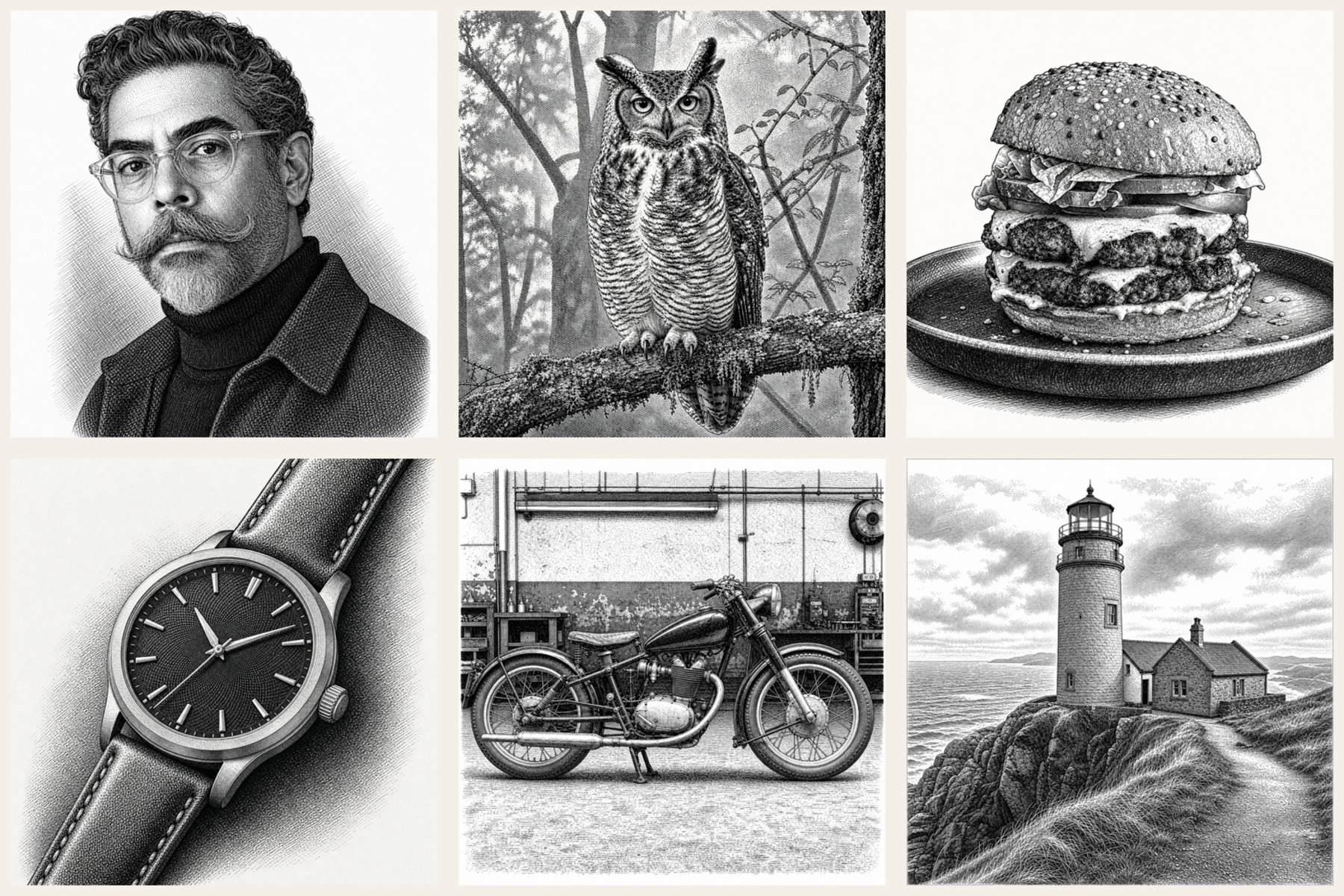
Layers, texture, shine, and tiny ingredients transformed into an unexpectedly detailed editorial illustration.
-
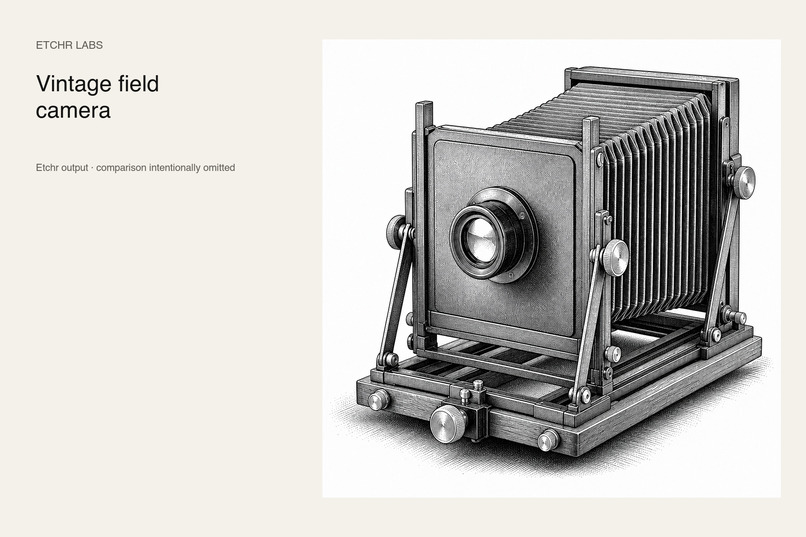
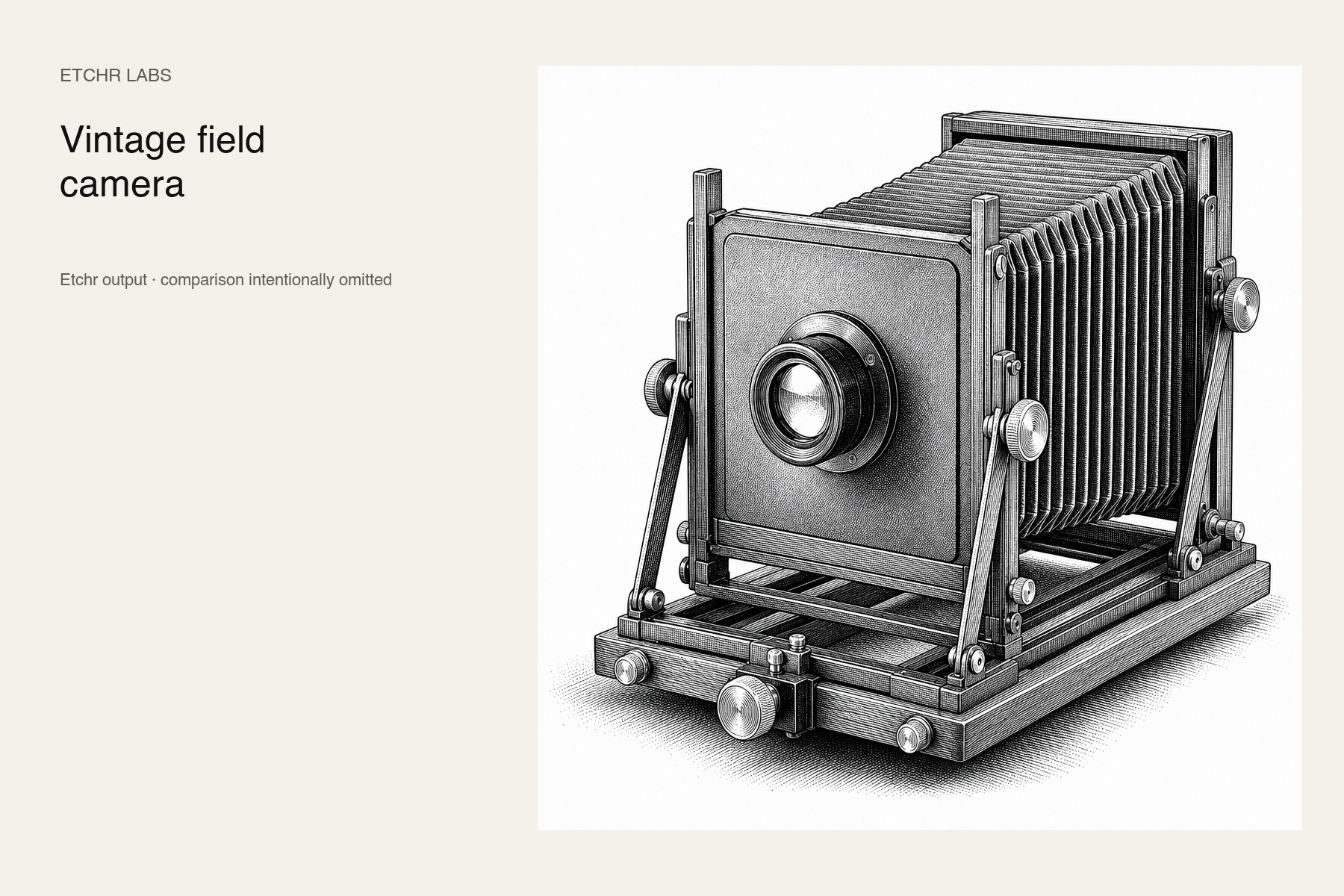
Bellows, hardware, glass, and mechanical structure rendered with remarkable clarity in an output-only Etchr Labs study.
-
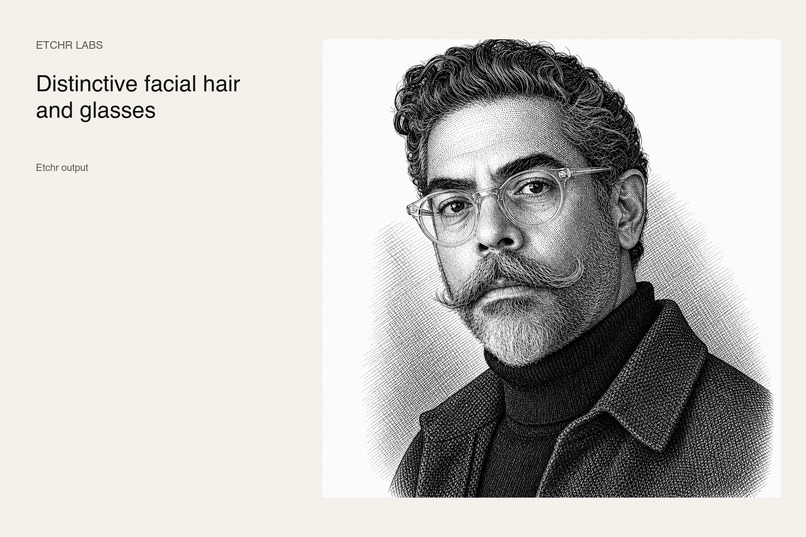
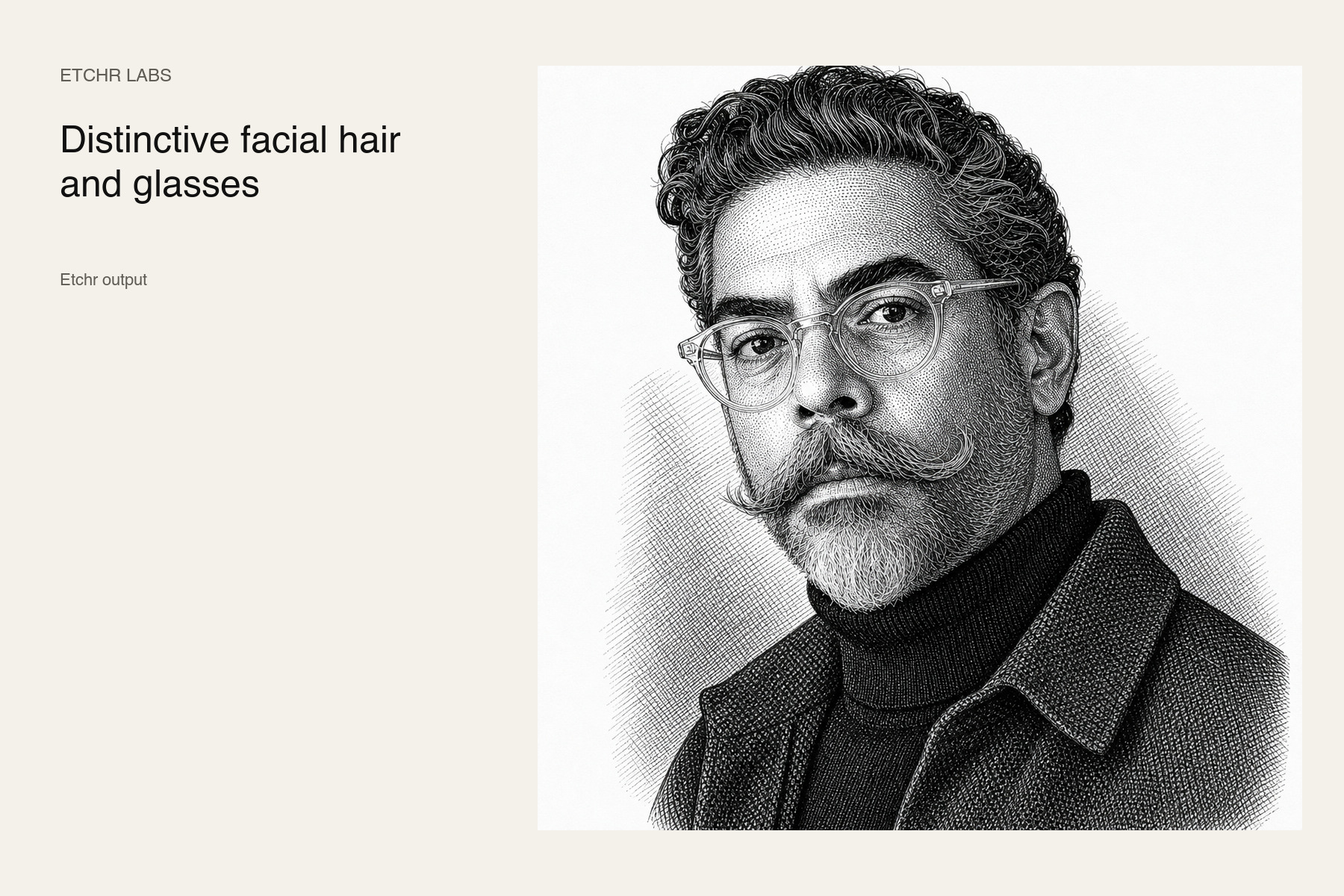
Fine facial detail, glasses, hair, expression, and character preserved in a distinctive editorial portrait.
-
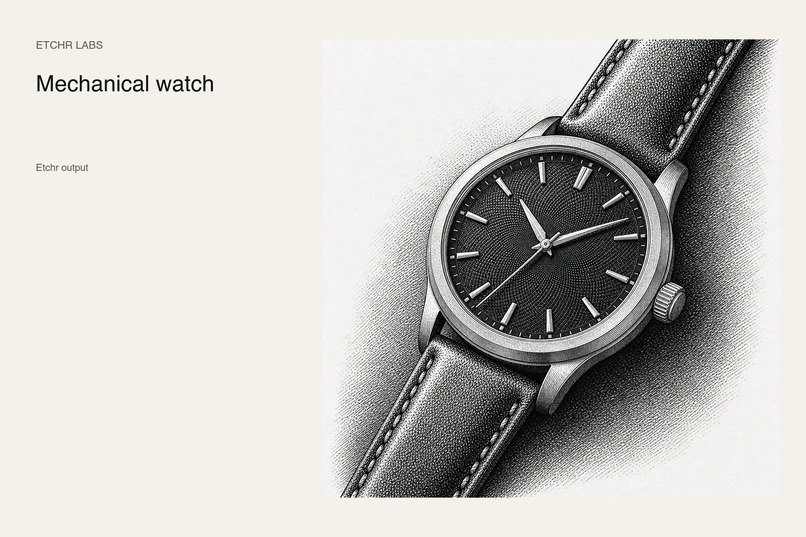
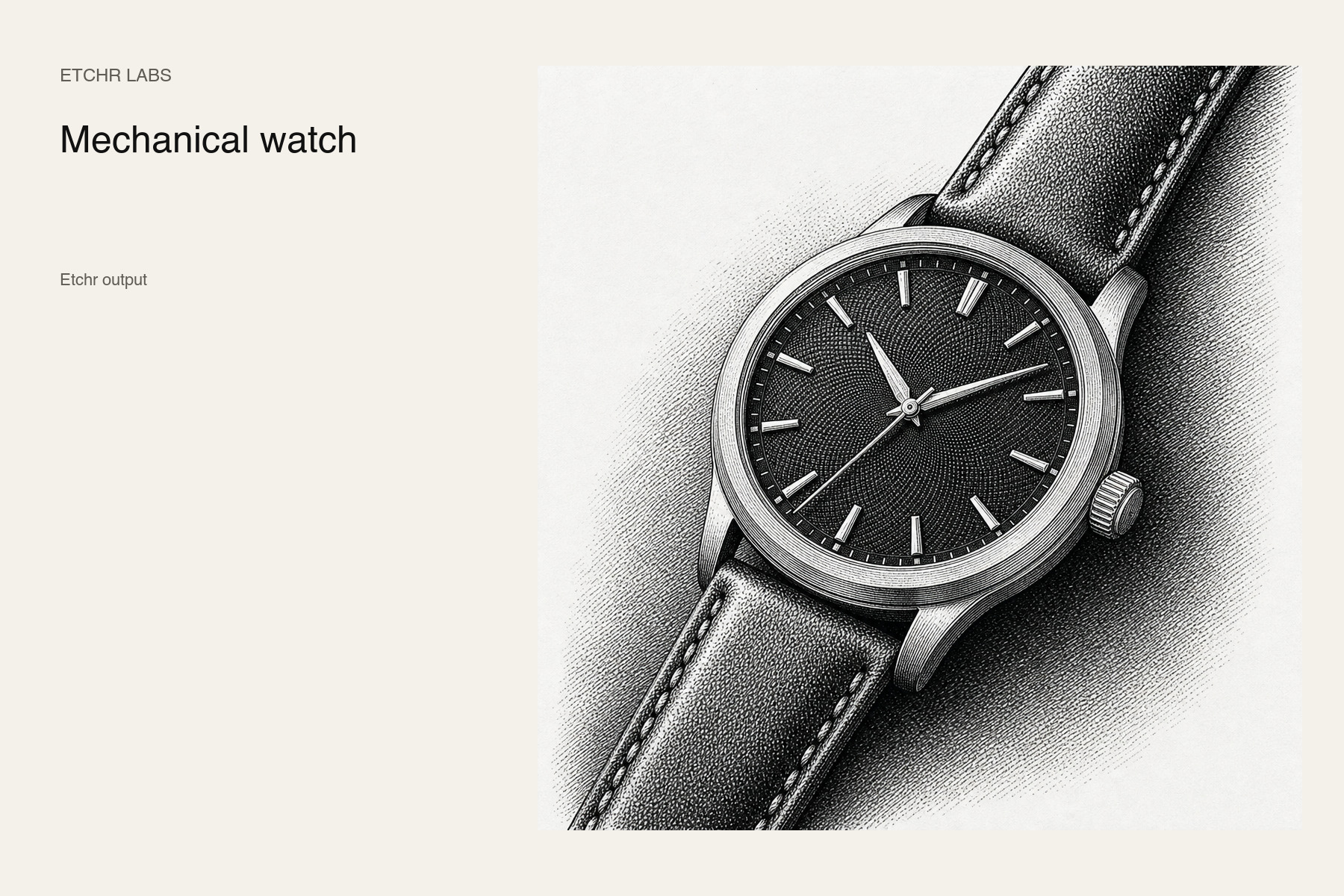
Metal, leather, stitching, reflections, and mechanical detail translated into a clean, precise editorial rendering.
-
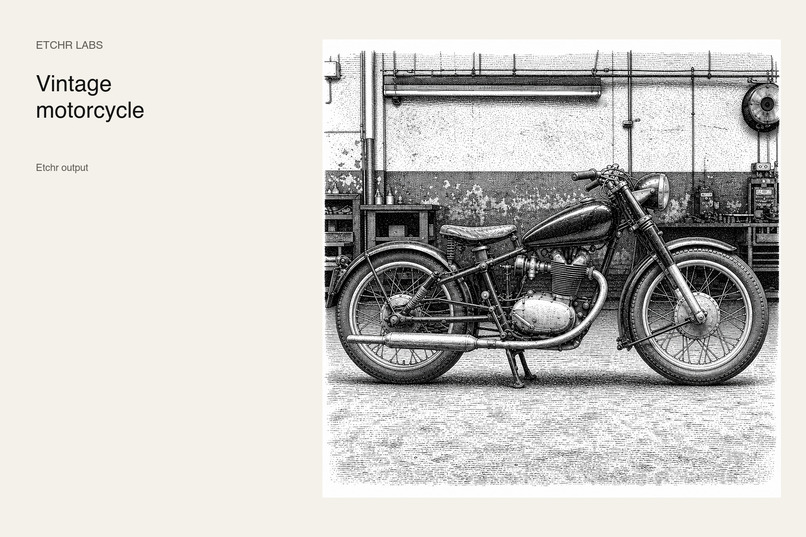
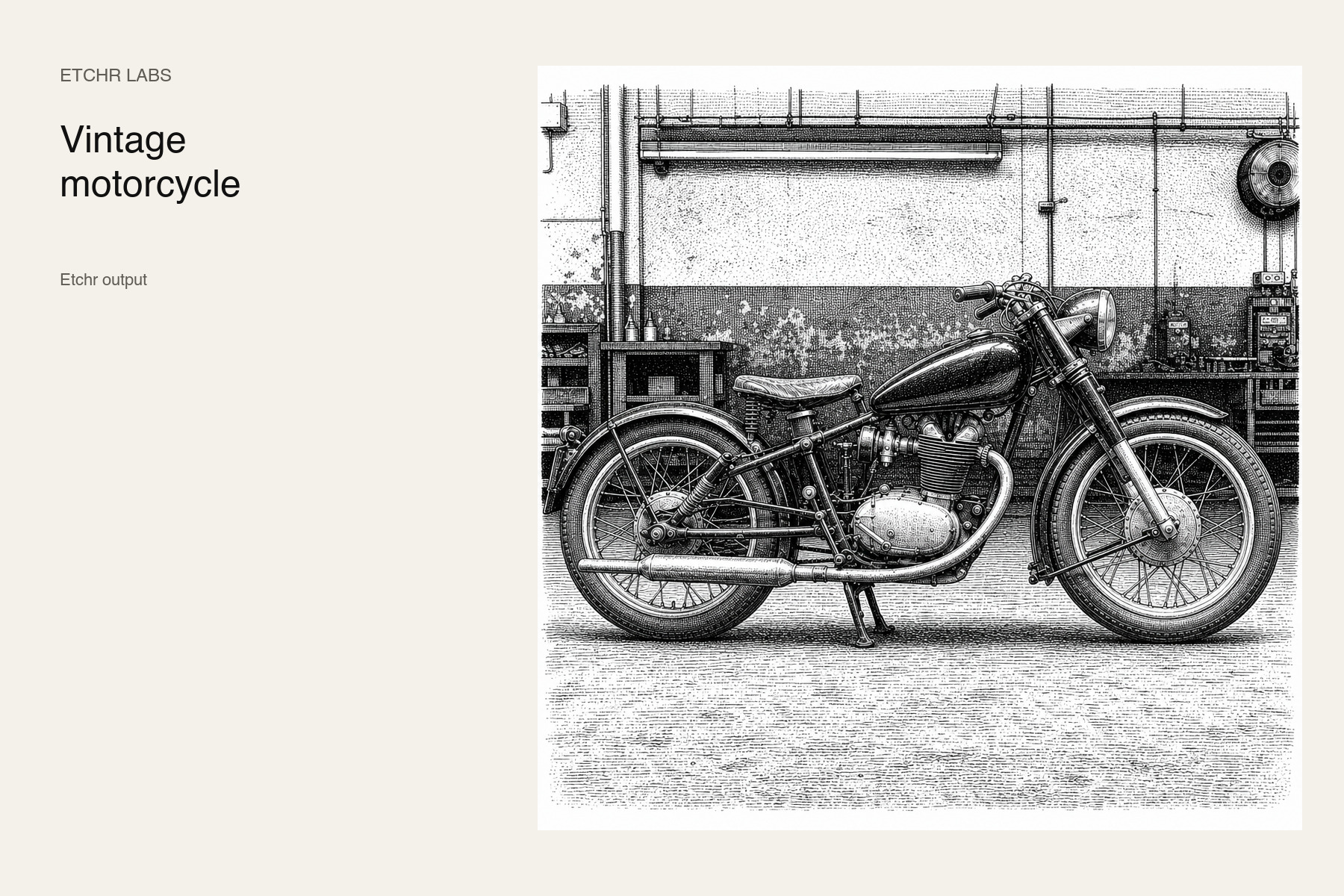
Engine components, spokes, chrome, tires, and workshop texture preserved in a richly detailed editorial illustration.
-
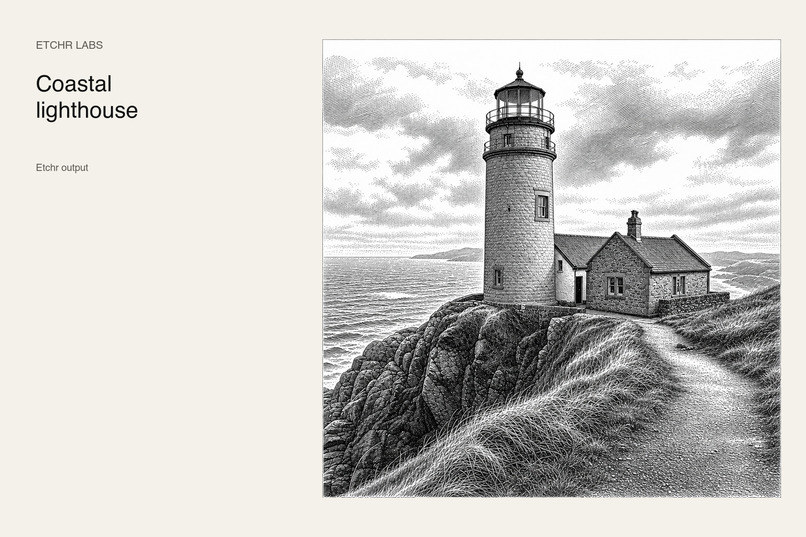
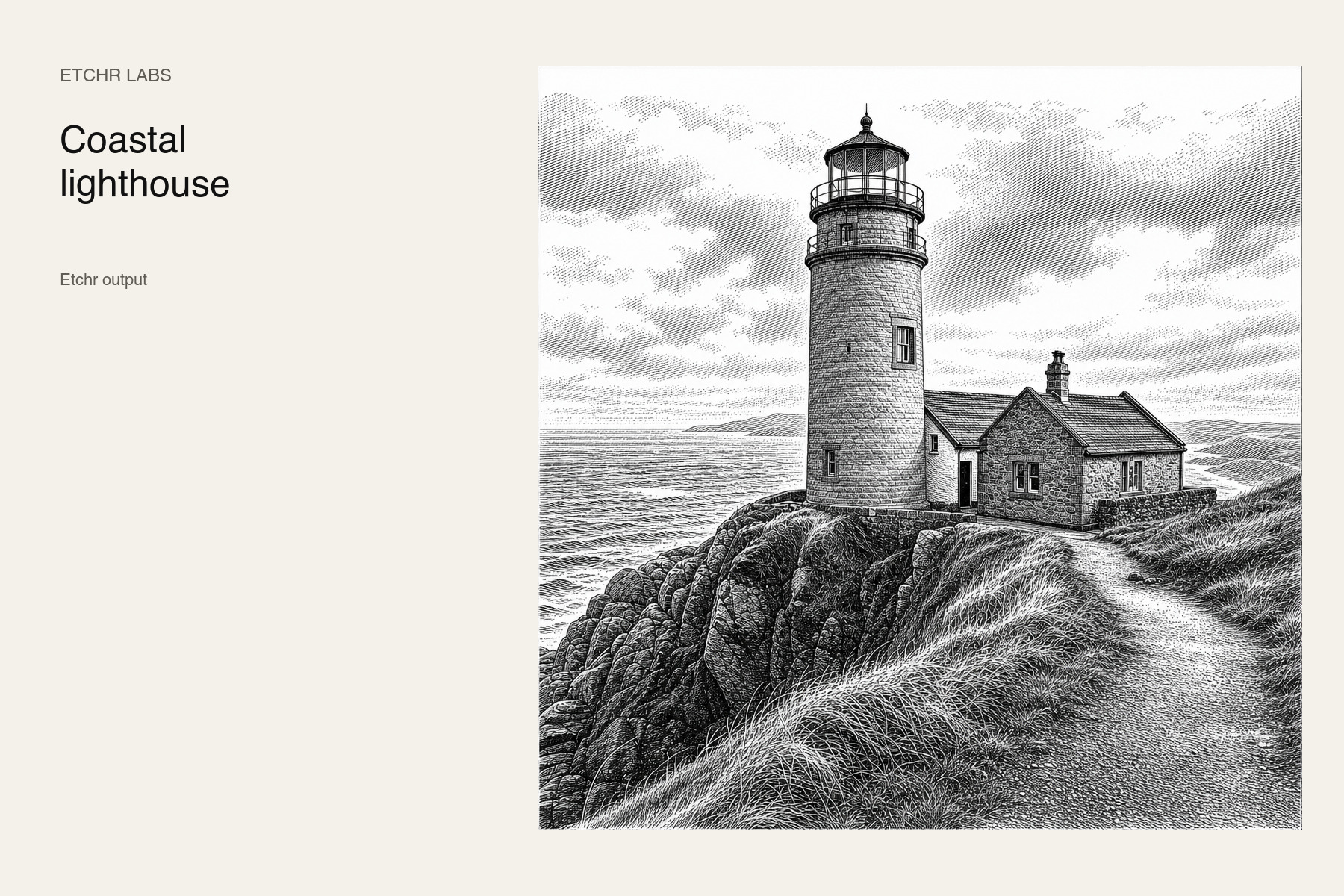
Architecture, stone, sea, clouds, and landscape unified into a timeless editorial rendering with exceptional environmental detail.
-
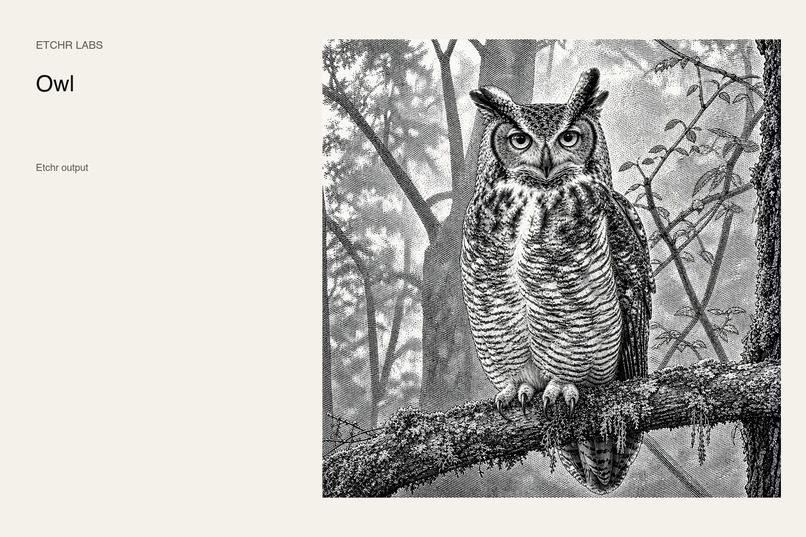
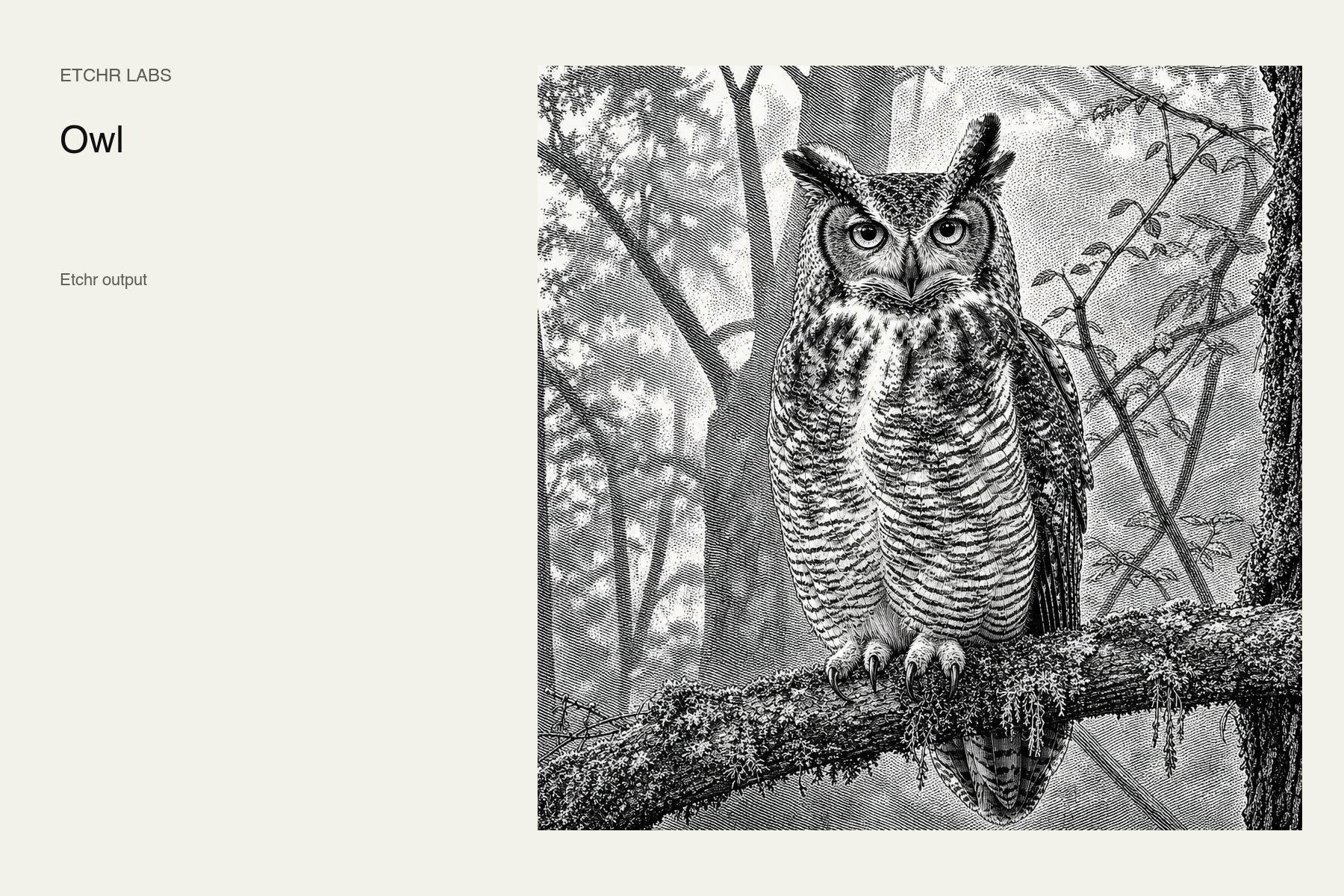
Feathers, eyes, bark, and forest texture rendered with the precision and restraint of a traditional editorial engraving.
-
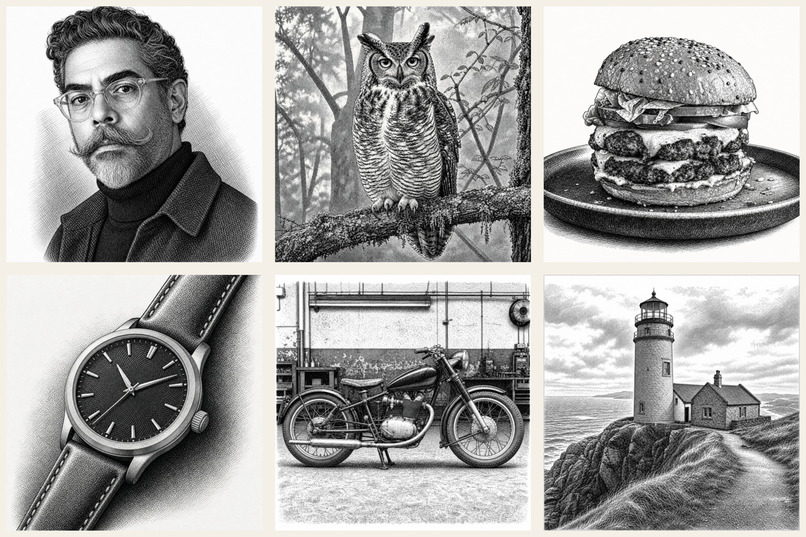
Etchr Labs explores how the same editorial craftsmanship can preserve detail across people, animals, food, products, and places.
Etchr — The Editorial Identity Engine
Inspiration
Growing up, I was fascinated by the editorial portraits I saw in publications like The Wall Street Journal.
They were not ordinary photographs. Artists created them by hand through stippling, crosshatching, and thousands of carefully placed lines. Somehow, those portraits could feel more timeless and more personal than the original photograph.
I remember wondering whether I could have one made for myself.
But these were true commissioned works of art, usually created for people being featured in the publication. There was no accessible way for an ordinary person to create one, so the idea stayed with me and eventually faded into the background.
Years later, generative AI changed what was possible.
I came back to the same question:
What if anyone could turn one real photograph into an editorial portrait they would be proud to use everywhere?
LinkedIn.
Company profiles.
Speaker bios.
Personal websites.
Social media.
That became Etchr.
Not a tool for inventing artificial people.
Not a replacement for photographers or artists.
And not another generic AI avatar app.
Etchr is built around a simpler belief:
Everyone deserves one photograph they are genuinely proud to use.
One that still looks like them.
Just a little more refined.
A little more timeless.
A little more intentional.
Technology made Etchr possible.
But technology is not the point.
The point is confidence.
What Etchr does
Etchr transforms one real photograph into a premium editorial portrait.
The experience is built around a simple philosophy:
Recognizable enough to feel true.
Designed enough to stand out.
A user can:
- Upload a real photograph.
- Confirm image rights and frame the subject.
- Create a private Etchr editorial portrait.
- Compare the original and finished result.
- Save or share the portrait.
- Receive a practical portrait pack for profiles, social platforms, editorial use, and personal branding.
The finished portrait is delivered in five useful formats:
Profile
Square
Portrait
Story
Landscape
Etchr is not trying to create a different person. The goal is to preserve the subject’s identity while transforming the photograph into something more intentional and publication-ready.
The hardest product problem
Creating an attractive image was only part of the challenge.
A portrait can be technically impressive and still fail if the person no longer feels recognizable.
We repeatedly evaluated likeness, facial structure, hair, expression, age, and overall character.
We also discovered that even tiny differences in eye position, head scale, mouth position, or crop could make a before-and-after comparison feel artificial.
The viewer did not experience the artistic treatment changing.
They experienced the face moving.
To solve that, we built a canonical facial-registration system that aligns the original photograph and finished portrait inside one stable frame.
For approved comparison pairs, the face now appears stationary while only the artistic treatment changes.
The experience moves from:
“The image shifted.”
to:
“The portrait emerged.”
The system can also refuse to show a comparison when a pair does not meet the visual standard. A strong finished portrait can remain available without being forced into a misleading before-and-after experience.
Founder Review
We did not want to accept an output simply because a model successfully returned an image.
We built a private Founder Review system that separates:
Complete and reviewable
Output not ready
Fixture error
Approve
Revise
Exclude
The system preserves decisions, notes, provenance, request records, checksums, generation costs, and visual-quality evidence.
This allowed us to evaluate the product deliberately instead of selecting only the outputs that happened to look impressive.
It also reinforced an important product principle:
Refusing to show weak work is a feature.
Etchr Labs
During Build Week, we discovered that the underlying transformation generalized far beyond human portraits.
We created Etchr Labs as a private proving ground for a broader idea:
The Editorial Identity Engine.
Using one canonical transformation workflow, we completed a 30-pair benchmark across:
People and identity
Animals and natural detail
Food and drink
Products and objects
Transportation and instruments
Architecture and places
Editorial and narrative illustration
The benchmark included subjects such as:
An owl with detailed feathers
A cheeseburger
A mechanical watch
A vintage field camera
A motorcycle
A lighthouse
Architecture
Packaging
Environmental animal scenes
Twenty-nine of the thirty outputs received founder visual approval.
One was marked for revision because the finished illustration was excellent, but the source and output framing made the comparison slider misleading.
Etchr Labs remains exploratory rather than an unrestricted consumer product promise. It demonstrates that the same underlying system can interpret the visual identity of people, products, animals, food, machines, architecture, and editorial scenes.
Reviewing the collection felt less like testing an image model and more like flipping through an editorial magazine.
How we built it
Etchr was built through a founder-led collaboration with GPT-5.6 and Codex.
Steve — Founder and creative direction
I provided:
The original product idea
The founder vision
The visual references
The product taste
The quality bar
The customer experience
The approval, revision, and exclusion decisions
The business priorities
The final product judgment
GPT-5.6 and Codex did not invent Etchr.
They helped me turn a long-held idea into a real product.
GPT-5.6
GPT-5.6 served as my:
Product strategist
Product manager
Principal product designer
UX and interaction-design lead
Visual-system partner
Architecture and engineering-direction partner
Code-review partner
QA-strategy partner
App Store launch advisor
Build Week storytelling and submission partner
It helped turn subjective founder reactions such as:
“The face is moving.”
“The reveal feels jerky.”
“This does not feel premium.”
into precise product specifications, visual acceptance criteria, and engineering direction.
Codex
Codex served as the implementation and validation agent.
It handled:
Repository verification and recovery
Isolated review branches and worktrees
Implementation of approved specifications
Browser and responsive QA
Playwright automation
Registration measurements and visual overlays
Private Founder Review tooling
Generation ledgers and checksum verification
A 30-pair editorial benchmark
Provenance and cost tracking
Native iOS and Capacitor work
StoreKit integration
Xcode archive and TestFlight preparation
Preview and production validation
Controlled commits, pushes, and draft pull requests
The working model was:
Vision → Design → Approval → Implementation → Validation → Founder Review → Ship
Challenges
Preserving identity
A technically impressive portrait still fails if the person no longer feels recognizable.
We repeatedly evaluated facial structure, expression, hair, age, and overall character.
Facial registration
Small geometric differences made comparisons feel fake.
We audited the full coordinate, crop, scaling, translation, browser-rendering, and CSS-transform chain. We removed compounded legacy transforms and calibrated approved pairs inside one canonical frame.
Designing motion without distracting from the portrait
The reveal initially felt like a wipe, brush effect, or interface transition.
We learned that the portrait must remain spatially immutable and that the final result needs enough stillness to register emotionally.
Honest quality evaluation
Incomplete fixtures originally appeared beside approval controls.
We corrected the review workflow so missing outputs could never be mistaken for failed visual results or accidentally approved.
Privacy and publication boundaries
Founder visual approval does not automatically grant publication approval.
We tracked provenance and checksums, kept benchmark media private, separated visual quality from public-use decisions, and withheld misleading comparisons.
Shipping across web and iOS
The native app loads Etchr’s web application remotely, so production deployment, native bridge behavior, StoreKit, TestFlight builds, and App Store submission all had to be coordinated carefully.
Accomplishments
We are proud that we:
Built a working premium editorial portrait product
Preserved identity instead of producing generic avatars
Created a five-format portrait pack from one result
Solved high-salience facial-registration drift
Built an auditable Founder Review system
Completed a 30-pair Editorial Identity benchmark
Achieved 29 founder-approved benchmark outputs
Tracked provider requests, costs, provenance, and checksums
Prepared Etchr for both the web and iOS
Built the product through a deep founder, GPT-5.6, and Codex collaboration
What we learned
Quality is a system
The generation model matters, but so do framing, registration, review, rights, delivery, motion, and product judgment.
The best technology often disappears
Canonical registration succeeds when the viewer does not notice it.
The person simply remains still while the artistic interpretation changes.
Restraint is a competitive advantage
More motion, more controls, and more features did not automatically make the product better.
Often, the strongest decision was to remove something.
Founder judgment and automation complement each other
Automated measurements, QA, benchmarks, and scoring made review faster and more rigorous.
Founder visual judgment remained the final authority.
The product may be larger than its first use case
Etchr began as an editorial portrait product.
Etchr Labs suggests that the same engine may support products, animals, architecture, food, machines, and editorial storytelling.
What’s next
Near term:
Launch Etchr on the App Store
Complete the StoreKit purchase-to-generation lifecycle
Refine the final processing and reveal experience
Improve gallery and content-publishing workflows
Expand public-safe editorial examples
Continue improving object and scene registration
Make the portrait workflow faster and more reliable
Longer term:
Build Etchr Labs into a curated experimental gallery
Create specialized modes for products, architecture, food, and editorial scenes
Develop a scalable founder Content Studio
Expand the Editorial Identity Engine for individuals, publications, brands, and creative teams
What we believe
People deserve one photograph they are proud to use.
Technology should disappear behind craftsmanship.
Confidence is more valuable than features.
People should still look like themselves.
Restraint is a competitive advantage.
One beautiful artifact is worth more than one hundred average ones.
Software should remove anxiety.
The reveal matters.
Sharing should feel like pride, not promotion.
The portrait comes first.
Everything else is secondary.
Closing
Etchr started with a question I had carried for years:
Why should a timeless editorial identity be reserved for people who appear in the newspaper?
Now one real photograph can become something recognizable, distinctive, and ready to be seen.
Built With
- app-store-connect
- authentication
- capacitor
- codex
- github
- gpt-5.6
- image-generation
- ios
- node.js
- object-storage
- openai
- playwright
- postgresql
- react
- rest-api
- storekit
- stripe
- supabase
- swift
- testflight
- typescript
- vercel
- vite
- web-app
- xcode

Log in or sign up for Devpost to join the conversation.