-
-

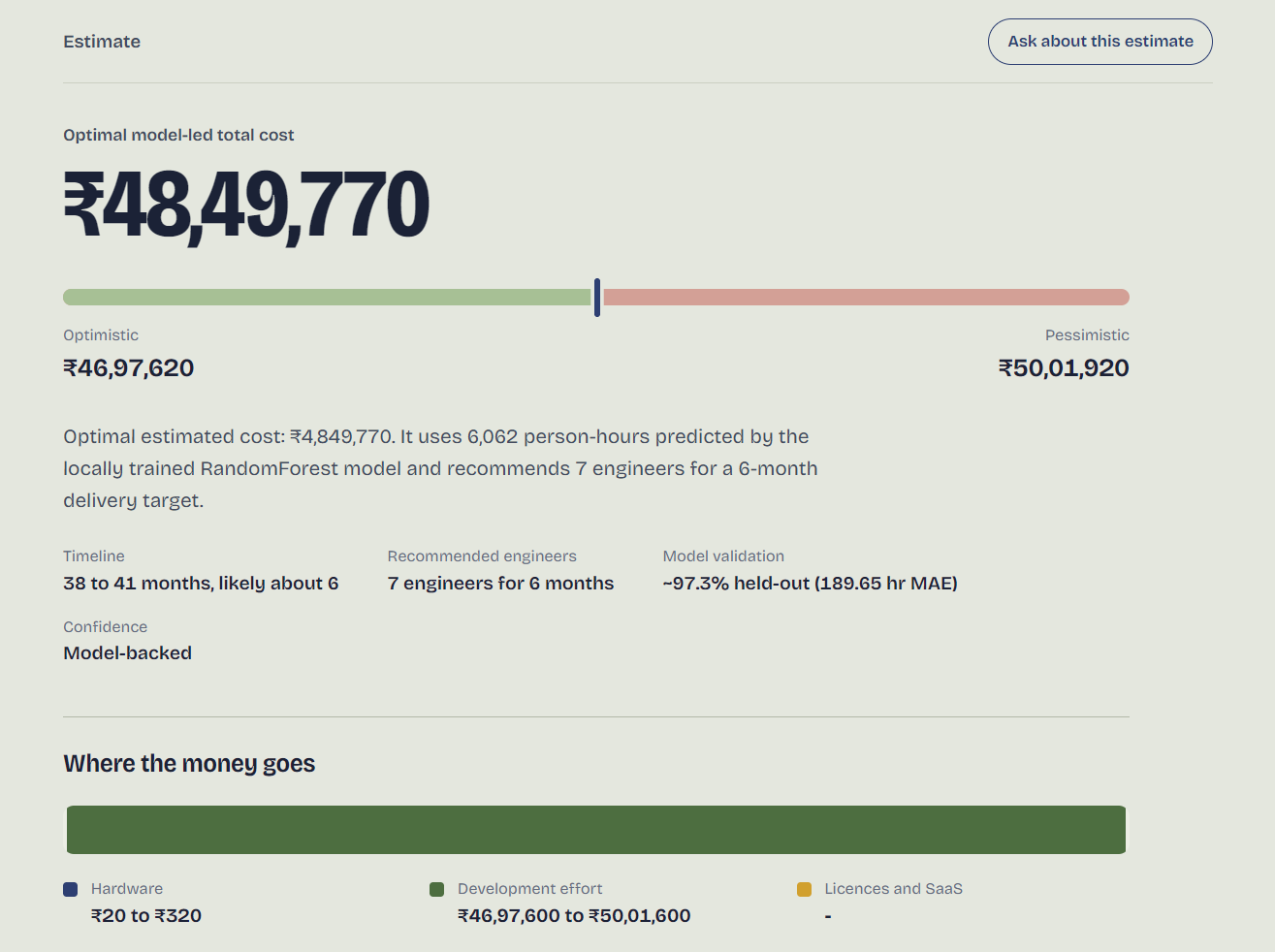
Shows no hardware items required if no hardware items involved in the project's image uploaded
-
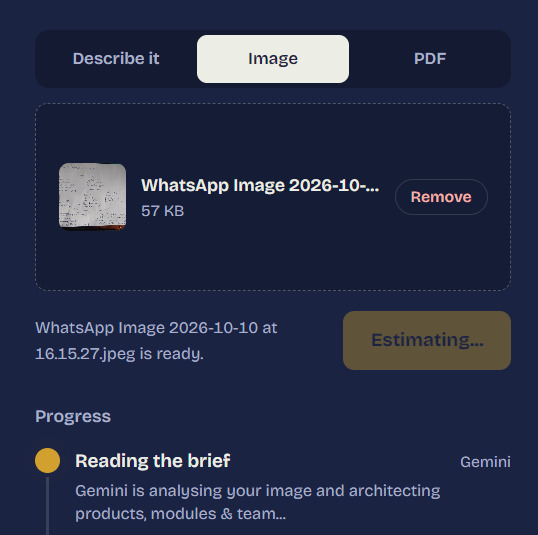
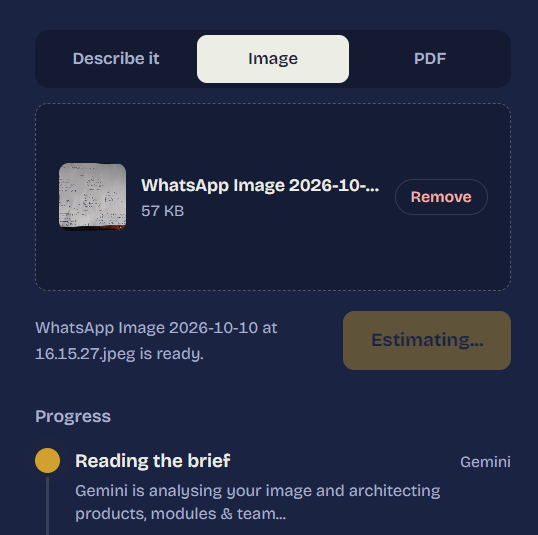
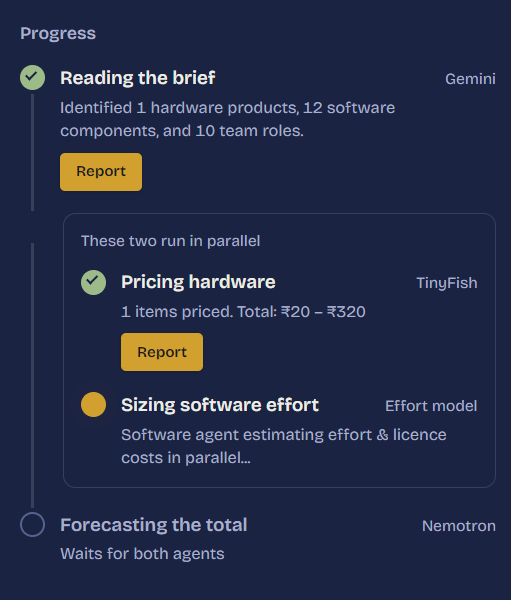
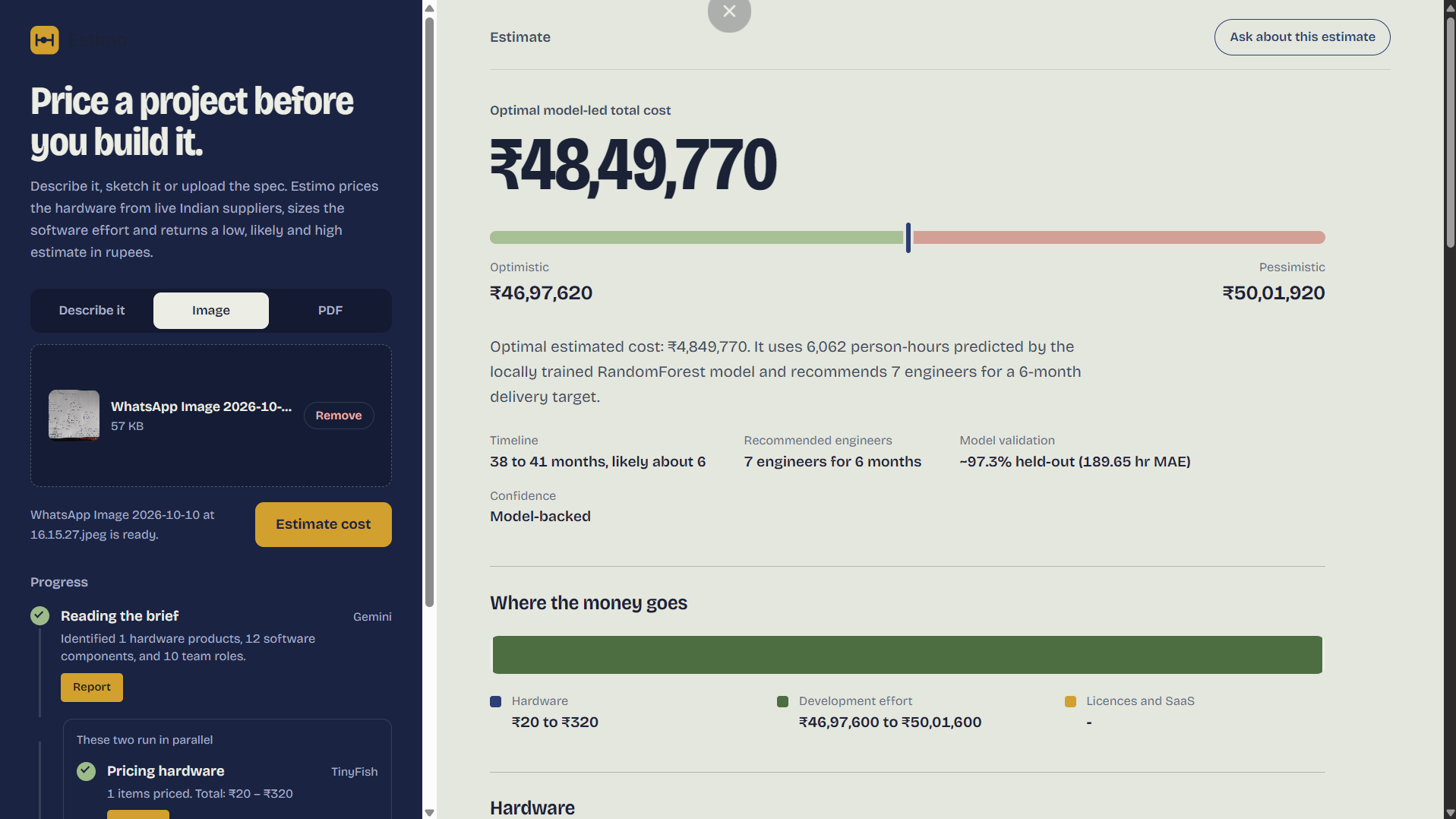
Agent start when the image added
-
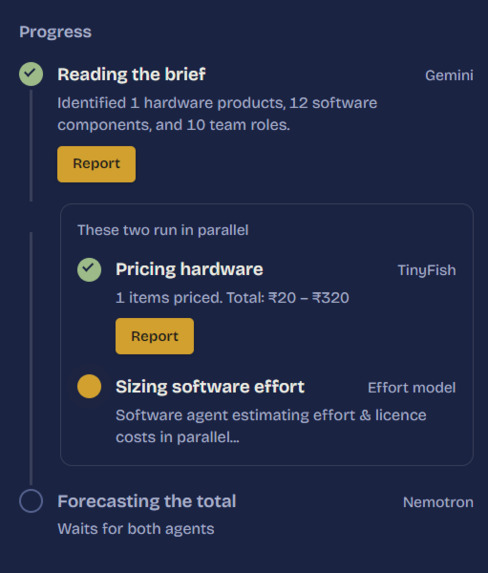
main model splits the image by dividing the hardware and software items & both agents gets the info from the internet and provides to nvidia
-
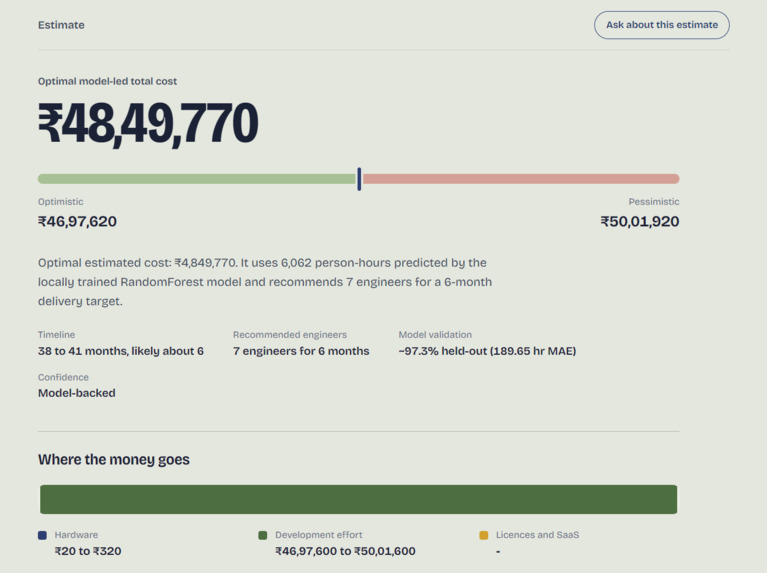
After research all these shown in the secondary page of the webpage
-
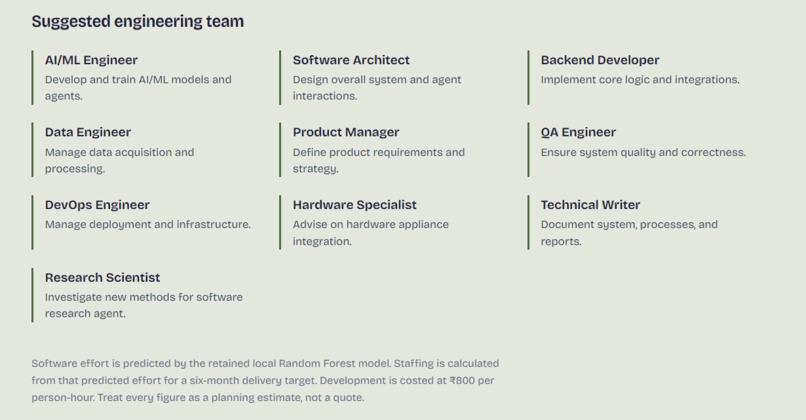
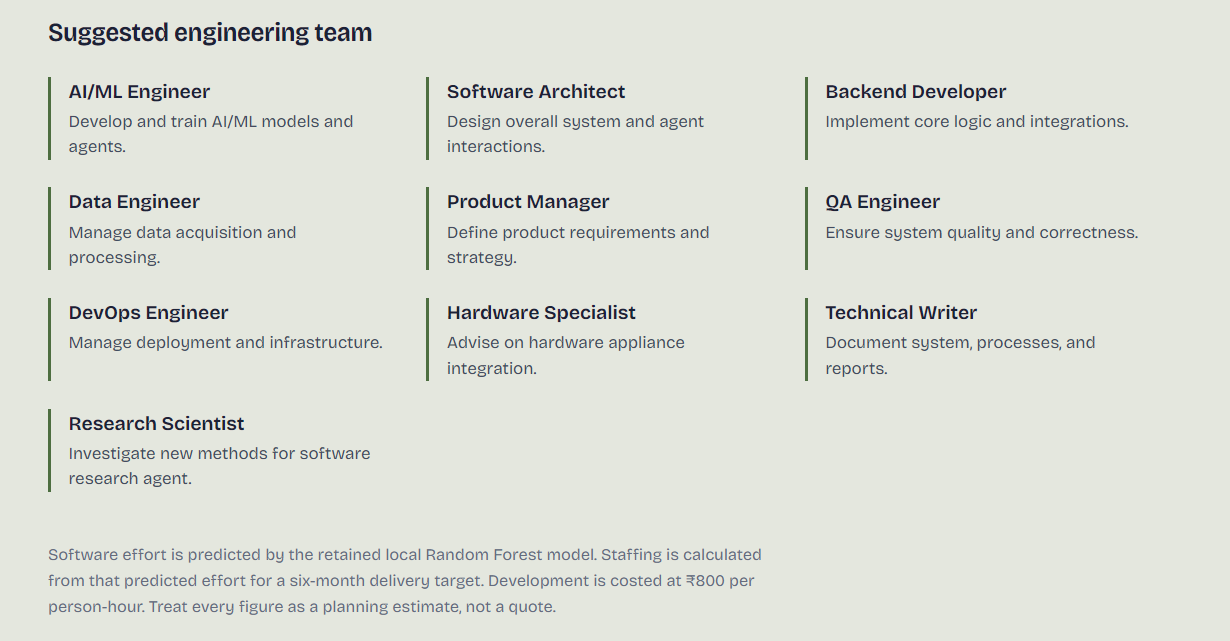
Provides all the engineering team required to the uploaded project
-
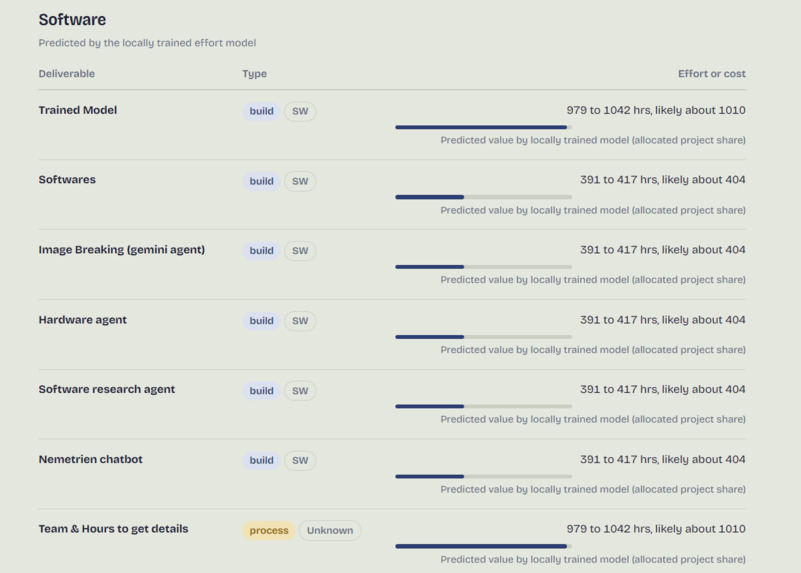
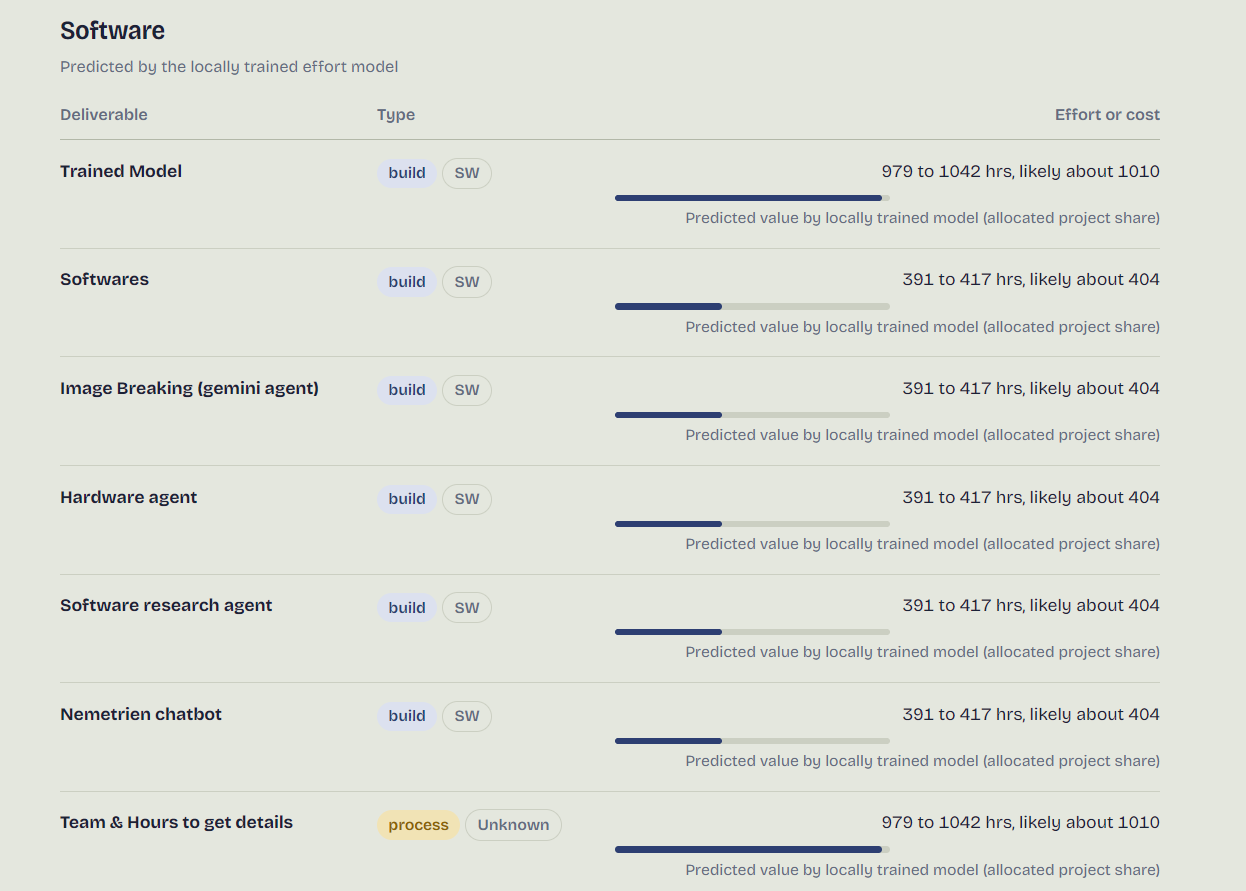
Shows what all the software things required
-
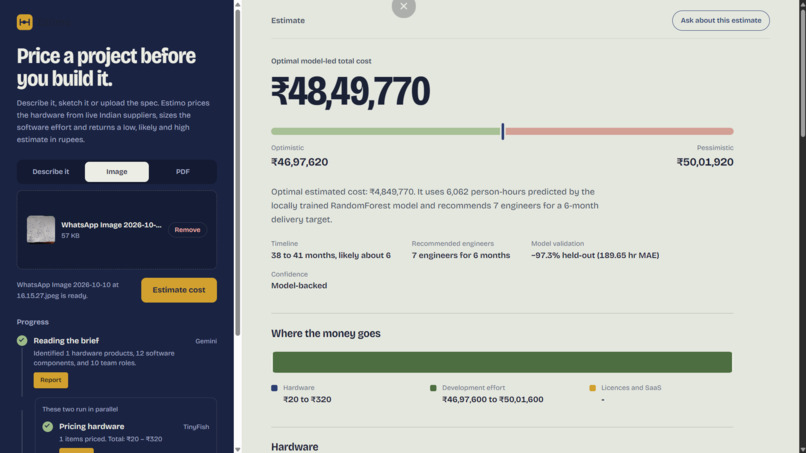
Total view of the prototype

Inspiration
Large IT projects overrun their budgets by 45% on average, run 7% late and deliver 56% less value than planned. A big reason is that cost estimation is still manual: a spreadsheet, an expert's guess, and one number with no sense of how uncertain it is. Existing tools give story points per ticket, forecast cloud bills, or are built for huge programs. None of them take a plain project idea and return a full budget. We wanted to build that.
What it does
Estimo turns a plain-text description or a diagram of a software project into a full budget covering people, hardware, software and cloud.
Instead of a single number, it gives a calibrated P50 / P80 range, so a project manager sees both the likely cost and the safe cost. Users can edit the breakdown, try what-if scenarios such as a smaller team or a different scope, and ask a chatbot to explain any cost item in plain words.
How we built it
Estimo is a pipeline of small, focused agents and models:
- Gemini agent: reads the text or image and splits the project into hardware and software.
- Hardware agent: researches the cost of devices and equipment.
- Software research agent: a trained model predicts team size and hours, and a search-based agent finds sourced tool and cloud prices.
- Report in summary: collects the hardware, team and software findings in one place.
- Nemotron decision: divides the total and gives the cost and expenses for the project.
- Nemotron chatbot: explains each cost item using the project's own data.
The numbers come from models, not from the LLM. Effort is predicted with LightGBM trained on public datasets (China, SEERA and NASA93). Conformal prediction turns predictions into calibrated P50 / P80 ranges, and SHAP shows which factors drive the cost. The LLMs break down, advise and explain, with outputs checked using Pydantic. The app is built with Streamlit and Plotly, using free tools only.
We judge the effort model with a standard error measure:
$$ \text{MMRE} = \frac{1}{n}\sum_{i=1}^{n}\frac{|y_i - \hat{y}_i|}{y_i} $$
and \(\text{PRED}(25)\), the share of projects estimated within 25% of the actual value.
Challenges we ran into
- Small, older data. The public datasets are limited, so we report results honestly instead of overclaiming.
- Keeping the LLM away from the math. Models set the numbers, and Nemotron only advises and explains.
- Prices that can be wrong. Searched prices can be outdated, so every price shows its source and stays editable.
- LLM limits. We added caching and an offline mode so the demo does not depend on a single API call.
- One build day. We built the must-haves first and left the rest for later.
Accomplishments that we're proud of
- A working flow from a plain description or diagram to a full budget with a P50 / P80 range.
- Hardware, software and team cost handled in one estimate, which most existing tools do not do.
- A chatbot that explains every cost item in plain words.
- A benchmark page that compares our model with a baseline on MMRE and PRED(25).
- Built entirely with free tools and public data, with no GPU needed.
What we learned
- A range is more useful than a single number, because it changes how teams plan contingency.
- Splitting the job across agents made each step easier to test and fix than one big prompt.
- Calibration matters. A range is only useful if it covers the real outcome as often as it claims to.
What's next for Estimo
- Live Jira, MS Project and ERP links
- A feedback loop that learns from actual project costs and recalibrates
- A team-size optimizer and company-specific tuning
Built With
- artficial-intelegence
- cost-estimation
- css
- flask
- gemini-api
- google-gen-ai
- html
- javascript
- joblib
- machine-learning
- numpy
- nvidia-nemotron
- pandas
- project-management
- python
- random-forest
- scikit-learn
- server-sent-events
- tinyfish
- web-scraping
