-
-
Poster Board

Inspiration
Growing up in Southern California and having been affected by asthma as a child, health damages from wildfires was a topic that was close to home. Furthermore, in my everyday research, I focus more on climate change mitigation, and I emphasize the importance of utilizing co-pollutants to turn global climate change into a local problem. I was excited to apply similar arguments to CA wildfires.
What it does
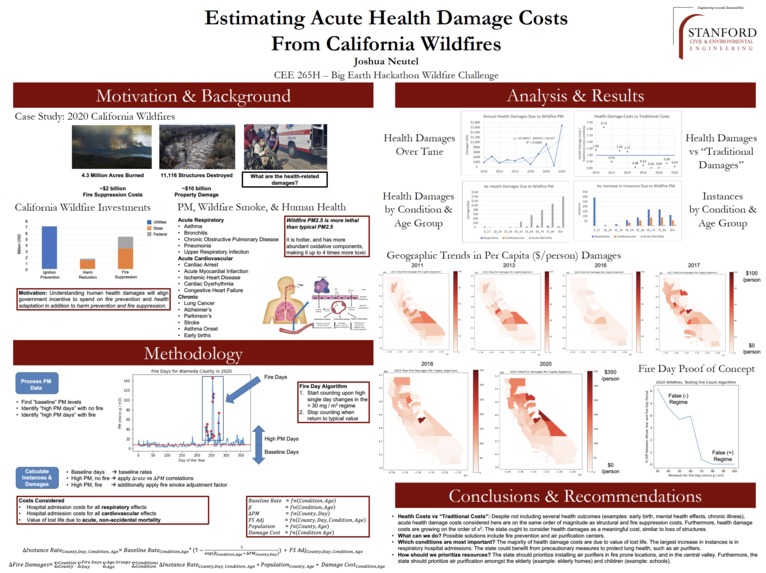
My model calculates increased instances and associated health damage costs (due to wildfire) from respiratory hospital admissions, cardiovascular hospital admissions, and acute non-accidental mortality. The model can display results for a provided input year, age, and county (or all-state), and it can provide results on a total basis or a per capita basis. It also comes with some helpful graphing and mapping functions.
The model is easy-to-use and scalable in the sense that it relies on only publically available data and a few user inputs. Other models of a similar ilk rely on difficult-to-obtain health records data.
How we built it
I built a novel fire-day counting algorithm that utilizes time-series analysis on PM data to identify "fire days." From there, I tap into the literature to correlate changes in PM to changes in health outcomes, and additional literature to correlate changes in health outcomes to damage costs.
Challenges we ran into
The most difficult part of the project was being able to identify "fire days" from "non-fire days." This is critical to properly allocate costs, especially because adjustments are made to instance rates based on the presence of "fire PM" vs "typical PM" (the prior being up to 4 times more toxic). Other models utilize geospatial imaging to identify fire days. The challenge here is geospatial images have no understanding of depth, and thus PM smoke high above the surface can have little to no impact on ground-level PM concentrations (and therefore health). For this reason, a novel algorithm was created that utilizes characteristics of the PM data itself to identify the "fire-days."
An additional challenge was aligning multiple literature sources on health outcome correlations to come up with a consistent and sensible mathematical formulation.
Accomplishments that we're proud of
My own personal goal coming into the project was to utilize the skills I have been learning in my CS classes. For example, I wanted to practice working with object-orientate programming, time-series analysis, as well as geospatial data. Most of all, I wanted to go through the experience of starting from a completely blank screen with no data to a fully-functioning model. These will be very helpful skills as I now start my PhD journey!
What we learned
** Health Costs vs “Traditional Costs”: ** Despite not including several health outcomes (examples: early birth, mental health effects, chronic illness), acute health damage costs considered here are on the same order of magnitude as structural and fire suppression costs. Furthermore, health damage costs are growing on the order of x2. The state ought to consider health damages as a meaningful cost, similar to the loss of structures.
** What can we do? ** Possible solutions include fire prevention and air purification centers.
** Which conditions are most important? ** The majority of health damage costs are due to the value of lost life. The largest increase in instances is in respiratory hospital admissions. The state could benefit from precautionary measures to protect lung health, such as air purifiers.
** How should we prioritize resources? ** The state should prioritize installing air purifiers in fire-prone locations, and in the central valley. Furthermore, the state should prioritize air purification amongst the elderly (example: elderly homes) and children (example: schools).
What's next for Estimating Acute Health Damage Costs From CA Wildfires
Professor Mary Prunicki has expressed interest in continuing to work together, and to potentially publish on this topic together. She is particularly interested in including damage costs due to mental health effects from wildfires. I hope to continue to work with Professor Prunicki to develop these ideas and share them with the community.

Log in or sign up for Devpost to join the conversation.