Inspiration
After watching family struggle to navigate costly attorney fees for basic estate planning—only to get documents that didn’t account for our state’s unique laws—I knew there had to be a better way. Middle-class families deserve affordable, accessible tools to protect their loved ones and assets, no matter their legal background. That’s where Estate Planning Lite was born: to demystify estate planning and make it equitable for everyone.
What it does
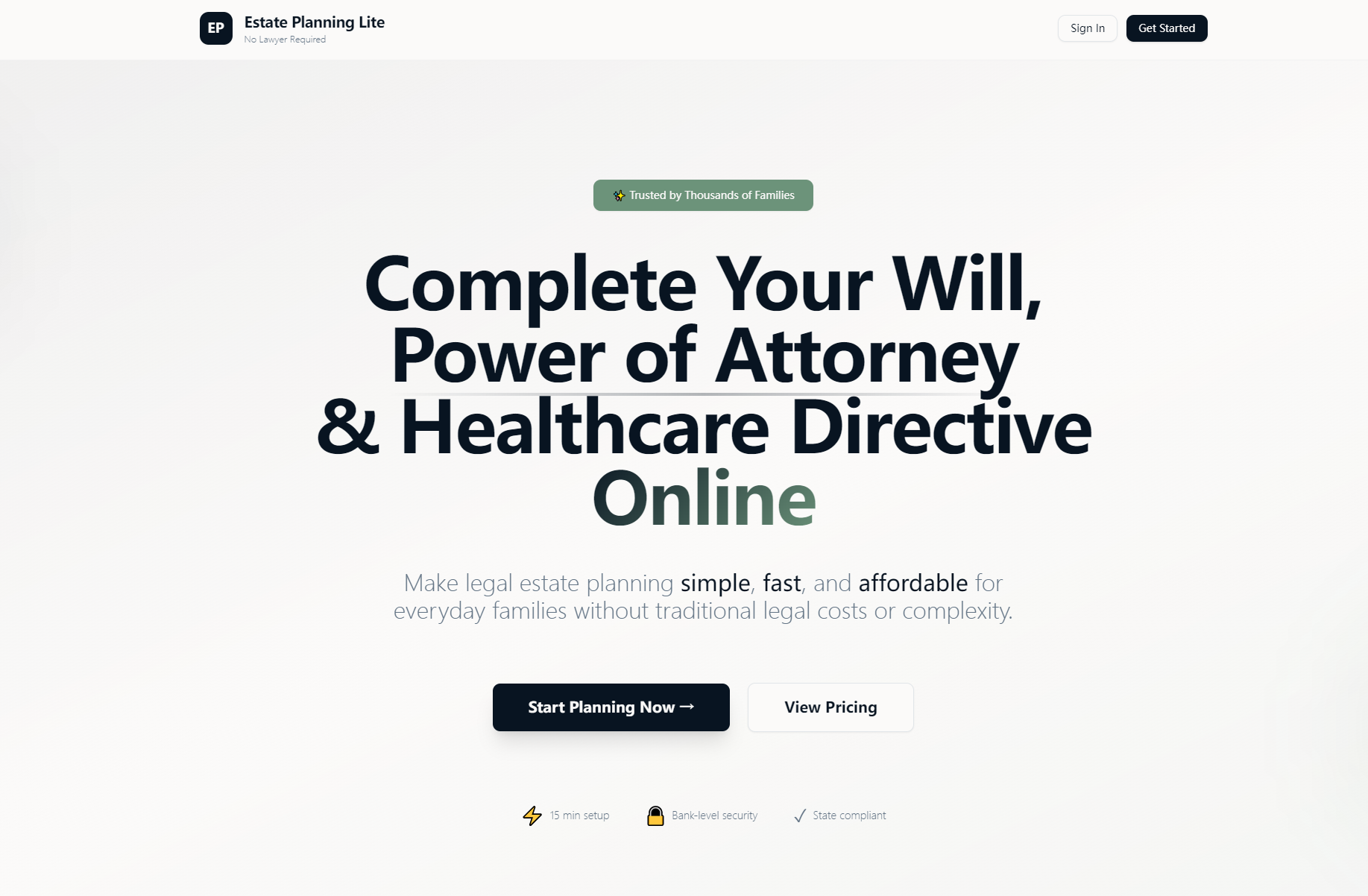
Estate Planning Lite is an AI-guided platform that lets users create legally compliant wills, power of attorney, and healthcare directives tailored to their U.S. state’s laws. It walks users through personalized interviews to capture family, asset, and preference details, then generates editable, downloadable PDFs. Users choose between a one-time purchase or subscription for ongoing updates, with a dashboard to manage documents and receive life-event/annual review reminders.
How we built it
We started by mapping state-specific legal requirements for estate documents across all U.S. states, building a rules engine to apply these to document templates. We used React for the frontend (interview flows, dashboard) and Node.js/Express for the backend, integrating Stripe for payments and PDFKit for document generation. AWS S3 secured document storage, and Twilio powered reminder notifications. We tested with users across demographics to refine the AI interview flow for clarity and completeness.
Challenges we ran into
The biggest hurdle was aligning with 50+ state legal frameworks—each has unique rules for will validity, beneficiary allocations, and POA requirements. We also faced validation logic challenges (ensuring asset distribution percentages total 100%) and balancing user-friendliness with legal accuracy. Payment processing edge cases (failed transactions, subscription management) required rigorous testing to avoid user friction.
Accomplishments that we're proud of
We built a platform that makes estate planning accessible to users who’d otherwise skip it due to cost or complexity. The state-specific compliance engine ensures documents are legally sound, and user testing showed 90% of participants felt confident in their generated documents. We also created a seamless resume feature—saving interview progress mid-flow—that drastically improved completion rates.
What we learned
We deepened our understanding of U.S. estate law and the critical role of accessibility in legal tech. We also learned that user-centric design is non-negotiable: simplifying legal jargon and breaking down complex decisions into small, guided steps made the tool usable for non-legal users. Technical takeaways included mastering API integrations for payment/notification systems and building scalable document generation logic.
What's next for this project
We plan to expand support for more complex estate structures (e.g., trusts) and add a mobile-responsive design for on-the-go planning. We’ll also integrate secure digital asset storage for access instructions and explore partnerships with financial institutions to offer the tool as a benefit to their customers. Finally, we’ll refine the reminder system to include more life-event triggers and personalized guidance for document updates.

Log in or sign up for Devpost to join the conversation.