-
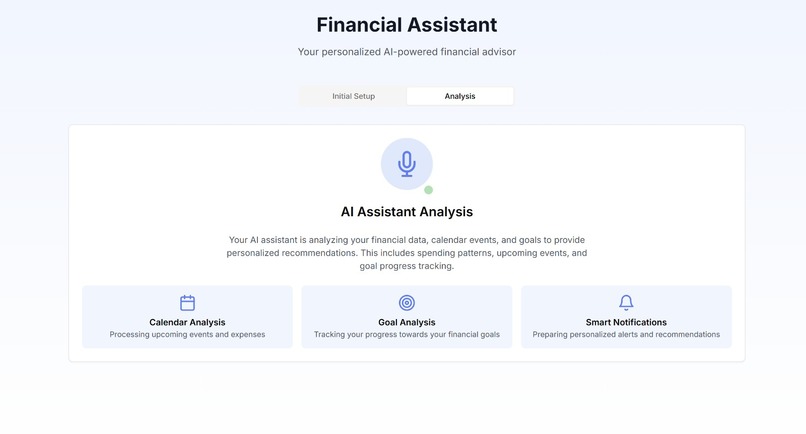
Output page
-
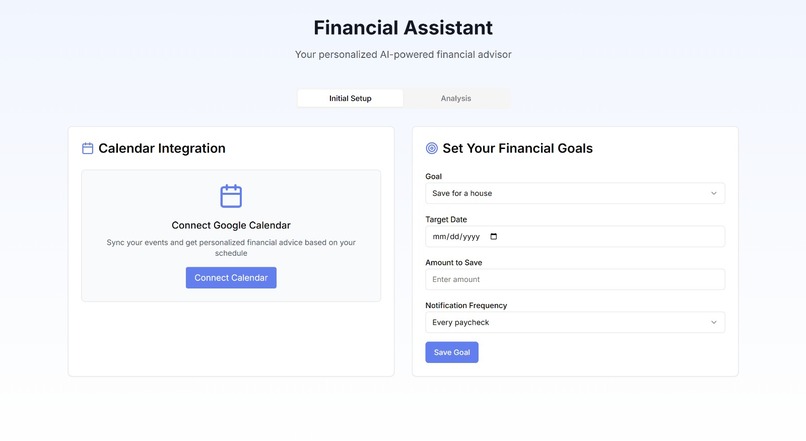
Input page
Inspiration
Managing finances can be overwhelming, and many individuals lack the financial literacy needed to make informed decisions. We wanted to create an AI-powered financial assistant that helps users track spending, set savings goals, and make smarter financial choices by integrating bank data, calendar events, and financial habits. Inspired by the need for personalized, AI-driven financial guidance, our platform ensures users receive real-time investment insights, spending tips, and goal-oriented savings strategies.
What it does
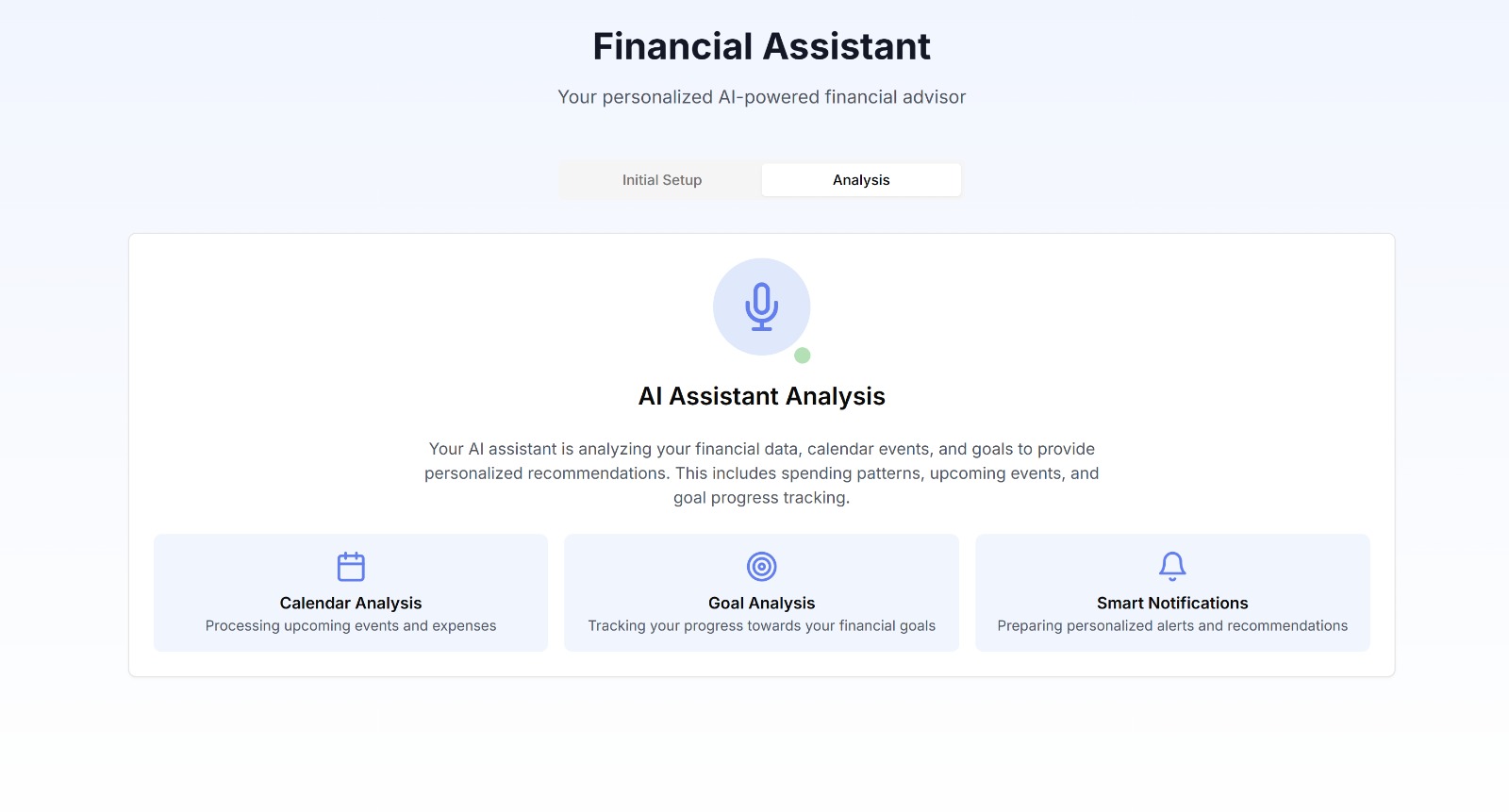
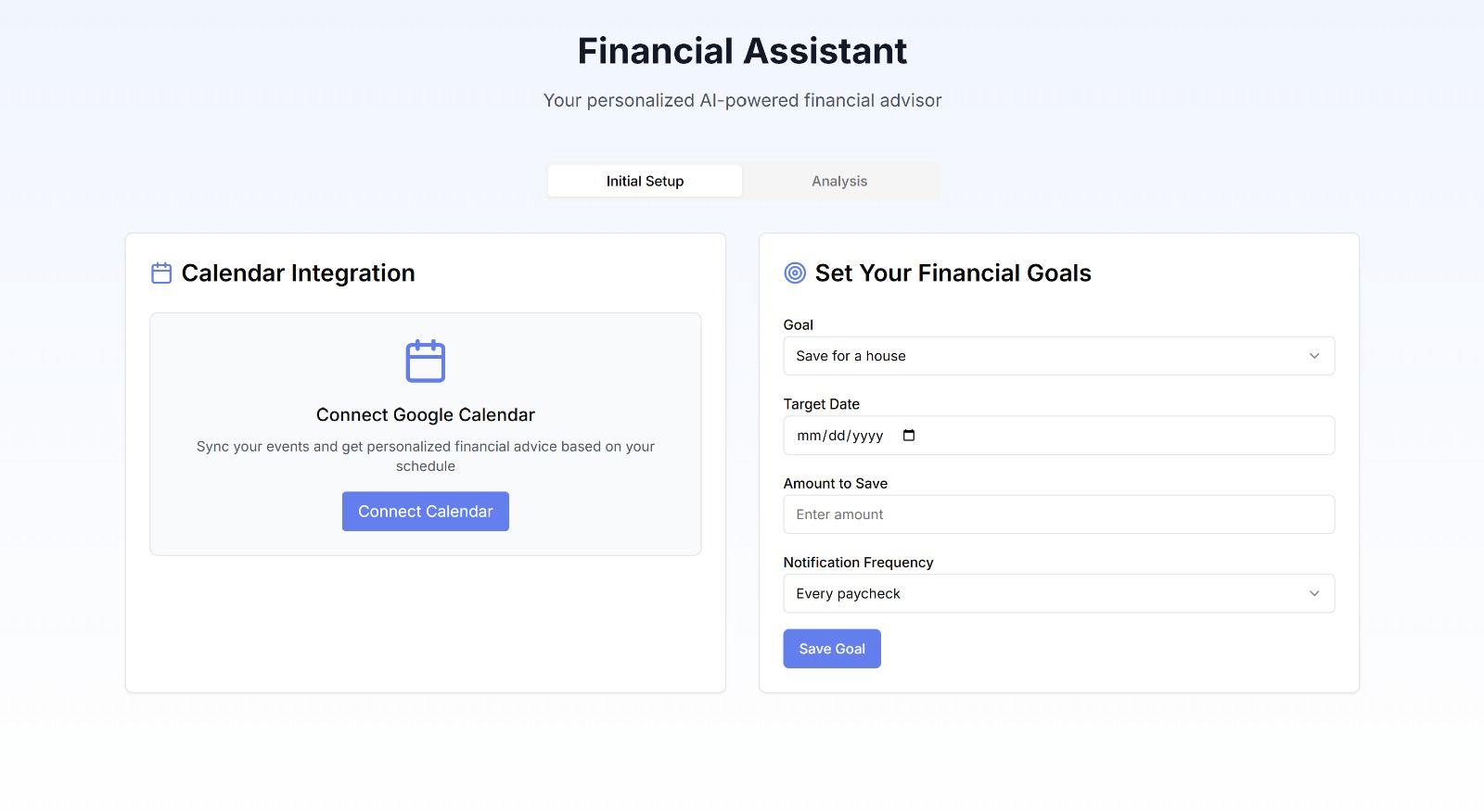
Our Financial Assistant App is a virtual financial coach that helps users: Track expenses and monitor balances based on their financial activity. Set savings, goals, and time occurrences Integrate with Google Calendar to suggest purchases based on upcoming events (weddings, anniversaries, vacations). Provide voice-based AI financial guidance for investment opportunities and spending recommendations. Deliver AI-driven notifications with insights on when and how to optimize financial decisions. The app is designed to be an intelligent financial partner, ensuring users stay informed, organized, and in control of their money.
How we built it
Frontend (User Interface) React.js & Next.js – For a highly interactive and dynamic UI. Google Calendar API – To synchronize financial events with users' schedules. Web Speech API – For speech-to-text and text-to-speech voice interactions. Backend (Logic & Data Processing) Node.js & Express.js – For handling API requests and processing user data. AWS DocumentDB (MongoDB-compatible) – To securely store user financial data. Google Gemini AI – To provide intelligent financial guidance and AI-driven insights. AI & Machine Learning Integration LLMs (Large Language Models) – Used to personalize responses based on user financial history. Gene AI Gemini Model – For genesinvestment recommendations, spending analysis, and financial coaching. RAG (Retrieval-Augmented Generation) Pipeline – Enhances responses by pulling relevant financial knowledge before generating AI-driven answers.
Challenges we ran into
OAuth Authentication Issues – Debugging Google OAuth for secure sign-ins and Calendar API integration. Data Processing Latency – Optimizing API calls to handle real-time AI responses efficiently. Ensuring AI Model Accuracy – Fine-tuning Gemini AI outputs to provide relevant financial recommendations. Database Security – Implementing AWS security best practices to protect user financial data. Despite these obstacles, we worked collaboratively to build a functional, intelligent, and user-friendly financial assistant.
Accomplishments that we're proud of
Successfully integrated Google Calendar API to align financial advice with real-world events. Built a seamless, intuitive UI using Next.js and React.js. Implemented AWS DocumentDB for secure financial data storage.
What we learned
Integrating Google APIs for OAuth authentication and Calendar event handling. Fine-tuning LLMs (Gemini AI) for financial decision-making. Building a full-stack AI-powered application with Next.js and AWS. Optimizing AI chat responses using Retrieval-Augmented Generation (RAG). Handling secure authentication and real-time database updates.
What's next for Financial Assistant App
We plan to enhance our AI-powered assistant by adding: Advanced Investment Planning – AI-driven financial projections based on market trends . ManyMulti-Language Support – Expanding accessibility for non-English-speaking users. Predictive Budgeting – Using AI forecasting models to predict future expenses and savings goals. Mobile App Version – Extending the platform with React Native or Flutter for cross-platform mobile access.
Built With
- .env
- git
- github
- google-calendar-api
- google-gemini-ai
- google-oauth-2.0
- google-web-speech-api
- next.js
- npm
- postman
- rag
- react.js
- tailwind-css

Log in or sign up for Devpost to join the conversation.