-
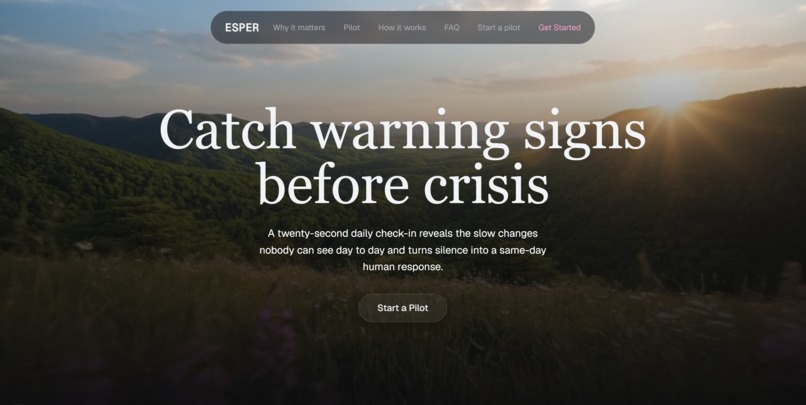
Snapshot of the Dashboard
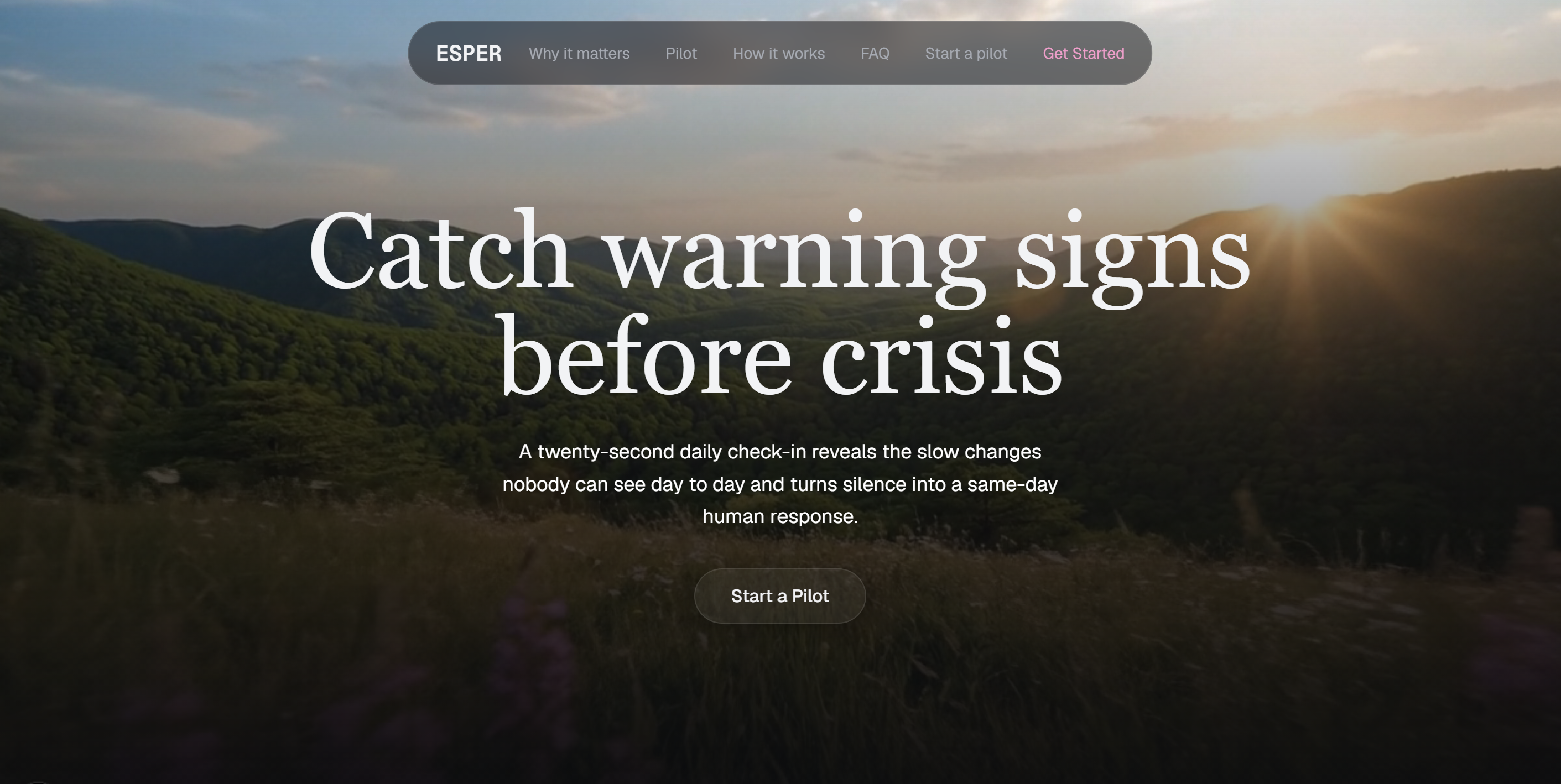
Inspiration
Seniors rarely go from healthy to crisis overnight. Before a fall or hospitalization, there are often weeks of subtle warning signs: later check-ins, shorter messages, missed meals, poor sleep, and lower mood.
Families usually see only one day at a time, while senior-center coordinators may be responsible for hundreds of people. Esper was inspired by that invisible period before a crisis—when a simple phone call or neighbor visit could still make a difference.
What it does
Esper is an early-warning system for seniors who live alone. Each senior completes a simple 20-second daily check-in covering sleep, meals, mood, and an optional note.
Esper uses two detection tiers:
- Tier 1 detects a missed check-in and starts a human escalation ladder: neighborhood buddy, senior-center coordinator, then emergency contact.
- Tier 2 analyzes gradual changes using Health and Isolation scores compared with each senior’s personal baseline.
Coordinators receive ranked alerts explaining what changed, how confident the system is, and what action is recommended. Detection is deterministic and traceable; the language layer converts the calculated results into an understandable outreach brief.
How we built it
We built the frontend with Next.js, React, TypeScript, Tailwind CSS, Framer Motion, and Radix UI.
The core detection engine is a framework-free JavaScript system that runs locally and offline. It includes:
- A single controllable demo clock
- Personalized check-in deadlines based on median historical behavior
- A deterministic escalation state machine
- A lagging personal baseline that prevents gradual decline from becoming the new “normal”
- Transparent Health and Isolation scores
- Lightweight keyword and sentiment analysis with a negation guard
- Confidence levels and reasons for uncertainty
- Trend projections and historical replay
- Coordinator actions and state serialization
We created 12 deterministic simulated seniors. Four central personas demonstrate slow decline, stable behavior, harmless missed days, and an urgent missed check-in. Every score and explanation is calculated live from raw check-in histories.
Challenges we ran into
The hardest challenge was separating meaningful decline from normal human variation. A missed check-in could indicate an emergency, a dead phone, or a family visit. We addressed this by matching the response to the uncertainty: an ambiguous signal starts with a neighbor’s knock, not an emergency response.
Another challenge was preventing a slowly declining senior from pulling their own baseline downward. We solved this with a lagging baseline that compares recent check-ins against an earlier period.
We also handled short histories, near-zero variance, check-ins crossing midnight, negated health language, multiple missed days, late check-ins, backward demo-clock movement, malformed data, and duplicate alerts.
Accomplishments that we're proud of
Esper is more than a static concept. Its scoring and escalation engine is functional, deterministic, reproducible, and fully offline.
Our automated suite contains 41 passing tests covering scoring, escalation, confidence, trend projection, replay, coordinator actions, simulated personas, and persistence.
In our demonstration, Esper identifies Dorothy’s decline seven days earlier, while 11 of 12 simulated seniors never receive a decline alert. The system also catches Sam’s missed check-in, escalates it appropriately, and preserves the complete alert timeline.
What we learned
We learned that health-adjacent technology must explain both its decisions and its uncertainty. A transparent calculation can be more trustworthy than a powerful model that cannot explain itself.
We also learned that AI should not be added everywhere simply because it is available. In Esper, deterministic math decides who needs attention. The language layer only helps a human coordinator understand the result and respond appropriately.
Most importantly, we learned that prevention does not always require additional sensors. A tiny daily interaction becomes valuable when it is interpreted as a long-term pattern instead of an isolated answer.
What's next for Esper
Our next step is connecting the detection engine to complete senior and coordinator interfaces. This includes an accessible daily check-in screen, a ranked dashboard, interactive trend charts, alert timers, and one-click volunteer assignments.
We then want to conduct a small senior-center pilot focused first on daily participation and usability. The pilot would test whether changes in timing, mood, meals, sleep, and engagement provide useful early warning.
Future work includes local encrypted persistence, optional SMS notifications, stronger accessibility testing with seniors, configurable escalation policies, and careful evaluation using real consent-based data.
Built With
- d3.js
- framer-motion
- javascript
- lucide-react
- next.js
- node.js
- pnpm
- radix-ui
- react
- recharts
- shadcn/ui
- tailwind-css
- typescript
- vercel

Log in or sign up for Devpost to join the conversation.