-
Introduction
-
Problem & Solution
-
The Importance
Inspiration
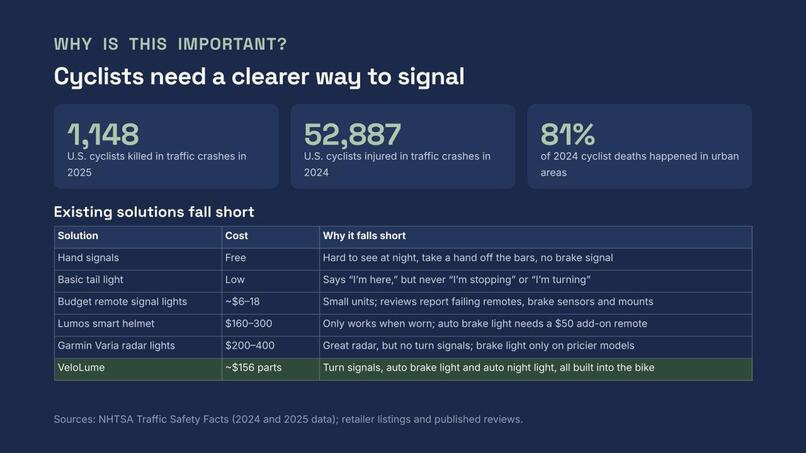
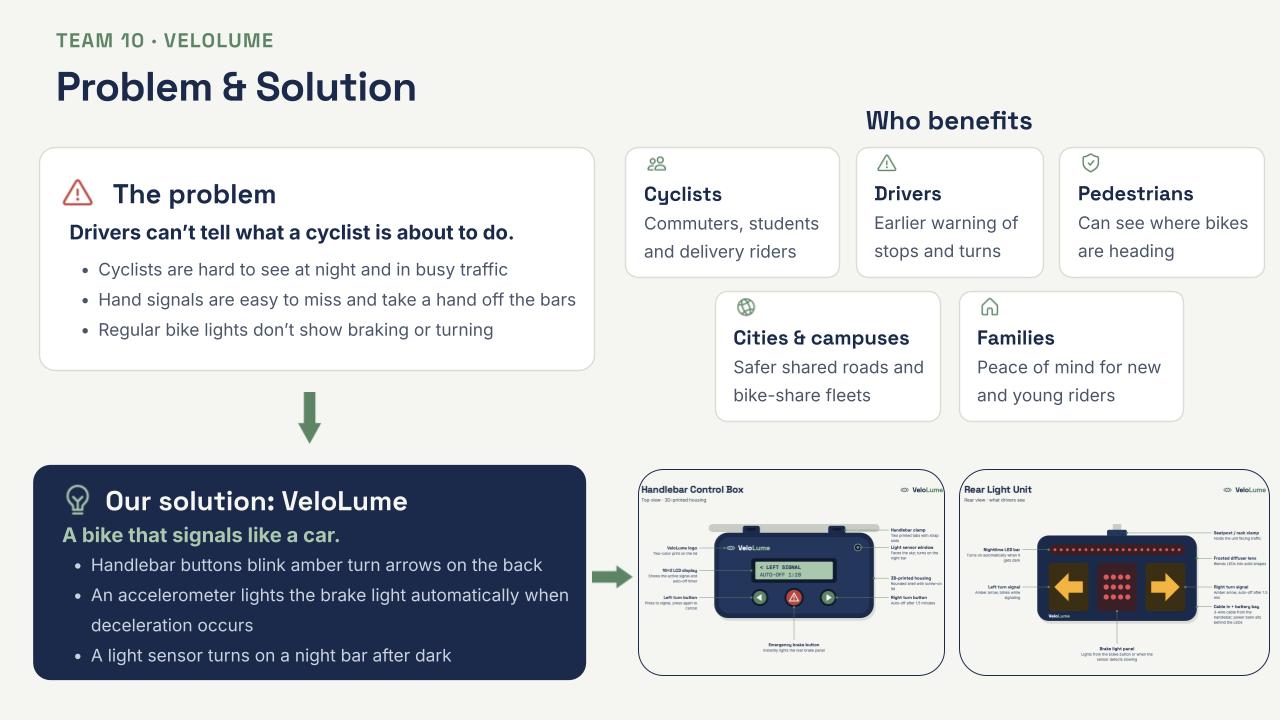
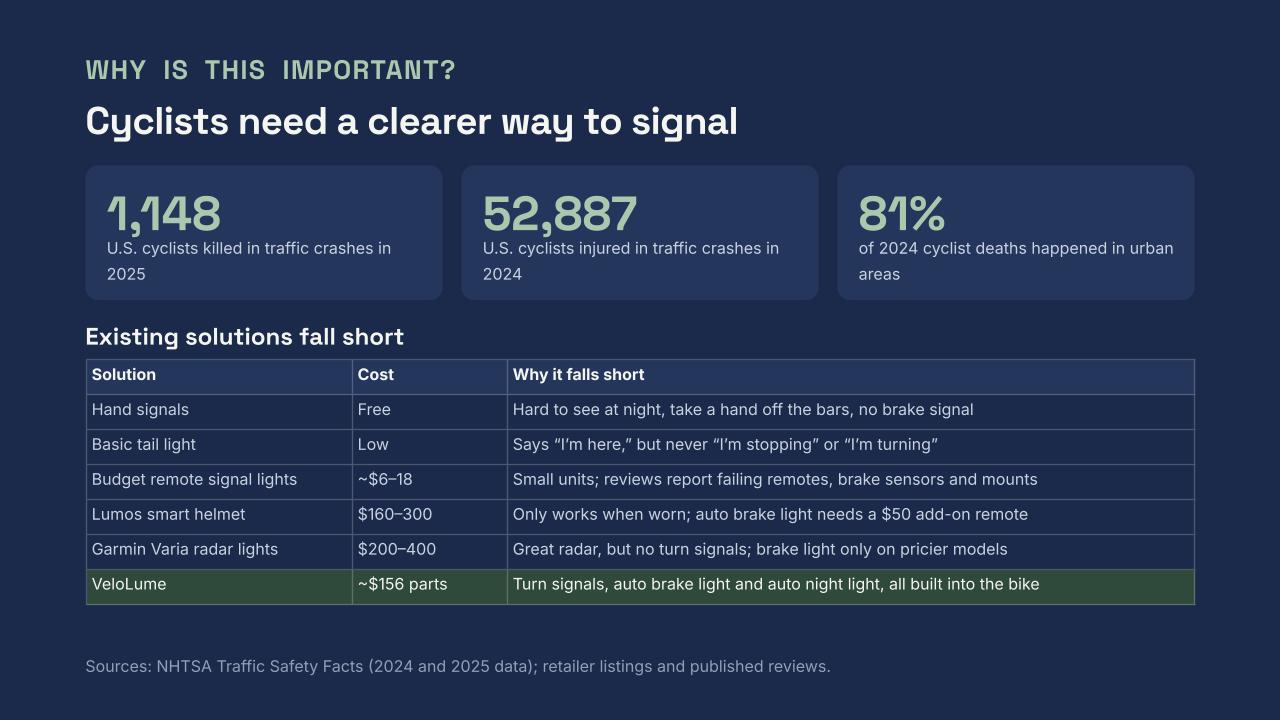
Riding around Penn's campus and Philadelphia, we noticed how often drivers have no idea what a cyclist is about to do. Hand signals are hard to see at night and mean taking a hand off the handlebars, and most bike lights only say "I'm here," not "I'm stopping" or "I'm turning." Cars solved this decades ago with brake lights and turn signals, so we asked: why don't bikes have them too? Existing options were either expensive (smart helmets and radar lights cost $160–$400) or cheap remote lights with poor reliability, so we set out to build something affordable that lives on the bike itself.
What it does
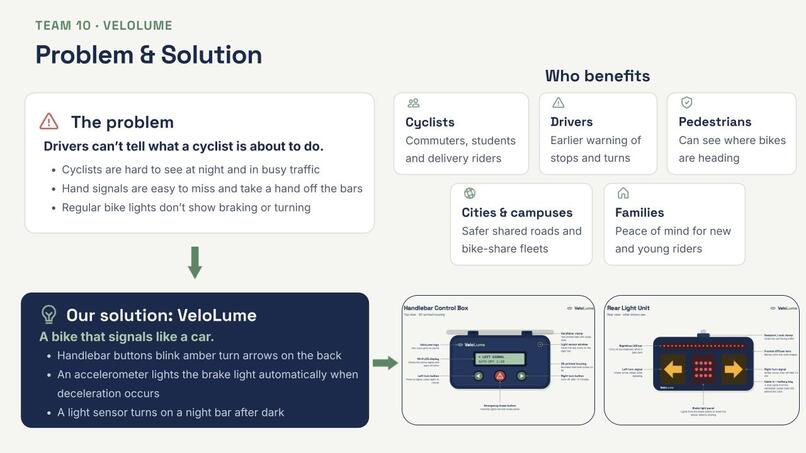
VeloLume has two parts. A 3D-printed handlebar box holds an Arduino, three buttons (left, right, emergency brake), a 16×2 LCD, an accelerometer/gyroscope and a light sensor. A rear light unit shows amber turn arrows, a red brake light and a nighttime LED bar. Turn signals blink until you press again or 1.5 minutes pass, the brake light comes on automatically when the accelerometer detects you slowing down (or the emergency brake button is pressed), and the night bar turns on by itself when it gets dark.
How we will build it
- Electronics: An Arduino Nano Every reads the three buttons, an MPU-6050 accelerometer over I2C, and a photoresistor on an analog pin. The same I2C bus drives the LCD.
- Lighting: The rear unit uses WS2812B addressable LEDs (three 8×8 panels plus a strip) chained on a single data line, so one wire controls every light and the code decides which sections turn on.
- Wiring: Just three wires (5 V, ground, data) run along the frame from the handlebar box to the rear unit on the bike chassis, with a USB power bank at the rear to keep the high-current LED wiring short.
- Build: We will prototype on a breadboard, then solder everything onto perfboard so it would survive vibration on the road, and will design 3D-printed housings for both units.
- Code: We used
millis()-based timing instead ofdelay()so the brake light can respond instantly even while a turn signal is blinking.
Challenges we may run into
- False brake triggers: Bumps and potholes look like sudden deceleration, so we have to filter the accelerometer data and tune a threshold.
- Power: 200+ LEDs at full brightness would draw over 10 A, so we need to cap brightness in code and move the battery next to the lights to avoid voltage drop.
- Vibration: Breadboard jumpers could come loose, which pushed us to a soldered perfboard for our components.
- Light sensor placement: The sensor has to face the sky and stay away from the LCD backlight and our own LEDs so it won't create a false reading.
Accomplishments that we're proud of
TBD
What we learned
TBD
What's next for ESE 1110, Team 10, VeloLume
- A wireless link between the handlebar box and the rear light, removing the cable entirely.
- Front-facing turn signals so oncoming traffic and pedestrians can see them too.
- Automatic turn-signal cancel using the gyroscope to detect when a turn is complete.
- A smaller, weatherproof custom PCB to replace the perfboard.
Built With
- accelerometer
- arduino
- buttons
- gyroscope
- lcd
- photoresistor
