-
-
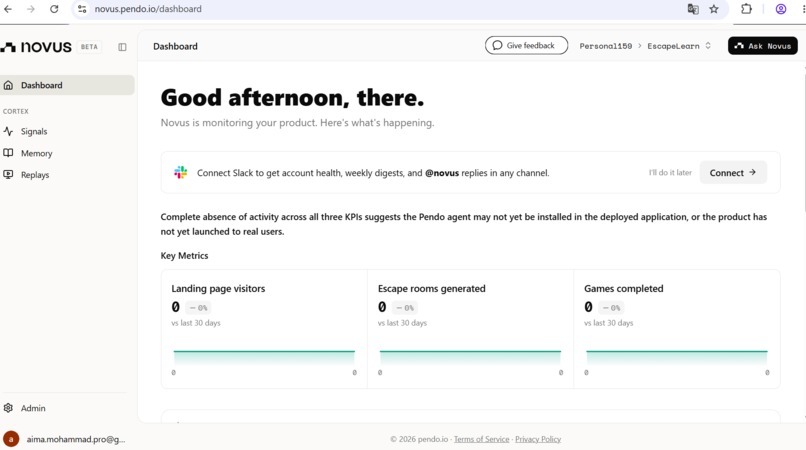
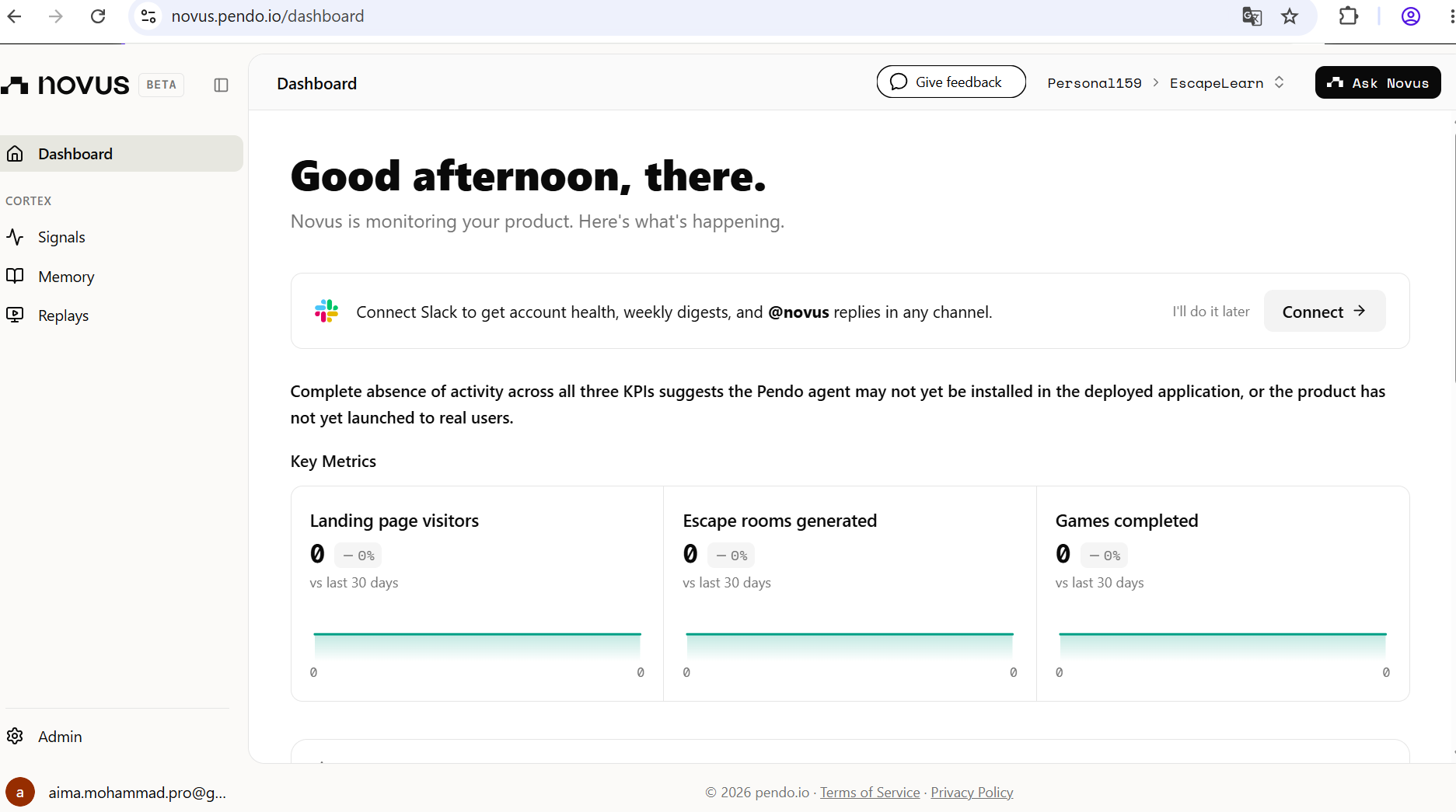
Novus dashboard
-
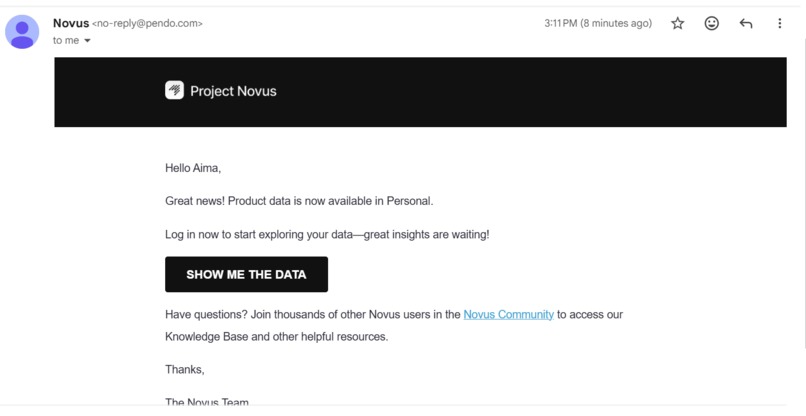
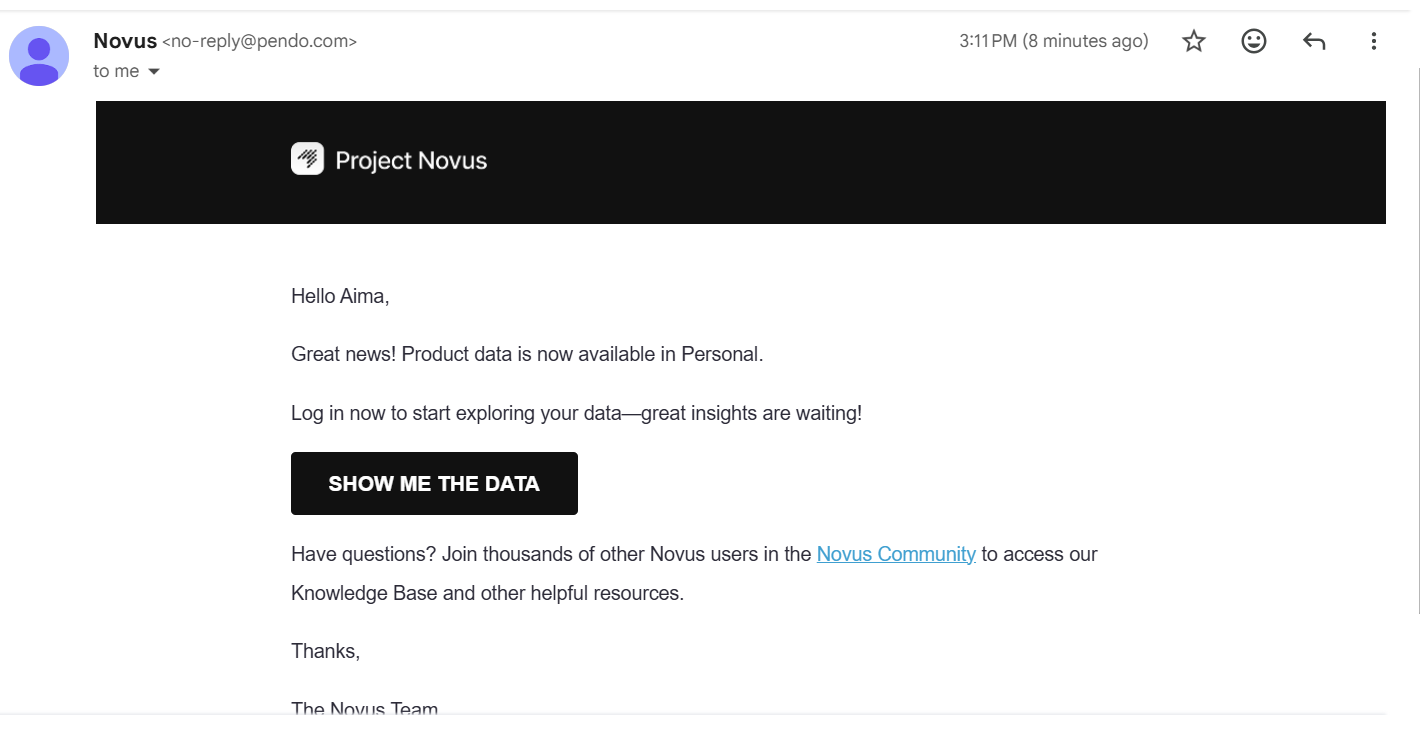
Novus confirmation installation
Inspiration
Every important moment in life begins with a PDF.
Your university lecture.
Your employment contract.
The legal case you're defending tomorrow.
The research paper behind your next startup.
The strategy deck your manager sends an hour before the meeting.
The problem isn't that PDFs contain bad information.
The problem is that they're terrible at helping humans understand it.
For thirty years, we've accepted the document as the default interface for knowledge: passive, linear and forgettable.
Meanwhile, games solved engagement decades ago. In fact, learning is maximized by Games, as suggest neuroscience studies PubMed paper.
Games reward progress.
They demand understanding.
They make people want to continue.
So I asked myself:
What if every important document became an experience instead of something you scroll through?
That's how EscapeLearn was born.
EscapeLearn reimagines the PDF as something you don't read.
You adventure in it.
What it does
EscapeLearn turns any PDF into an interactive escape room in seconds.
Upload a lecture. A legal brief. A compliance handbook. A research paper. A product specification. An investor memo.
The AI doesn't summarize it: it transforms it into puzzles that force understanding.
Instead of scrolling through 80 pages hoping something sticks, you unlock doors by connecting ideas, reconstruct timelines, solving cause-and-effect chains, deciphering evidence, and applying concepts.
When you finish, you don't just know you completed it.
You know exactly what you understood, what you missed, and how much you improved.
Some use cases :
- University — replace lectures with experiences students actually remember. a) Before a lecture — a 5-minute room as a wake-up call. Students walk in curious and competitive, primed to actually listen. b) After a lecture — the class ends on an adventure instead of a slide, while the material is still fresh. c) As homework — professors assign a room instead of a worksheet. A dashboard shows who finished, who didn't, and exactly which concept the class is struggling with, live, not three weeks later on an exam. d) At university scale — administrators get visibility into comprehension gaps across entire courses, not just one classroom.
- Corporate — turn compliance, onboarding of new hires, SOPs and security training into something employees finish instead of skip.
- Managers — upload the 60-page strategy deck your team receives one hour before the meeting.
- Lawyers — turn a litigation file into an investigation where every clue matters.
- Consultants — master a client's industry before the kickoff call.
- Medical professionals — learn new treatment guidelines through interactive cases.
- Parents — transform tonight's homework into tonight's adventure.
- Anyone — if it lives inside a PDF, it shouldn't feel like homework.
Students, professors, universities, study groups, onboarding teams, corporate meeting preparation, etc : anywhere a PDF currently goes to die, EscapeLearn gives it a pulse.
How I built it
Built on Lovable, with Supabase handling auth, database, and row-level security.
Claude does the heavy lifting twice: it reads the parsed PDF and generates the full escape room, narrative, concepts, and structured game data mapped to one of four mechanics, then it evaluates whether a student's answer shows real understanding, not keyword matching.
Framer Motion makes every room feel physical: door unlocks, lever pulls, particle bursts on success, shake feedback on failure.
Novus.ai is wired through the entire funnel, upload to completion, giving me a live, code-aware view of exactly where students drop off and which mechanics actually drive comprehension. The same data a university would kill for.
Challenges I ran into
The real fight wasn't the AI, it was refusing to ship another quiz with a UI skin. My first version had students typing free-text answers. Even evaluated intelligently, it still felt like homework. The breakthrough was forcing every concept into a physical game mechanic instead of a question, rebuilding the entire data structure the AI generates, not just the visuals.
Getting Claude to reliably pick the right mechanic per concept, and generate puzzles that were fair and solvable, took real iteration, an ambiguous circuit or a guessable safe code breaks the whole illusion instantly.
I also had to make room creation effortless for a professor who's never touched a tool like this: upload, wait seconds, get a code. Any more friction, and it never reaches a real classroom.
Accomplishments that I'm proud of
EscapeLearn isn't another an edtech hackathon project. EscapeLearn isn't building a better quiz.
EscapeLearn is redefining how people interact with knowledge across education, work, and everyday life.
I genuiely believe the next interface for knowledge isn't another PDF viewer or AI summary.
It's an experience.
The crucial need of EscapeLearn in today's context :
AI has made information abundant and instantly accessible. That's a remarkable shift. But access isn't understanding, and understanding still requires curiosity, attention, and effort. As information becomes cheaper, the ability, and the desire, to truly learn becomes more valuable than ever.
And I believe everyone should be a lifelong learner. But that only happens when learning stops being something we endure and becomes something we seek. Not because it's easier, but because the process of figuring things out becomes rewarding.
EscapeLearn is built around a simple belief: effort shouldn't be the enemy of learning. It should be the most enjoyable part.
The goal isn't to make learning effortless.
It's to make putting in the effort feel worth it.
To make understanding something people genuinely want to chase.
What I learned
The biggest lesson wasn't technical.
It was psychological.
People rarely avoid difficult challenges.
They avoid experiences that don't reward progress.
Games solved this decades ago through continuous feedback, clear objectives and visible achievement.
Documents still ask us to trust that all the effort will pay off later.
EscapeLearn brings those two worlds together.
Not by making learning easier.
By making progress impossible to ignore.
What's next for EscapeLearn
Today, EscapeLearn transforms PDFs into escape rooms.
Tomorrow, it will transform every kind of knowledge.
Support for diagrams, formulas and scientific notation will unlock STEM subjects.
Multiplayer rooms will let classrooms, colleagues and families solve challenges together.
Organizations will gain live visibility into understanding across entire teams instead of relying on end-of-course assessments.
Because the future of learning isn't reading more.
It's experiencing knowledge.
The goal was never to make studying feel like a game.
It's to make learning the thing people are a little addicted to, at university, at home, at any age, the sane kind of addiction that builds curious, lifelong learners who never stop wanting to understand the world a little better.
Built With
- claude
- lovable
- novus.ai
- react
- supabase
- typescript
- vite

Log in or sign up for Devpost to join the conversation.