Inspiration
Last summer, I struggled to find affordable, personalized entertainment for my niece’s birthday party—commercial escape rooms were pricey, and generic party games felt flat. I thought: what if anyone could build a tailored escape room at home, with minimal effort? That spark led to Escape Room Builder: a tool to make immersive, DIY escape rooms accessible to everyone.
What it does
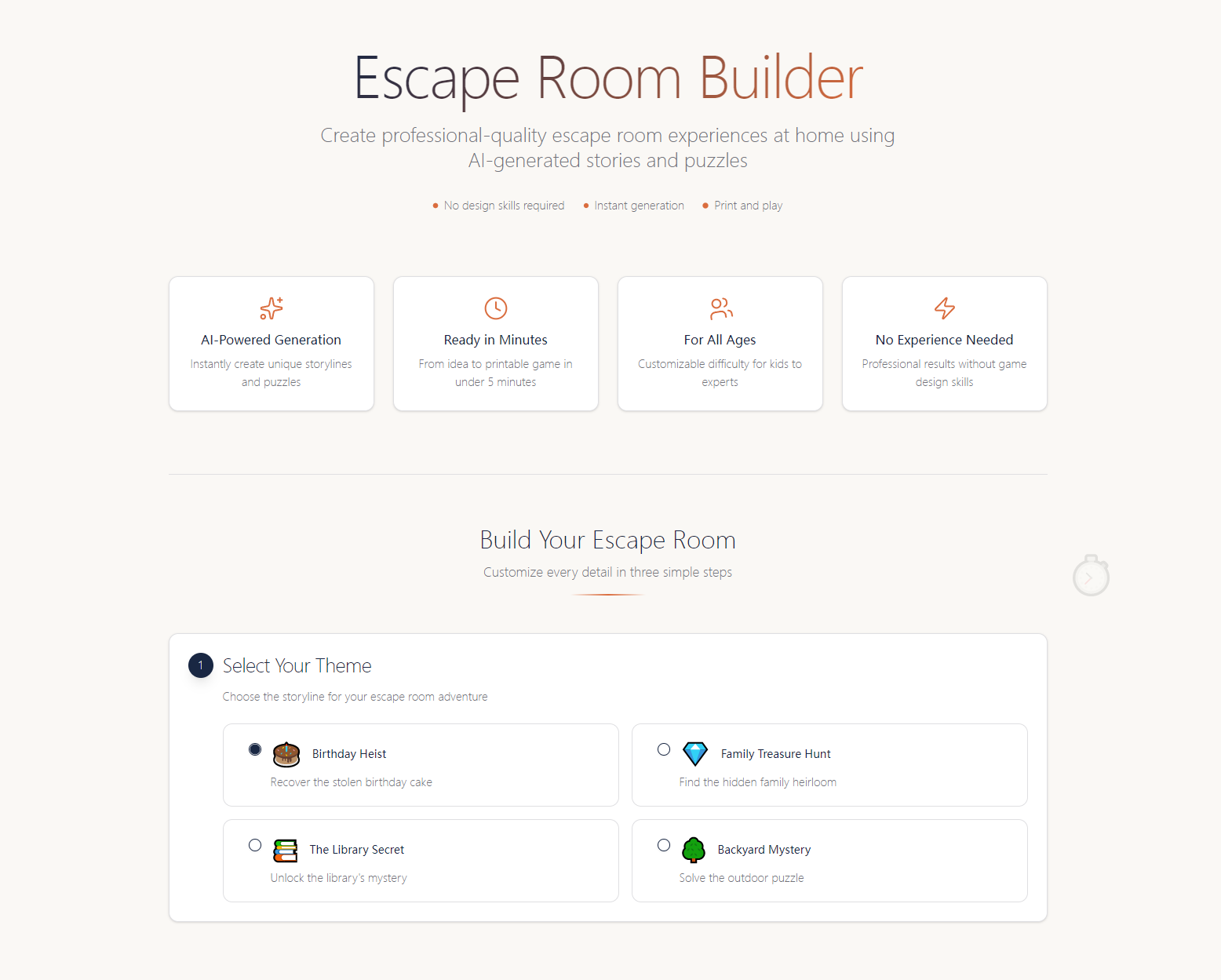
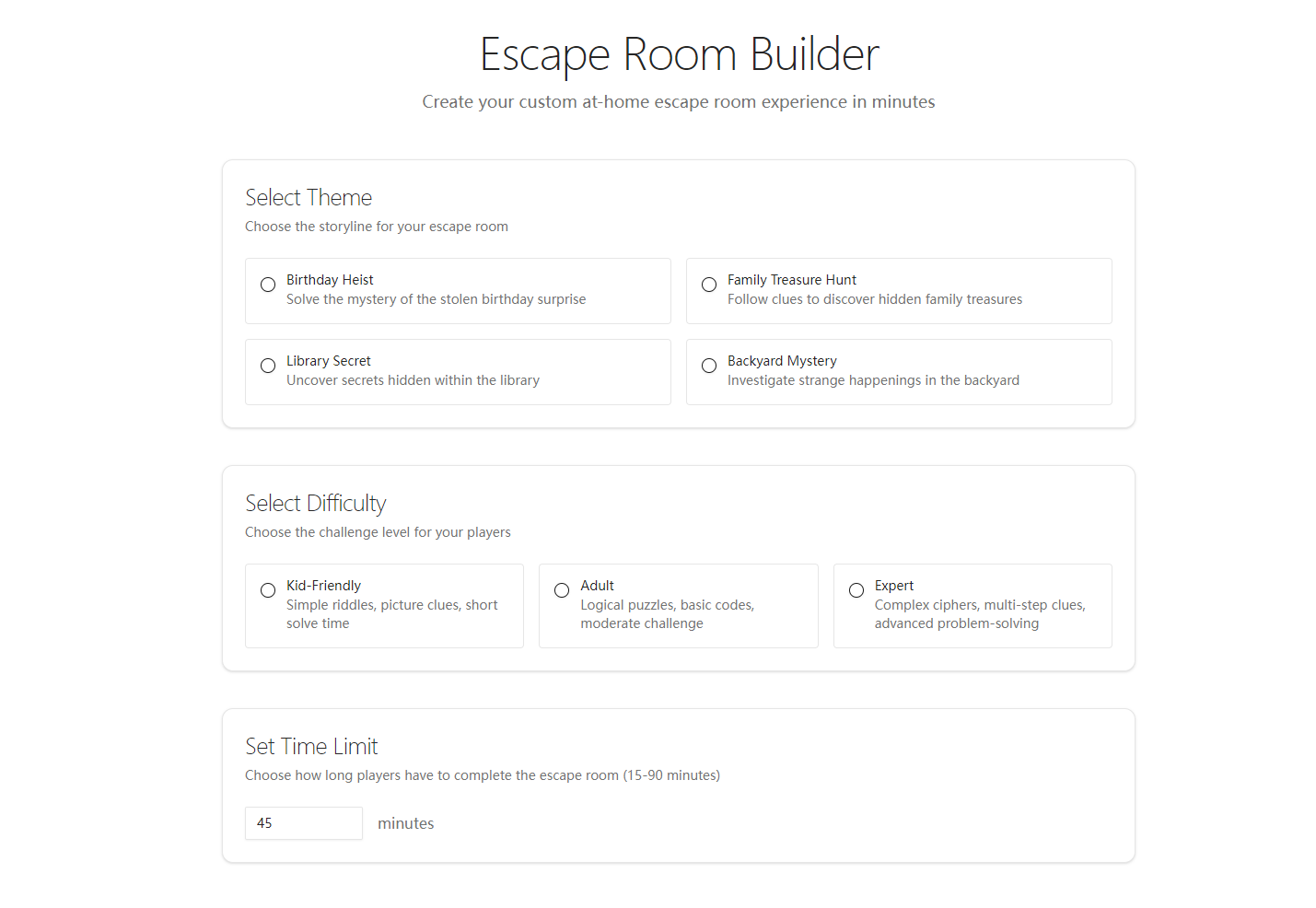
Escape Room Builder lets users pick a theme (Birthday Heist, Family Treasure Hunt, etc.), difficulty (Kid-Friendly to Expert), and time limit (15-90 mins). With one click, AI generates a full escape room package—storyline, puzzles, printable clues/props, and a setup guide. It also includes a game timer with extensions and PDF export for physical prep.
How we built it
We started with core web tech (React/Node.js) for the UI and backend. Integrated OpenAI API to power content generation, mapping difficulty rules to AI prompts (e.g., simple riddles for kids, complex ciphers for experts). We used PDFKit to optimize printable materials for US letter paper and built custom timer logic with React’s state management. The UI was designed for simplicity, with clear navigation between dashboard, story/puzzle display, print preview, and subscription pages.
Challenges we ran into
The biggest hurdle was aligning AI-generated content with difficulty rules—ensuring Kid-Friendly puzzles stayed simple (no complex ciphers!) and Expert content was challenging but solvable. We also struggled with PDF export consistency across browsers, and validating time limit inputs (blocking values outside 15-90 mins) required robust error-handling.
Accomplishments that we're proud of
We created a seamless user flow: from theme selection to PDF export, no login required. The AI generates unique content every time (even on theme refresh) while keeping difficulty intact, and the printable materials are professional-grade—perfect for home use. Most importantly, beta testers loved how quick it was to build a full escape room (under 5 mins!).
What we learned
I mastered AI prompt engineering to tailor content to specific difficulty levels, and learned how to optimize PDF exports for real-world printing needs. I also gained insight into user-centric design—prioritizing simplicity for casual users (party planners, families) over complex features.
What's next for this project
First, we’ll add more themes (holiday-specific, like Halloween Haunt) and refine AI-generated puzzle variety. We plan to test regional paper size support (EU A4) for broader usability, and explore a lightweight mobile-responsive design. Long-term, we’ll expand the subscription tier to include collaborative game building for groups—making it even easier to plan shared fun.
Built With
- javascript
- node.js
- openai-api
- react

Log in or sign up for Devpost to join the conversation.