-
-
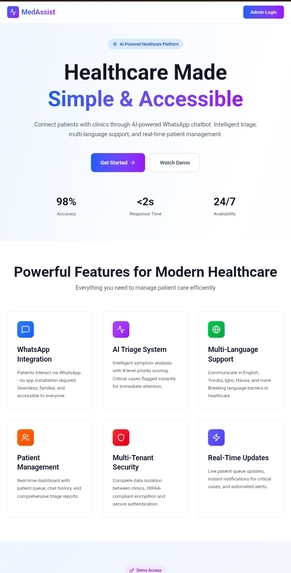
Dashboard
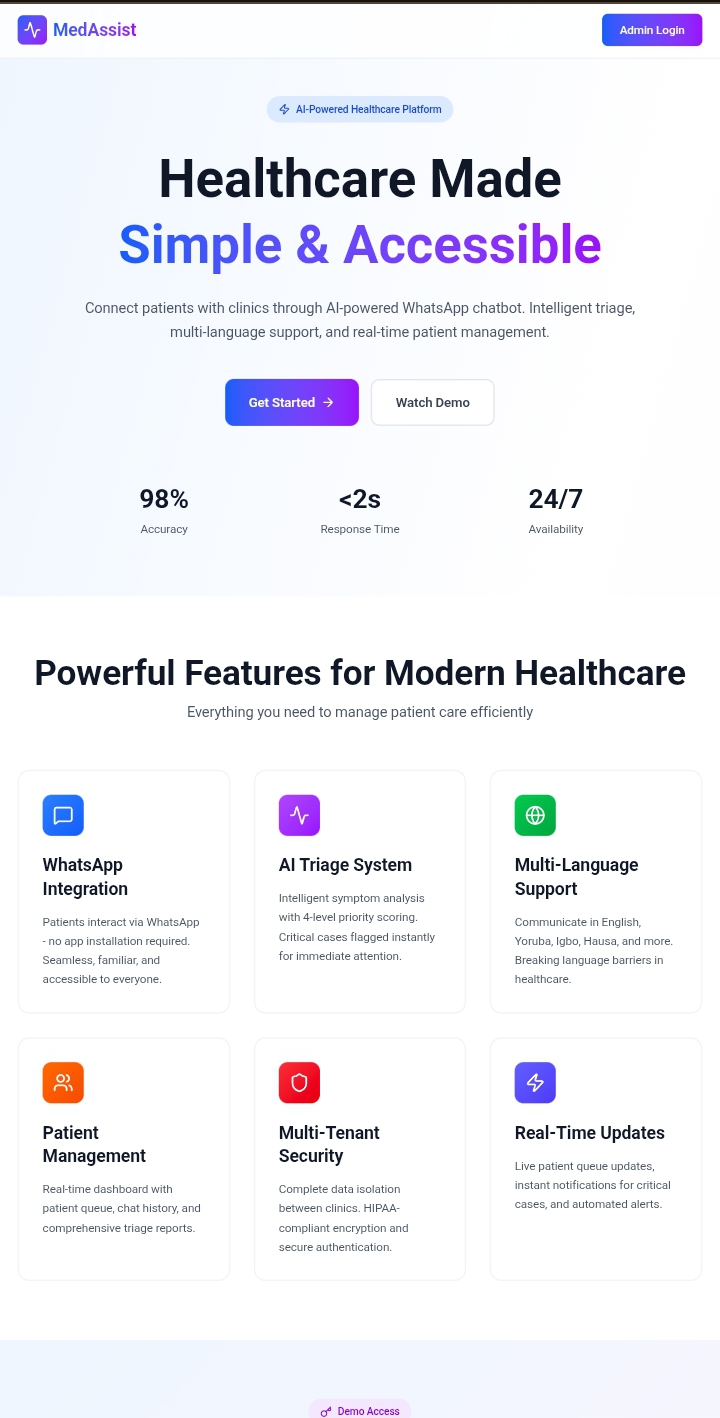
Inspiration
A friend of ours went to the hospital with an eye issue and, because of the queue, wasn't able to see a doctor in time. That moment made the problem real for us — it's not just "administrative inefficiency," it's someone in pain waiting behind a system that has no way to triage or communicate ahead of time. We wanted to build something that gives local clinics a way to manage that flow before it costs someone their appointment.
What it does
MedAssist is an AI-powered assistant that automates patient communication, streamlines appointment management, and extracts actionable insights for local clinics, pharmacies, and hospitals. Instead of patient communication scattered across WhatsApp, phone calls, and email, MedAssist consolidates it into one AI-driven flow — handling routine questions, managing appointment scheduling and follow-ups, and surfacing patterns in patient complaints that staff would otherwise never have time to notice.
How we built it
The backend runs on Java Spring Boot, handling appointment scheduling, patient records, and clinic-facing logic. The AI layer runs separately in Python — a fine-tuned model handling patient-facing conversation and health-specific language understanding. The admin dashboard (used by clinic staff) is a TypeScript frontend. On the patient side, there's no app to download — patients interact entirely through a WhatsApp bot, since WhatsApp is already how most people in Nigeria communicate, which meant we could reach patients without adding any friction to adoption.
Challenges we ran into
The biggest challenge was fine-tuning the AI model to be health-specific — general-purpose language models don't reliably handle medical terminology, triage language, or the nuance of patient communication out of the box, so getting it to respond appropriately in a healthcare context took real iteration.
Accomplishments that we're proud of
We tested MedAssist with students at the University of Lagos, and they found it genuinely helpful — that real-world validation, even at small scale, means more to us than a demo that only works in isolation. We're now working on scaling it beyond that initial test group.
What we learned
That the hardest part of applying AI to healthcare isn't the model — it's making it trustworthy and specific enough for a domain where a vague or wrong answer has real consequences.
What's next for MedAssist
Scaling beyond our initial University of Lagos test group to real clinic partnerships, and continuing to refine the model's health-specific accuracy as we get more real-world usage data.
Built With
- appointment-scheduling
- chatbot
- fastapi
- fine-tuned-model
- groq
- healthcare
- healthtech
- java
- jwt
- machine-learning
- natural-language-processing
- openai
- patient-communication
- patient-management
- postgresql
- python
- render
- rest-api
- spring-boot
- spring-security
- twilio
- typescript
- whatsapp-api
- whatsapp-bot


Log in or sign up for Devpost to join the conversation.