Inspiration
Finding reliable information online is not just about searching for answers. It is about comparing evidence, identifying trustworthy sources, understanding conflicting claims, and recognizing what remains uncertain. ResearchPilot AI was created to make this process more structured and transparent.
What it does
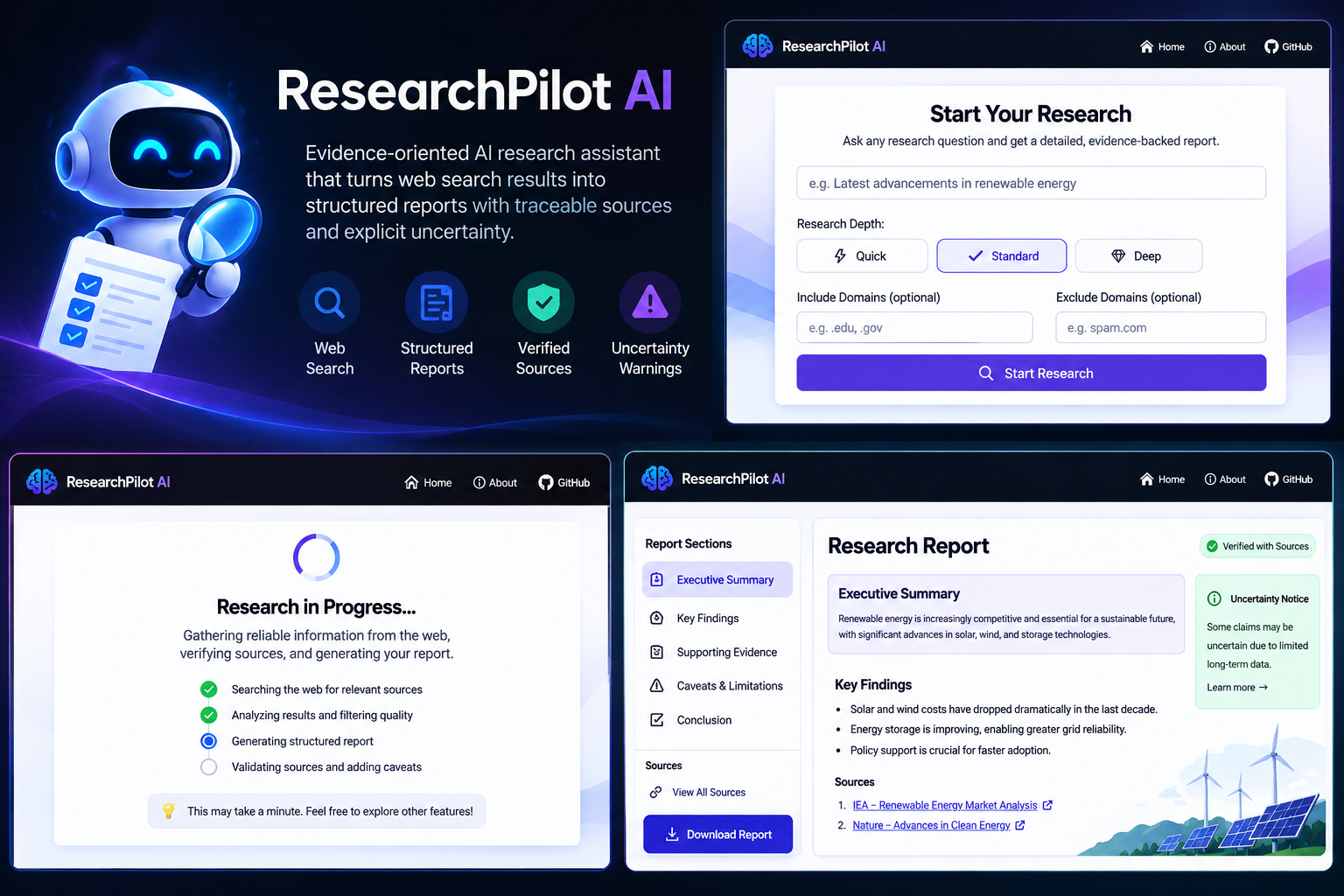
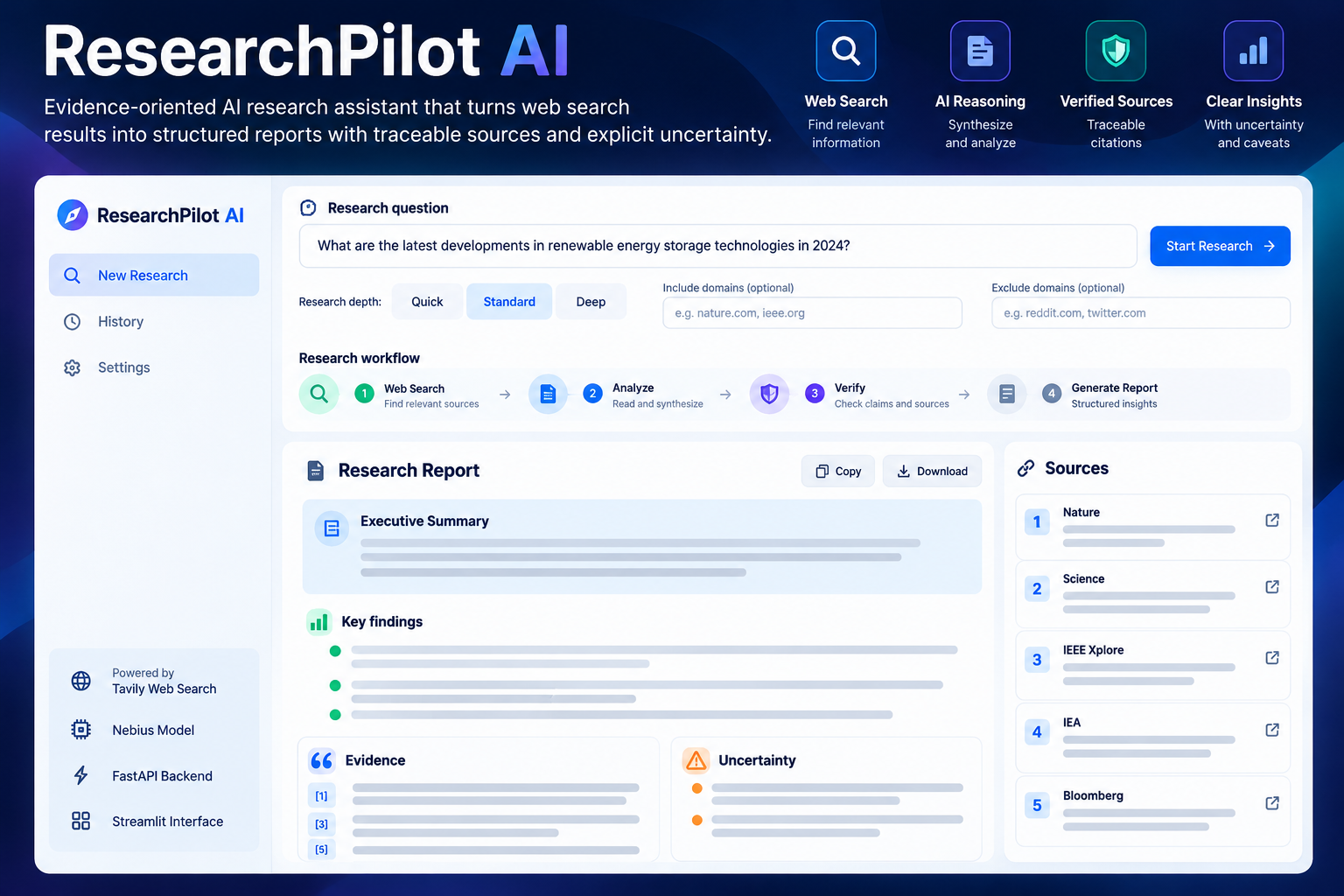
ResearchPilot AI is an AI-powered web research assistant that transforms a research question into a structured report supported by identifiable web sources.
Users can:
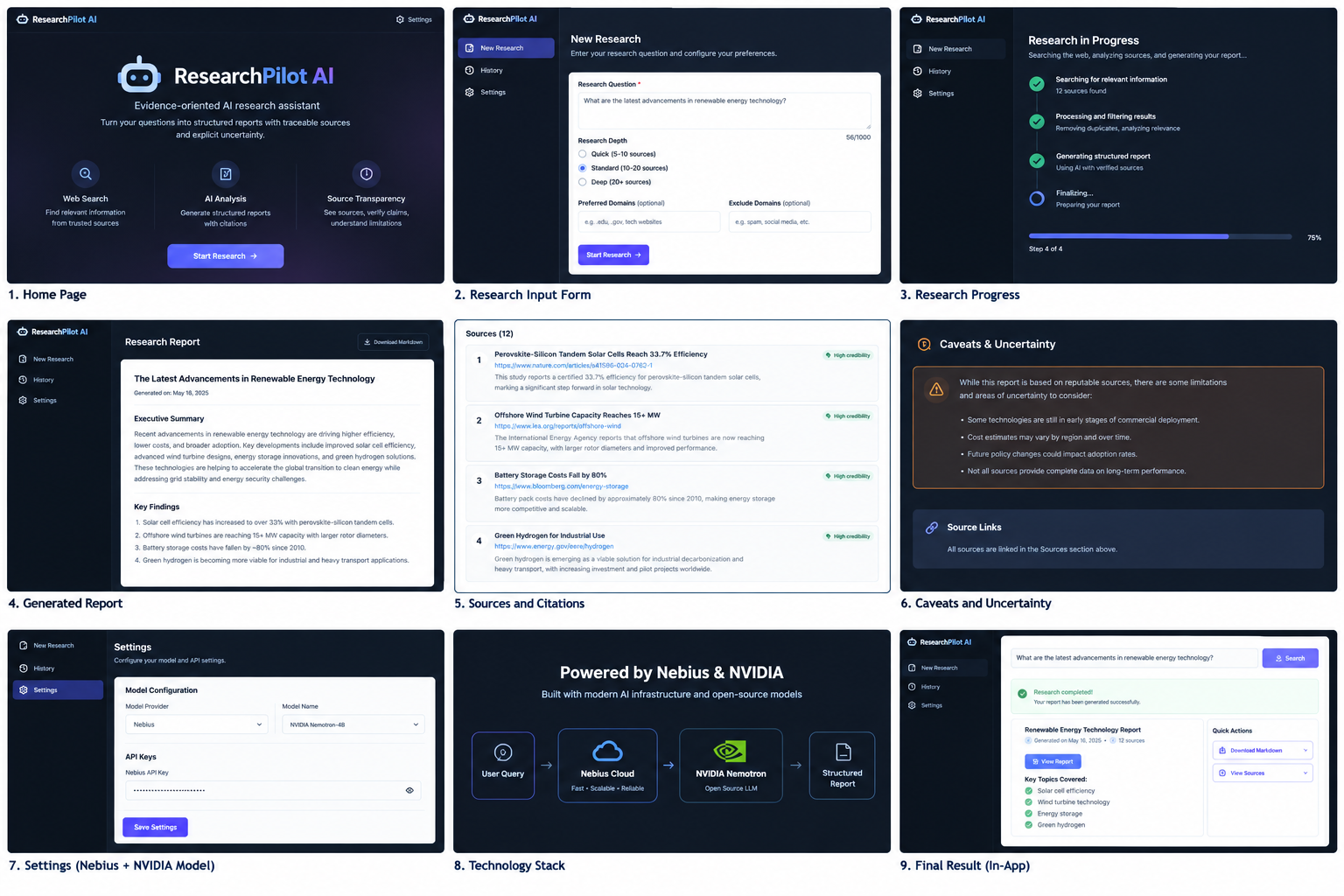
- Submit a research question through a simple web interface.
- Choose quick, standard, or deep research.
- Include preferred domains or exclude unwanted domains.
- Generate a structured Markdown report with an executive summary, key findings, supporting evidence, caveats, and a conclusion.
- Inspect linked sources and review uncertainty warnings.
- Download the generated report as a Markdown file.
How we built it
The project uses Streamlit for the user interface and FastAPI for the backend. Tavily provides web search results, while a configurable language model accessed through the Nebius API generates the research report.
The research pipeline gathers results, removes duplicate URLs, assigns source identifiers, and instructs the language model to use the supplied evidence rather than unsupported claims. A report-validation step checks source references and adds caveats where appropriate.
Challenges
A key challenge in research automation is producing useful summaries without presenting uncertain or unsupported claims as facts. ResearchPilot AI addresses this by connecting report claims to source identifiers, separating findings from uncertainty, and surfacing limitations in the available evidence.
Another challenge is making the research workflow configurable and accessible. The application provides adjustable research depth and domain filters through a straightforward interface.
What we learned
This project explores how web search, language models, structured prompting, and validation can work together to make AI-assisted research more transparent. It also highlights the importance of communicating evidence limitations rather than treating every generated answer as definitive.
Future improvements
Potential improvements include deeper source retrieval, stronger claim-level verification, richer evidence comparison, and deployment as a publicly accessible application.
Built With
- ai
- fastapi
- language
- large
- models
- nebius
- python
- streamlit
- token

