Inspiration
A student gets a corrected math test back, looks at it for ten seconds, checks the grade and puts it away. Yet that paper holds the most personal information of their whole schooling: the exact list of the mistakes they keep making. Not "revise fractions", but "you lost a sign while expanding — like last week, and like the test before".
Every AI study tool starts from the blank exercise and hands over the answer. None starts from the one artefact that already contains the diagnosis: the teacher's correction. So Errata flips the gesture — you don't photograph the exercise, you photograph the correction.
What it does
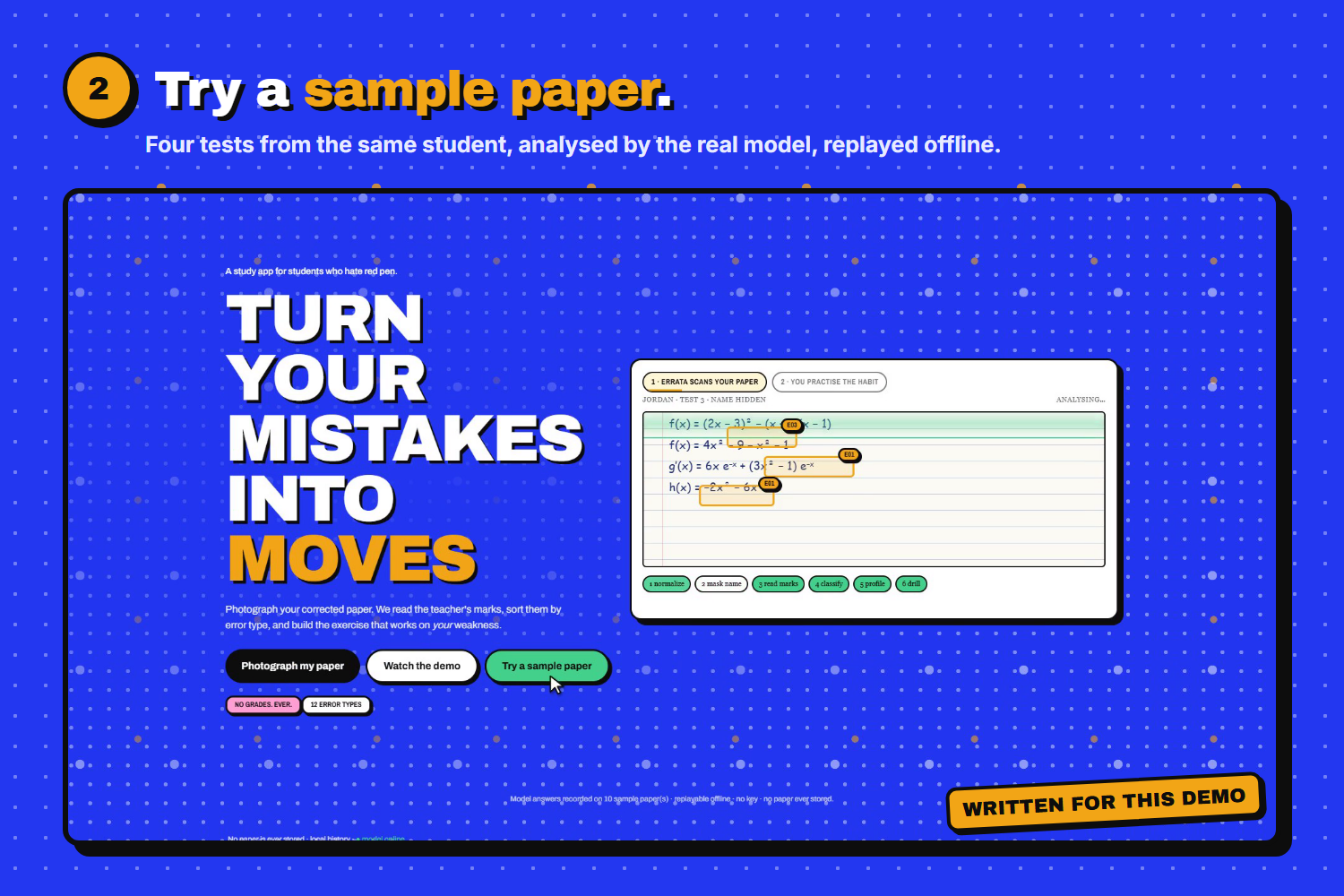
- Snap your corrected paper (or try a sample paper).
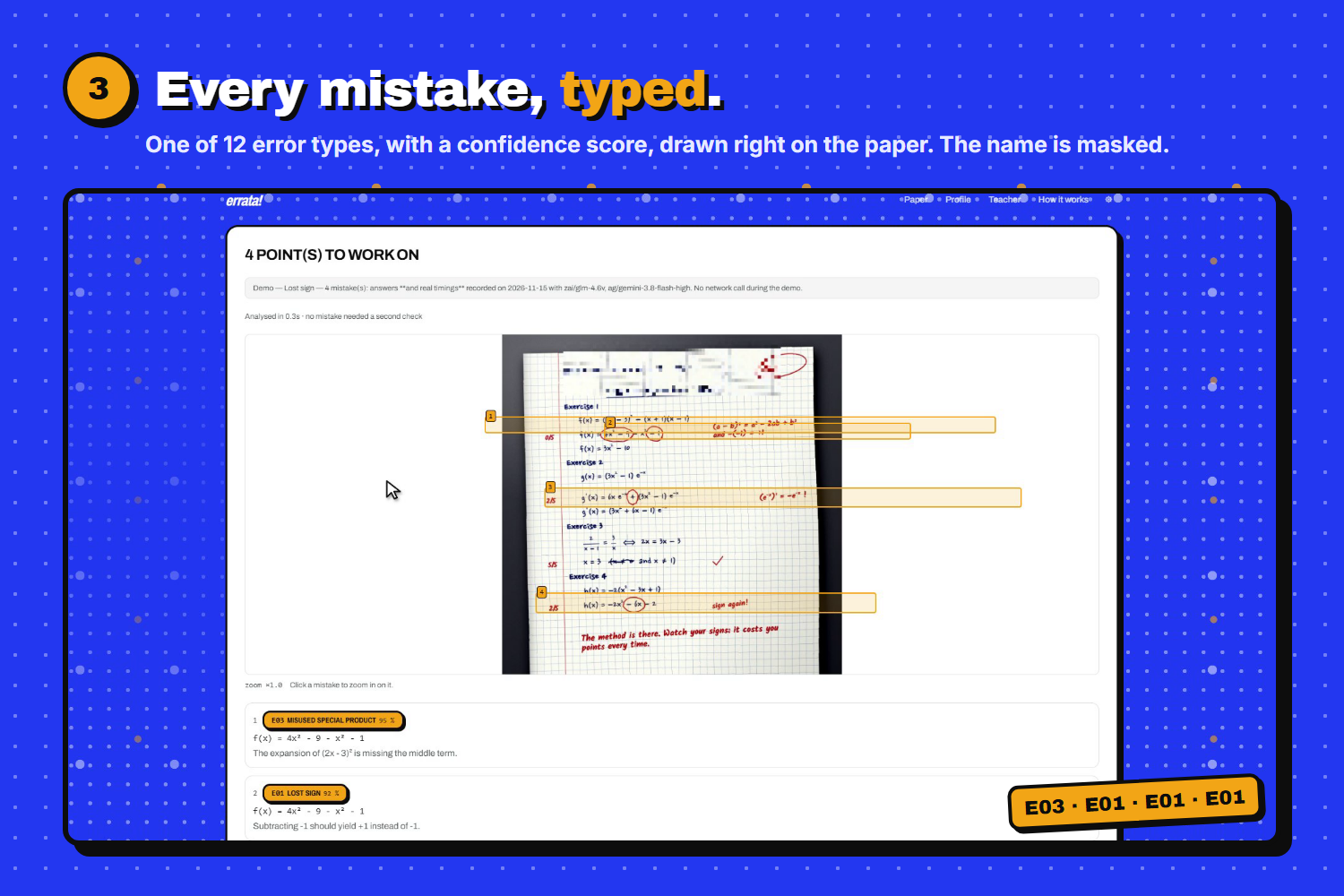
- Errata masks your name on the device, then a multimodal vision model reads the teacher's marks.
- Each mistake gets exactly one type from a closed list of 12 —
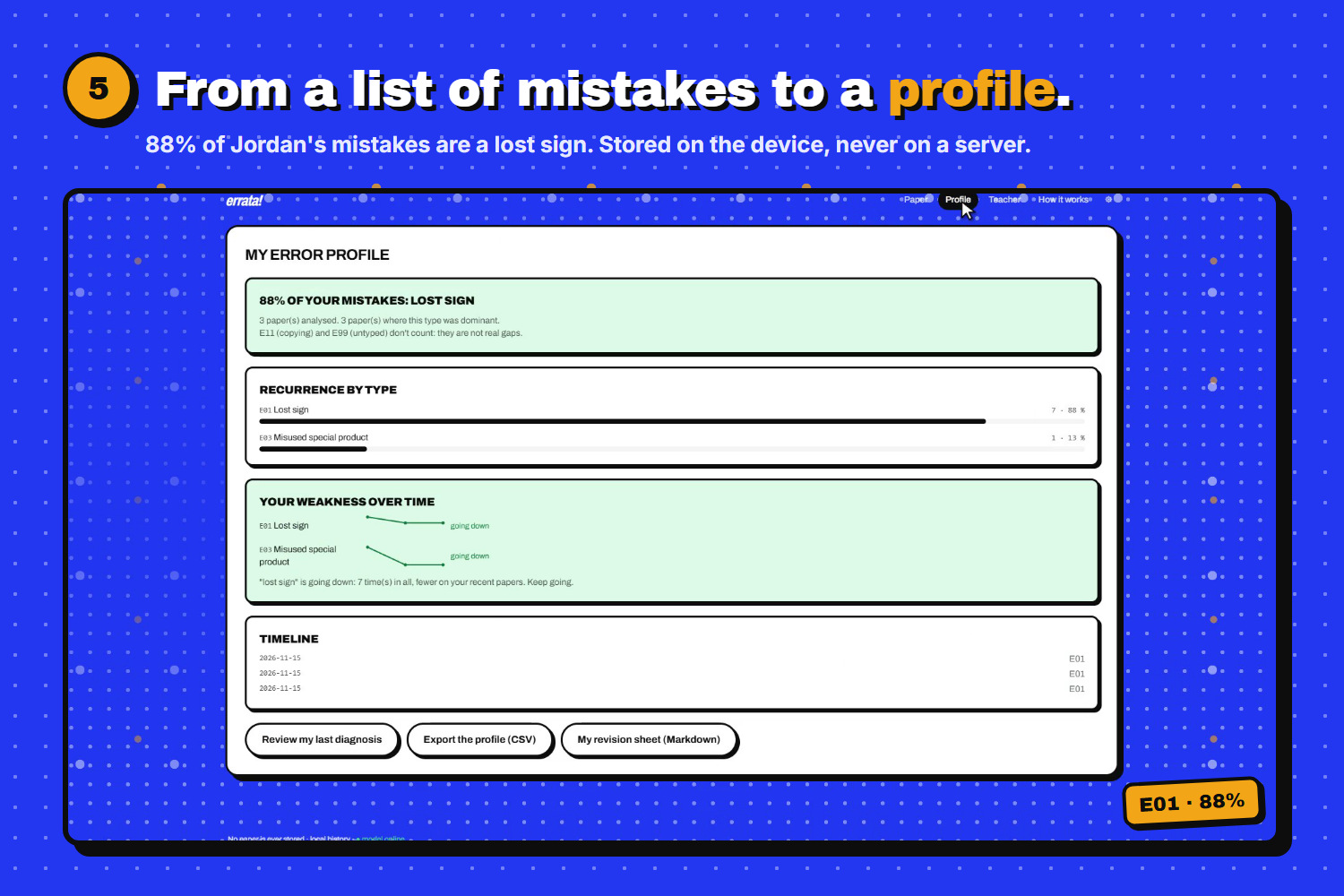
E01lost sign,E03misused special product,E06mishandled power… — with a confidence score. Below 0.6 it stays untyped and doesn't count. - After a few papers it's no longer a list of mistakes, it's a profile: "88% of your mistakes are a lost sign."
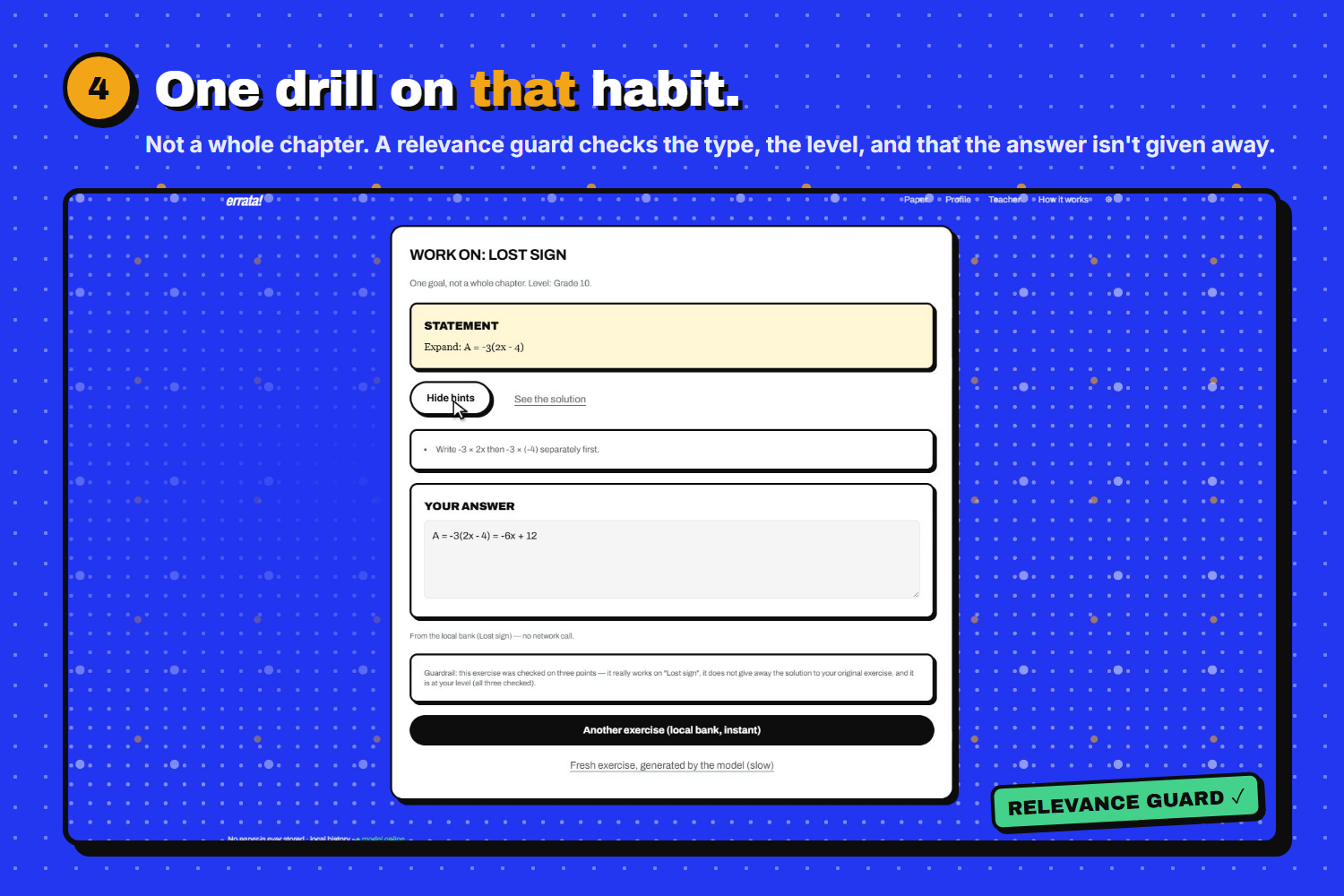
- You get one short drill on exactly that habit, checked by a relevance guard: it targets the right type, doesn't give the original answer away, and matches your level.
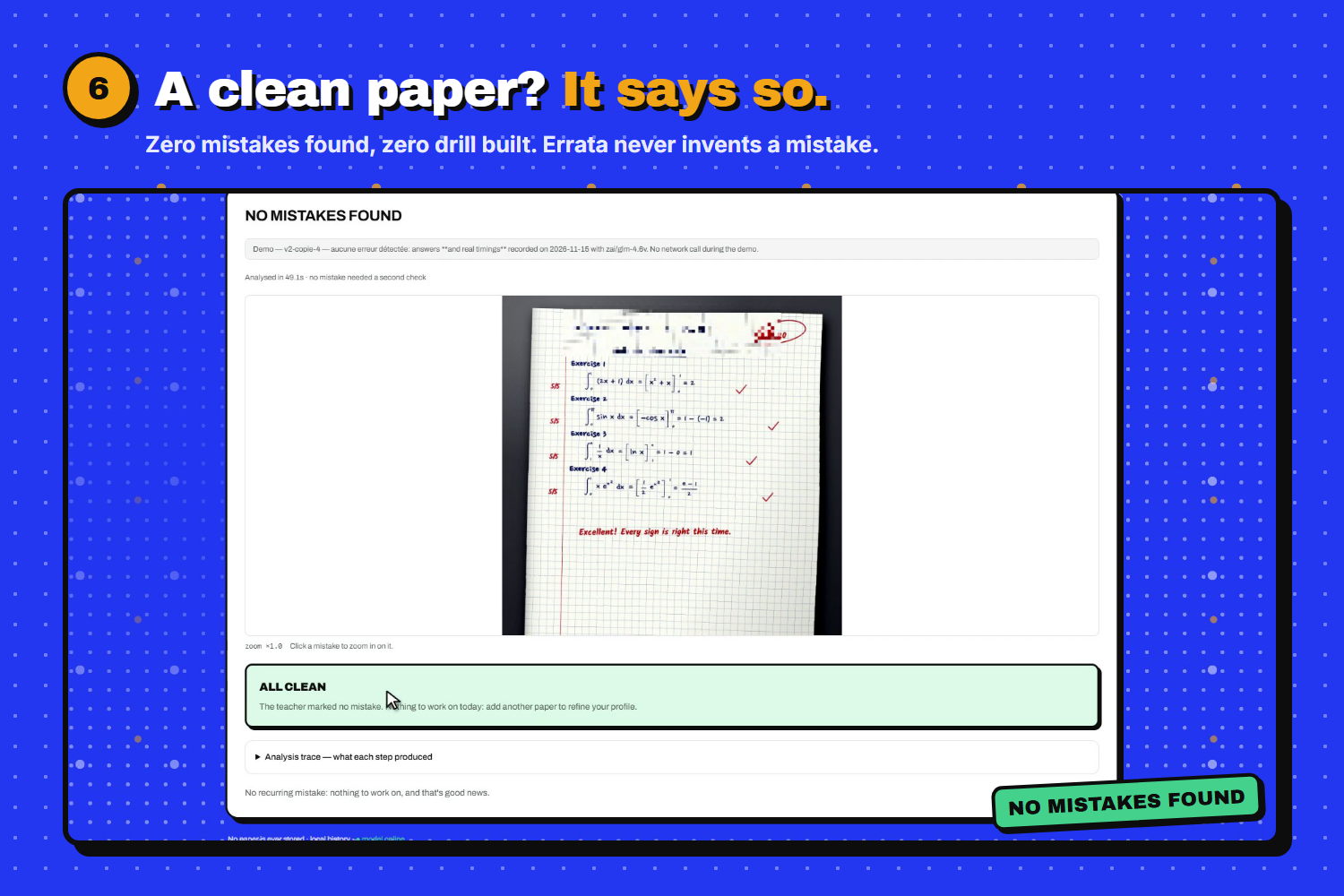
- A clean paper? Errata says "no mistakes found" and builds nothing. It never invents a mistake.
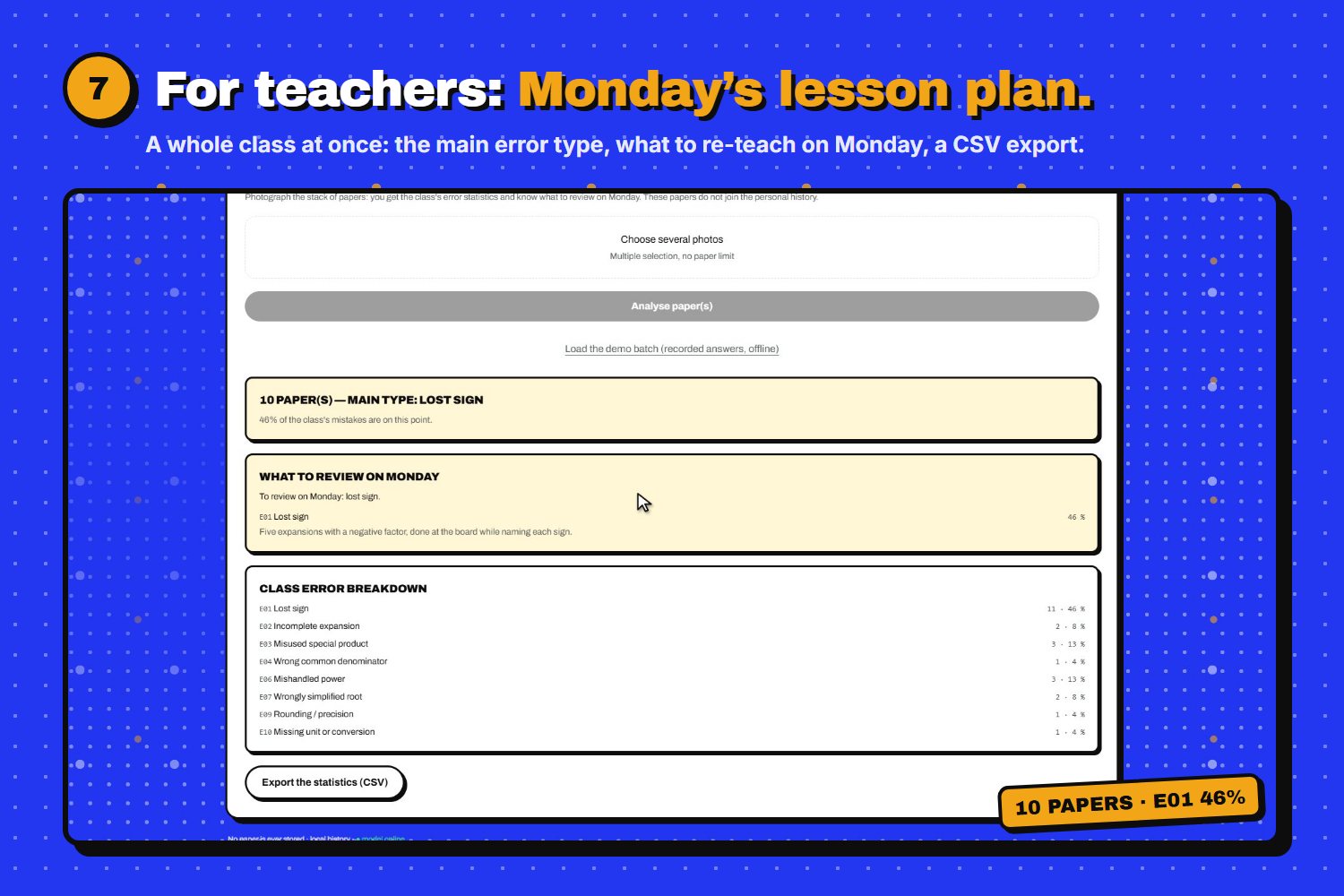
- Teacher view: a whole class at once — the main error type, what to re-teach on Monday, and a CSV export.
No grades, no red pen in the UI, no account, and no paper is ever stored: history stays on your device.
How we built it
- Front end: React + TypeScript + Vite + Tailwind, a bold "sticker" design system, deployed on GitHub Pages.
- AI pipeline (6 steps): normalise → mask name → read marks → classify → aggregate → generate. Steps 3 and 4 are merged into a single vision call to cut latency.
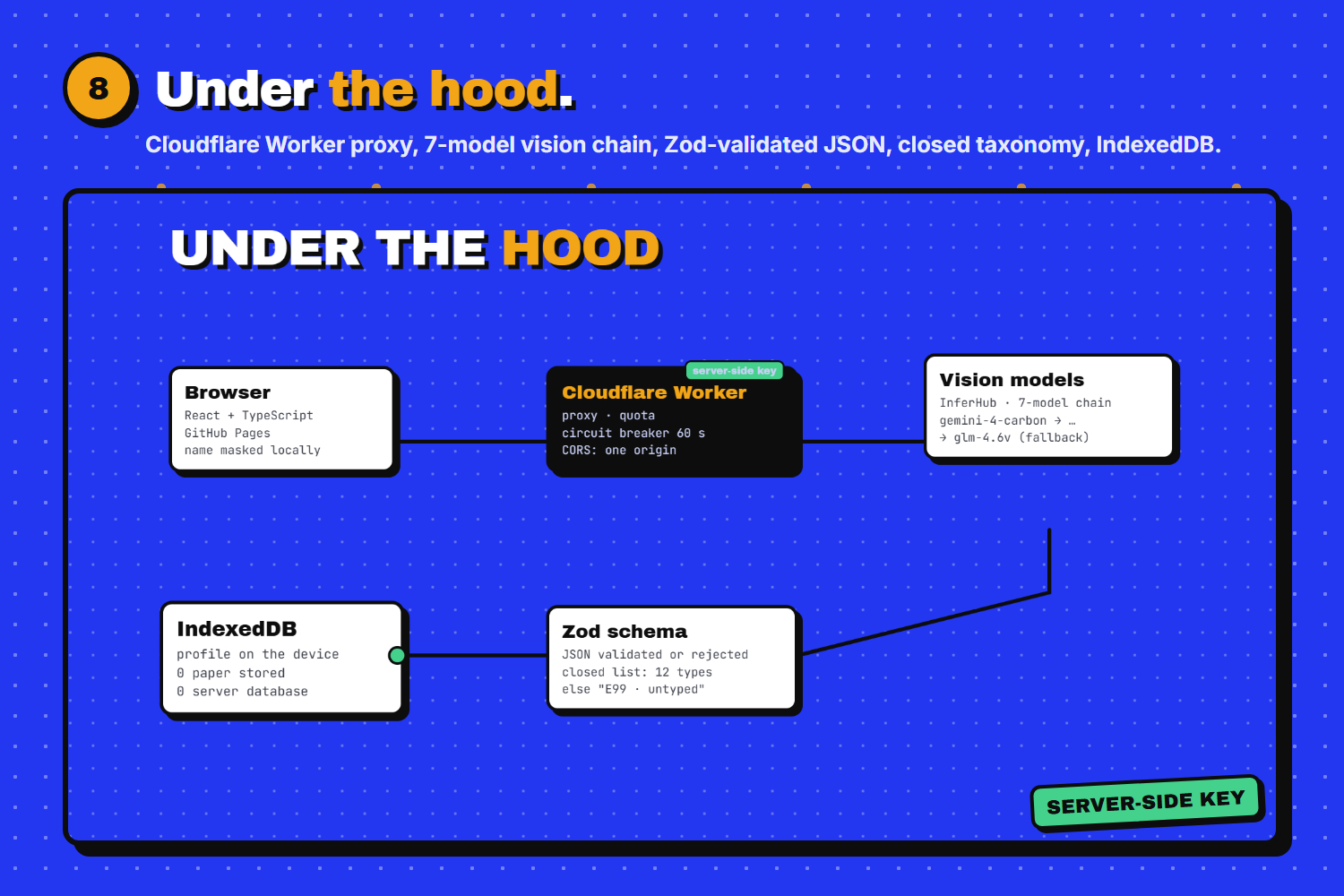
- Reliability: every model answer is validated against a Zod schema; the taxonomy is closed, so the model cannot invent a category.
- Edge proxy: a Cloudflare Worker keeps the API key server-side, caps the quota, falls back across a chain of 7 vision models and trips a 60-second circuit breaker. A BYOK mode takes over if the quota runs out.
- Privacy by design: the profile lives in IndexedDB, the proxy logs only timestamp, status and latency.
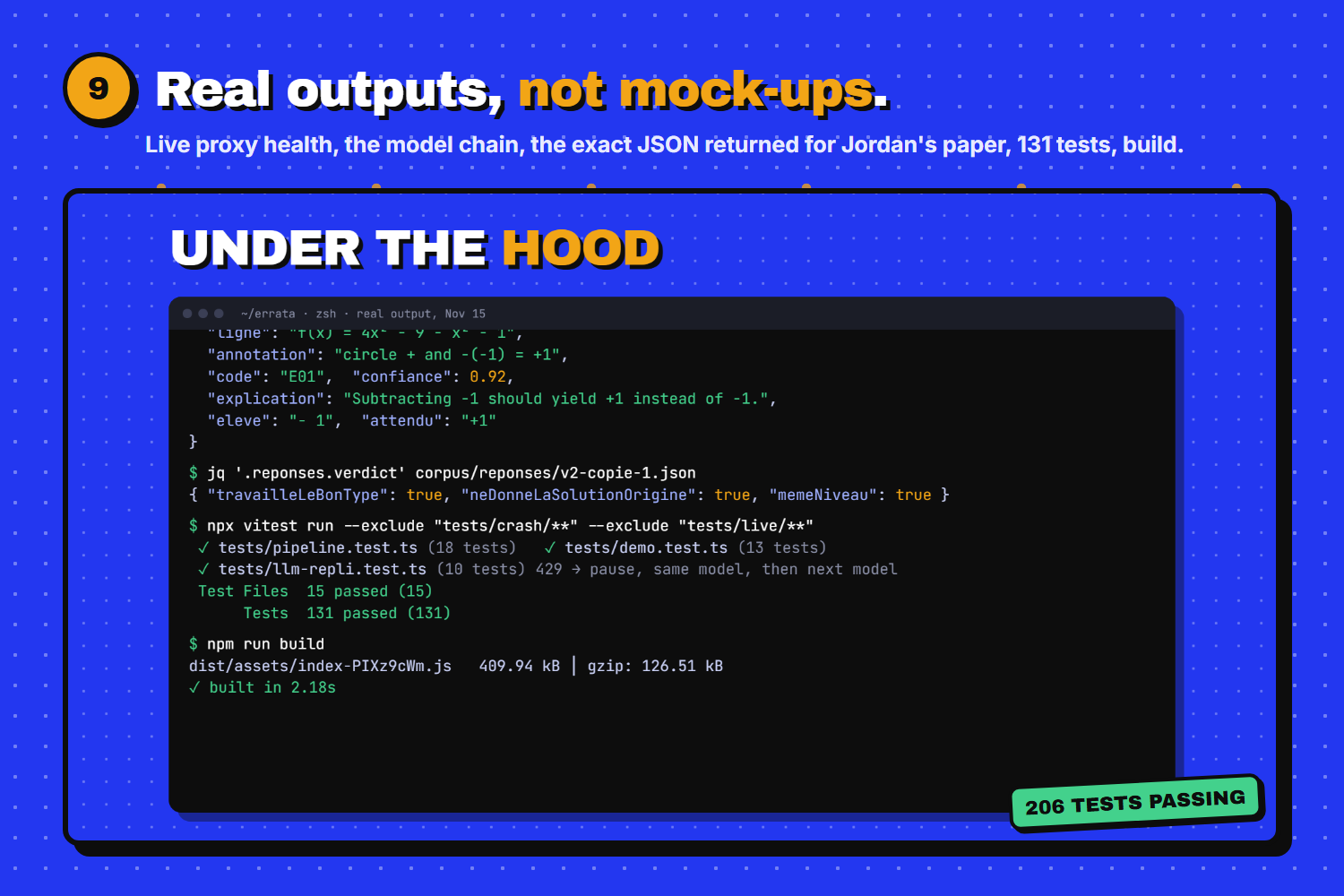
- Quality: 206 offline tests (Vitest), CI under 5 minutes on GitHub-hosted runners, merges through a Mergify queue.
- Offline demo: sample papers written for this demo were analysed by the real model; answers and real timings are recorded and replayed, so the demo keeps working even when the provider doesn't.
Challenges we ran into
- Handwriting: classic OCR was unusable on teachers' marks, so all reading goes through one multimodal call.
- Invented mistakes: the first prompt "found" errors on clean papers — the worst possible flaw for this product. Now "clean paper" is an expected answer and classification isn't even called (enforced by a test that forbids any network call).
- Over-confident model: 0.95 everywhere made the threshold useless → calibration instructions, and a 0.31 test case that must end up untyped.
- Off-topic drills: generation drifted to the general topic instead of the faulty gesture → the relevance guard, two attempts max, then an honest message.
- A saturated upstream: on the last day the whole vision marketplace answered
503for hours and the screen hung silently → a global time budget, progress messages naming each model tried, and a clear Try again. Fixed before the deadline: the proxy now leads with InferHub's virtualcombo/cheapmodel, which fails over between providers on its own. On the public site, a never-seen sample paper now goes photo → typed diagnosis in 12 to 44 seconds. If the upstream is ever saturated again, the app says so with a Try again button, and the sample papers keep working offline.
Accomplishments that we're proud of
- Zero false positives on clean papers, enforced by tests.
- A measurable diagnosis — a statistic, not a list of sentences.
- A UI that never adds red to a paper already covered in red: amber for the diagnosis, green for progress.
- A ~127 KB gzip bundle, a static site, and a demo that works offline.
- Live analysis works end to end on the public site: photo → masked name → typed mistakes → targeted drill, with no key for the user.
What we learned
A diagnosis is only worth something if it's stable: the same paper analysed twice must give the same type. The closed taxonomy and the confidence threshold aren't technical constraints — they are what lets a student trust their own profile.
The product doesn't sell AI, it sells recurrence. And honesty is a feature: saying "no mistakes found", showing confidence scores, and admitting "no exercise available for this type" earn more trust than any animation.
What's next for Errata
- Other subjects — the architecture is ready, the taxonomies (physics, then languages) are not.
- Teaching validation on a real class: does working on your dominant type improve the next test?
- LMS integration for the teacher export.
- A second vision provider, so one marketplace's outage never blocks a live analysis.
AI coding assistants were used during development and are declared in the repository (docs/DECLARATION-IA.md). The sample papers in the demo were written for the demo.
Built With
- cloudflare-workers
- github
- github-actions
- indexeddb
- inferhub
- react
- tailwindcss
- typescript
- vite
- vitest
- zod
