-
-
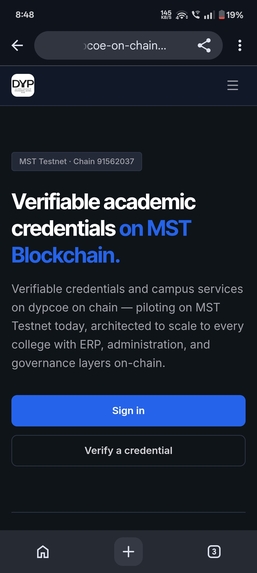
Mobile view
-
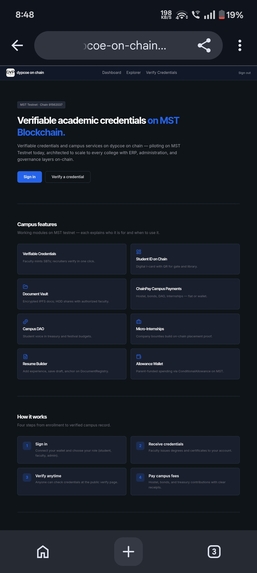
Desktop view
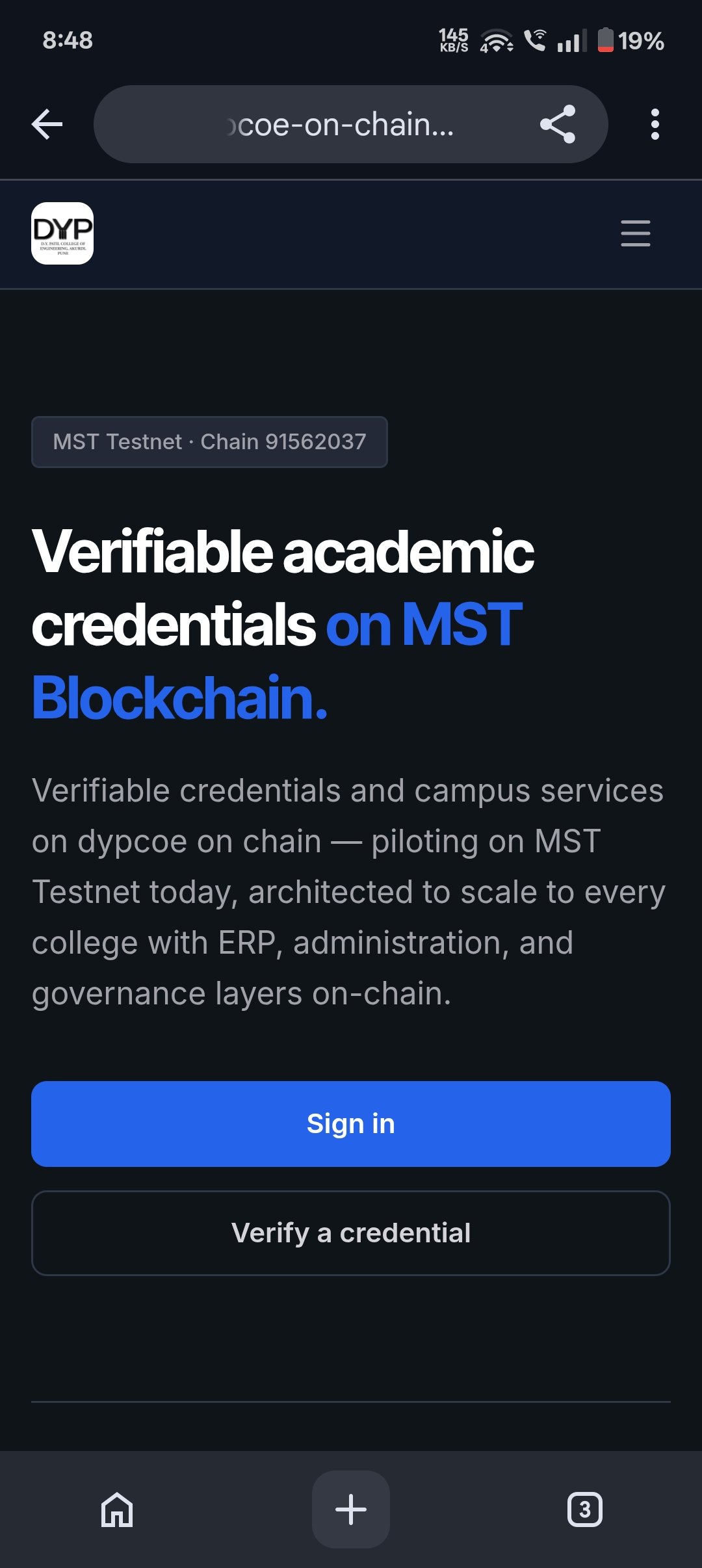
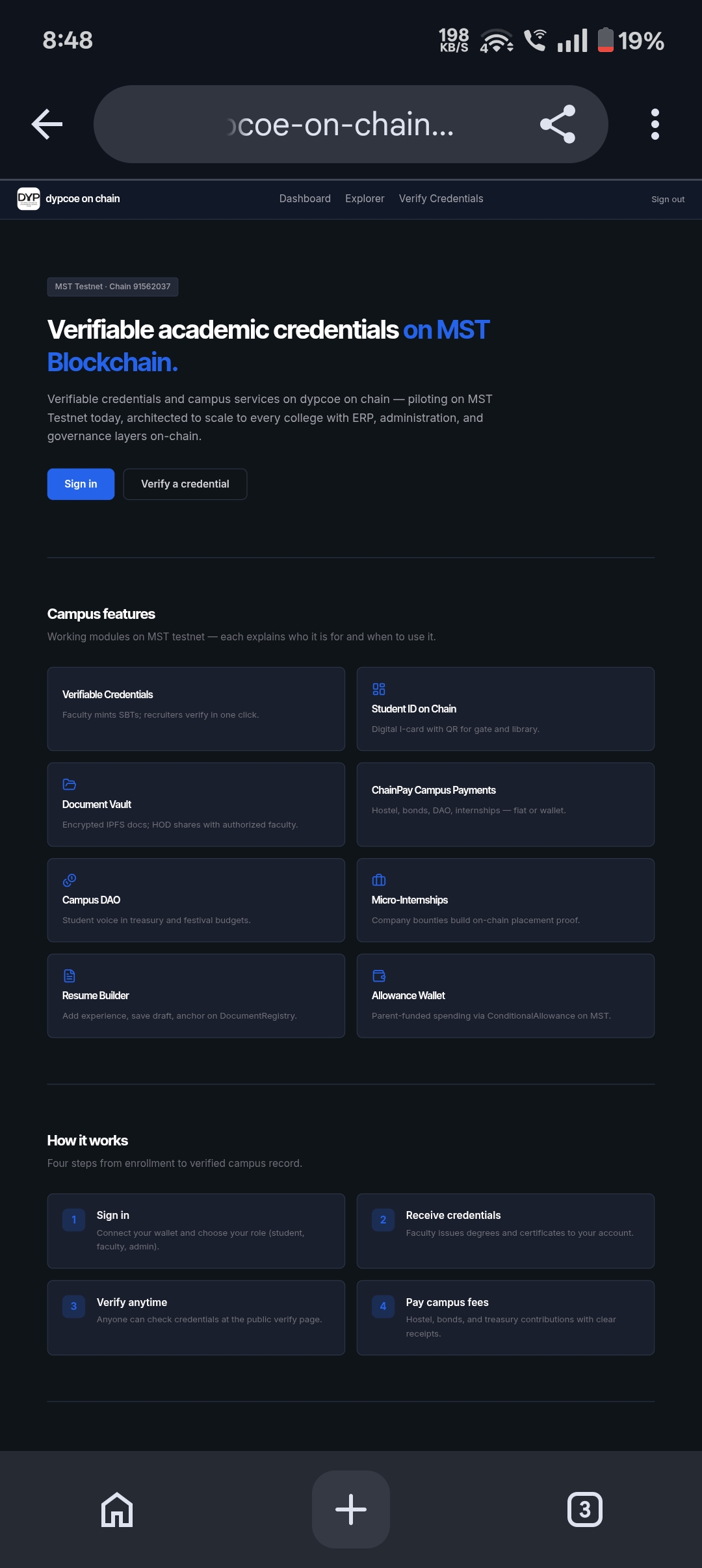
ERP On-Chain
Inspiration
Universities still depend on fragmented ERP systems, centralized databases, and manual verification processes to manage academic records. Verifying a degree often requires emails, phone calls, or institutional approval, making the process slow, expensive, and vulnerable to fraud.
We wanted to rethink educational infrastructure using Web3 principles. Instead of simply digitizing documents, we envisioned a trust layer where academic credentials are cryptographically verifiable, students own their identities, institutions retain issuance authority, and anyone can verify credentials without relying on intermediaries.
ERP On-Chain was inspired by this vision of building the next generation of campus infrastructure—where blockchain, AI, decentralized storage, and governance work together to create a secure, transparent, and future-ready academic ecosystem.
What it does
ERP On-Chain is an AI-powered Web3 Academic Operating System that modernizes higher education through decentralized identity, verifiable credentials, and transparent governance.
The platform enables institutions to:
- Issue tamper-proof academic credentials
- Verify documents publicly without institutional intervention
- Store encrypted academic records on IPFS
- Manage decentralized student identities using wallet authentication
- Anchor resumes, learning passports, and certificates on-chain
- Automate scholarship and campus finance workflows
- Support transparent campus governance using DAO-based voting
- Integrate AI-powered academic assistance and anti-plagiarism services
- Connect traditional ERP workflows with blockchain infrastructure
Rather than storing documents on-chain, ERP On-Chain stores cryptographic proofs on the blockchain while encrypted documents remain securely stored on IPFS, ensuring privacy without compromising verifiability.
How we built it
We designed ERP On-Chain as a four-layer architecture that separates user experience, business logic, decentralized storage, and blockchain infrastructure.
Frontend
- Next.js
- React
- TypeScript
- Tailwind CSS
- Wagmi
- RainbowKit
Backend
- NestJS
- PostgreSQL
- Prisma ORM
- Redis
- BullMQ
Blockchain
- Solidity
- OpenZeppelin Upgradeable Contracts
- MST Blockchain Testnet
- Ethers.js
Storage & Security
- IPFS
- Pinata
- SIWE Authentication
- SHA-256 Hashing
- AES-256 Client-side Encryption
- Role-Based Access Control
The document lifecycle follows a privacy-first workflow:
- Student signs in using SIWE.
- Document is hashed locally.
- File is encrypted in the browser.
- Encrypted file is uploaded to IPFS.
- Hash and CID are anchored on-chain.
- Blockchain events are indexed into PostgreSQL.
- Anyone can verify authenticity by recomputing the document hash.
Challenges we ran into
Building an enterprise-ready Web3 ERP introduced several technical and architectural challenges:
- Designing secure role-based issuance workflows for universities.
- Balancing decentralization with usability for non-crypto-native users.
- Integrating blockchain events with off-chain ERP systems.
- Building a reliable event indexer for synchronization.
- Optimizing smart contract deployments using upgradeable proxy architecture.
- Implementing secure client-side encryption while maintaining a smooth user experience.
- Managing decentralized identity without compromising institutional governance.
- Designing a platform that can scale from a single college to multiple universities.
Accomplishments that we're proud of
- Built a full-stack Web3 Academic Operating System from scratch.
- Deployed 70+ upgradeable smart contracts on the MST Blockchain Testnet.
- Designed a privacy-preserving document verification workflow using IPFS and blockchain.
- Implemented decentralized identity using SIWE wallet authentication.
- Developed public credential verification without requiring institutional login.
- Built DAO-based governance modules for campus administration.
- Integrated scholarship, finance, attendance, and academic workflows into a unified platform.
- Designed the platform with future support for W3C Verifiable Credentials and multi-campus deployments.
- Created a production-grade architecture that combines blockchain, AI, and enterprise ERP workflows.
What we learned
Throughout this project, we learned that successful enterprise blockchain applications require much more than smart contracts.
Real-world adoption depends on:
- Strong governance models
- Regulatory compliance
- Secure operational workflows
- User-friendly onboarding
- Scalable architecture
- Clear separation between private data and immutable blockchain proofs
We also learned that Web3 can significantly improve trust in higher education when integrated thoughtfully with existing institutional processes rather than attempting to replace them entirely.
What's next for ERP On-Chain
Our roadmap focuses on transforming ERP On-Chain into a globally interoperable academic infrastructure.
Upcoming milestones include:
- W3C Verifiable Credentials support
- Multi-university deployment architecture
- Cross-chain credential interoperability
- AI-powered institutional copilots
- Mobile application
- Gas-sponsored onboarding for non-crypto-native users
- Mainnet deployment
- Independent smart contract security audit
- Enterprise ERP integrations
- Global compliance support (DPDP, GDPR, FERPA)
- Multi-language support
- Large-scale institutional pilot deployments
Our long-term vision is to establish ERP On-Chain as the trust layer for modern higher education, enabling universities worldwide to issue secure, interoperable, and instantly verifiable academic credentials.
Built With
- aes-256
- ai
- bullmq
- css
- ethereum
- ipfs
- mst
- nestjs
- next.js
- pinata
- postgresql
- prisma
- rainbowkit
- react
- redis
- sha-256
- siwe
- solidity
- tailwind
- typescript
- wagmi


Log in or sign up for Devpost to join the conversation.