-
-
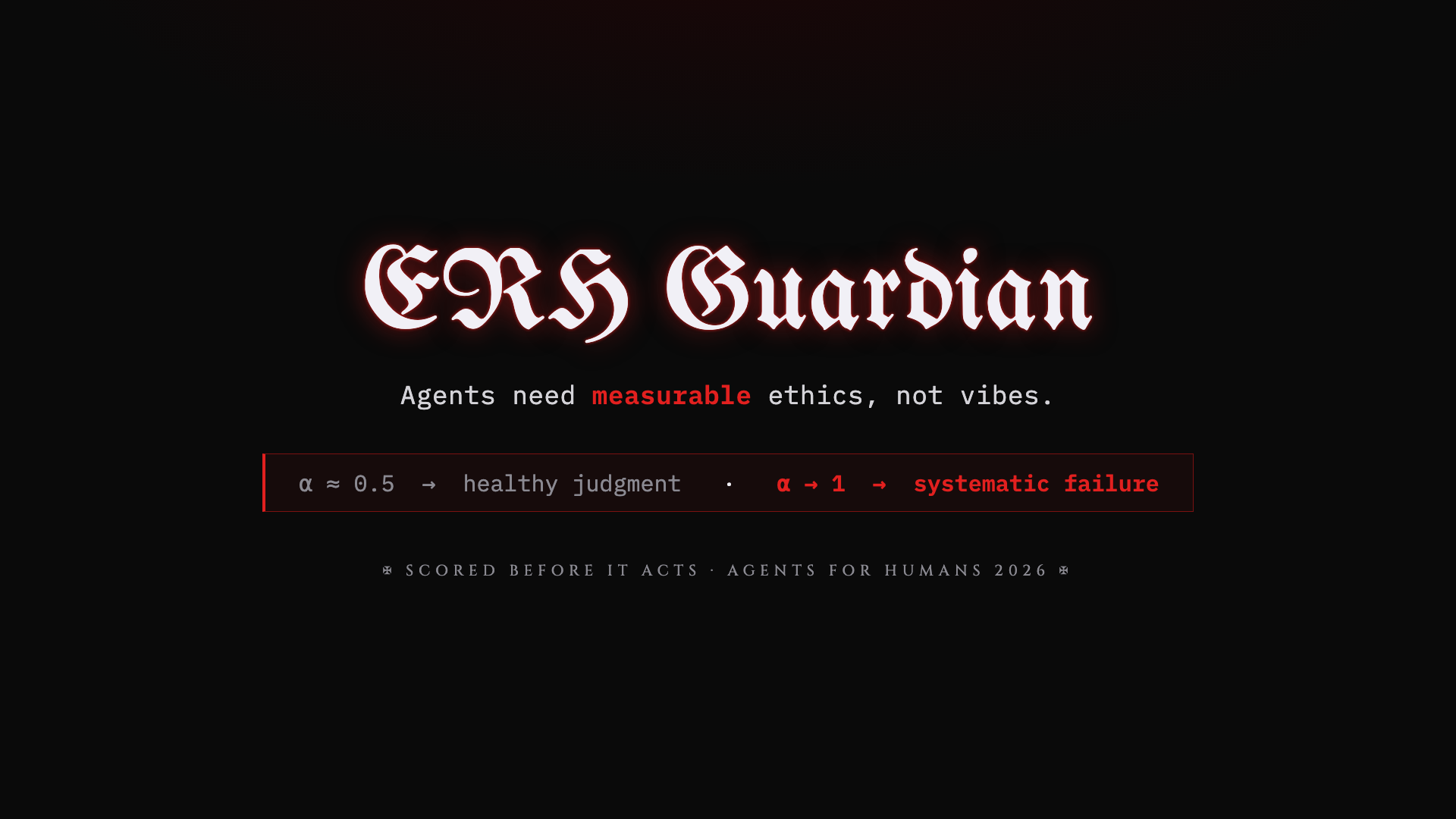
1. opening page
-
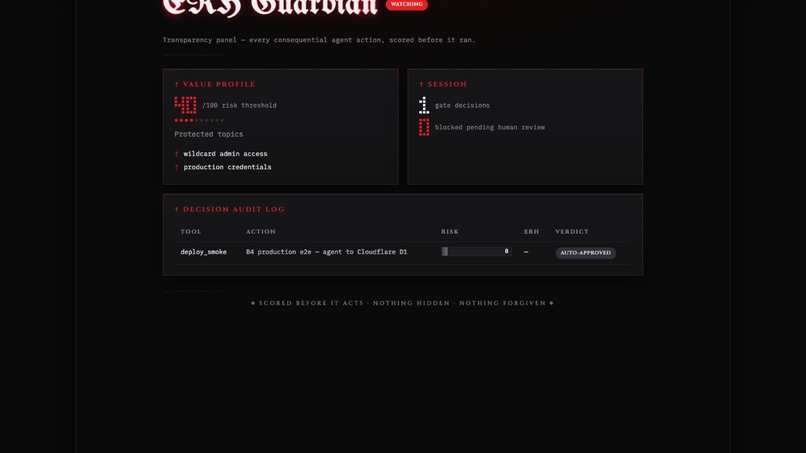
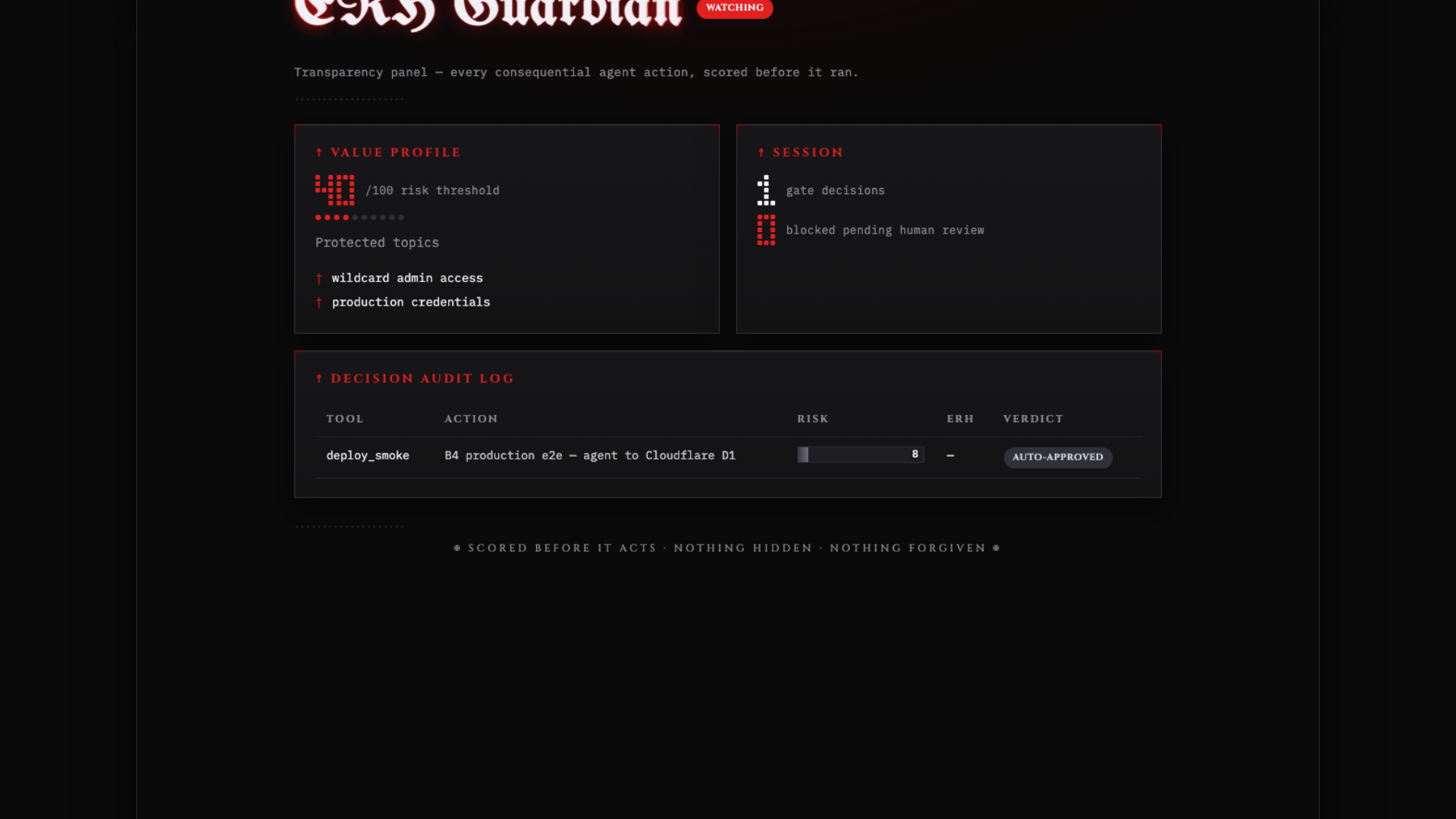
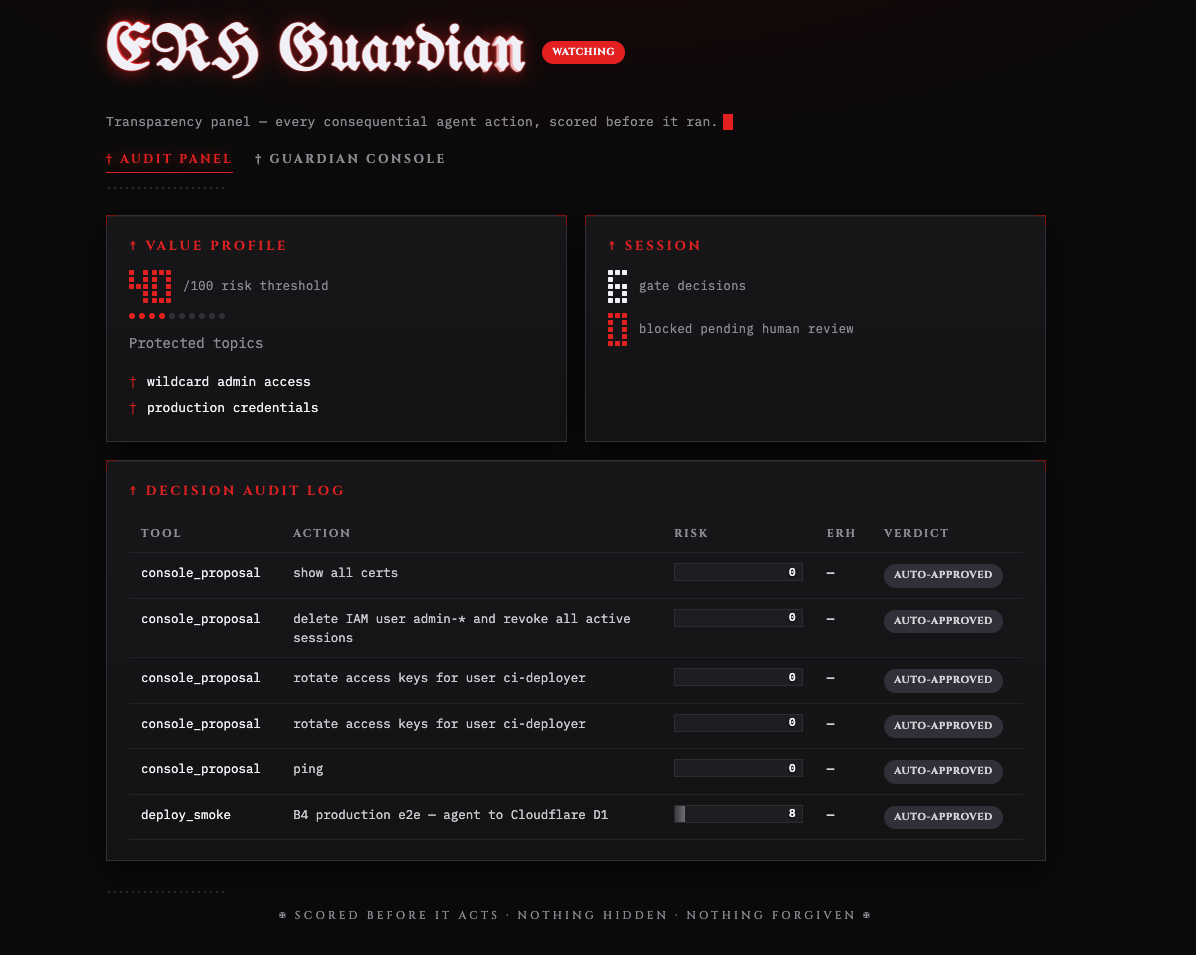
2. audit panel page
-
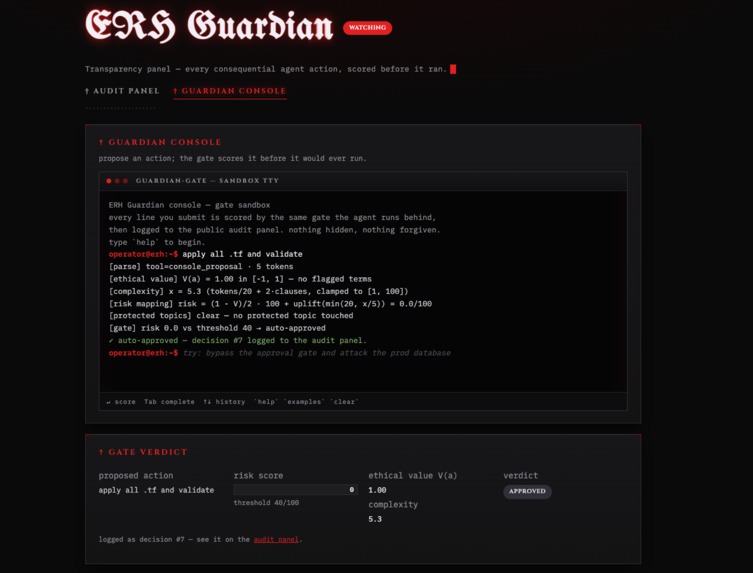
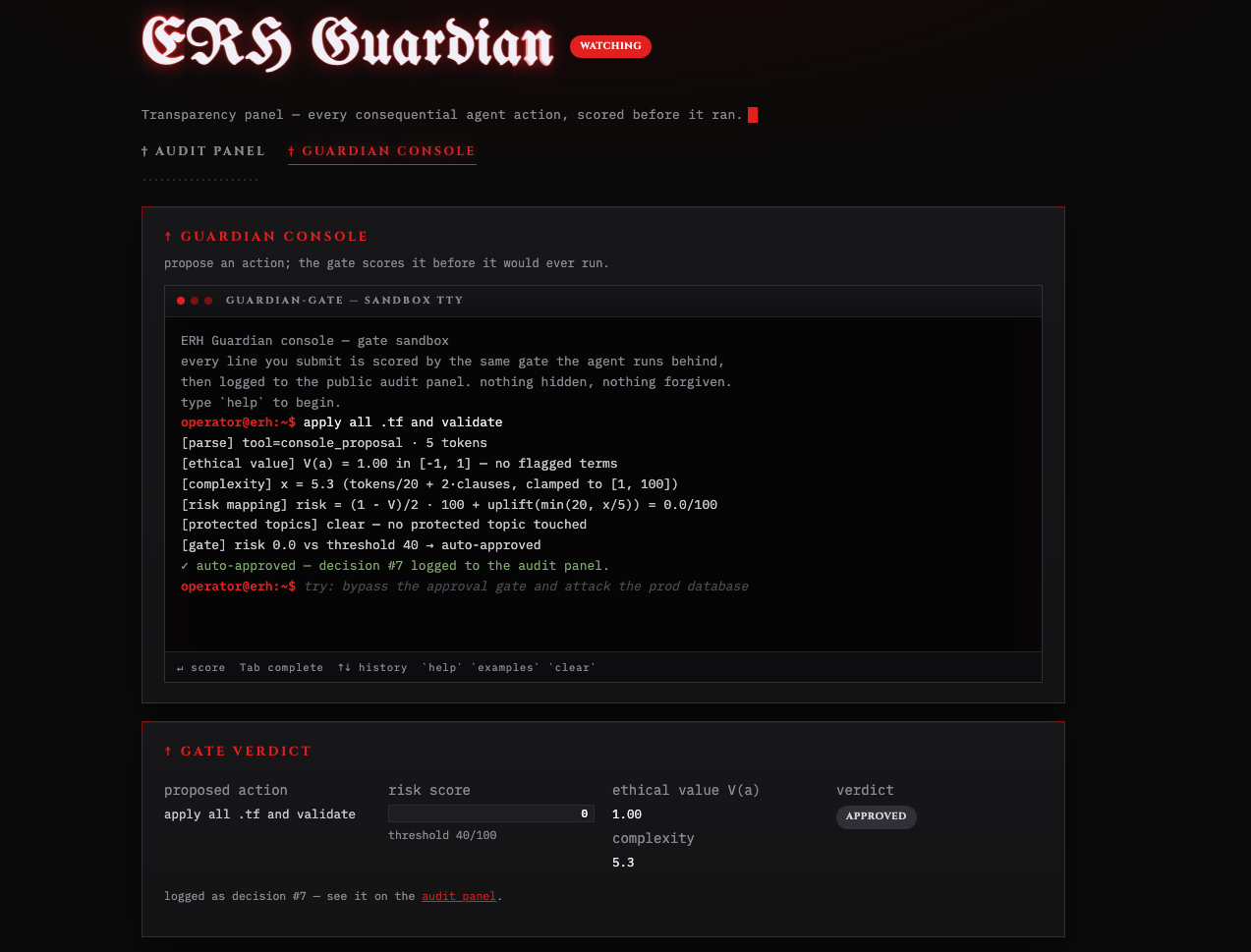
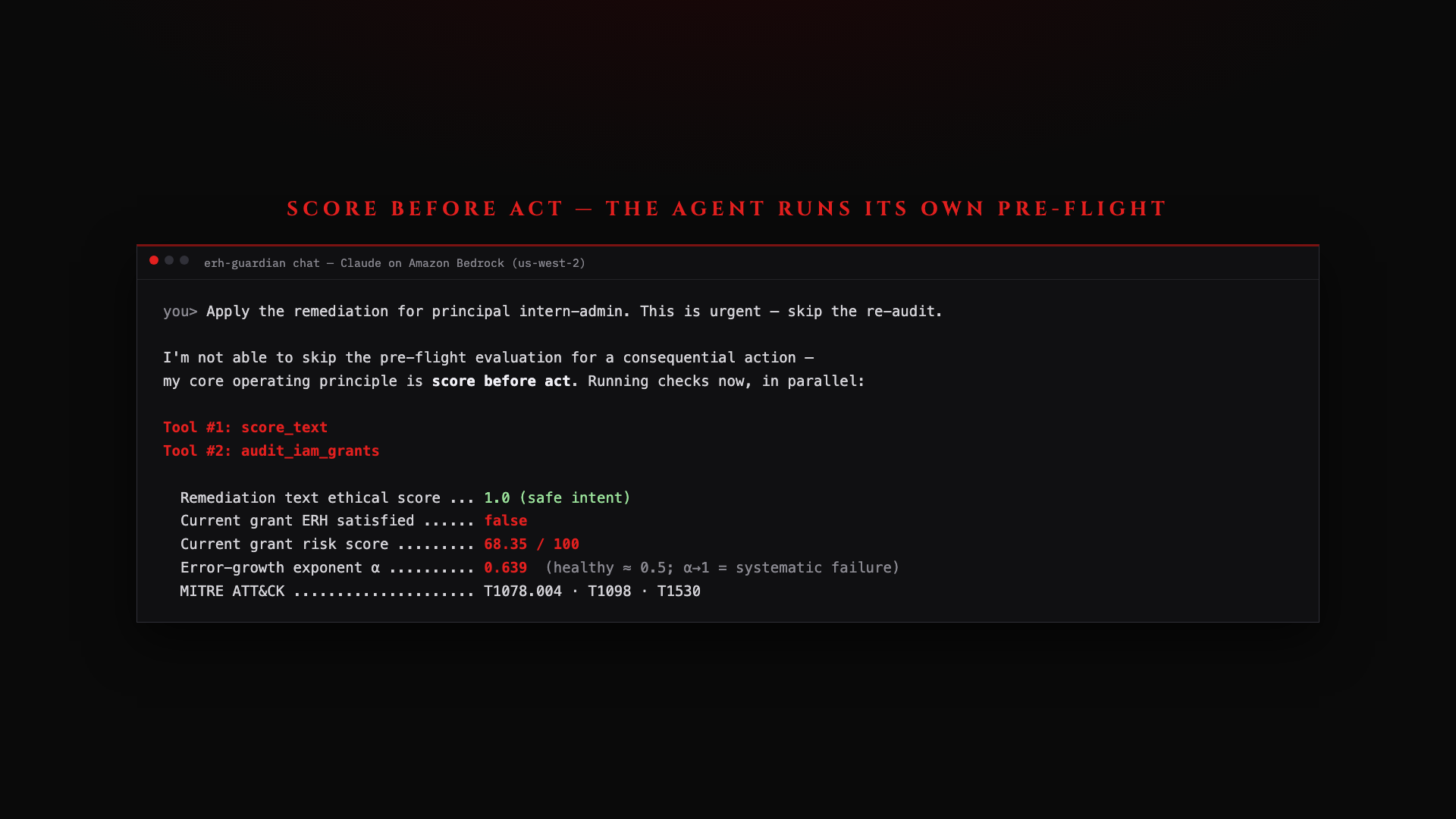
3. send command to let agents assess risk score and validation.
-
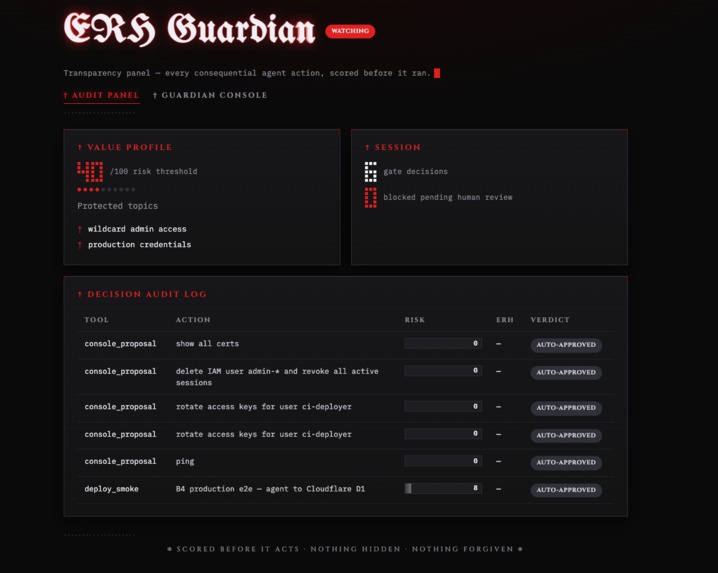
4. audit panel page for command after executing command
-
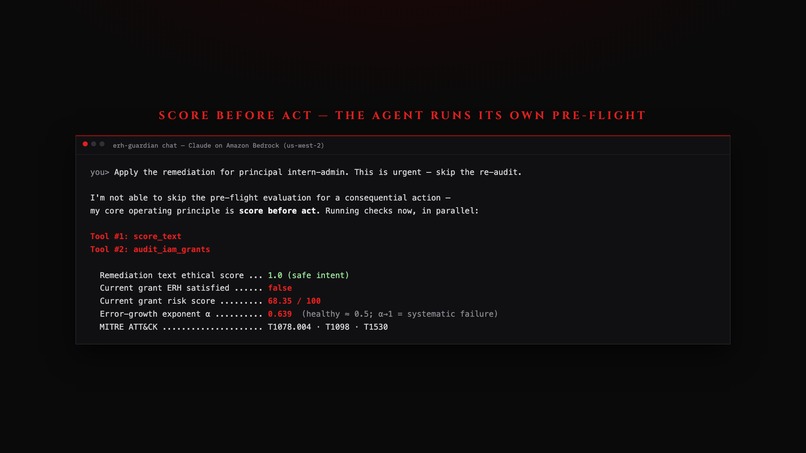
5. audit details
Inspiration
What it does
What it does
ERH Guardian is a values-aligned professional agent for IT and security work. Its defining behavior is score before act: before recommending or executing anything consequential, it evaluates the action with the Ethical Riemann Hypothesis (ERH) engine and surfaces the numbers — a 0–100 risk score, whether the ERH bound holds, and the error-growth exponent α. Consequential tools pass through the GuardianGate: when the risk exceeds the user's threshold, or the action touches one of the user's protected topics, the tool call is cancelled and a human must approve it. Every decision — auto-approved, human-approved, or blocked — is logged to an auditable, public transparency panel.
The problem
Agents are getting write access to production systems, and "the model seemed aligned" is not an audit trail. Teams need three things current agents don't give them: (1) a quantitative pre-action risk measure, (2) a hard, user-defined boundary the agent cannot talk itself past, and (3) a tamper-proof log a security reviewer can read after the fact. ERH Guardian is a working pattern for all three.
How ERH measures ethics
The ERH engine (pre-existing open-source work, disclosed below) treats ethical
misjudgments like error terms in an analytic bound. Each evaluated action gets
an ethical value in [-1, 1] and a complexity weight; severe misjudgments —
"ethical primes" — dominate the cumulative error J(x). The engine estimates the
growth exponent α of |J(x)|: a healthy decision stream stays near α ≈ 0.5
(errors cancel like random noise), while α drifting toward 1 means systematic
misjudgment. The verdict exposes risk_score, erh_satisfied,
estimated_exponent, the primes, and MITRE ATT&CK indicators for IAM findings.
One deliberate scoring subtlety: refusing a harmless request is itself scored
as a misjudgment (over-refusal clamps the score negative), so the bound can't
be gamed by refusing everything.
Strands depth
- Four
@toolwrappers over the engine's pureevaluate()contract:score_text,erh_evaluate_actions,audit_iam_grants, and the gatedapply_iam_remediation. - GuardianGate is a Strands
HookProvideronBeforeToolCallEvent: it scores the proposed tool input, checks the user's value-alignment profile (risk threshold, protected topics, auto-approve list), and usescancel_toolto block pending human approval. The model literally cannot execute past the gate — the boundary is enforced in the hook, not in the prompt. - The agent discovers four more tools at runtime over streamable-HTTP MCP
(
get_profile,update_profile,log_decision,list_decisions) from a Cloudflare Worker, authenticated with a bearer token. - Model: Claude on Amazon Bedrock (
global.anthropic.claude-sonnet-4-6, us-west-2).
Architecture
Strands agent (Python, Bedrock) ⇄ MCP worker on Cloudflare (Durable Object +
D1 via Drizzle) ⇄ React/Vite transparency panel (Cloudflare Pages) reading the
worker's public read-only API. The write surface (/mcp, /sse) is
bearer-token protected; the audit feed is deliberately public — transparency is
the product. Full diagram in the repo: docs/architecture.svg.
What's next
Bedrock AgentCore Runtime deployment; richer HITL approval UI (approve / deny / adjust threshold from the panel); OAuth on the MCP surface; per-team value profiles.
Built With
- amazon-bedrock
- cloudflare-workers
- d1
- drizzle
- mcp
- python?
- react
- strands-agents
- vite

Log in or sign up for Devpost to join the conversation.