-
-
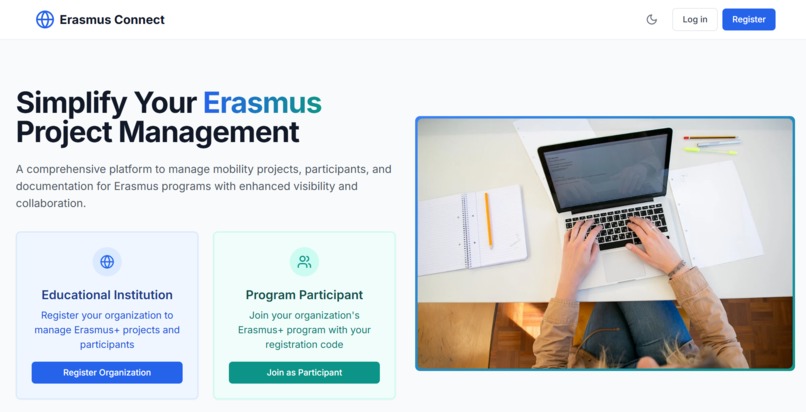
Simplify Your Erasmus Project Management
-
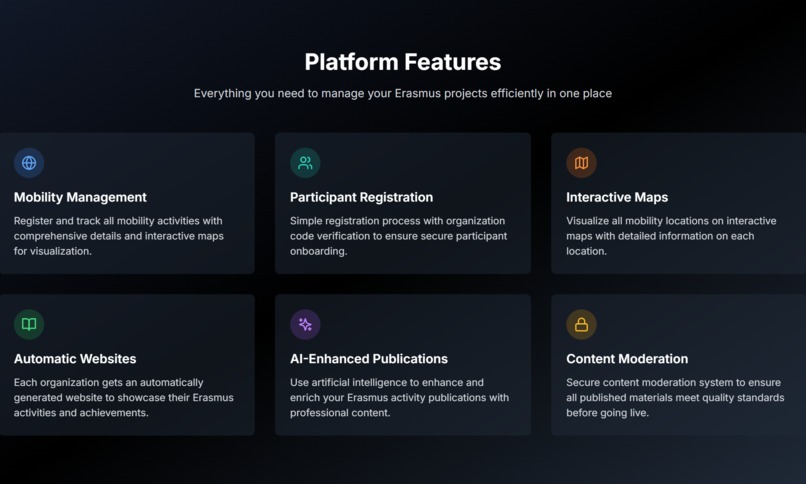
Everything you need to manage your Erasmus projects efficiently in one place

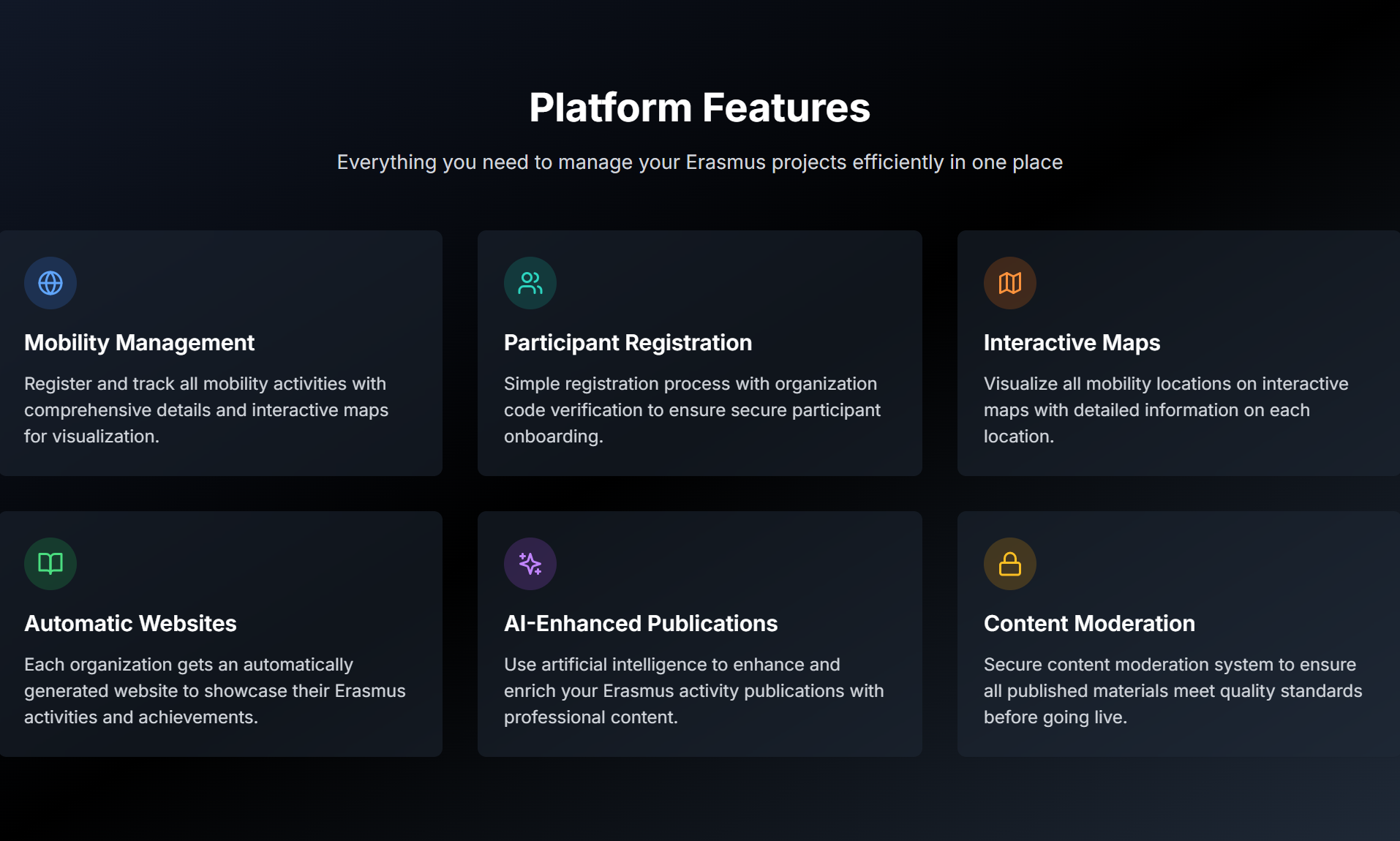
About the Project: Erasmus Connect
Inspiration
The inspiration for Erasmus Connect arose from the direct observation of the complexities and fragmentation in the management of international mobility projects, especially within the Erasmus+ framework. Educational institutions and participants often face challenges in organizing mobilities, tracking documentation, disseminating experiences, and collaborating between entities. We wanted to create a centralized solution that not only simplified these administrative tasks but also enhanced the visibility and impact of Erasmus experiences, transforming management into an opportunity for sharing and connection. The vision was to build a digital bridge that united organizations and participants, facilitating a smoother and richer Erasmus+ experience for everyone.
Learnings
During the development of Erasmus Connect, the team gained valuable experience on multiple fronts:
Modern Application Architecture: We delved into building a robust and scalable React application, using react-router-dom for navigation and react-hook-form for efficient form management, which allowed us to create a dynamic and reactive user interface.
Complex State Management: We learned to effectively manage application state with Zustand and AuthContext, ensuring that user information and authentication were handled securely and consistently throughout the platform.
Database and Authentication Integration: The implementation of Supabase was a key learning, from configuring the PostgreSQL database to managing user authentication and applying Row Level Security (RLS) policies to protect data.
Development of Advanced Features: We explored the integration of external APIs, such as geocoding for visualizing locations on interactive maps with Leaflet, and content generation with AI models (Gemini), which added significant value to the platform.
Performance Optimization and User Experience: We focused on image optimization and creating reusable components to ensure a fluid user experience and optimal performance, even with complex functionalities.
Project Development
The Erasmus Connect project was developed following an iterative and modular approach. We began by defining the core functionalities: organization management, participant registration, mobility tracking, and publication creation.
- Database Design: A relational database schema was designed in Supabase, establishing tables for organizations, participants, mobilities, publications, and documents, with clear relationships and RLS policies for data security.
- Frontend Setup: The project was initialized with Vite and React, using Tailwind CSS for rapid and consistent UI development. The application was structured into reusable components and pages dedicated to each functionality.
- Authentication Implementation: Supabase Auth was integrated for registration and login, creating a custom
AuthContextto manage user authentication state throughout the application. - Key Module Development: Mobilities: The creation, editing, and viewing of mobilities were implemented, including integration with a geocoding function to display locations on an interactive map. Publications: A publication system was developed allowing participants and organizations to share their experiences, with support for different publication types (mobility diaries, final evaluations) and AI integration to enhance content. Documents: A module for document management was created, enabling organizations to upload and categorize resources, with options for public or private visibility. Web Connect: A standout feature was the ability to automatically generate custom websites for each organization, showcasing their publications and mobilities, with different templates and customization options.
- Refinement and Testing: Throughout development, continuous testing was performed to ensure the application's functionality, usability, and security, adjusting the design and logic as needed.
Challenges Faced
The journey was not without obstacles, and each challenge was a learning opportunity:
Managing RLS Policies in Supabase: One of the biggest challenges was correctly configuring Row Level Security (RLS) policies in Supabase. Ensuring that each user type (organization, participant, public) had appropriate data access, without compromising security or functionality, required a deep understanding of policies and multiple iterations to fine-tune access rules.
Geocoding API Integration: Real-time address validation and geocoding presented challenges, especially when dealing with the diversity of address formats and the limitations of free APIs. Ensuring coordinate accuracy and the robustness of the process was crucial.
Image and Multimedia Content Optimization: Managing image uploads and optimizing them for application performance, including resizing and compression, was a technical challenge to ensure a smooth user experience without overloading the server.
Designing User Experience (UX) for Multiple Roles: Creating an intuitive and functional interface for two distinct user types (organizations and participants), with different needs and workflows, required careful design and constant consideration of usability.
AI Content Generation: Effectively integrating AI content generation, ensuring that the generated text was relevant, coherent, and within character limits, was a creative and technical challenge.
Developing Reusable and Flexible Components: Building components like PublicationForm or WebConnectForm that could adapt to different publication types or website configurations, while maintaining clean code and ease of maintenance, was a constant exercise in software engineering.
Despite these challenges, the development process of Erasmus Connect was incredibly rewarding, allowing us to apply and expand our skills to build a platform that we hope will have a positive impact on the Erasmus+ community.
Built With
- authentication
- for-database
- gemini
- javascript
- leaflet.js
- netlify
- node.js
- quill
- react
- supabase
- tailwind
- typescript

Log in or sign up for Devpost to join the conversation.