About Velora
Inspiration
The inspiration for Velora came from observing competitive racing and realizing how strategy, driver behavior, vehicle dynamics, and environmental conditions all interact to determine outcomes. We wanted to create a lightweight, interactive simulator that models multiple agents in real-time, enabling experimentation with mobility systems in racing, traffic management, or other scenarios.
What it does
Velora is a real-time mobility event simulator that models multiple moving agents — such as racing cars — while simulating dynamic events like pit stops, mechanical failures, accidents, and environmental changes. It outputs a live leaderboard and telemetry, allowing users to observe how different factors affect performance. Users can run what-if scenarios, such as applying weather changes, forcing a car to lose power, or introducing an accident, and immediately see the impact on the race.
How we will build it
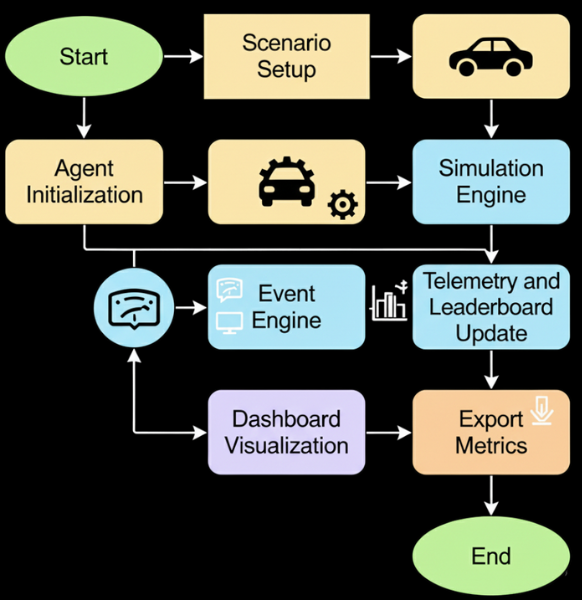
Simulation Engine: We will use Python with
asyncioto create an agent-based simulation. The engine updates each car’s position, speed, energy, and other dynamic properties at every step of the simulation.Vehicle & Driver Parameters: Each car (agent) has attributes such as tyre type and health, braking efficiency, engine power, downforce, car weight, DRS/MOM usage, handling, driver style (from 5–6 predefined types), and driver weight.
Environmental Factors: Conditions like temperature, humidity, air density, and track state influence how each car performs during the simulation.
Agent Dynamics: A car’s effective speed is determined by a combination of its vehicle attributes, driver characteristics, and environmental conditions. Its position is updated over time, while fuel and tyre health decrease according to usage.
Event Engine: Both probabilistic and manual events are supported, including pit stops, mechanical failures, accidents, and other scenario-specific interventions.
Leaderboard & Dashboard: A WebSocket-powered React dashboard displays live agent rankings, telemetry, and event notifications. Users can select cars or scenarios to test different conditions and immediately see the results.
Metrics & Export: Lap times, distance covered, event logs, and all relevant parameters can be exported as CSV or JSON for analysis and replay.
Challenges we might run into
- Scalability & Performance: Maintaining smooth real-time updates with many agents.
- Complex Event Interactions: Ensuring simultaneous events (weather, accidents, pit stops) are handled correctly.
- Determinism & Reproducibility: Guaranteeing consistent results for the same input scenario.
- Visualization Clarity: Making the dashboard intuitive while showing multiple agent parameters and events.
Accomplishments that we'll be proud of
- Designing a modular, real-time multi-agent simulator.
- Developing a dynamic, live-updating leaderboard with telemetry data.
- Build a configurable scenario system for reproducibility and experimentation.
- Integrate environmental, vehicle, and driver factors to model realistic outcomes.
What we will learn
Through Velora, we aim to deepen our understanding of:
- Multi-agent dynamics and their interaction under complex events.
- Real-time event scheduling and its effect on performance.
- Visualization of telemetry and event-driven outcomes.
- Optimization strategies for mobility systems, both competitive and logistical.
What's next for Velora
- Scale the simulation to hundreds of agents while maintaining performance.
- Introduce AI-controlled agents with different strategies.
- Extend Velora to other mobility domains like drones, urban traffic, or logistics.
- Add advanced analytics and visualization, such as heatmaps, predictive modeling, and scenario comparison.
Built With
- asyncio
- d3.js
- docker
- fast-api
- google-cloud
- javascript
- matplotlib
- numpy
- postgresql
- python
- react
- restapi
- scipy
- socket.io
- typescript
- weatherapis
- websocket

Log in or sign up for Devpost to join the conversation.