-
Introduction to Image Classification with Pytorch
## Inspiration
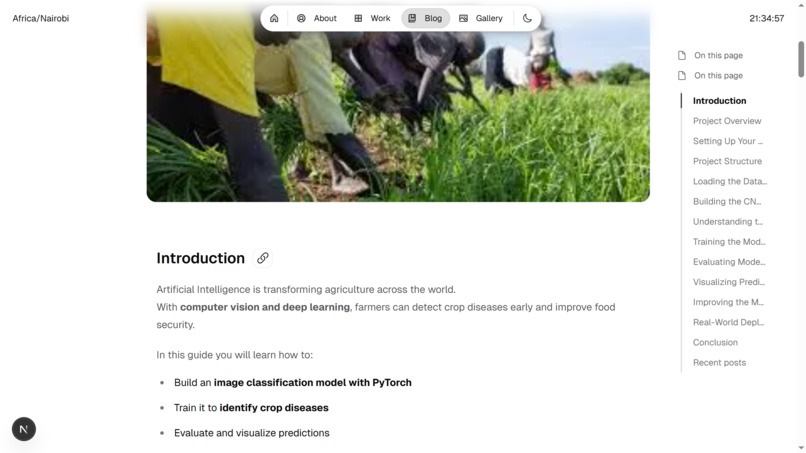
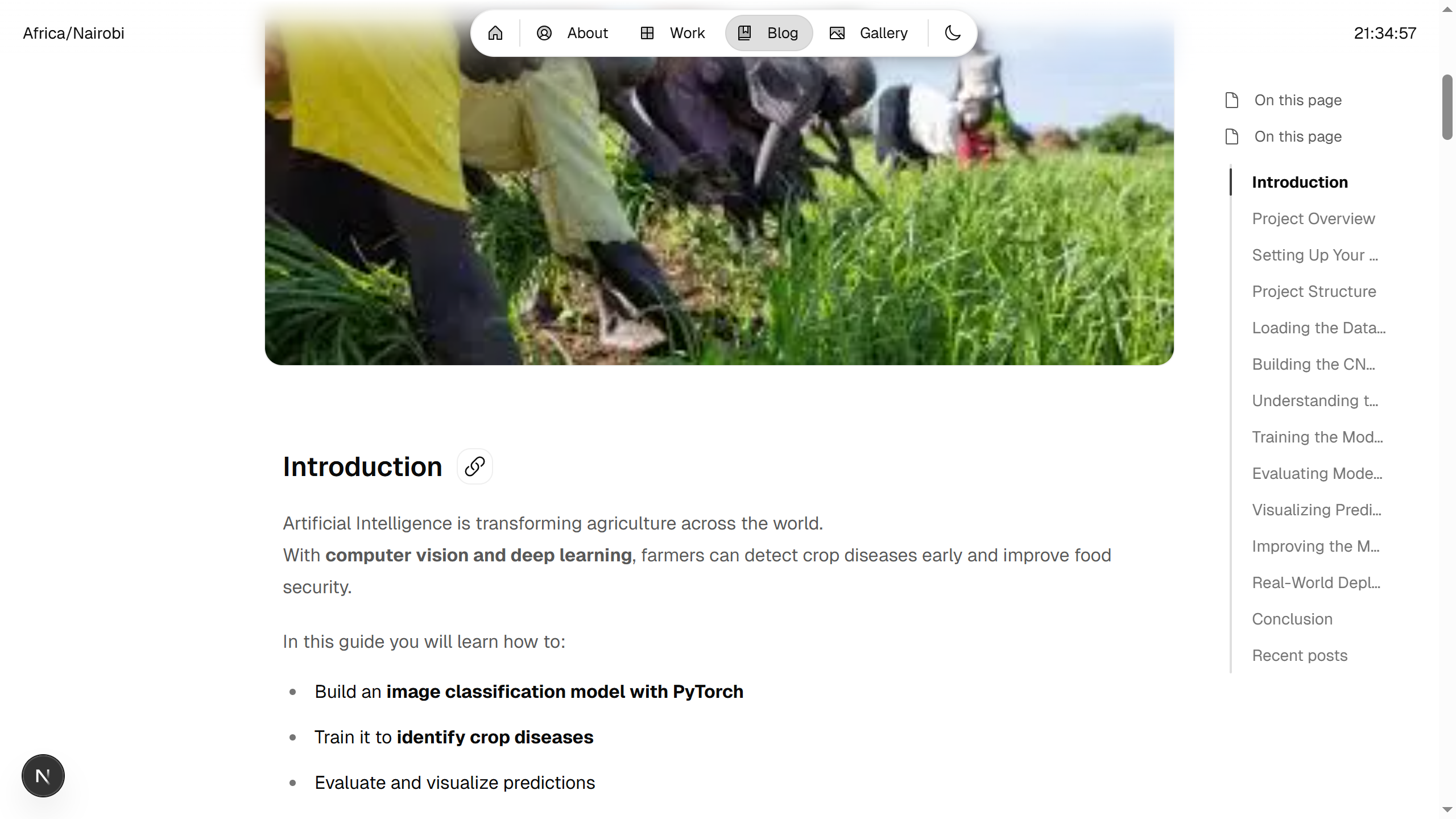
Agriculture remains the backbone of many African economies, supporting millions of livelihoods and sustaining local communities. However, many farmers across the continent still face challenges such as crop diseases, pest infestations, and limited access to timely agricultural expertise. These issues often lead to reduced yields, economic instability, and food insecurity.

As a **Senior Software Engineer and the creator behind Africa's first AI-Native learning ecosystem**, I, **Jerome Mukindia**, was inspired to explore how artificial intelligence could bridge the knowledge gap for farmers. The goal was to create a practical AI-driven tool that leverages image detection to help farmers quickly identify crop diseases and agricultural issues using accessible technology such as smartphones.

The inspiration was rooted in a simple belief: **technology should empower local communities and solve local problems**. By enabling farmers to harness AI directly in the field, we can democratize access to agricultural expertise and strengthen food systems across Africa.

## What it does
The Image Detection Model is an AI-powered system designed to assist farmers and agricultural stakeholders in identifying crop diseases, pests, and plant health issues through images.

Key capabilities include:

- **Crop disease detection:** Farmers can capture an image of a plant leaf or crop, and the model identifies potential diseases or issues.
- **Pest identification:** The system recognizes common pests affecting crops.
- **Early diagnosis:** Early detection helps farmers take corrective action before crop damage spreads.
- **Accessible technology:** Designed to work with mobile devices and lightweight infrastructure, making it usable even in rural areas.
- **Knowledge empowerment:** The model provides insights and recommendations that help farmers make informed decisions.

Ultimately, the solution acts as a **digital agricultural assistant**, making expert-level crop analysis more accessible to farmers across Africa.

## How I built it
Building the Image Detection Model involved combining machine learning, computer vision, and scalable infrastructure to create a reliable agricultural intelligence system.

The development process included:

1. **Data Collection**
   - Sourced agricultural datasets containing images of crops, plant diseases, and pests.
   - Curated and labeled images relevant to African farming conditions.

2. **Data Preprocessing**
   - Cleaned and normalized image datasets.
   - Applied data augmentation techniques such as rotation, scaling, and flipping to improve model robustness.

3. **Model Architecture**
   - Implemented a deep learning computer vision model using convolutional neural networks (CNNs).
   - Leveraged modern frameworks such as TensorFlow and PyTorch to train and optimize the model.

4. **Training & Evaluation**
   - Trained the model on thousands of crop images.
   - Evaluated performance using accuracy, precision, recall, and F1-score.

5. **Deployment**
   - Optimized the model for mobile and web integration.
   - Integrated it into an AI-native learning ecosystem to allow educational and real-world usage.

6. **User Accessibility**
   - Designed the solution to be lightweight and accessible for farmers using smartphones.
   - Focused on low-bandwidth environments common in rural regions.

## Challenges I ran into
Developing an AI solution tailored to African agricultural contexts came with several challenges:

- **Limited localized datasets:** Many public agricultural datasets focus on crops from other regions, requiring additional effort to find or curate relevant African data.
- **Model generalization:** Ensuring the model performs well across diverse crop varieties and environmental conditions.
- **Connectivity limitations:** Many rural farmers have limited internet access, requiring efficient and lightweight deployment.
- **User adoption:** Designing the solution in a way that is simple enough for non-technical users to adopt.

Overcoming these challenges required creative engineering, dataset augmentation, and continuous model iteration.

## Accomplishments that I'm proud of
Several milestones stand out as key accomplishments in this project:

- Developing an **AI-powered crop diagnostic tool tailored for African farmers**.
- Contributing to **technology-driven agricultural empowerment across local communities**.
- Demonstrating how AI can be used to solve real-world problems within African ecosystems.
- Integrating the system into **Africa's first AI-Native learning ecosystem**, expanding its educational impact.
- Creating a scalable solution that can evolve to support additional crops, regions, and use cases.

This project represents a step toward **bridging the gap between emerging technologies and grassroots agricultural innovation**.

## What I learned
Working on this project provided valuable insights across both technology and social impact:

- **AI must be contextualized** to the environments and communities it serves.
- **Data quality is critical** in computer vision applications.
- **User-centered design matters**, especially when building solutions for non-technical users.
- **Technology adoption in agriculture requires trust, simplicity, and accessibility.**
- **Local innovation is powerful** when combined with global technological tools.

Most importantly, I learned that **AI can serve as a catalyst for community empowerment when designed with local challenges in mind.**

## What's next for Equitable Accessibility Contribution
The long-term vision for this project is to expand its capabilities and accessibility across Africa and beyond.

Future plans include:

- **Expanding the crop and disease detection database**
- **Integrating multilingual support for African languages**
- **Building offline-first AI models for rural deployment**
- **Developing farmer education modules within the AI-native learning ecosystem**
- **Collaborating with agricultural organizations and research institutions**
- **Scaling the platform to support climate-smart agriculture initiatives**

By continuing to innovate and collaborate, the goal is to ensure that **AI becomes an inclusive tool for agricultural transformation across Africa**, empowering farmers, strengthening food systems, and contributing to sustainable development.


Log in or sign up for Devpost to join the conversation.