-
-
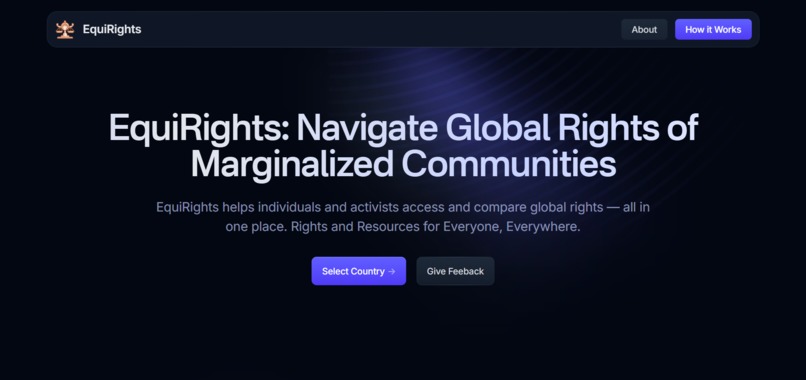
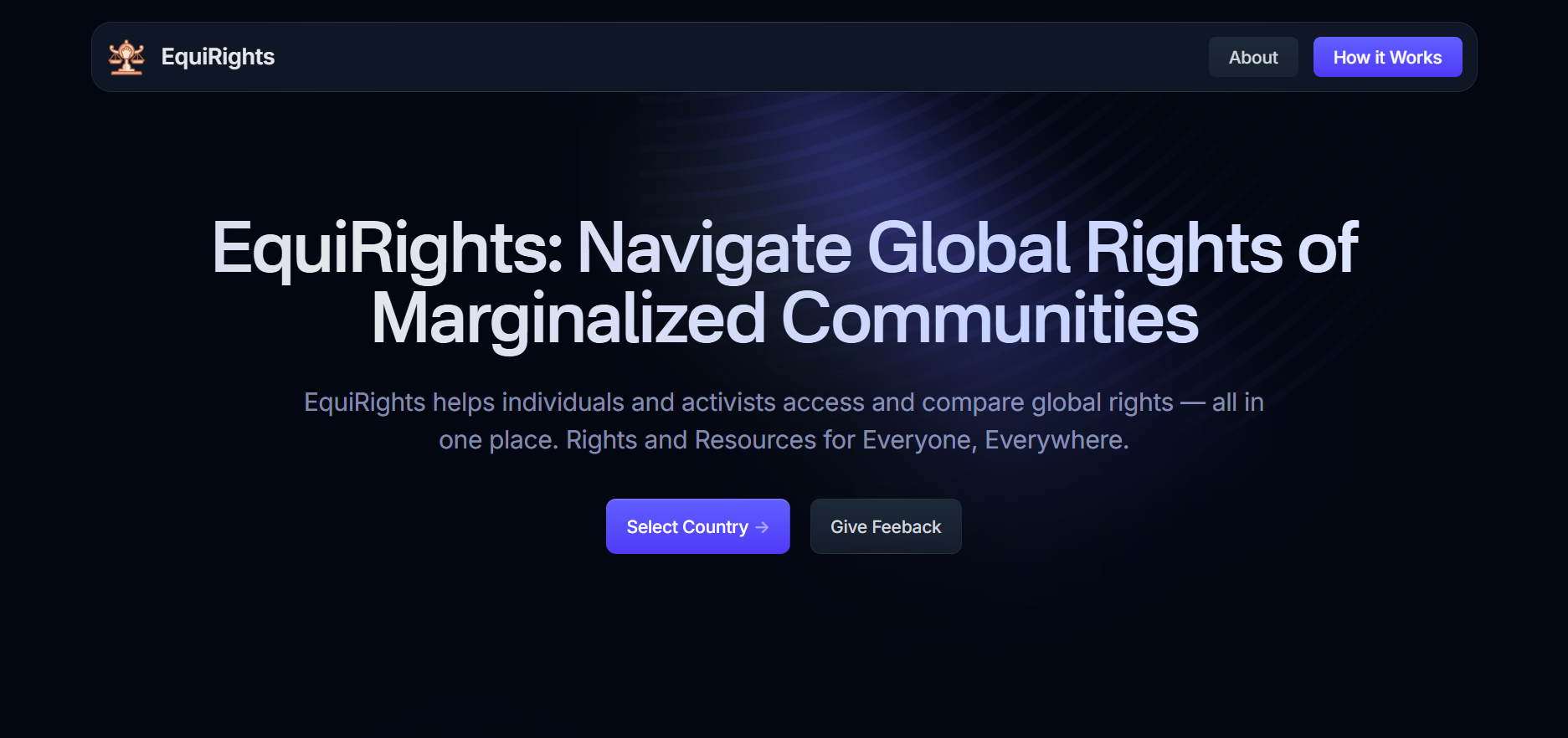
EquiRights homepage
-
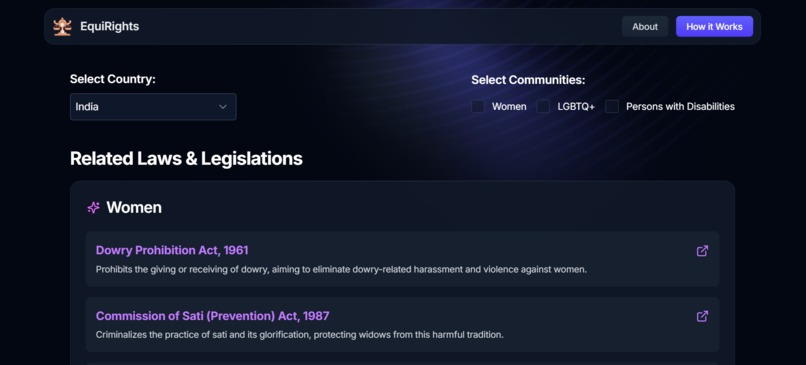
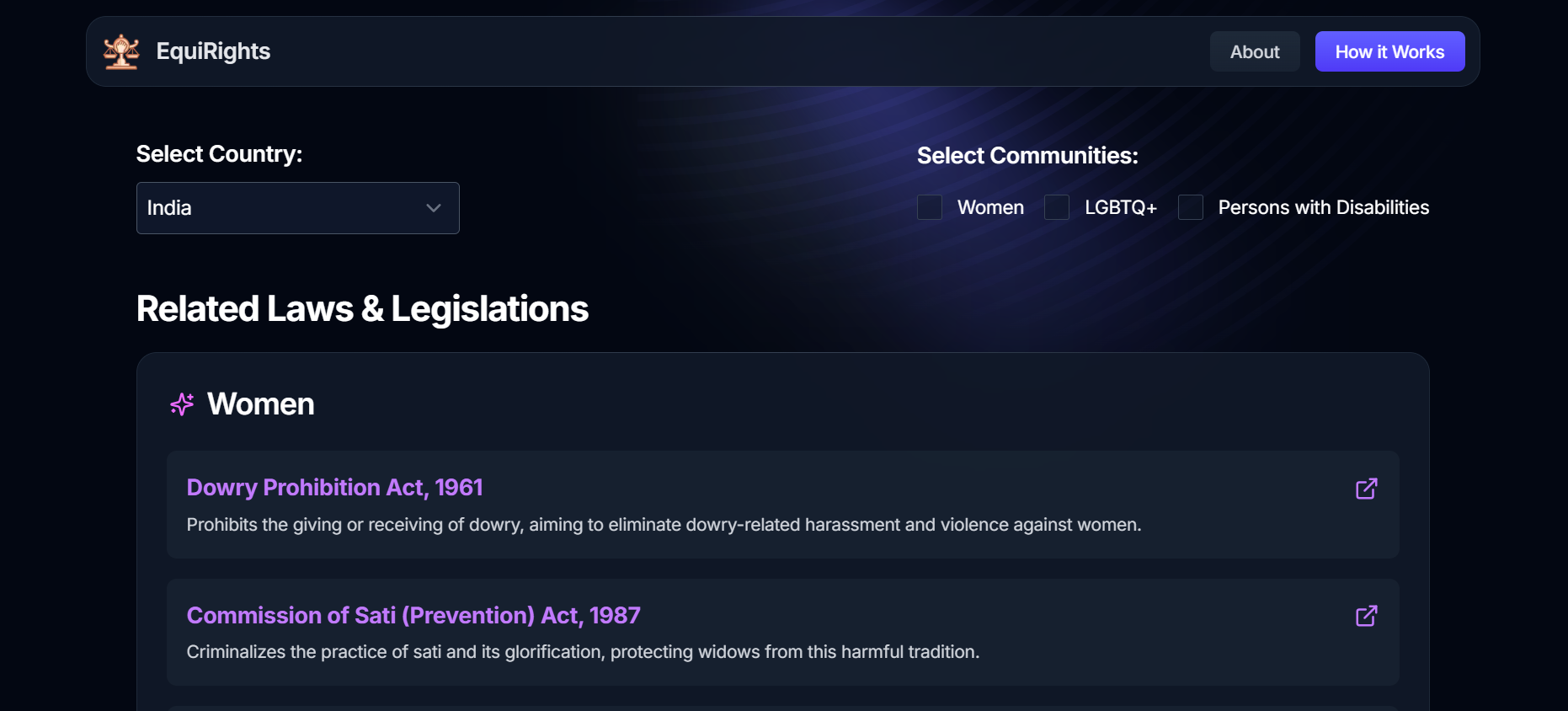
Select Country and view relevant legislations!
Inspiration
The idea of EquiRights came from recognising that many people, especially from marginalized communities, often struggle to access clear, reliable, and centralized information about their legal rights, especially across borders. Laws related to gender, sexuality, and disability are scattered across government websites, buried in complex legal language, or simply inaccessible.
This becomes even more critical for travelers, activists, and support organizations working in unfamiliar jurisdictions. The platform was built to bridge that gap by making legal knowledge discoverable, understandable, and actionable.
Because the first step to justice is knowing what you're entitled to.
What it does
EquiRights is a global rights aggregator that allows users to explore country-specific legislations and currently supports the USA and India. Users can filter by identity groups (Women, LGBTQ+, and Persons with Disabilities) to view laws and protections relevant to their communities.
The site also includes helpful pages such as “About,” “How It Works,” “Feedback,” and a combined “Changelog & Roadmap” to enhance transparency and user trust.
How we built it
The project was built using React and styled with TailwindCSS. It currently uses a simple, JSON-based data model for rights information, making it easy to scale or update content. I plan to migrate to Firebase when the need arises. Vercel is used for deployment.
Pages and navigation are designed to be simple, responsive, and clear, with future-proofing in mind for features like data visualizations and chatbot support.
Challenges I ran into
- One major challenge was deciding how to structure and represent legal data in a way that’s both accurate and digestible. Laws vary dramatically by region and can be complex to simplify.
- Another challenge was creating a clean UX while managing country and community filters without overwhelming the user. To speed up to development process, I used a template and customized it to fit EquiRights.
- Technical issues like routing errors and Vercel deployment problems were also part of the journey, but there's nothing a quick Google Search can't solve, right? (the pnpm errors 😭😭)
Accomplishments that we're proud of
Bringing this idea to life as a solo project, from initial concept and research to design, development, and deployment, is something I'm extremely proud of. Creating a working prototype and successfully deploying it is a huge win.
What I learned
Building EquiRights reinforced the importance of thoughtful but clean UX and design, especially when working with sensitive, community-specific content. It was also a learning experience in managing scope and scaling ambition appropriately in a limited timeframe, while still delivering something useful and polished.
What's next for EquiRights
I do have a list of features I want to add to EquiRights, such as:
- Adding more countries and deeper legal datasets
- Developing a comparison feature to contrast legal landscapes across countries
- Integrating visual insights via charts and maps
- Building an AI-powered chatbot for rights-related queries
The long-term goal is to turn EquiRights into a living platform that empowers users to understand and advocate for their rights, wherever they are.


Log in or sign up for Devpost to join the conversation.