-
-
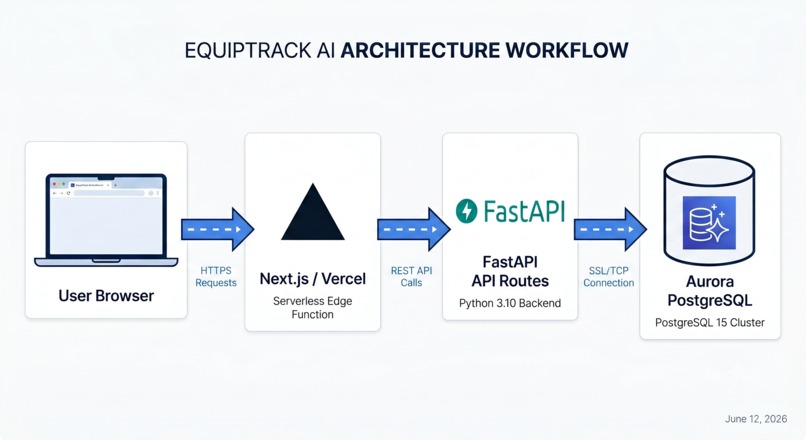
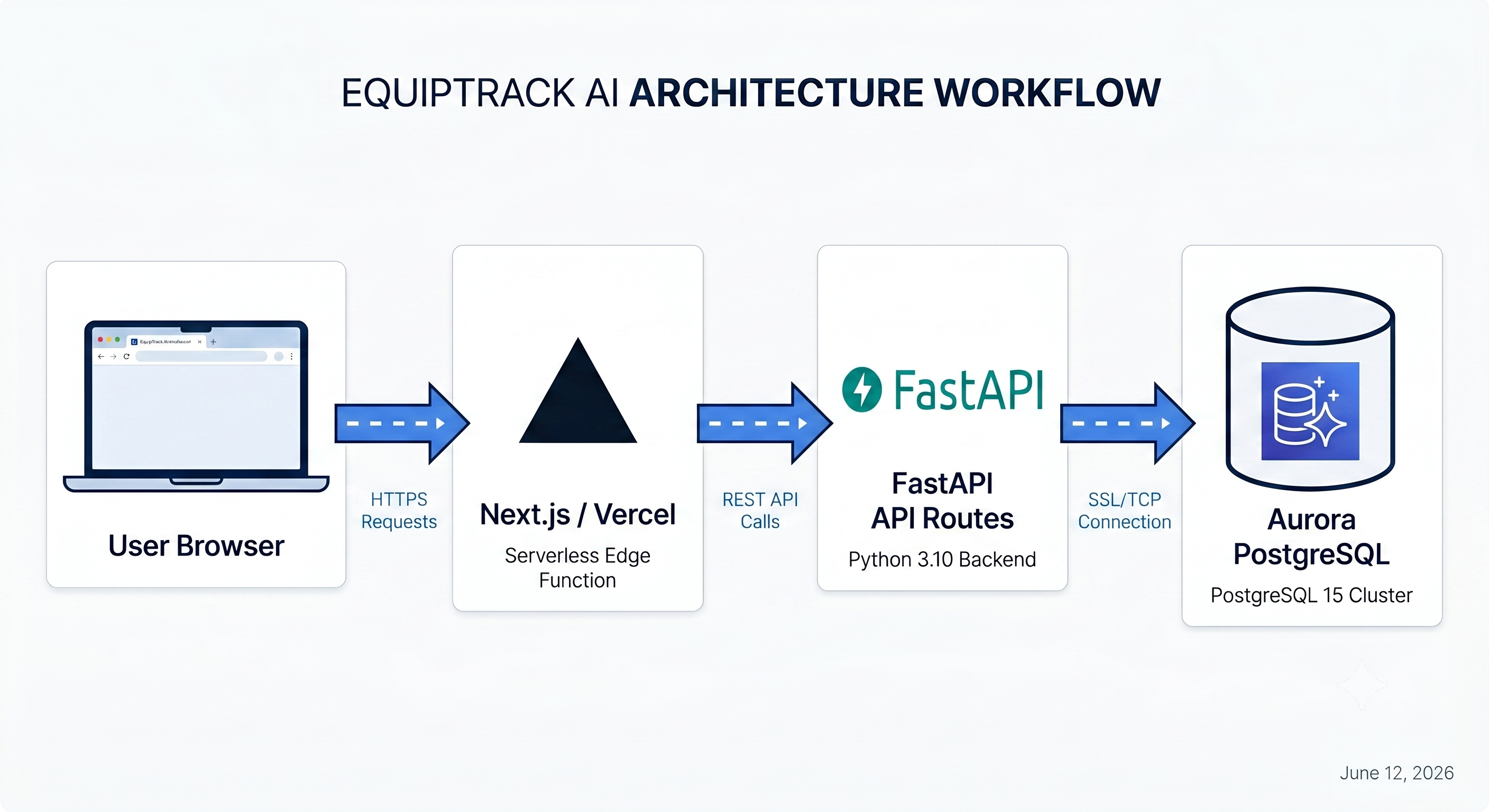
EquipTrack AI Architecture — Next.js/Vercel (Serverless Edge) → FastAPI REST API (Python 3.10) → Amazon Aurora PostgreSQL 15 Cluster
Inspiration
I run an HVAC contracting company in Lagos, Nigeria. Every day, my team manages service requests via WhatsApp threads, I dispatch technicians by phone, and fill out paper job cards in the field, and prepares invoices days after the job is done.
In asset-heavy industries like commercial HVAC, hospitality, and manufacturing, equipment downtime translates directly to severe financial and operational losses. Managing client locations, field technicians, maintenance logs, and spare parts inventory is manually chaotic. EquipTrack AI was built to eliminate this, a scalable, automated engine designed for real-world operations from day one.
What it does
EquipTrack AI is an automated enterprise field service and asset maintenance engine that eliminates logistical bottlenecks:
Client & Facility Portal: Clients submit service requests, track ticket status in real-time, and view full asset maintenance history across multiple operational zones.
- Smart Technician Dispatch: When a ticket is created, the system checks available technicians by region and current workload and suggests the best match. Admins assign the job to a technician with one click. Automated Data Lifecycle: The moment a technician submits a field report, three things happen automatically; parts inventory is decreased, an invoice draft is generated, and the ticket status moves to Resolved. Zero manual steps.
How we built it
We designed EquipTrack AI using a lean, ultra-scalable architecture that respects the Zero Stack philosophy:
- Frontend: Built a dynamic, responsive dashboard and mobile-optimised technician views using Vercel's v0.app, exported directly into a Next.js App Router framework with Tailwind CSS and React Query. Deployment & Core Logic: We deployed the full-stack application natively on Vercel, utilising Next.js Serverless API routes backed by a Python FastAPI layer to handle business automation safely at the edge. Database Layer: it's powered entirely by Amazon Aurora PostgreSQL Serverless v2. Because asset management is inherently relational — Organisations to Facilities to Assets to Tickets to Field Reports to Invoice Drafts. Aurora PostgreSQL provides bulletproof data integrity, relational speed, and seamless compute auto-scaling. Connected via Vercel's native AWS storage integration with Prisma ORM for type-safe queries and clean migrations.
Challenges we overcame
It required highly optimised connection pooling while securely connecting serverless edge environments to industrial-scale database clusters within tight network constraints. We overcame this by configuring efficient Prisma data-access layers that prevent connection exhaustion during traffic bursts, ensuring the platform remains fast under enterprise loads.
Scope discipline was equally challenging. The full vision includes predictive maintenance alerts, WhatsApp-based technician reporting, and multi-currency invoicing. Shipping all of that in 18 days while running an active contracting business would have produced a broken demo. Three modules were built deeply; six modules were built shallowly.
Accomplishments that we're proud of
We successfully built a highly complex, relational enterprise application that completely bypasses rigid infrastructure setup. By pairing Vercel's deployment speed with AWS Aurora's robust database scaling, we created shippable software capable of moving from prototype to heavy corporate production, and immediately deployable for our own contracting operations.
What we learned
Building software to solve a problem you personally live every day is a different kind of motivation. Every design decision had a real-world reference the invoice draft feature was designed around an actual client billing cycle; the dispatch logic mirrors how technicians are assigned today.
Building with the Vercel and AWS ecosystem also proved that developers no longer need to compromise between rapid front-end iteration and rock-solid, production-grade back-end infrastructure.
What's next for EquipTrack AI
EquipTrack AI will be deployed for our own contracting operations immediately after the hackathon. Next development priorities:
WhatsApp-based technician reporting, field engineers report via WhatsApp, no app download required Paystack integration, invoice payment collection directly within the platform
Predictive maintenance scheduler: historical equipment logs trigger automatic preventive maintenance cycles before physical breakdown occurs Multi-tenant SaaS packaging, targeting the Nigerian HVAC, facilities management, and hospitality maintenance market, where thousands of businesses currently run these operations on spreadsheets and WhatsApp


Log in or sign up for Devpost to join the conversation.