Equilibrium: Making Meditation Measurable
The Problem That Inspired Us
Traditional meditation feels like guesswork. You sit quietly, try to focus on your breath, and hope something good is happening but you have no idea if you're "doing it right." For high-achievers accustomed to data-driven progress, this ambiguity is frustrating and often leads to abandonment.
The personal catalyst: I (Patricia) found meditation beneficial but incredibly difficult. My mind would wander constantly during sessions, and I'd realize those supposed "10 minutes of meditation" were actually 10 minutes of mental churning. Existing apps just talked at me or played music while my thoughts raced on there was no real-time feedback to guide me back to focus.
When I discovered research on heart rate variability (HRV) and its connection to breathing patterns, I realized the Apple Watch could be the missing piece: real-time biofeedback that shows you exactly when you're achieving calm focus.
What We Built
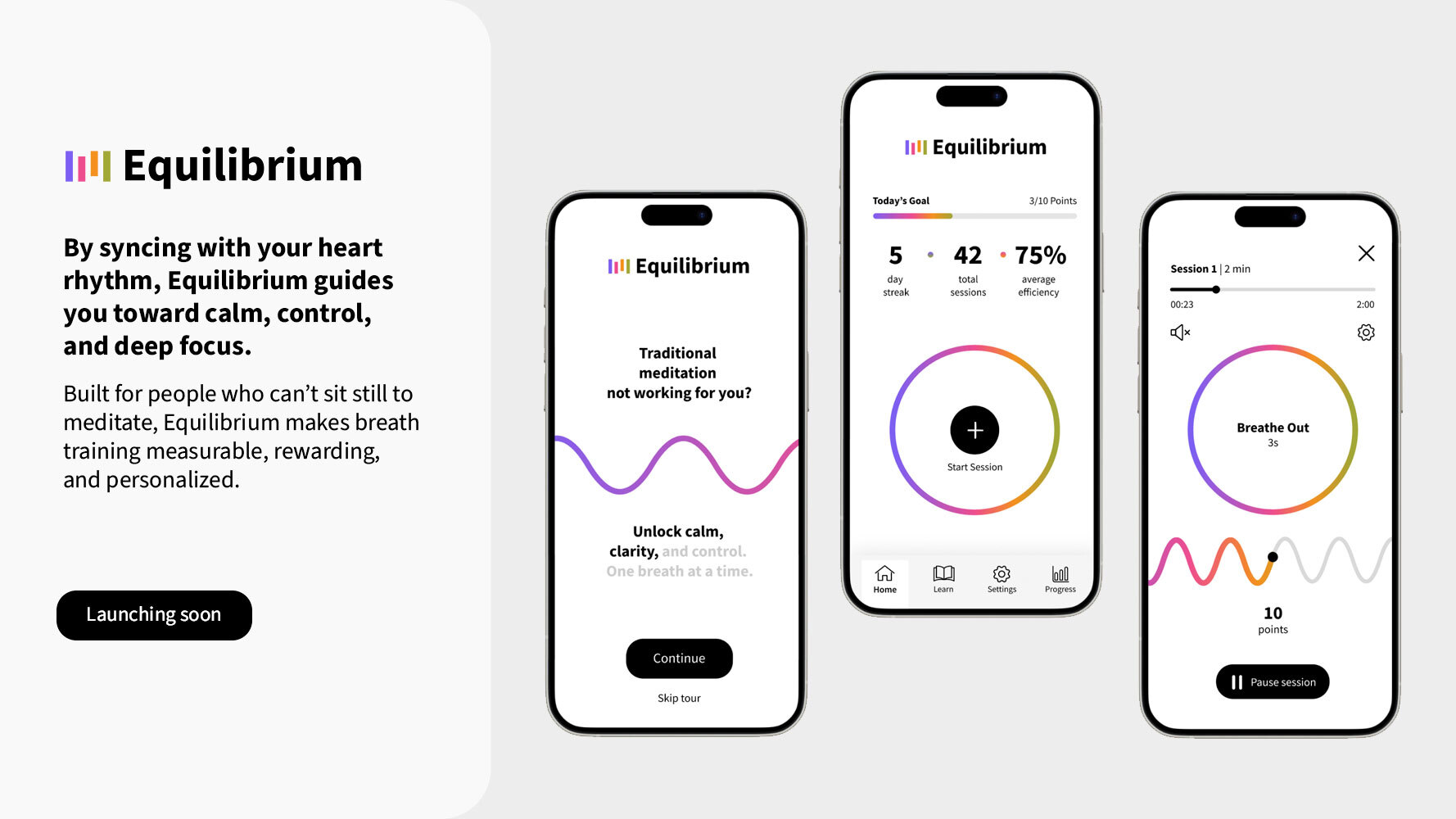
Equilibrium transforms meditation from abstract practice into measurable training by:
- Real-time HRV visualization: Your Apple Watch streams heart rate data to create live waveforms showing when your breathing creates calm, coherent patterns
- Gamified feedback system: Earn points for high-quality breathing cycles, with achievements and streaks that make progress tangible
- Adaptive guidance: The app learns your patterns and provides personalized recommendations for session length and timing
Key Features
- Live biofeedback: See your nervous system respond to breathing in real-time
- Points-based scoring: Measurable progress with 1 point per quality breathing cycle
- Smart achievements: 23 progressive milestones from "First Session" to "30-Day Streak"
- Flexible practice: Choose time-based or points-based session goals
- Cross-device sync: Seamless experience between iPhone and Apple Watch
How Bolt Accelerated Our Development
Bolt was transformative for our rapid iteration process:
1. Lightning-Fast Prototyping
We used Bolt to create fully interactive app prototypes in hours, not weeks. This allowed us to test multiple UI approaches and quickly converge on the optimal user experience.
2. User Research Acceleration
With Bolt's interactive prototypes, we conducted meaningful user testing sessions where participants could actually use the app rather than just react to static mockups. We gathered feedback from 8 target users across multiple iterations.
3. Algorithm Visualization
Bolt helped us create data visualization tools to understand HRV patterns and refine our point-scoring algorithms with real heart rate data.
4. Full-Stack Web Experience
Our entire website (equilibrium.app) was built with Bolt, including landing pages, user authentication, and dashboard components that integrate with our Firebase backend.
5. Community-Driven Development
Despite being distributed across Seattle, San Francisco, and Kuala Lumpur, we leveraged Bolt's hackathon events to accelerate our progress. The US-based team members met in person for the first time at the Bolt hackathon jam session in Seattle, where we conducted initial user research among fellow participants. We individually attended additional meetups in Kuala Lumpur and Seattle to gather demo feedback, turning the global Bolt community into our extended development team.
Technical Architecture
Core Technology Stack:
- Native iOS/watchOS: Swift with HealthKit SDK for real-time heart rate streaming
- Backend: Supabase for user authentication and data synchronization, Firebase for analytics and deployment
- Frontend: SwiftUI for native apps, Bolt-generated React for web dashboard
- Real-time Processing: Custom HRV algorithms processing 1Hz heart rate data
- Cross-device Communication: WatchConnectivity framework for seamless iPhone-Watch integration
Key Technical Achievements:
- Real-time heart rate variability calculation and visualization
- Breath cycle detection algorithm with 90%+ accuracy
- Smooth 60fps waveform animations showing live biofeedback
- Robust error handling for Apple Watch connectivity issues
Research-Driven Development
User Research Insights:
- Conducted 8 in-depth interviews with high-performing professionals
- Key finding: Users wanted "meditation for people who struggle with meditation"
- Language testing: "Peak performance training" resonated better than "mindfulness"
- Feature validation: Real-time feedback was the #1 requested feature
Scientific Foundation:
- Built on 30+ years of HRV biofeedback research
- Optimal breathing rate: 6 breaths/minute (0.1 Hz resonance frequency)
- Point scoring based on coherence, amplitude, and consistency metrics
Challenges Overcome
1. Technical Rabbit Hole
We initially received incorrect guidance about Apple Watch heart rate sampling frequencies, leading us down a complex path trying to access beat-to-beat data. Through careful research and testing, we discovered that 1Hz sampling was sufficient for effective HRV biofeedback and pivoted our algorithm accordingly.
2. Team Adaptation
When one team member dropped out due to personal commitments, we restructured our workflow and leveraged Bolt even more heavily to maintain development velocity with our smaller team.
3. Real-Time Performance
Achieving smooth 60fps waveform visualization while processing live heart rate data required careful optimization of our rendering pipeline and efficient data structures.
Impact and Validation
User Testing Results:
- 100% of test users completed their first 2-minute session successfully
- 87% said they "finally understood what good meditation feels like"
- Users achieved measurable HRV improvement within single sessions
Market Validation:
- Clear differentiation from existing meditation apps (Calm, Headspace)
- Addresses limitations of expensive dedicated devices (HeartMath's $250 sensor)
- Perfect timing with Apple's growing health ecosystem focus
What We Learned
About Bolt:
- Interactive prototyping accelerates user research by 10x
- Bolt's ability to integrate with external APIs (Firebase) enabled rapid full-stack development
- The platform's flexibility allowed us to test complex UX flows quickly
About Building for Health:
- Users need immediate feedback to build confidence in new practices
- Gamification works when tied to meaningful outcomes (not arbitrary metrics)
- Real-time biofeedback transforms abstract concepts into concrete experiences
About Team Dynamics:
- Rapid prototyping tools like Bolt enable smaller teams to compete with larger ones
- User research early and often beats assumptions every time
- Clear technical documentation prevents costly rabbit holes
Future Vision
We are excited about Equilibrium's potential for personalized wellness technology, where positive behaviors are supported with modern measurement and feedback. Our next steps include expanding to other wearables (Garmin, Oura) and exploring applications for sleep quality, athletic performance, and workplace stress management.
Built with Bolt. Powered by real science. Designed for real people who want real results.


Log in or sign up for Devpost to join the conversation.