
EquiHER started from a real problem in healthcare: women are often diagnosed later or incorrectly because symptoms can present differently, and many medical datasets have historically been male-centered. I wanted to build something that supports fairer diagnosis, not just better prediction.
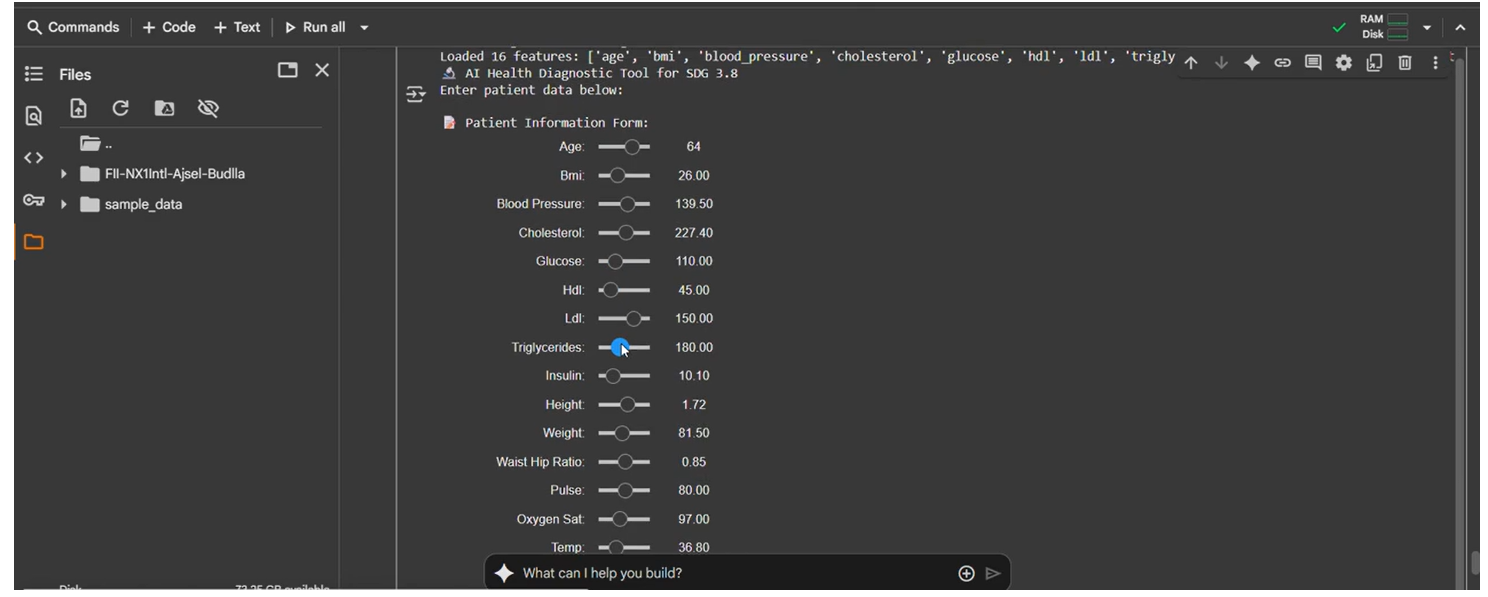
EquiHER is a diagnostic risk flagging tool. It uses a neural network trained on synthetic medical data to identify patients who may be at higher risk of being misdiagnosed, with special attention to patterns that can affect women. It analyzes 15 clinical variables and achieves about 84–87% accuracy.
I built the project by first creating a synthetic dataset using medically realistic ranges, since real medical data is restricted. I cleaned and normalized the features, then trained a neural network with the architecture:
15 → 128 → 64 → 32 → 2
The hidden layers use ReLU activation, and the output layer uses the sigmoid function:
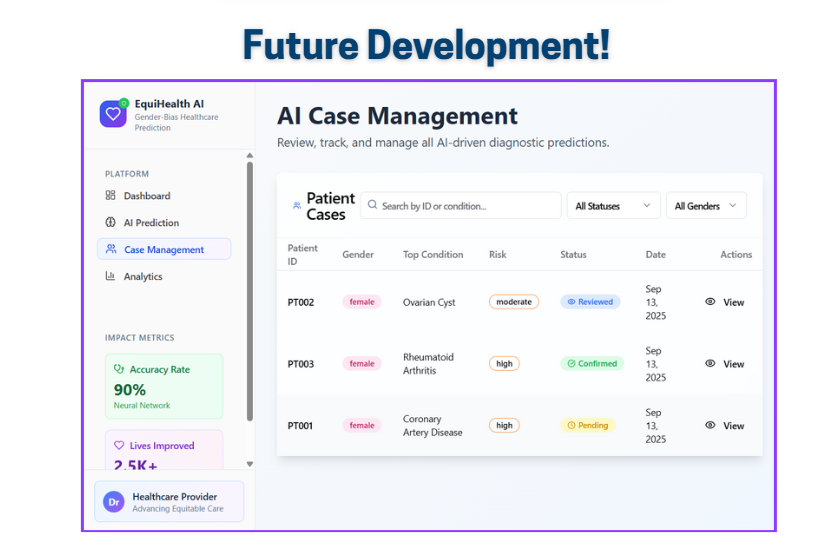
The model is trained using binary cross-entropy loss: $$ L = - \sum_{i=1}^{n} y_i \log(\hat{y}i) $$ where \( y_i \) is the true label and \( \hat{y}_i \) is the predicted probability. The weights are updated using gradient descent: $$ \theta{t+1} = \theta_t - \eta \nabla L(\theta) $$ One of the main challenges was designing synthetic data that was realistic enough to train a meaningful model without introducing artificial bias. I also had to carefully prevent overfitting and make sure the system remains clinician-supportive rather than clinician-replacing. Through this project, I learned that in healthcare, performance is not only about accuracy, it is also about fairness, trust, and responsible use. EquiHER supports SDG 3.8 by improving diagnostic quality within universal healthcare, and SDG 5 by addressing gender-based bias in medical systems. What’s next for EquiHER includes testing on real anonymized datasets, integrating explainable AI methods, implementing fairness metrics such as equalized odds, and developing a deployable clinician dashboard.

Log in or sign up for Devpost to join the conversation.