
Why I built equen
In more than ten years as a software engineer, I have been through many difficult conversations. Today I mentor junior engineers, which often means listening to their concerns and, at times, giving hard guidance.
One thing I keep noticing: many people in the younger generation approach work calmly, from a little distance, and seem uneasy when high expectations are placed on them. This is only my guess, but in a world that frames work and personal life as opposites, they may be afraid of putting too much of themselves into their work. Saying "I enjoy my job" or "my work feels meaningful" can seem a little uncool.
I don't want to dismiss that view. But now that so many ways of working are visible, I believe we need to help each person find a way of working they can approach with dignity. That means a manager sometimes has to state a demanding expectation clearly, watch closely how the other person responds, and take that response seriously.
That can't be learned at a desk. Most managers already understand what it takes to explain something logically. The hard part is the moment the other person gets defensive, deflects, or pushes back. Pause too long and you lose their trust, so you have to answer quickly. Under that pressure, you need to cut your message down to what matters most and say it while still accepting the person in front of you. The only way to learn that is to say it out loud and fail, many times.
That is why I built equen.
What it does
equen is an iPhone app for rehearsing tough conversations with the people you work with, whether you are their manager or their peer.
There are already many conversation rehearsal apps. equen differs from them in three main ways.
1. Pressure that feels like the real thing
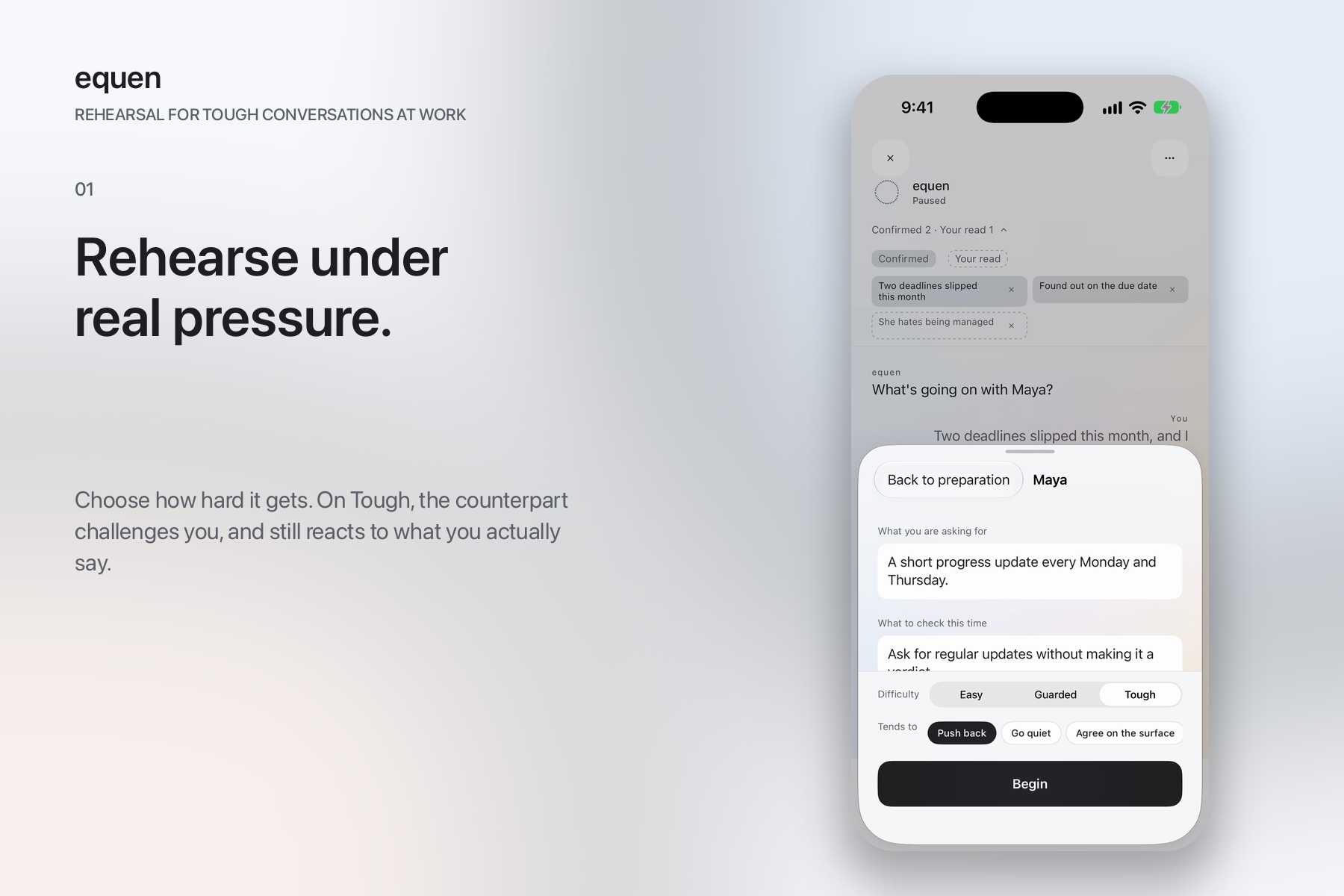
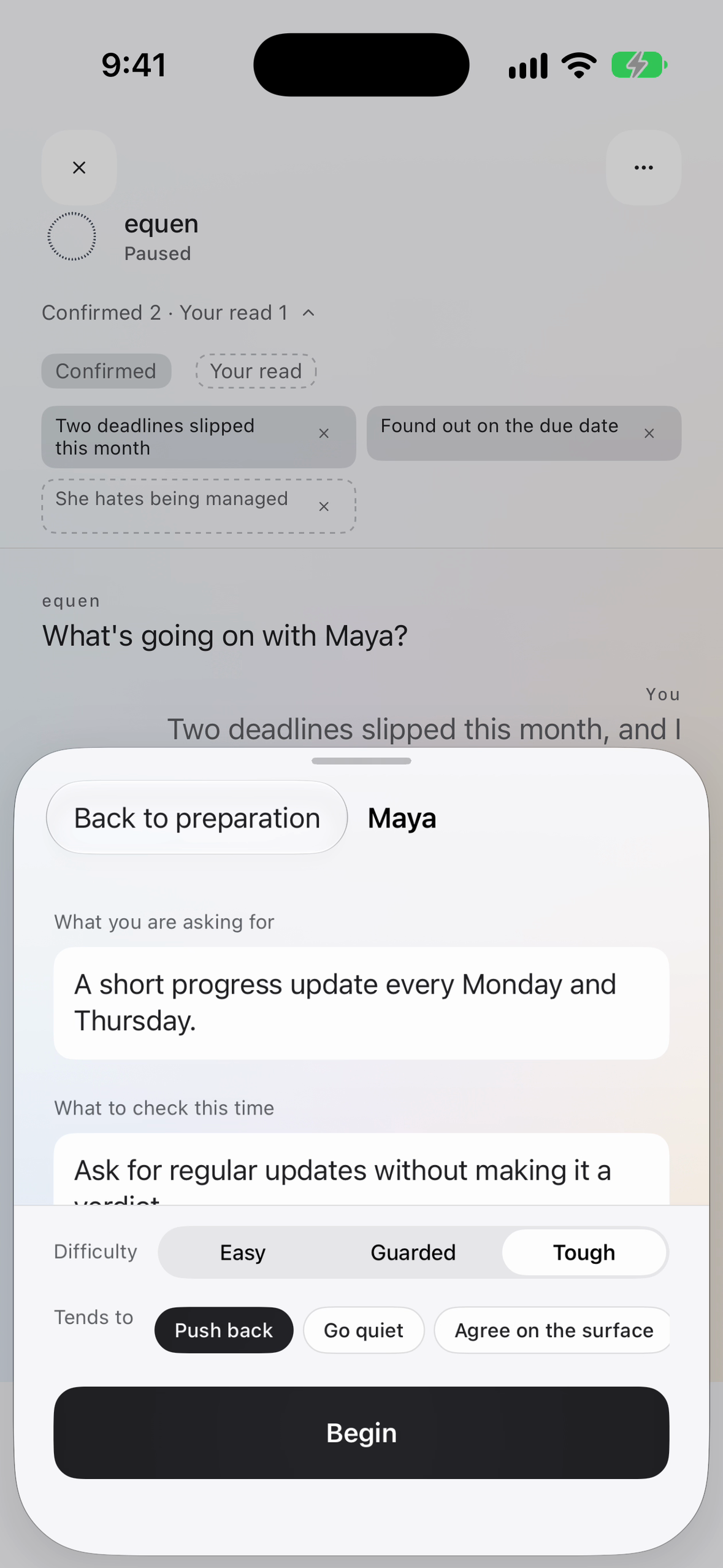
I concluded that the most important thing in a rehearsal is enough pressure. A counterpart that praises your first answer is not practice. equen's AI counterpart hesitates, deflects, misunderstands, and pushes back.
You can set how defensive the counterpart is. At the maximum, it challenges you aggressively and critically. Ask for "progress updates on a fixed schedule, every time," and a direct report might brush it off: "Sounds like a problem with how you manage."
Realism here does not mean simple hostility. The counterpart responds to what you actually said. It has its own position and background, and it may take time to understand you. I aimed for rehearsals that make the real conversation feel easier by comparison. Try it, and compare how the counterpart's defensiveness feels with other rehearsal apps.
2. A conversation you can run by voice alone
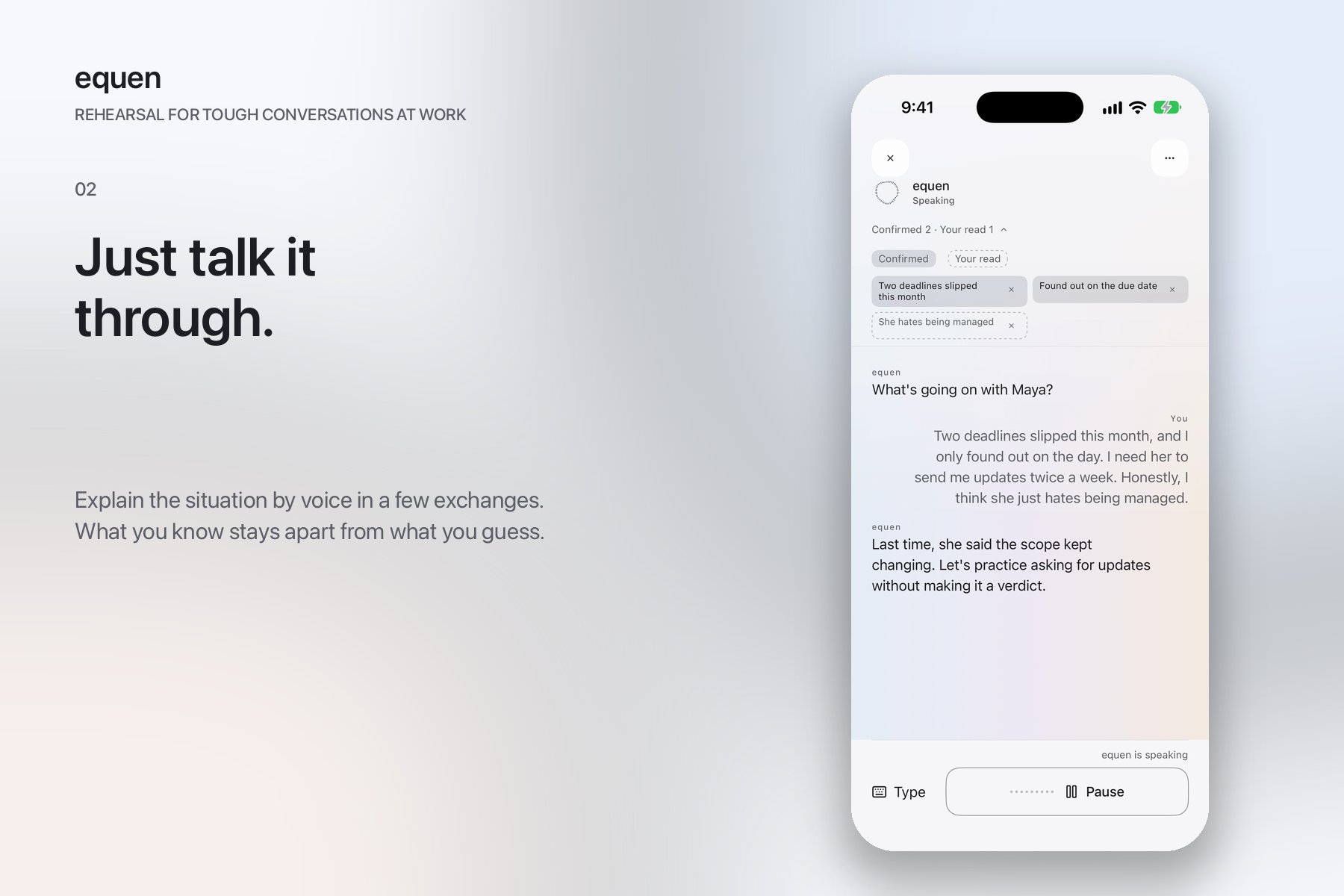
Not only the rehearsal, but also the setup can be done by voice. In a few exchanges with an AI coach, you can sort out what happened, what you have already tried, and what you want to ask of the other person.
Content read from rough notes, text, images, and documents can also be added to that context.
To keep the conversation flowing, I carefully tuned interruptions, silences, turn-taking, and the timing of each response.
3. Person memory
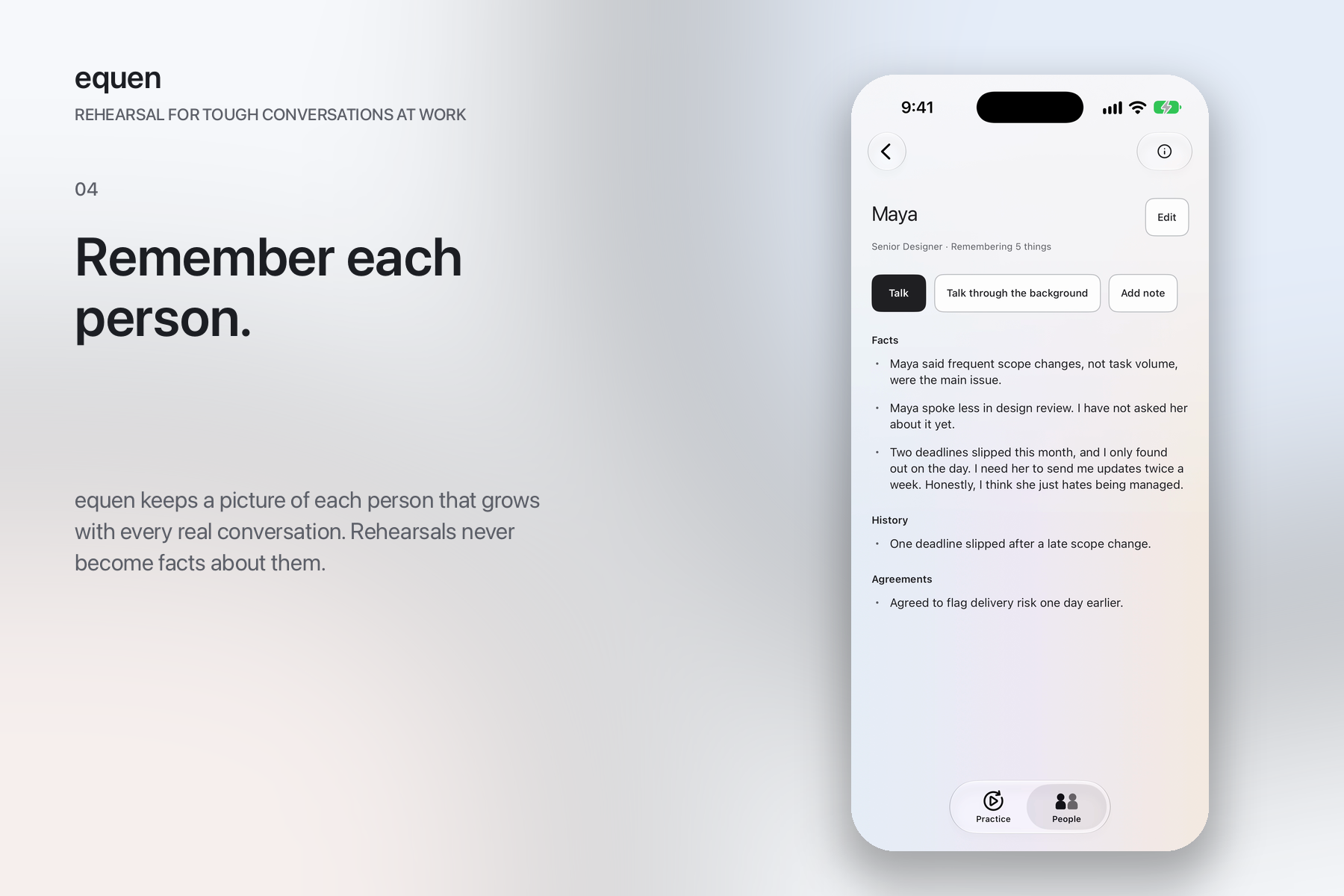
equen remembers background for each person you talk with. What you first describe by voice is combined into a single profile of that person, and it is updated whenever a new topic brings new background. Through the flow of real work, a manager can gradually build a fuller picture of the other person and rehearse with a more realistic counterpart.
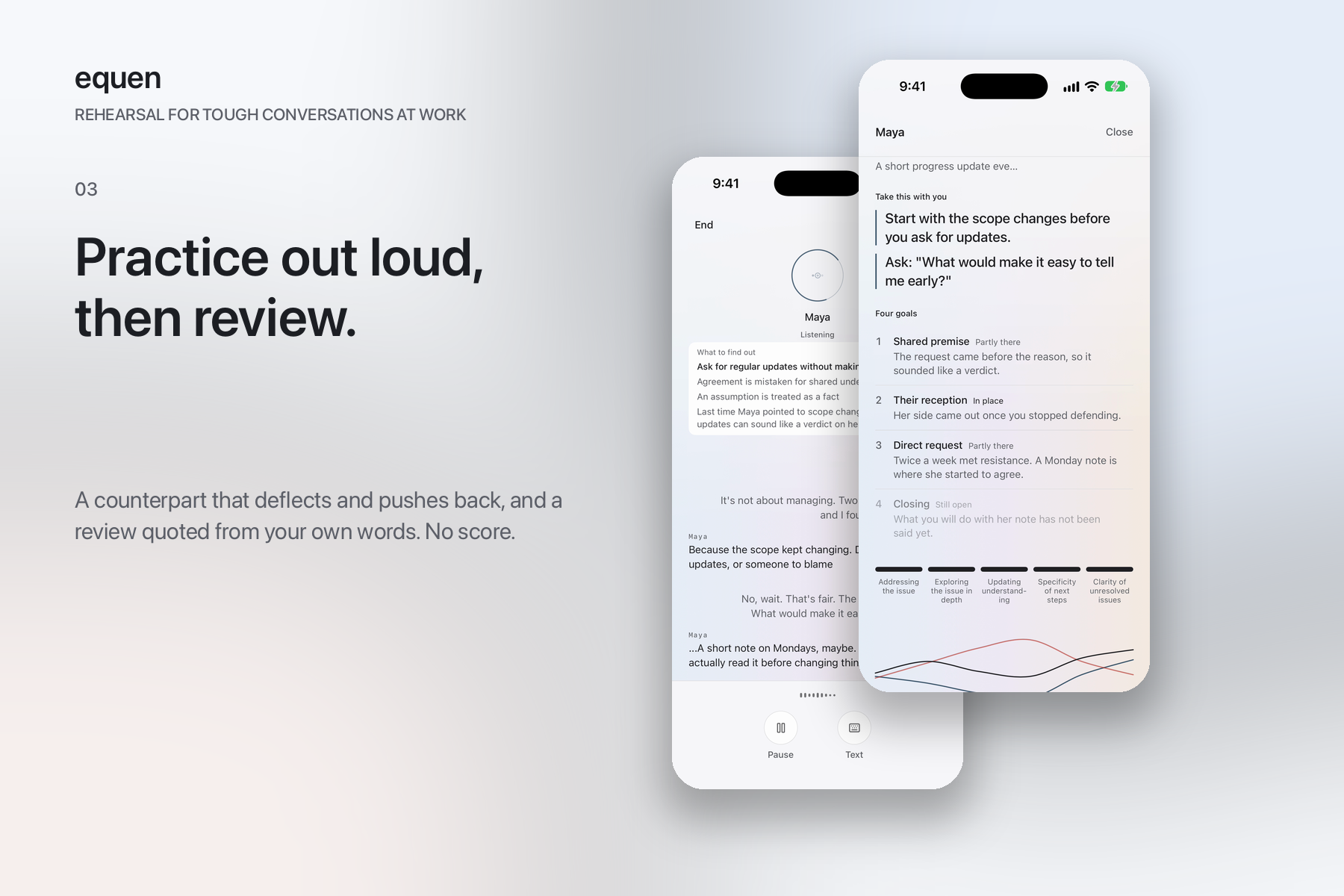
Rehearsals themselves are never saved to that person's record, because a simulation includes things that never actually happened. Person memory only holds what you entered yourself, plus the agreements, open questions, and new background you record after the real conversation. The reflection after each rehearsal is also grounded in the words you actually said.
Privacy, and what equen does not do
equen does not record real meetings. It does not score people, diagnose personalities, or make employment decisions. People, notes, preparation, and confirmed records are stored on the iPhone. Anything processed by AI is explained each time and sent only with your consent.
The hardest part
Calibrating the pressure. Too weak, and it isn't practice. Too strong, and it becomes plain harassment. The counterpart has to respond coherently to your words without going easy on you. I rebuilt that balance many times, along with voice timing such as interruptions, silences, and turn-taking.
What I am proud of
The experience comes full circle. equen does not end with an AI report. Preparation, rehearsal, reflection, a record of the real conversation, and the next conversation with the same person are all connected.
What's next
Ideally, you would practice with an AR or VR headset, seeing the other person's face. For now equen is voice-only, but I want to recreate the pressure that comes with eye contact and facial expressions.
In the near term, I want working managers to use it over time so I can see how rehearsal changes their real conversations. I also want to keep the counterpart's quality high across different cultures and relationships, and find out what kind of reflection you can still recall in the middle of the real conversation.
Personally, I hope the people around me can spend their days facing their work with bright eyes. I would be glad if equen can support the conversations that make that possible.
Award entry
equen is entered in the Shipaton 2026 Influencer Award — Career Coaching: Leadership Heather category.

Log in or sign up for Devpost to join the conversation.