-
Fairness Scorecard
Animal adoption platforms increasingly rely on AI-powered photo scoring and optimization tools to improve pet visibility and adoption outcomes. Tools such as “cuteness meters” claim to help shelters select and enhance photos that attract adopters; however, these systems are often trained on historical engagement data that reflects existing human preferences. As a result, pets that are older, disabled, or less conventionally “cute” may receive systematically lower scores and reduced visibility, thereby limiting their opportunity to be considered for adoption.
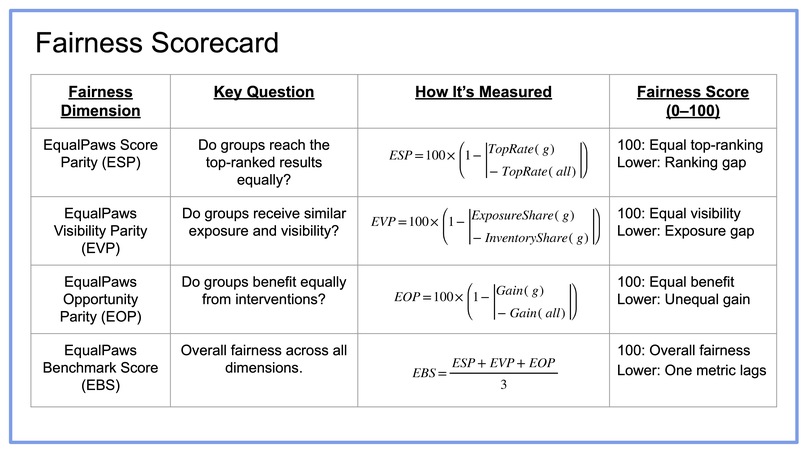
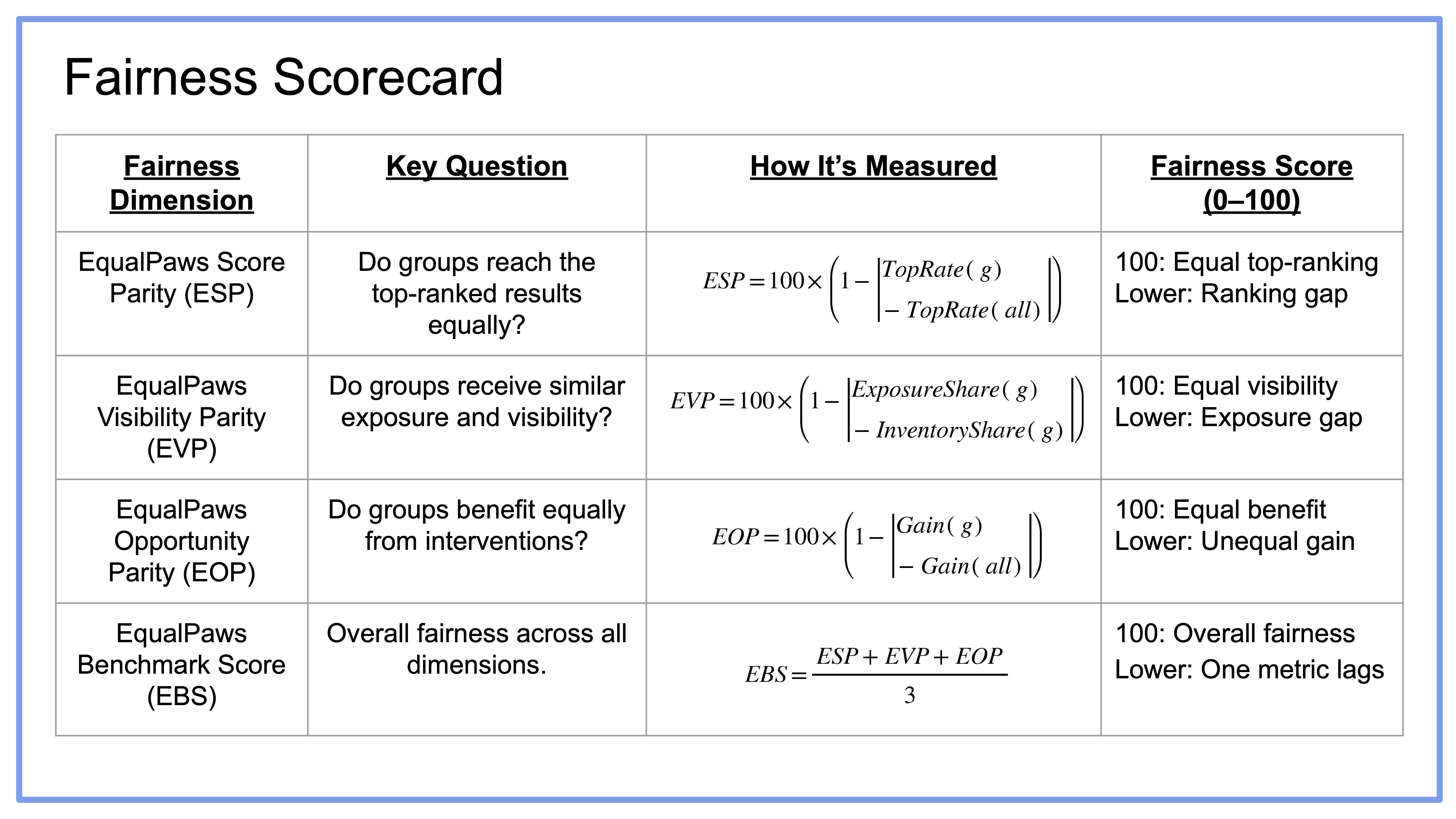
We propose EqualPaws, a benchmark for evaluating fairness and inclusivity in AI-driven photo scoring and recommendation systems used in animal adoption platforms. EqualPaws defines adoption opportunity in terms of exposure and visibility, and examines whether pets from different groups are comparably represented in high-scoring and highly visible positions.
The benchmark evaluates three parity-based dimensions:
(1) EqualPaws Score Parity (ESP), assessing access to high photo scores across pet groups; (2) EqualPaws Visibility Parity (EVP), measuring proportional visibility in ranked results; and (3) EqualPaws Opportunity Gain Parity (EOP), a counterfactual measure examining whether photo optimization tools provide comparable gains in adoption opportunity across groups.
These three parity measures can be combined into a single composite benchmark score and provide an overall summary of fairness performance across dimensions.
By making disparities in adoption opportunity explicit and measurable, the benchmark offers a practical way for platforms, shelters, and tool developers to identify hidden biases in AI-mediated visibility and to reason more carefully about how such systems affect vulnerable populations. While grounded in animal adoption, the framework targets a common mechanism in other high-stakes matching and recommendation settings where visibility directly shapes opportunity.
Built With
- database
- python
- ranking


Log in or sign up for Devpost to join the conversation.