-
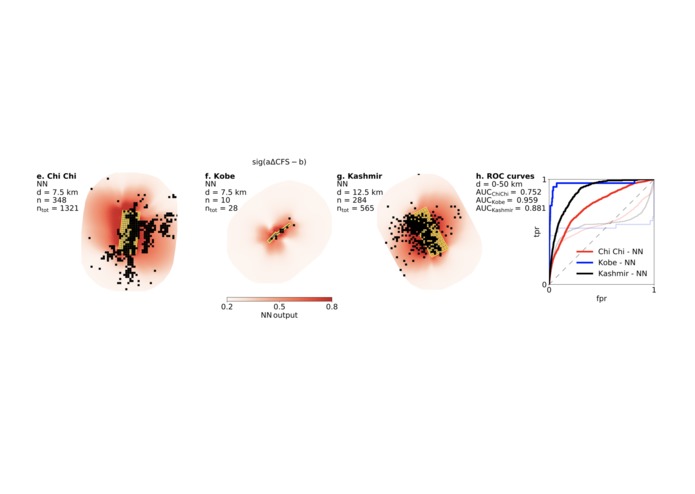
The AUC Curves and Spatial Distribution for 3 different data-points
-
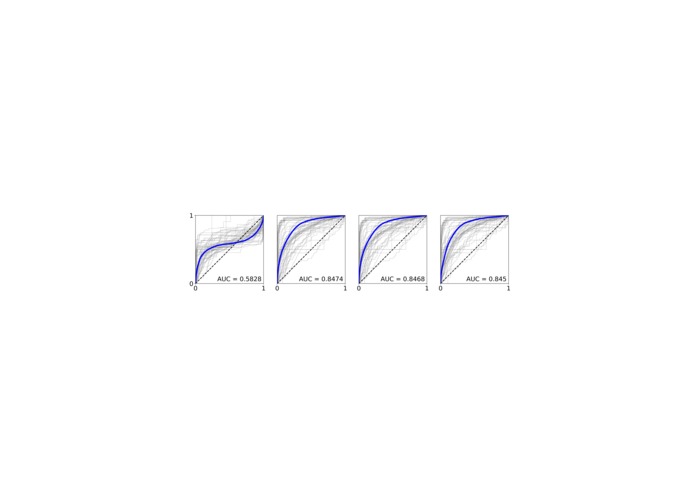
Comparison with 3 different methods.
Inspiration
Aftershocks are unpredictable tremors occurring on the surface of the earth between 1 second to 1 year after a major earthquake. These aftershocks can sometimes be equally life threatening and can cause serious injury to individuals. Unfortunately, there has been no way of knowing when or where will they occur and whether they will be fatal or not.
Using the Company Challenges for Natural Disaster Mitigation as our inspiration, we took this opportunity to come up with a Deep Learning Approach to predict the spatial location of these Aftershocks within a 150 KM radius from the epic centre.
What it does
Following the recent research paper published in Nature (2018) link, our 7 Layer Neural Network, inputs the magnitudes of the six independent components of the co-seismically generated static elastic stress-change tensor calculated at the centroid of a grid cell, and output the predicted probability whether the grid cell generates one or more aftershocks.
How we built it
We built the model using Keras, the high-level neural networks API, written in Python, running on top of Theano. The model used two NVIDIA RTX 2080Ti GPUs on the Rutgers University iLab Clusters, to train and predict the probabilities.
Challenges we ran into
After the model was ready, we needed to push it to production in the form of a hit and fetch results, API module. Being a researcher, I have never done that before, and my teammate and I ran into problems figuring out the basics.
Accomplishments that we're proud of
Achieved a good Test Accuracy of 84.56 using the model to predict the locations of Aftershocks on a never touched Test Dataset.
What we learned
Rapid Prototyping and Hyper Parameter Tuning.
What's next for Equake
Possible switch to PyTorch and building efficient models.

Log in or sign up for Devpost to join the conversation.