-
-
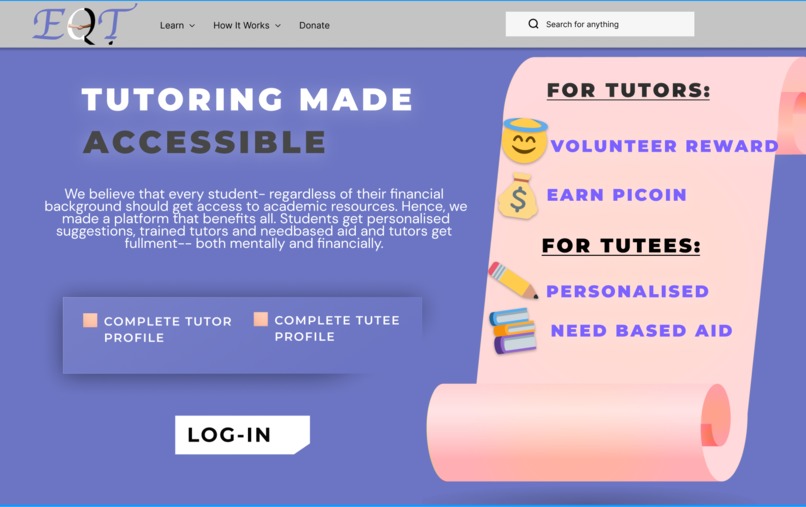
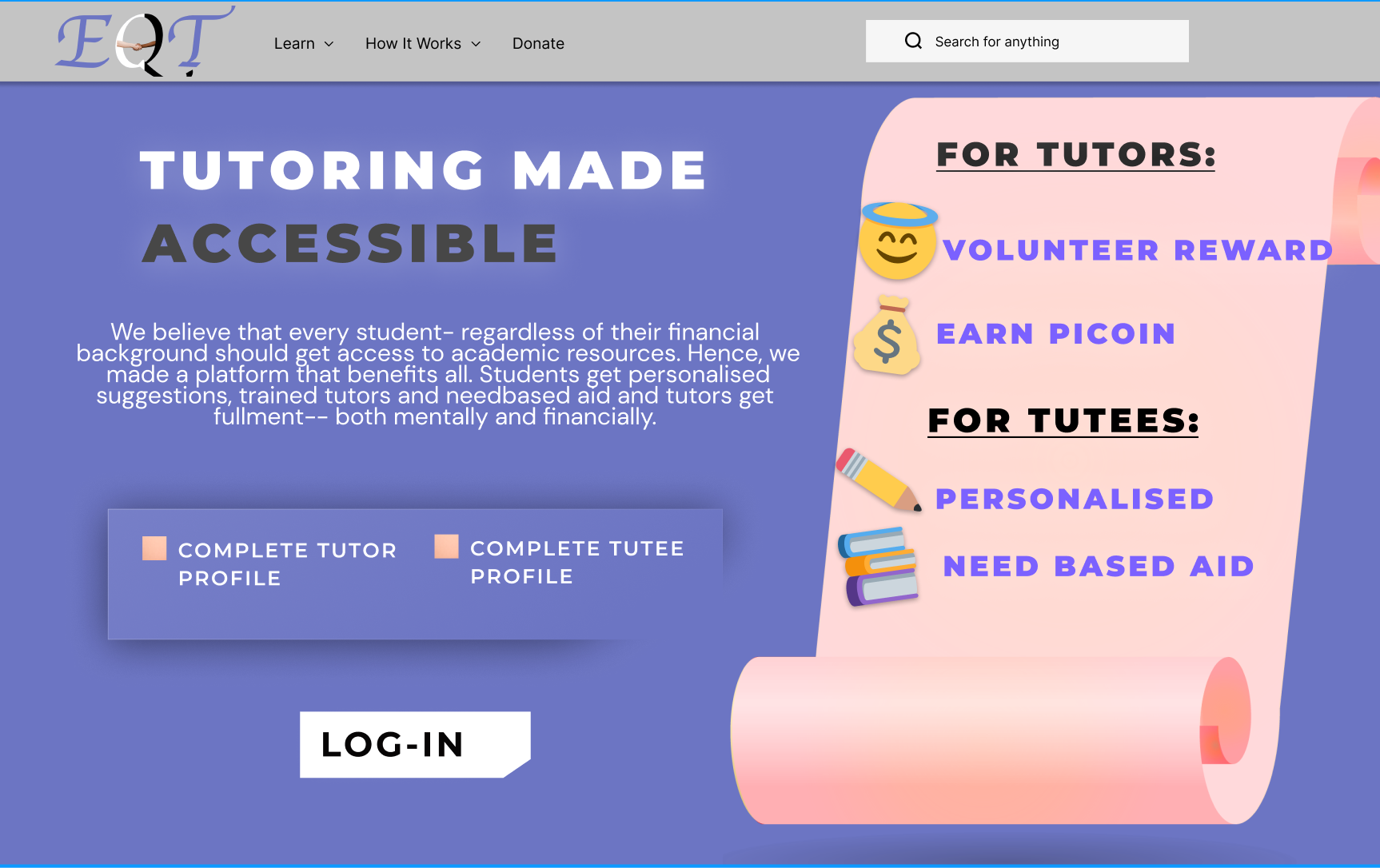
Front page
-
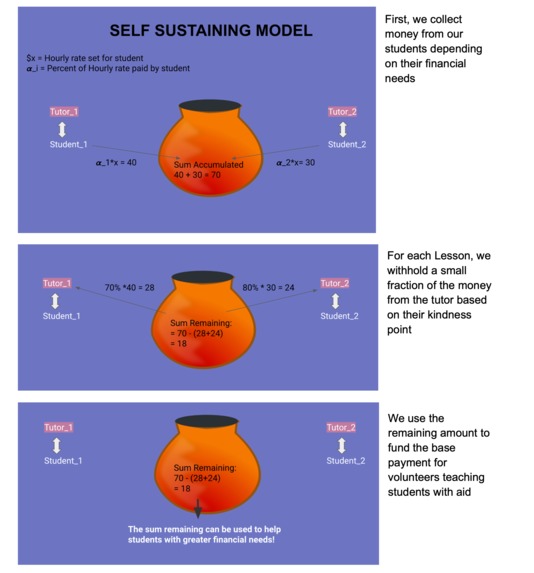
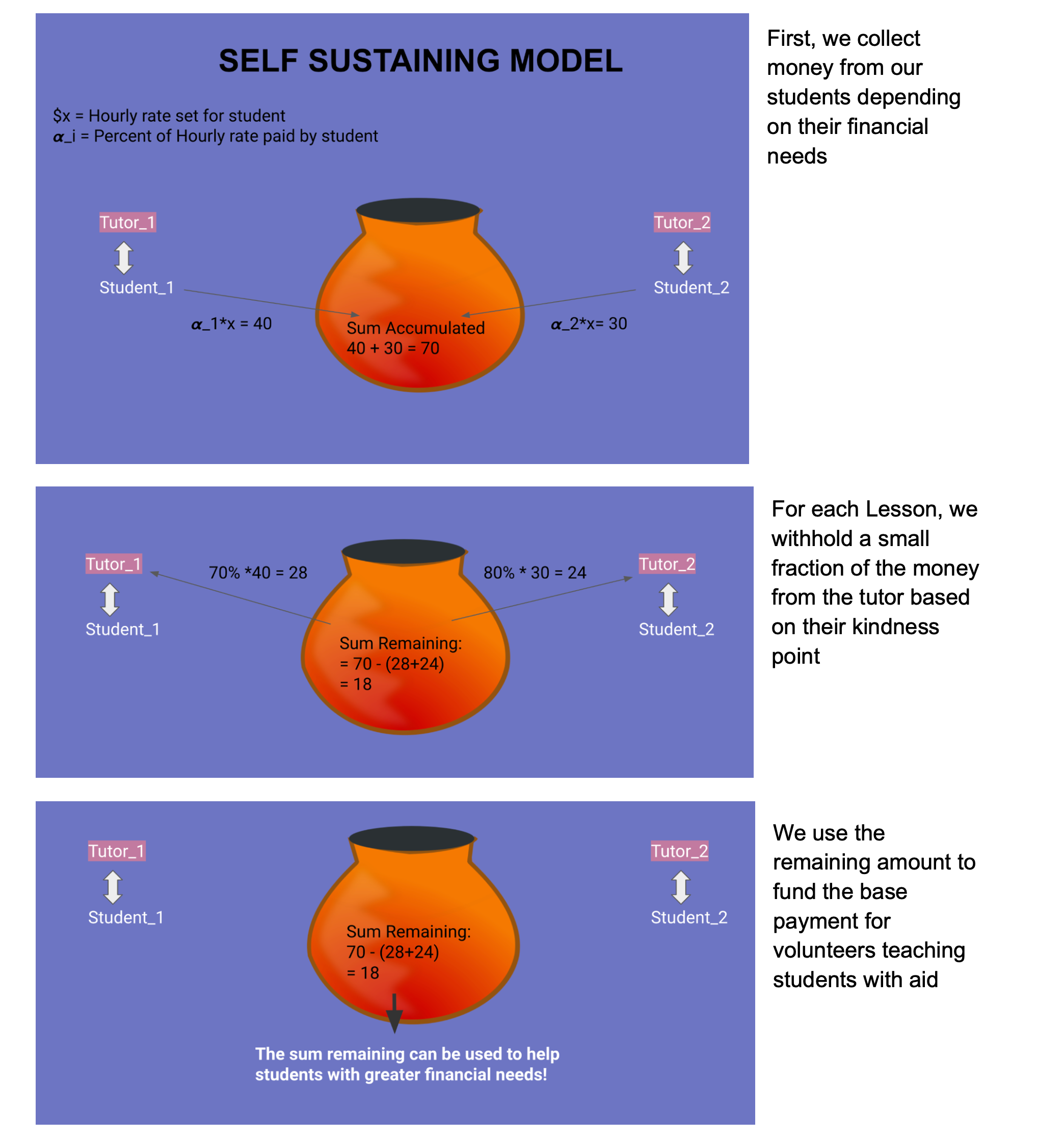
Sustainable Business model
-
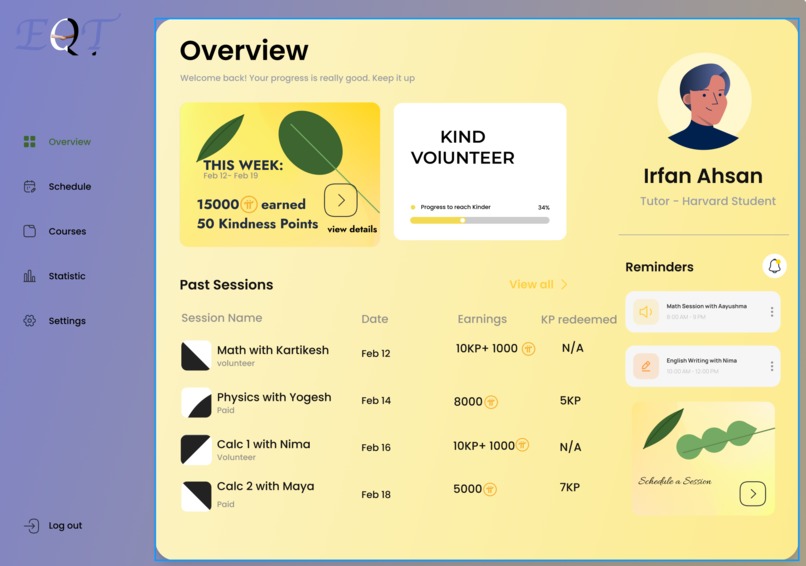
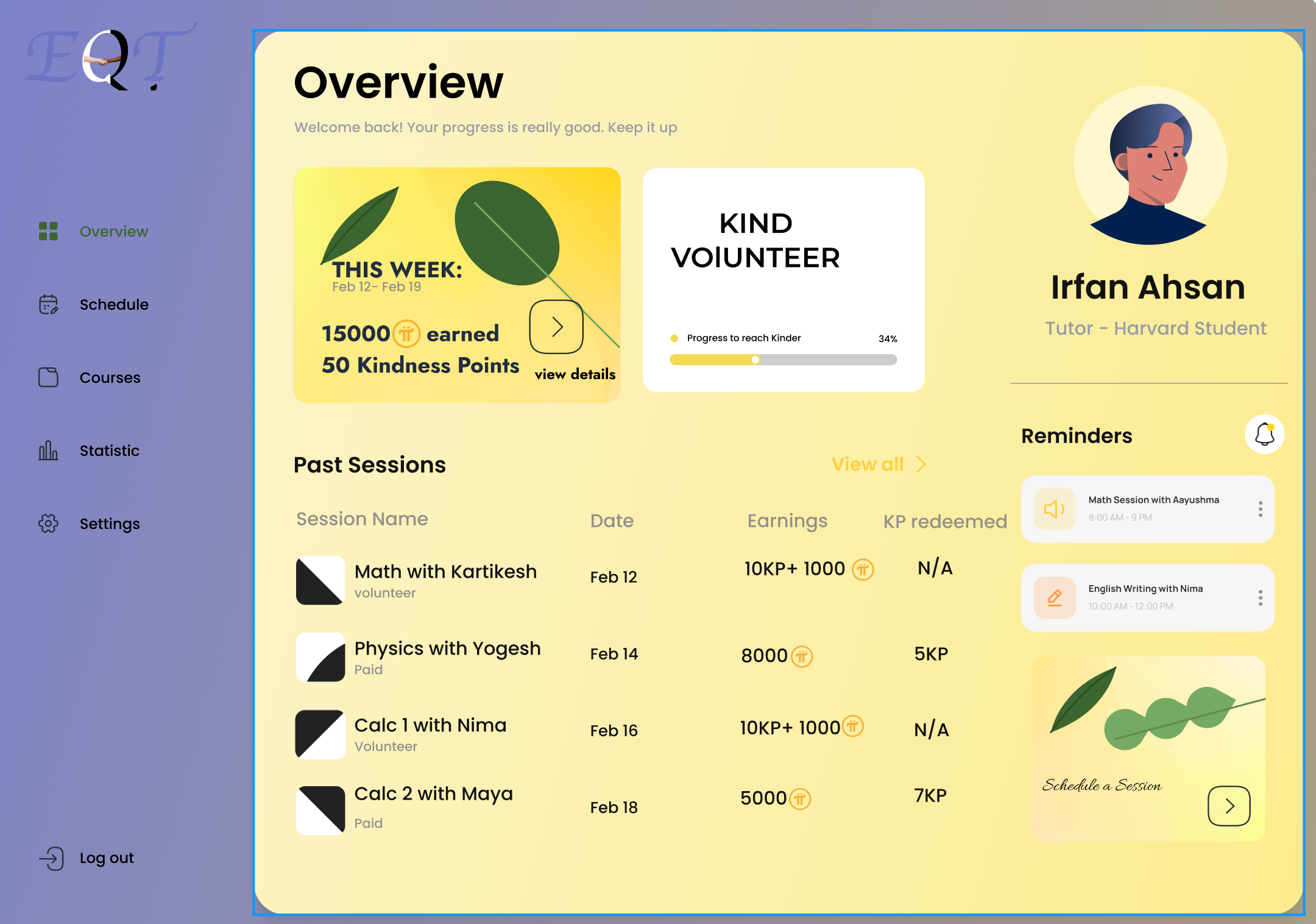
Tutor Profile
-
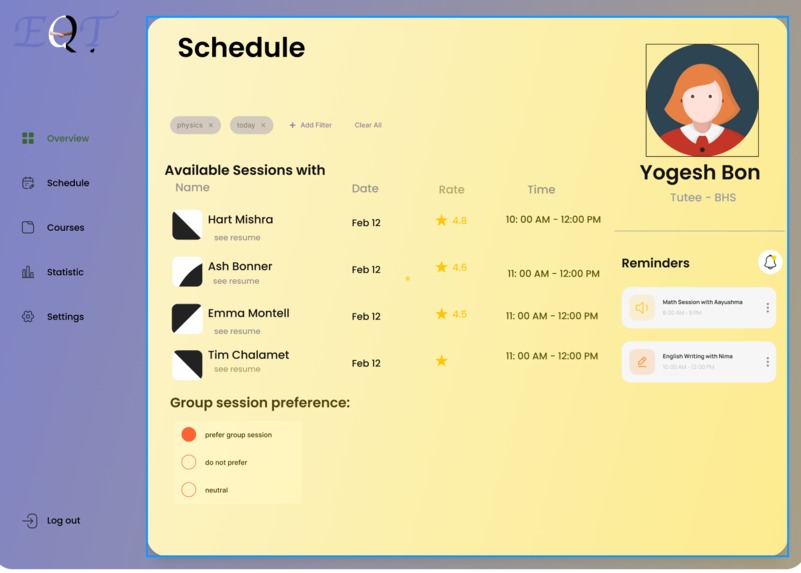
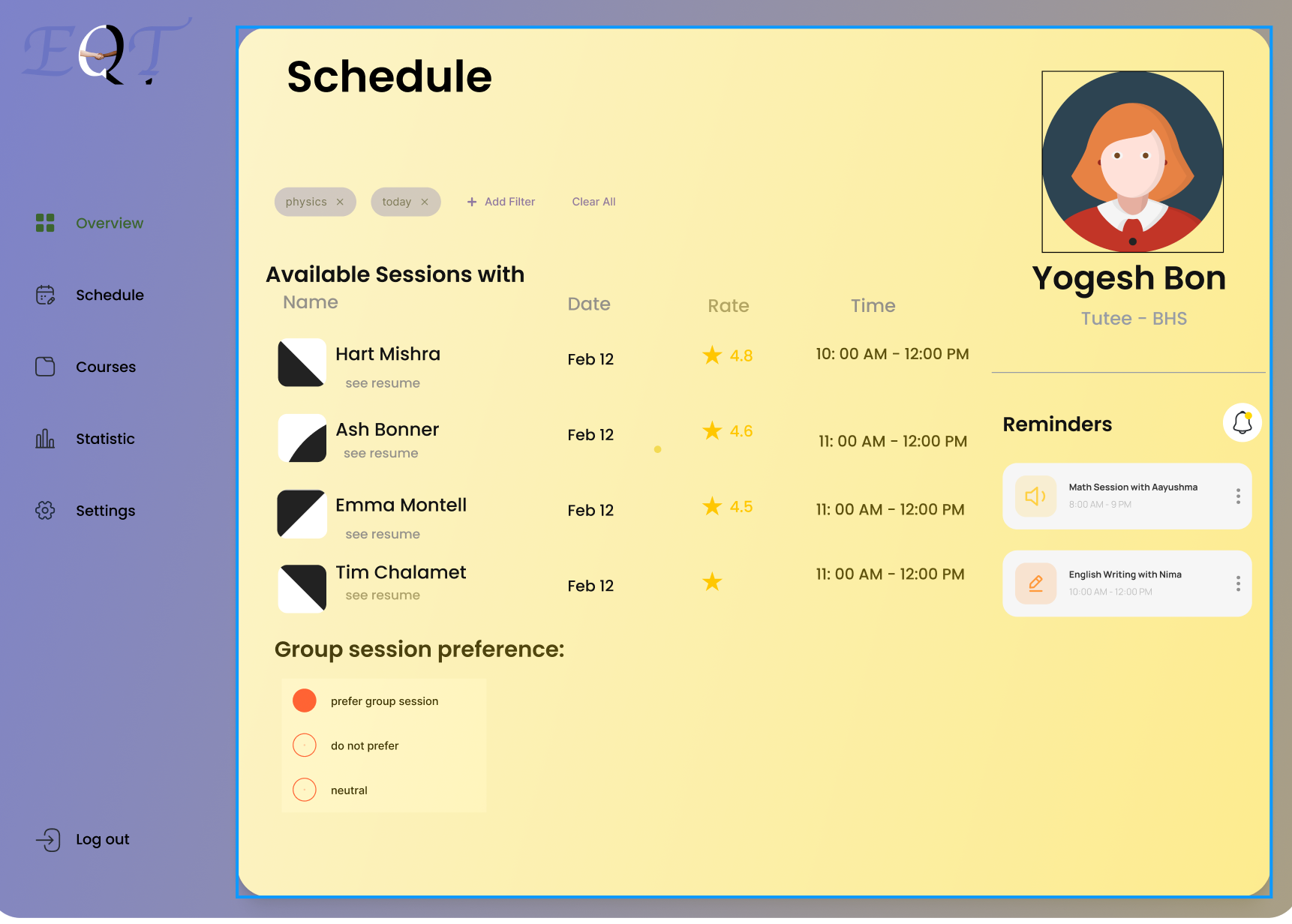
Tutee Scheduler
Inspiration:
Right now, tutoring is needed more than ever. The pandemic and initial school closures have increased inequality in educational outcomes across racial and socioeconomic lines, creating an urgency to identify programs and policies—such as tutoring—to mitigate COVID learning loss. At the same time, the pandemic further widened socioeconomic gaps.
In fact, not just tutoring but, accessible and equitable education is needed more than ever. Several non-profit organizations are trying to make that a reality but are usually constrained by funding or manpower. Our app, EQT, solves this problem.
What it does:
It creates personalized tutor and tutee matches and give need-based aid to tutees who need them with the help of the tutors who are incentivized to volunteer-- while earning. Each tutor can sign up to entirely volunteer or subsidize the cost for students and earn kind points while still receiving base pay. They can then redeem kindness points and get money proportional to kindness in form of PI-coins, which is a blockchain technology allowing for more decentralized, secure, and transparent transactions. Moreover, tutors can advance to different levels of volunteering-- KIND, KINDER, KINDEST, and SUPER-KINDEST to get a permanent base pay raise!
The app also shows ratings, reviews, and resumes of matched tutors so all tutees regardless of financial need can choose from a handful of their matches. Moreover, group tutoring sessions for up to 3 people (the optimal number of tutees according to research for a better learning environment) can also be scheduled. This allows tutees from diverse cultures and socio-economic backgrounds to connect and form meaningful friendships. Our platform allows tutees to connect with tutors/mentors who are leaders in their fields and gain valuable skills/mentorship.
How we build it:
Using SQL, Node.js and piNETWORK, HTML, figma and github
Challenges we ran into
Thinking about the sustainable financial model was an involved task.
What's next
Right now primarily focus on high school, but we can scale it to middle school, and elementary school for the most impact. This is essential because classroom learning has decreased relatively proportionally across all levels of the educational system. We plan to transcribe Figma to the front end to improve our existing front end and add extended functionality to the app.
If you want to read more about the app and our research/inspiration
The COVID-19 Pandemic and initial school closures have increased inequality in educational outcomes across racial and socioeconomic lines, creating an urgency to identify programs and policies—such as tutoring—to mitigate COVID learning loss. The COVID educational loss impacts students in disadvantaged backgrounds more compared to their counterparts with high socioeconomic ranking. In fact, according to a Pew Survey, 20% of upper-class households have hired someone to help with their children's educational needs, while only 7% of households in lower and middle-class households have hired someone. According to the OECD, the COVID-19 learning loss is projected to decrease GDP by 1.5% per year, on average. This is assuming that the learning loss can be recovered. However, this is an extremely tricky situation; if COVID learning loss has occurred proportionally among all age groups. As a result, teachers will need to modify their instruction to fill in those gaps. This is true for all levels of education; therefore, it is difficult to see how this can be recovered for those already in school as we'll be lowering the level of the studies for those in school to re-compensate for the learning loss. Therefore, the potential GDP loss is likely to be even higher. Loss in GDP is not only detrimental to the quality of life, but it also slows growth and innovation. Possessing fewer skills as a result of learning loss means workers will have decreased wages over their lifetime. In fact, the OPDC estimates the loss in income to be 3% over the lifetime of those who experienced learning loss due to COVID. In addition, this affects individuals in different socioeconomic groups disproportionately. Since those on the higher economic ladder can afford to learn outside of the classroom, their reduced income is not quite as large as the reduction in income of those who can not afford to learn outside the classroom. This is why we're seeking to make our tutorial services as accessible as possible, and usable even by those traditionally unable to afford tutorial services.
The benefits of this will be felt everywhere. The cut in the projected loss of GDP means all workers have higher skill levels. With the GDP as good as it can possibly be, the economy of the US--as a whole--will be at its best level. This means, in general, the general well-being of the country as a whole would be higher than what it would be with the effects of the COVID-19 learning loss.
So, in fact, not just tutoring but, accessible and equitable education is needed more than ever. Several non-profit organizations are trying to make that a reality but are usually constrained by funding or manpower. Our app, EQT, solves this problem. We create personalized tutor and tutee matches and give need-based aid to tutees who need them with the help of the tutors who are incentivized to volunteer-- while earning. Each tutor can sign up to entirely volunteer or subsidize the cost for students and earn kind points while still receiving base pay. They can then redeem kindness points and get money proportional to kindness in form of PI-coins, which is a blockchain technology allowing for more decentralized, secure, and transparent transactions. Moreover, tutors can advance to different levels of volunteering-- KIND, KINDER, KINDEST, and SUPER-KINDEST to get a permanent base pay raise!
The app also shows ratings, reviews, and resumes of matched tutors so all tutees regardless of financial need can choose from a handful of their matches. Moreover, group tutoring sessions for up to 3 people (the optimal number of tutees according to research for a better learning environment) can also be scheduled. This allows tutees from diverse cultures and socio-economic backgrounds to connect and form meaningful friendships. Our platform allows tutees to connect with tutors/mentors who are leaders in their fields and gain valuable skills/mentorship.
Now, you may ask, what makes our tutoring service different from others? We pride ourselves in being driven by the belief that anyone can learn and we just need to provide the right resources for people to learn. We strongly believe in our mission, and we hire people who do the same. We envision our volunteers to be strongly passionate about bridging the educational gap, and we believe that passion will drive the volunteers to do great things that money may not necessarily lead them to.
Now, another question is how do we provide need-based aid? We attract students from a wide range of socioeconomic backgrounds due to the qualifications of our tutors. Students who can afford to pay for their tutoring sessions are welcomed with as much zeal and enthusiasm as students who are not able to, and, in fact, we anticipate much more students from predominantly advantaged socioeconomic backgrounds. This is due to the nature of private tutoring; it is more predominant and easily accessible to students with high economic standing. We also provide high quality training to tutors from workshops and Q&A events hosted by students from top universities around the world. We’ve seen–across many hackathons, campus clubs, and social events–that people are willing to share the knowledge they have, and they do not shy away from teaching other people about their We see in a lot of university students the desire to teach others about their difficult, complicated work; this will expand the tutor’s horizon, which establishes a suitable environment to transfer the tutor’s knowledge into his tutees. Experiences like this will attract students from predominantly advantaged backgrounds. Furthermore, there is an incentive for economically privileged students to use EQT since their simple use of EQT could transform the experience for students disadvantaged by their economic situation. In addition, in an ever-growing diverse, globalized world, it is more important than ever to be able to get along with more people from diverse backgrounds. EQT–with the group tutoring services as well–allows for a perfect avenue to build these skills for people of all backgrounds. Diversity, we believe, makes people strong problem solvers and will only contribute to a greater understanding of themselves and the world around them.
This approach is also well scalable, not just with regards to the school year of the student. Right now primarily focus on high school, but we can scale it to middle school, and elementary school for the most impact. This is essential because classroom learning has decreased relatively proportionally across all levels of the educational system. In addition, we have the ability to scale it to different countries and increase the well-being of residents of the countries as they can benefit from recovering from that GDP loss.


Log in or sign up for Devpost to join the conversation.