-
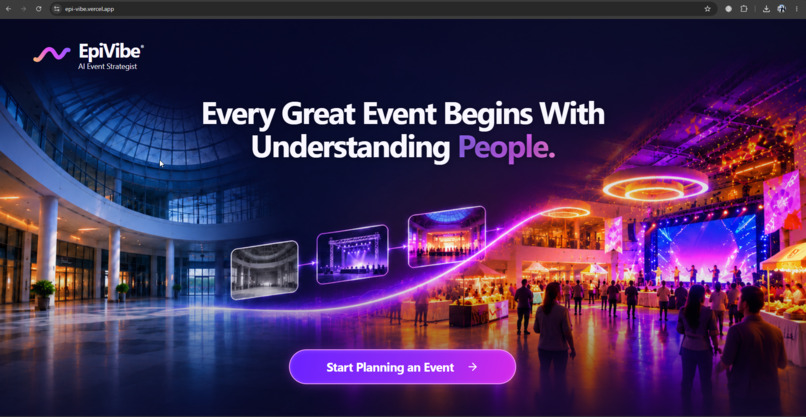
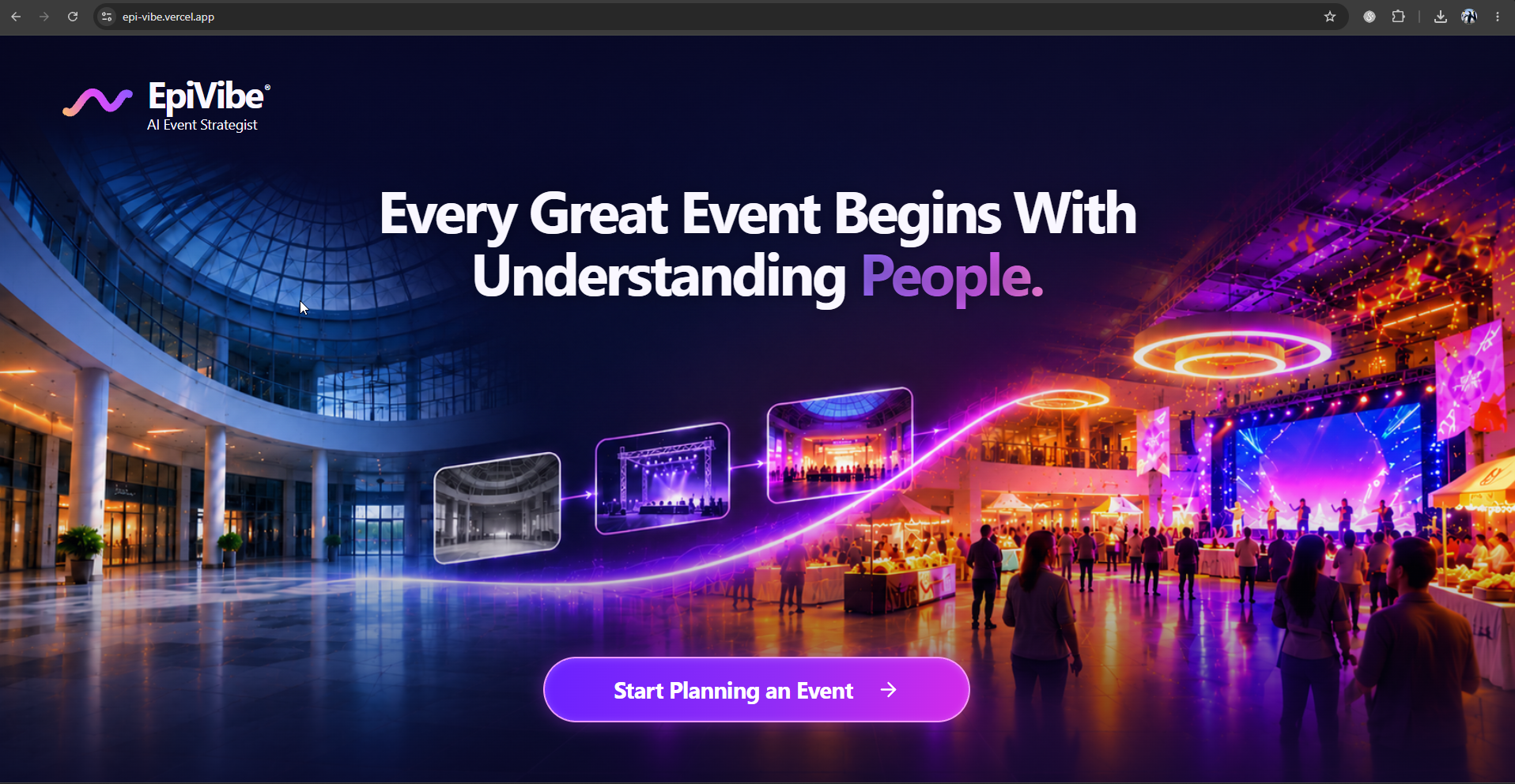
EpiVibe landing page
-
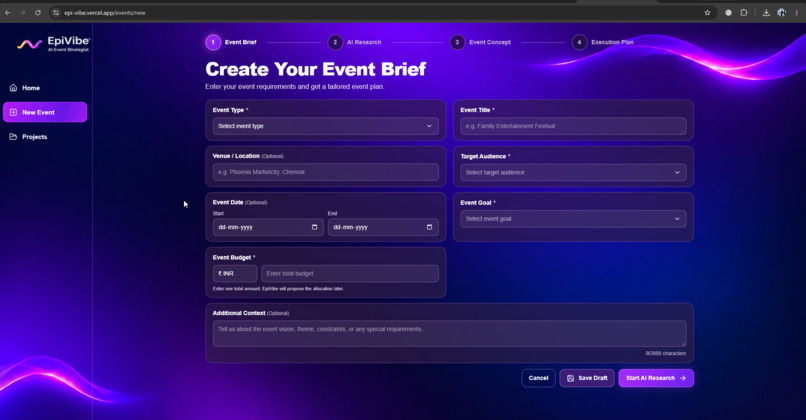
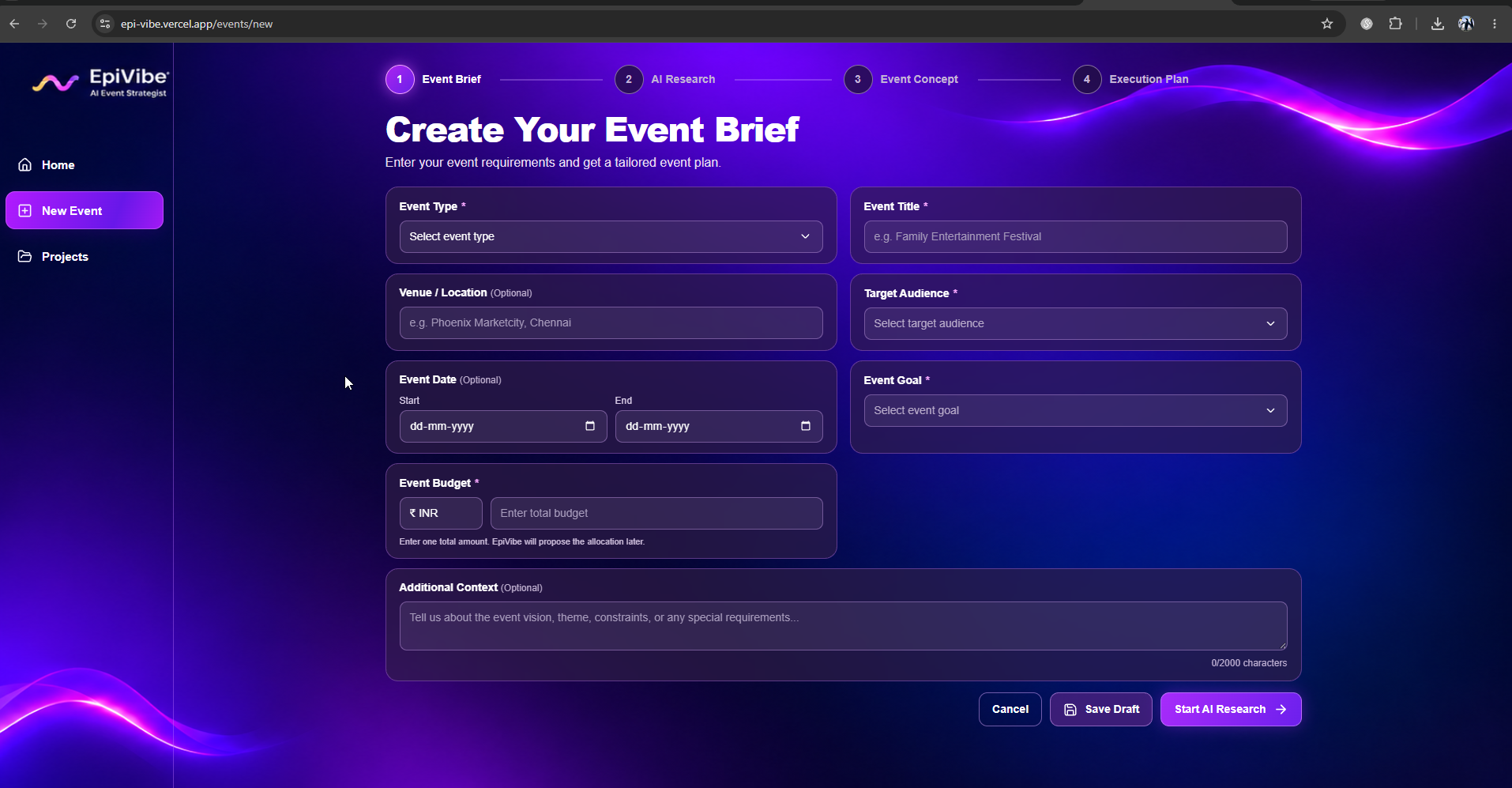
Event creation interface
-
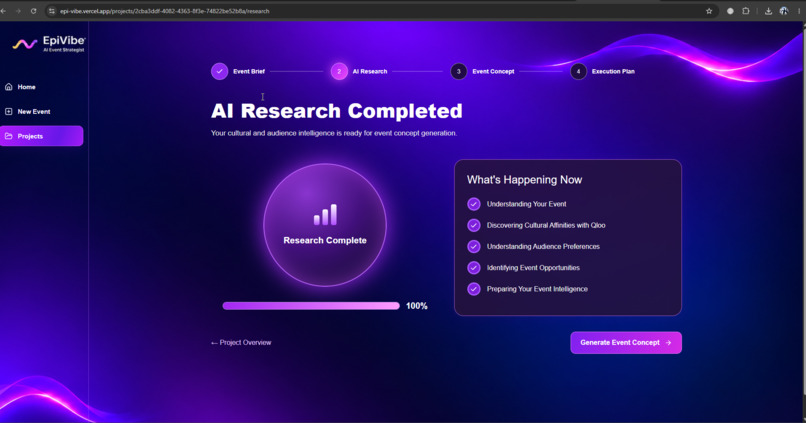
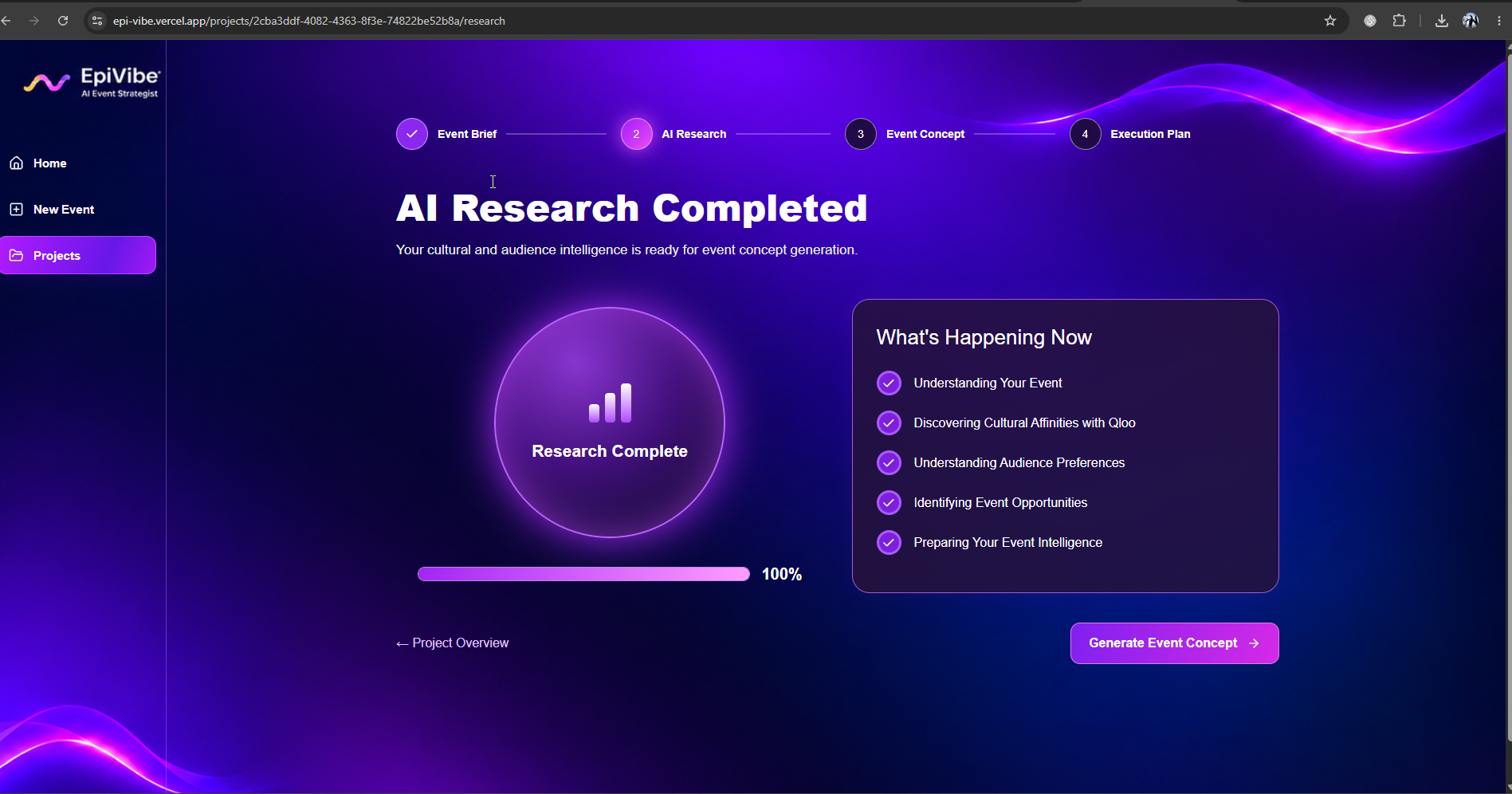
AI Research results showing Qloo cultural intelligence
-
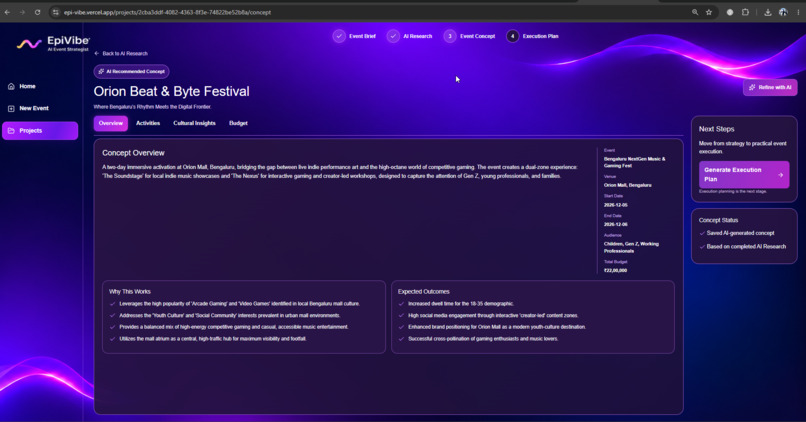
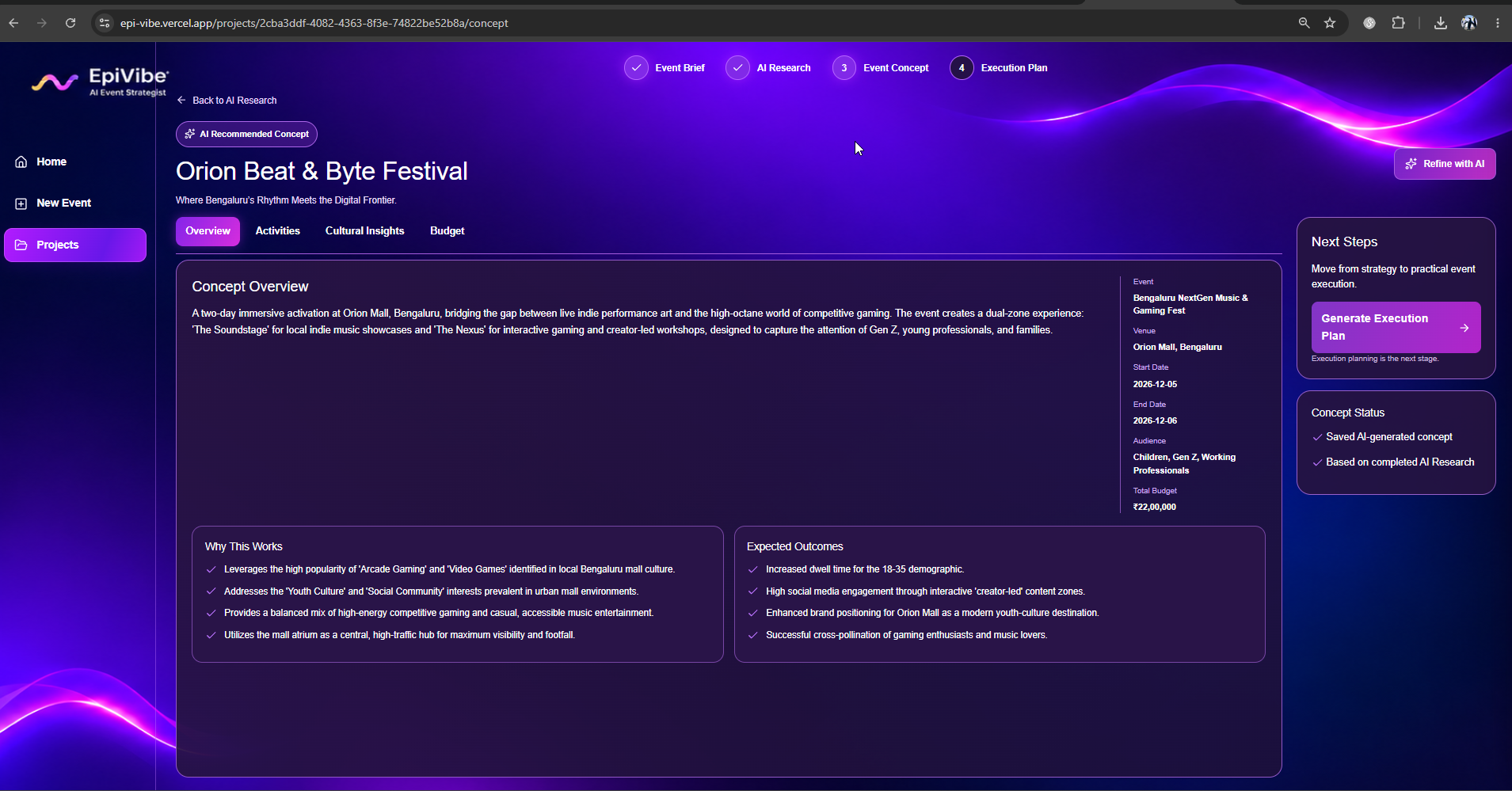
Event concepts
-
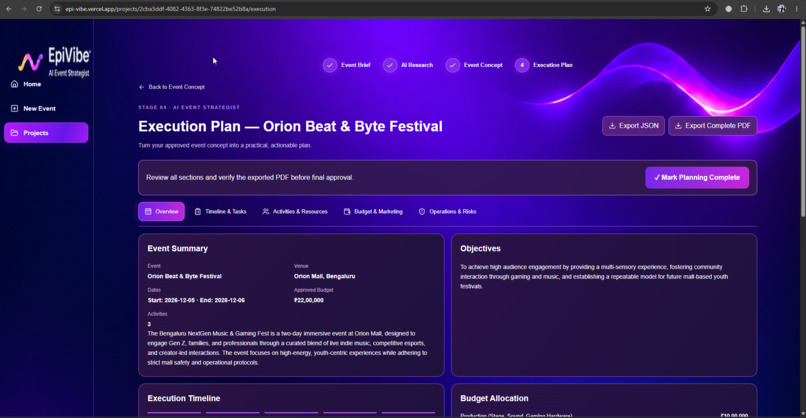
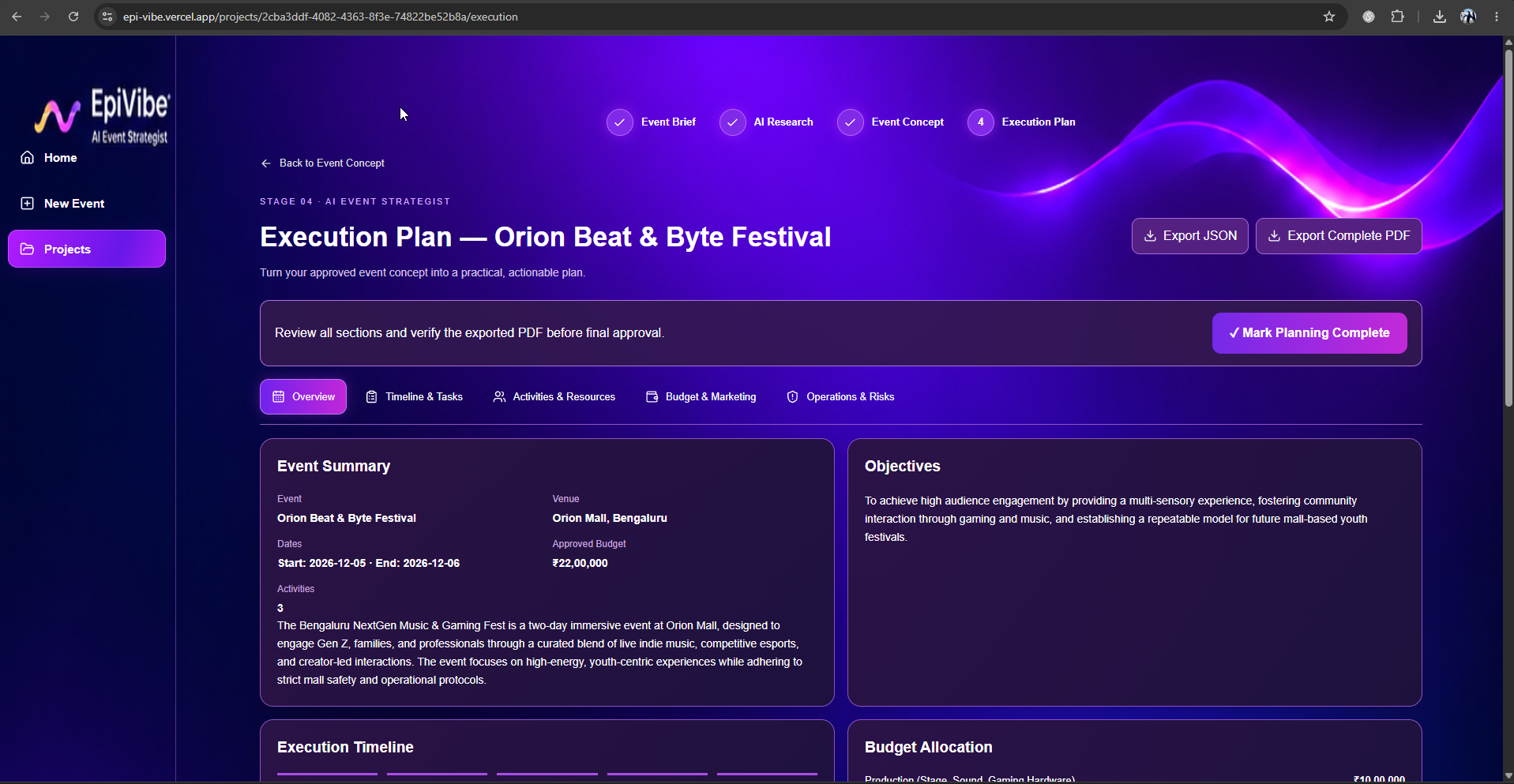
Execution plan
Inspiration
Every Great Event Begins With Understanding People.
Events bring people together. Whether it's a corporate conference, music festival, cultural celebration, product launch, brand activation, community gathering, or shopping mall experience, successful events share one essential characteristic: they connect with their audience.
However, creating that connection is not easy.
Event organizers and agencies must make numerous decisions before an event takes place:
- Who is the target audience?
- What interests, experiences, and cultural preferences resonate with them?
- Which event themes and activities are most relevant?
- How can the event stand out from competing experiences?
- How should the available budget be allocated?
- How can creative ideas be translated into an executable plan?
These decisions often require extensive research, brainstorming, coordination, and repeated revisions.
Traditional event-planning approaches depend heavily on manual research, professional experience, and assumptions about audience preferences.
Generative AI has made brainstorming easier, but generating an attractive event idea is not the same as developing an audience-informed event strategy.
We identified an opportunity to connect cultural intelligence, AI-powered creativity, and practical event planning in a single platform.
That idea became EpiVibe.
Our inspiration was to build an AI event strategist that goes beyond generating generic recommendations.
We wanted to create a platform that could understand event requirements, incorporate cultural-affinity insights, develop creative concepts, support human decision-making, and translate selected ideas into actionable execution plans.
By combining Qloo's cultural intelligence with Google Gemini, EpiVibe explores how AI can help event professionals make more informed creative and planning decisions.
Our vision is simple:
Make culturally informed event strategy accessible to every event organizer.
What it does
EpiVibe — From Cultural Intelligence to Event Execution
EpiVibe is an AI-powered event strategy and planning platform designed for:
- Professional event organizers and event management agencies
- Corporate event and conference teams
- Marketing, advertising, and experiential agencies
- Brands organizing launches and promotional experiences
- Venue operators and shopping mall management teams
- Festival, entertainment, and cultural event organizers
- Community organizations and businesses planning audience-focused events
The platform helps users transform event requirements into culturally informed concepts and structured execution plans.
Rather than providing a single AI-generated answer, EpiVibe guides users through a connected four-stage planning workflow.
Stage 1 — Create an Event Brief
Every event begins with a clear understanding of its requirements.
Users create an event brief containing information such as:
- Event name and location
- Venue and geographical context
- Event dates and duration
- Available budget
- Target audience
- Business or engagement objectives
- Event preferences and requirements
- Seasonal or festival context
These inputs establish the foundation for the subsequent AI-assisted planning stages.
EpiVibe uses the event brief to maintain context throughout the planning journey.
Stage 2 — AI Research and Cultural Intelligence
This stage introduces the cultural-intelligence capabilities that differentiate EpiVibe from conventional AI brainstorming tools.
EpiVibe integrates Qloo's API to bring cultural-affinity information into the event research process.
Qloo's cultural intelligence provides a way to explore relationships between audience interests and cultural preferences.
EpiVibe uses this research context to inform its event-planning workflow.
The objective is to move beyond assumptions and generic event recommendations by incorporating external cultural signals.
For example, event organizers may need to understand which types of entertainment, lifestyle interests, cultural themes, or experiences could be relevant to their intended audience.
EpiVibe brings cultural research into the same workflow where event concepts and execution plans are developed.
Stage 3 — AI-Generated Event Concepts
After the research stage, EpiVibe generates two alternative event concepts.
Each concept offers a different creative direction while considering the original event requirements and available research context.
Concepts include planning information such as:
- Event theme and creative direction
- Concept overview and positioning
- Intended audience
- Cultural and experiential relevance
- Suggested activities and attractions
- Budget considerations
- Event highlights and engagement opportunities
Presenting alternatives allows event professionals to compare creative approaches before committing to a strategy.
AI-Powered Concept Refinement
Event planning is rarely completed with the first idea.
EpiVibe supports conversational refinement, allowing users to request modifications to a proposed concept.
For example, users can ask the AI to adjust the event experience, change the creative direction, reconsider activities, or align the concept more closely with their objectives.
The refinement workflow supports reviewing proposed changes and comparing versions before accepting modifications.
This creates a human-in-the-loop planning experience, where AI assists with recommendations while the event professional retains decision-making control.
Stage 4 — AI-Generated Execution Plan
A creative event concept becomes valuable when it can be executed.
Once the user selects a concept, EpiVibe develops a structured execution plan.
The plan helps translate the selected event strategy into practical implementation activities.
It organizes planning information into actionable areas that event teams can use to prepare for delivery.
The workflow is designed to connect the original event brief, research context, selected concept, and execution requirements.
Users can review the generated planning information and export supported planning outputs as a PDF.
Saved Projects and Planning History
EpiVibe provides a project management interface where users can access previously created events.
Projects can be revisited based on their planning status.
The deployed application uses PostgreSQL for persistent storage, allowing saved project information to remain available across backend restarts.
What Makes EpiVibe Different?
1. Cultural Intelligence First
EpiVibe incorporates Qloo's cultural-affinity insights into event research instead of relying exclusively on generic language-model knowledge.
2. Strategy Beyond Brainstorming
The platform connects audience understanding with event concepts and execution planning.
3. Human-in-the-Loop AI
Users can review alternatives, request refinements, compare changes, and make the final planning decisions.
4. Structured End-to-End Workflow
Event requirements, research, concepts, and execution planning are connected in one experience.
5. Designed for Multiple Event Industries
EpiVibe is not limited to a single event category or venue type.
Its underlying workflow can support event professionals across corporate, entertainment, cultural, promotional, and community events.
EpiVibe transforms event planning from a collection of disconnected activities into a guided, AI-assisted strategy workflow.
How we built it
EpiVibe was developed as a full-stack web application integrating cultural intelligence, generative AI, backend orchestration, and persistent project storage.
1. Qloo — Cultural Intelligence
Qloo is the cultural-intelligence component of EpiVibe.
We integrated the Qloo API into the application's research workflow to incorporate cultural-affinity information into event strategy development.
This integration is central to our approach.
Instead of using generative AI alone to suggest event themes, EpiVibe is designed to combine external cultural signals with event-specific requirements.
The resulting research context supports the subsequent concept-generation process.
2. Google Gemini — Generative AI
Google Gemini powers AI-assisted planning activities within EpiVibe.
Its responsibilities include:
- Interpreting structured event requirements
- Supporting research synthesis
- Generating alternative event concepts
- Developing creative and experiential recommendations
- Responding to concept-refinement instructions
- Generating structured execution-plan content
Gemini enables EpiVibe to transform planning inputs and research context into organized, human-readable recommendations.
3. React, TypeScript, and Vite — Frontend
We built the user interface using React, TypeScript, and Vite.
The frontend provides a guided planning experience with dedicated interfaces for:
- Creating an event
- Reviewing AI research
- Exploring event concepts
- Selecting and refining concepts
- Reviewing execution plans
- Managing saved projects
The interface was designed to make a complex planning process approachable without requiring users to understand the underlying AI integrations.
The frontend is deployed using Vercel.
4. Python and FastAPI — Backend
The backend is developed using Python and FastAPI.
It coordinates the application workflow, manages project operations, communicates with external AI services, and handles database interactions.
The backend separates application logic from the user interface.
This architecture supports modular development and provides a foundation for future extensions.
The backend is deployed using Render.
5. PostgreSQL — Persistent Project Storage
The deployed application uses Neon PostgreSQL to store project information.
During development, we initially used SQLite.
However, deploying SQLite on a backend service with temporary filesystem storage caused project data to disappear after service restarts.
We introduced PostgreSQL support to address this problem.
The application retains SQLite compatibility for local development.
We successfully tested that saved projects remained available after restarting the deployed backend.
6. Application Architecture
The overall planning workflow is:
Event Brief → Qloo Cultural Research → AI Event Concepts → Human Review and Refinement → Execution Plan
The application consists of four primary technical layers:
Presentation Layer: React and TypeScript frontend.
Application Layer: Python FastAPI backend and planning workflow logic.
Intelligence Layer: Qloo cultural intelligence and Google Gemini.
Data Layer: PostgreSQL for deployed project persistence, with SQLite support for local development.
This modular approach separates user interaction, AI-assisted planning, external integrations, and data management.
7. Deployment
EpiVibe is deployed using cloud services:
- Vercel: Frontend hosting
- Render: FastAPI backend hosting
- Neon: PostgreSQL database
- GitHub: Public source-code repository
The application is accessible through a web browser.
Challenges we ran into
1. Connecting Cultural Intelligence With Event Planning
Our first challenge was determining how cultural-affinity information could become useful to event professionals.
Cultural data alone does not create an executable event.
An organizer must also consider the target audience, event objectives, location, budget, and practical constraints.
We addressed this challenge by designing a structured workflow that connects event requirements with cultural research and AI-assisted concept development.
This allowed us to focus on transforming insights into planning recommendations rather than presenting cultural information in isolation.
2. Designing a Flexible Platform for Different Event Types
Event requirements vary significantly.
A corporate conference has different priorities from a music festival, product launch, community celebration, or shopping mall activation.
We wanted EpiVibe to support different planning contexts without requiring a separate application for each event category.
We approached this through a flexible event brief and a general-purpose concept-generation workflow.
This provides a foundation for supporting multiple event industries.
3. Moving Beyond Generic AI Responses
A conventional chatbot can generate event ideas from a prompt.
Our challenge was to create a more structured experience that incorporates cultural research, produces alternative concepts, and supports refinement.
We addressed this by dividing the planning journey into defined stages and carrying relevant information between them.
This made the application more closely resemble an event strategy workflow than a standalone AI conversation.
4. Maintaining Context and Budget Consistency
Event planning involves connected decisions.
Changing an event concept can affect proposed activities, operational requirements, and budget assumptions.
We worked on preserving the original event brief and maintaining continuity across research, concept generation, refinement, and execution planning.
This was particularly important when users requested modifications to AI-generated concepts.
5. Implementing Human-in-the-Loop Refinement
We did not want users to accept AI-generated recommendations without review.
A key challenge was supporting iterative refinement while preserving user control.
We developed a workflow that allows users to request changes, review proposed modifications, compare versions, and decide whether to accept the updated concept.
6. Database Persistence During Cloud Deployment
One of our most significant technical challenges appeared after deployment.
The initial application used SQLite on Render's temporary filesystem.
Although the application worked, saved project data disappeared after a backend restart.
We resolved this by integrating Neon PostgreSQL for persistent cloud storage while retaining SQLite for local development.
After the change, we successfully tested project persistence across a backend restart.
7. Cloud Integration and Performance
Connecting the frontend, backend, database, and external APIs required resolving deployment and configuration issues.
We addressed frontend-backend communication and database compatibility during integration testing.
Project retrieval latency remains an area for future optimization.
Accomplishments that we're proud of
1. Built a Working End-to-End AI Event Strategy Application
We developed a functional web application that supports a connected planning journey from event requirements through research, concept generation, and execution planning.
This demonstrates the core EpiVibe product concept.
2. Integrated Qloo Cultural Intelligence
We incorporated Qloo's API into the event research workflow.
This is an important foundation for differentiating EpiVibe from event-planning tools that rely exclusively on generative AI.
3. Created a Multi-Stage AI Planning Workflow
EpiVibe organizes event strategy development into four connected stages.
This structure helps users progress from initial requirements toward actionable planning outputs.
4. Developed AI-Assisted Concept Refinement
We implemented a refinement experience that allows users to request changes and evaluate alternatives before making decisions.
This keeps event professionals involved throughout the creative process.
5. Designed for a Broad Event Industry
Rather than building a tool for one type of venue, we designed EpiVibe around a common challenge faced by event professionals:
How can we create experiences that are relevant to the audience while remaining aligned with business objectives and planning constraints?
This approach gives EpiVibe potential applications across multiple event categories.
6. Deployed a Full-Stack Application
We deployed the React frontend, FastAPI backend, and PostgreSQL database.
The application is accessible online and supports saved projects.
7. Solved a Real Deployment Persistence Issue
We identified and corrected a data-persistence problem caused by temporary backend storage.
We verified that saved projects survived a backend restart after moving to PostgreSQL.
8. Established a Foundation for a Commercial Product
EpiVibe demonstrates an opportunity to connect cultural intelligence, generative AI, and professional event planning.
The prototype provides a starting point for further technical development and validation with real event organizers.
What we learned
1. Understanding the Audience Is Fundamental
Event planning should begin with understanding the people an event is intended to attract or engage.
Creative ideas become more meaningful when they are connected to audience interests and cultural context.
2. Cultural Intelligence and Generative AI Serve Different Purposes
Cultural-intelligence data can provide external context about affinities and interests.
Generative AI can help interpret requirements, explore creative possibilities, and organize planning recommendations.
Combining these capabilities offers a promising approach to building more context-aware AI applications.
3. Structured AI Workflows Are More Useful Than Isolated Prompts
We learned that dividing a complex task into stages makes the planning process easier to understand and manage.
A structured workflow also helps maintain continuity between inputs, research, recommendations, and outputs.
4. Human Decision-Making Remains Essential
AI can assist with creative exploration and planning, but event professionals must evaluate recommendations against real business requirements.
We learned the importance of giving users control over concept selection and refinement.
5. Flexibility Is Important for Event Technology
Different event categories require different approaches.
Designing EpiVibe for multiple event types reinforced the importance of flexible inputs and reusable planning workflows.
6. Reliable Infrastructure Is Part of Product Quality
Our deployment experience demonstrated that data persistence and cloud architecture are essential, even for a hackathon prototype.
Moving from temporary SQLite storage to PostgreSQL helped us address a critical reliability issue.
7. AI Products Should Connect Insights With Action
Providing information is only one part of solving a business problem.
The greater opportunity is helping users turn information into decisions and practical next steps.
This principle guided EpiVibe's progression from cultural research to event concepts and execution planning.
What's next for EpiVibe
Our long-term goal is to develop EpiVibe into a comprehensive AI-powered cultural intelligence and event strategy platform for professional event organizers and businesses.
1. Advanced Cultural Intelligence
We plan to expand the use of Qloo's capabilities to support deeper cultural research, audience segmentation, and affinity-based recommendations.
Future development will explore more detailed relationships between audience interests, cultural preferences, event categories, and geographical context.
2. Specialized AI Planning Agents
We aim to introduce specialized AI agents for different planning responsibilities.
Potential capabilities include:
- Cultural research and audience intelligence
- Event concept development
- Budget and feasibility analysis
- Event operations planning
- Vendor and resource coordination
- Event performance analysis
These capabilities could support a more autonomous planning process while preserving human approval for important decisions.
3. Advanced Budget Planning
We plan to introduce more detailed budget allocation, cost estimation, and scenario comparison.
This would help event professionals evaluate the financial implications of different creative directions.
4. Vendor and Partner Ecosystem
Future versions could help organizers discover and coordinate relevant service providers, including venues, entertainment partners, production teams, and event vendors.
5. Event Collaboration
We plan to explore collaboration features for event management agencies and teams.
Potential functionality includes shared projects, assigned responsibilities, approval workflows, and planning updates.
6. Event Performance Intelligence
We want to extend EpiVibe beyond pre-event planning.
Future capabilities could include event performance measurement, audience engagement analysis, and recommendations for improving future events.
7. Improved Performance and Scalability
We plan to optimize backend performance, project retrieval, AI response times, and infrastructure reliability.
These improvements will be important as the application evolves beyond its initial prototype.
8. Industry-Specific Planning Experiences
Although EpiVibe is designed as a general event strategy platform, we see opportunities to develop tailored planning experiences for:
- Corporate events and conferences
- Music and entertainment festivals
- Cultural and community celebrations
- Brand activations and product launches
- Retail and shopping mall events
- Marketing and experiential campaigns
9. Real-World Validation and Commercialization
Our next business milestone is to validate EpiVibe with professional event organizers, agencies, and corporate event teams.
We want to understand their actual workflows, evaluate the usefulness of AI-generated recommendations, and identify opportunities to develop a commercially viable product.
Our Vision
We envision a future where event professionals can move seamlessly from audience understanding to creative strategy and practical execution.
A future where cultural intelligence informs ideas, AI accelerates planning, and humans remain in control of the experiences they create.
EpiVibe — Every Great Event Begins With Understanding People.
Built With
- api
- fastapi
- javascript
- neon
- postgresql
- python
- qloo
- react
- render
- sqlite
- typescript
- vercel
- vite


Log in or sign up for Devpost to join the conversation.