-
-
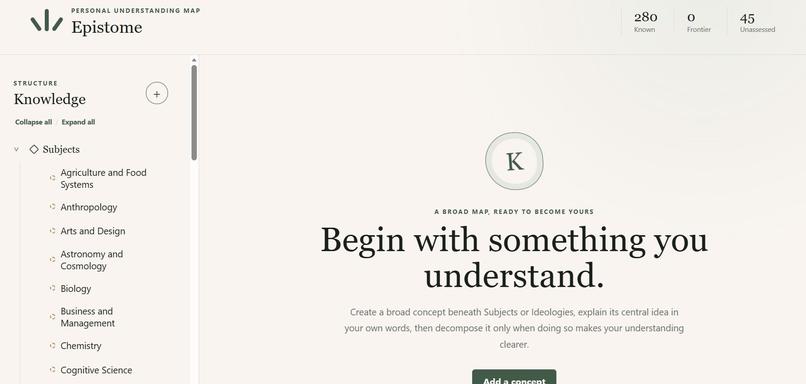
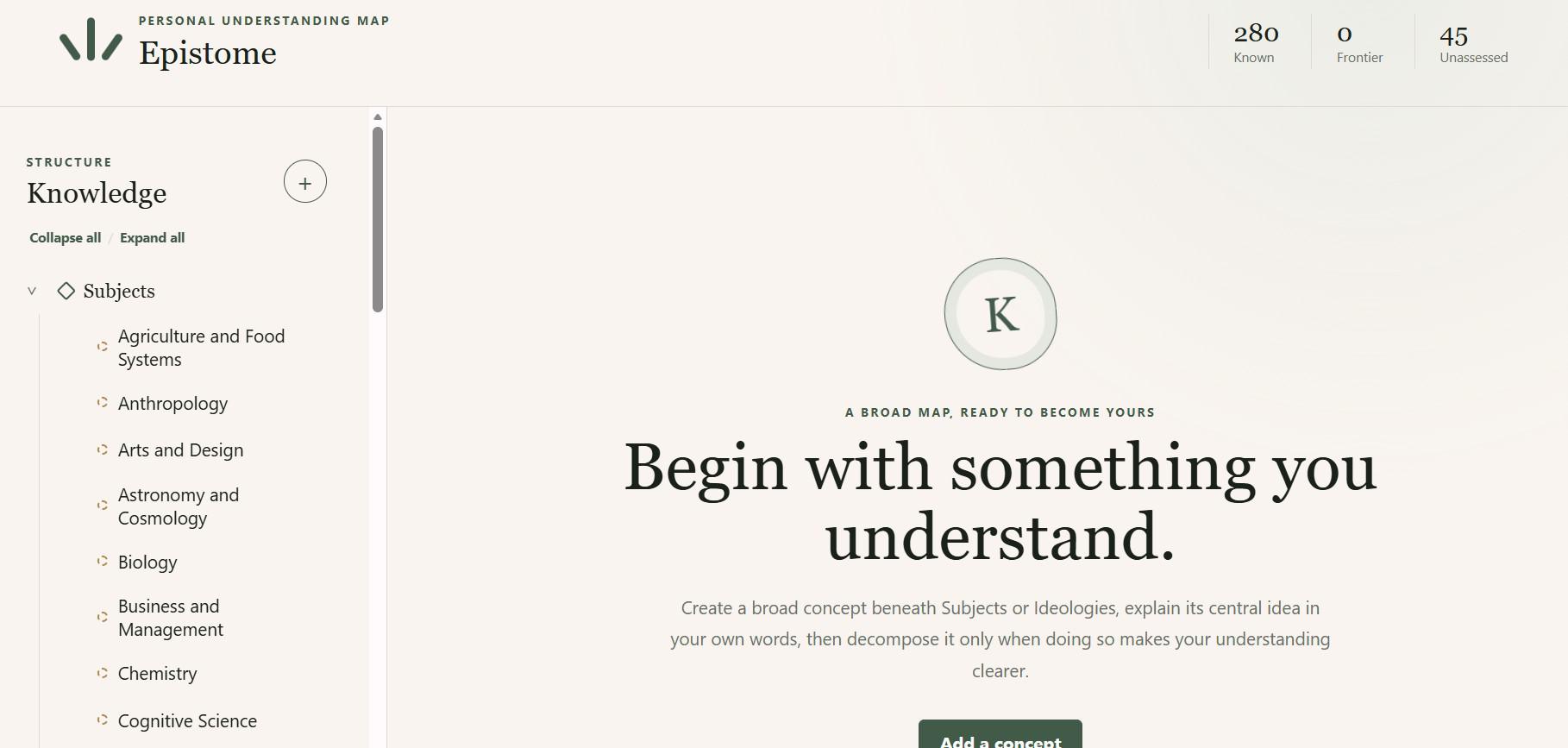
Main page
-
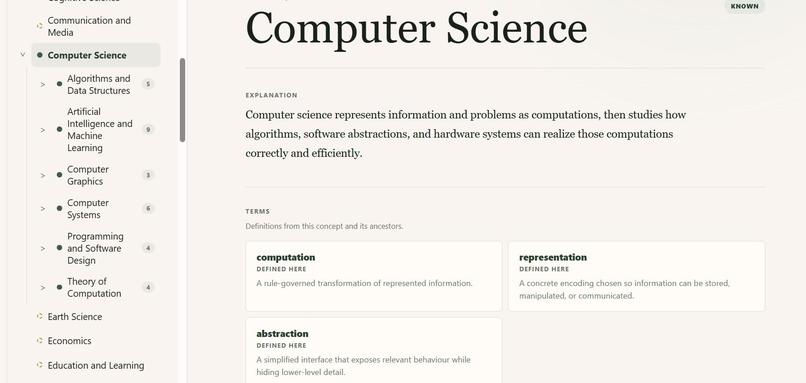
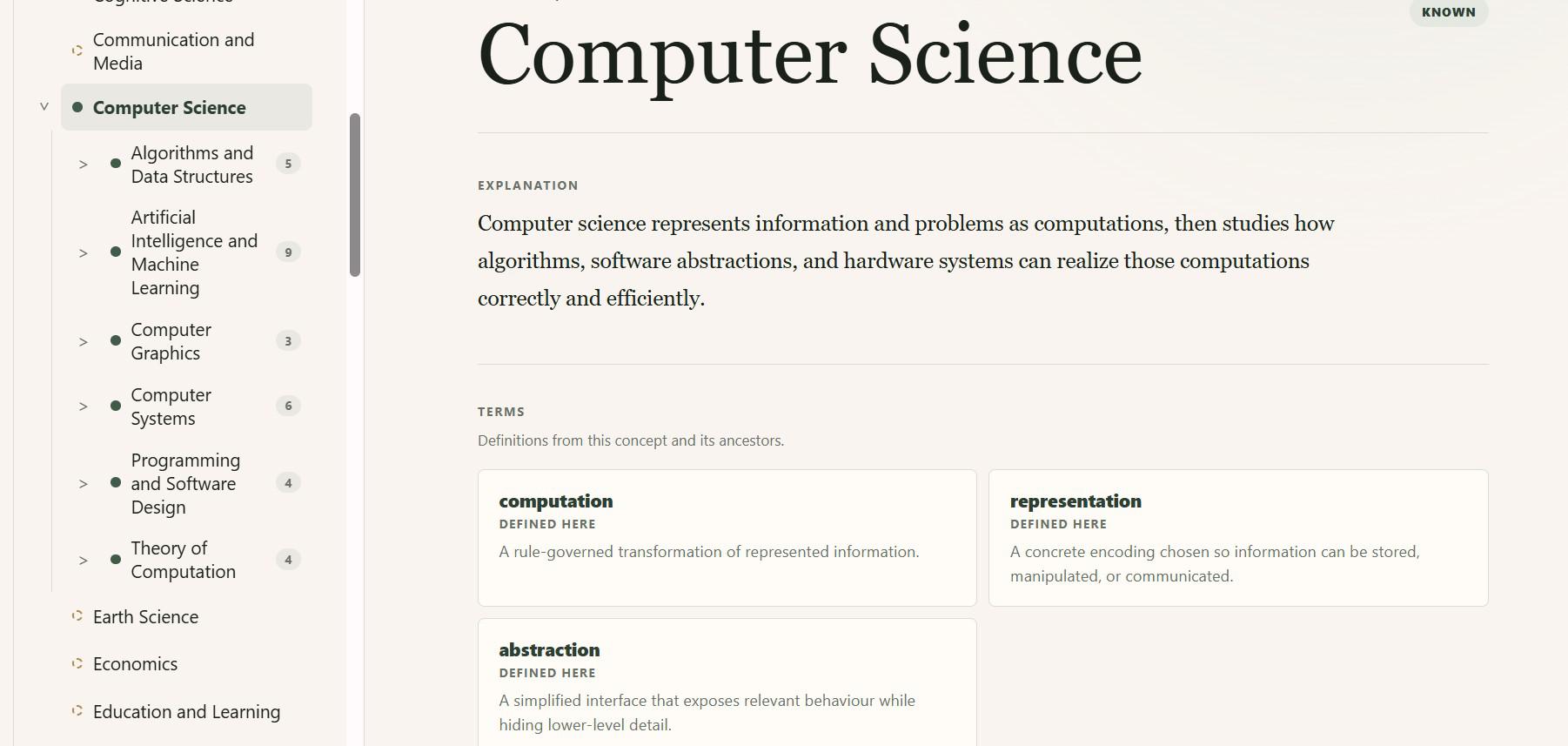
Subject node
-
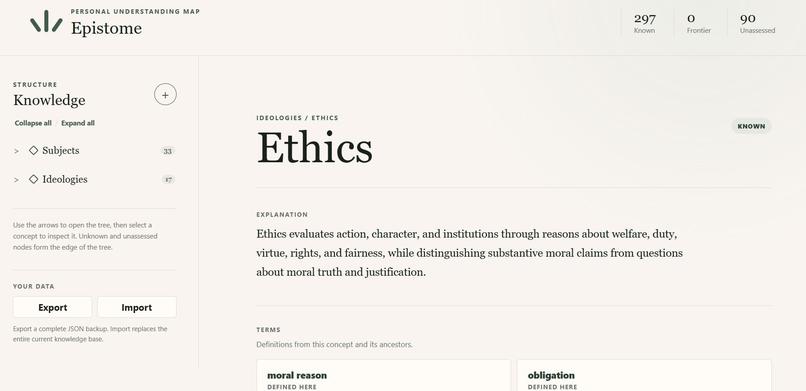
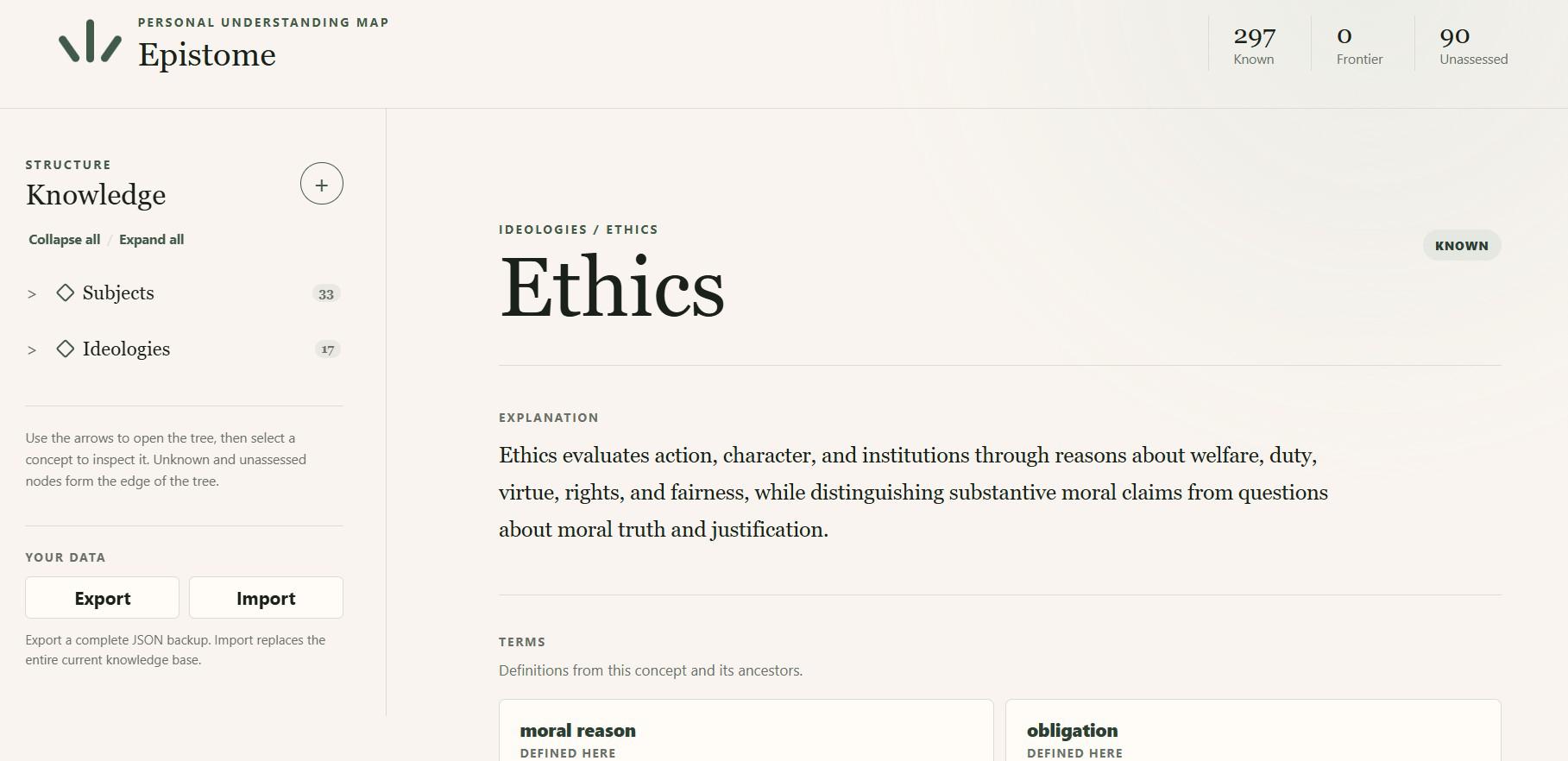
Ethics node
-
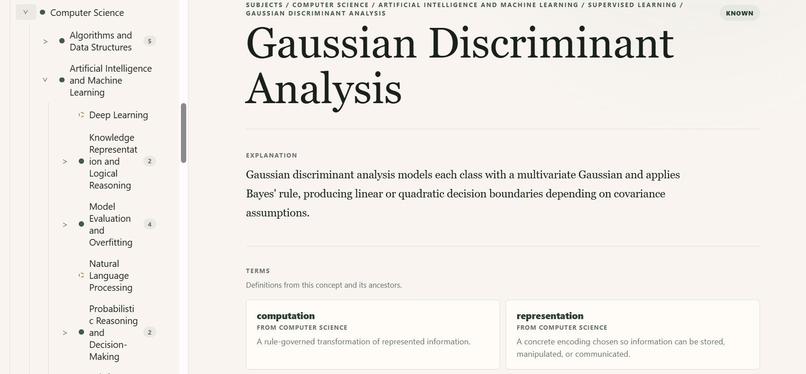
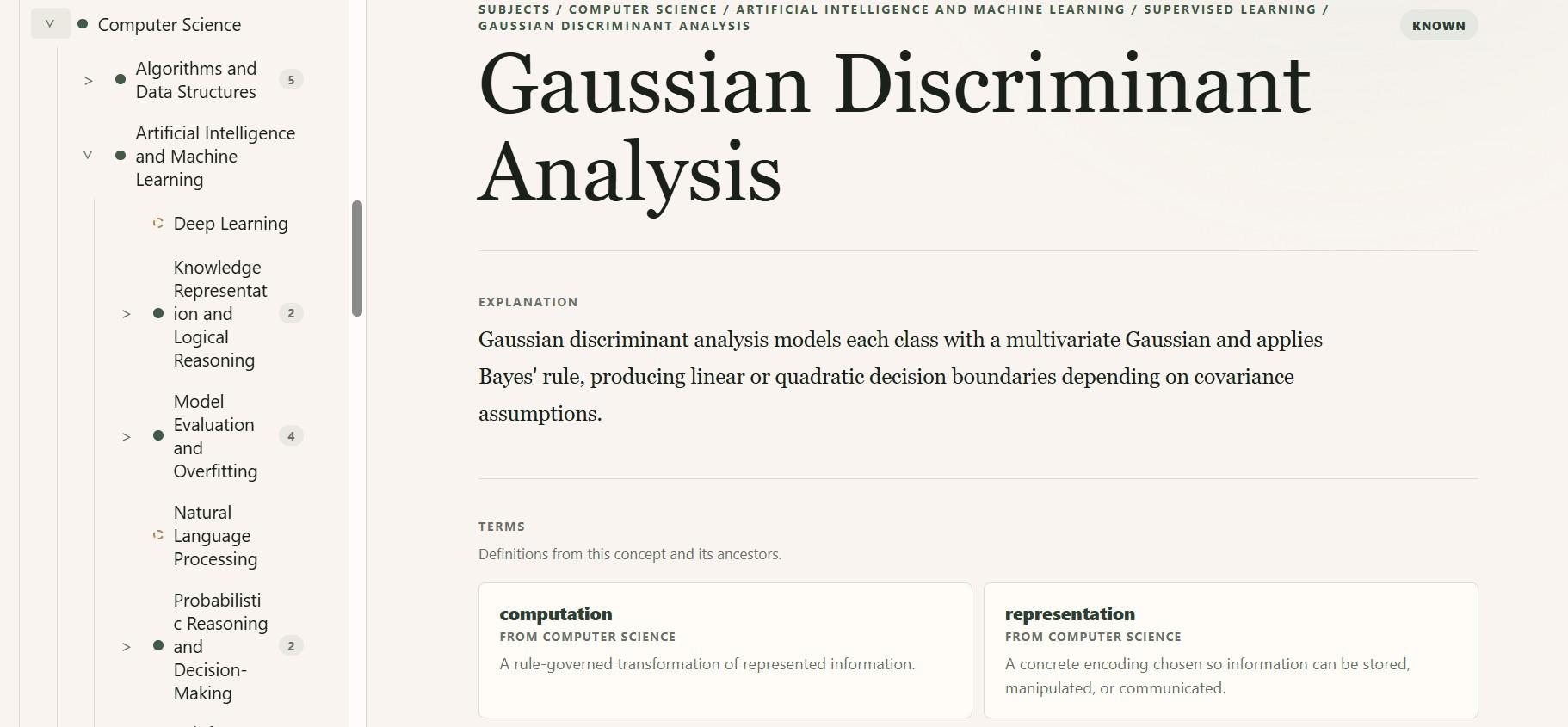
GDA node
Inspiration
Knowledge is rarely stored in a way that reflects how people actually understand it. Notes become scattered across documents, bookmarks, and applications, while traditional knowledge graphs often represent only relationships between topics—not whether someone truly understands them.
We built Epistome to create a structured, evolving record of personal knowledge. Instead of only storing information, Epistome helps users identify what they know, what they are still learning, and which concepts connect their understanding together.
What It Does
Epistome organizes a user's knowledge into an interactive hierarchy of concepts.
Users can:
- Record concepts they understand
- Expand concepts into relevant subtopics
- Track areas that are known, partially understood, or unexplored
- View definitions of important terms directly within explanations
- Navigate relationships between concepts through a visual interface
- Give AI agents structured context about the user's existing knowledge
Each concept can contain an explanation, related concepts, and important terms required to understand it. These terms appear directly within the explanation and can be opened without leaving the current page.
The result is not simply a collection of notes. It is a continuously evolving model of the user's understanding.
How We Built It
We designed Epistome around a structured knowledge model consisting of concepts, relationships, explanations, and embedded terms.
The application separates the system into three main layers:
- A backend that stores and manages the knowledge structure
- An AI-assisted expansion system that suggests relevant child concepts and important terminology
- An interactive frontend for exploring and updating the knowledge graph
Rather than allowing AI to generate an unrestricted tree, Epistome treats the backend as the authoritative owner of the knowledge model. AI is used selectively for tasks that require reasoning, such as determining appropriate subtopics, generating explanations, and identifying foundational terms.
This architecture allows the knowledge base to remain structured, editable, and usable by both humans and AI agents.
Challenges We Ran Into
One of the main challenges was deciding how knowledge should be represented.
A simple tree was easy to navigate, but it could not accurately represent concepts that belong to multiple fields. A fully connected graph was more expressive, but it quickly became difficult to understand visually. We therefore had to balance hierarchical navigation with relationships between concepts.
Another challenge was distinguishing between a concept that deserves its own node and a supporting term that should remain inside another concept. Creating a node for every term made the knowledge graph unnecessarily large, while storing everything as text removed meaningful structure.
We also had to prevent AI-generated expansions from becoming too broad, repetitive, or shallow. The system needed to suggest concepts that were central to understanding a topic rather than merely related to it.
Finally, designing the system for both human exploration and machine-readable context required careful separation between presentation, knowledge state, and AI-generated content.
Accomplishments That We're Proud Of
We created a system that represents knowledge as more than a list of notes or completed topics.
Epistome can:
- Model both knowledge and knowledge gaps
- Expand a concept into a structured learning path
- Preserve important terminology without overcrowding the graph
- Present definitions contextually through interactive term popups
- Maintain a knowledge structure that can be edited by the user
- Provide AI agents with explicit information about what the user does and does not know
We are especially proud of the distinction between concepts and embedded terms. It keeps the main knowledge structure understandable while preserving the detailed vocabulary needed for deeper comprehension.
What We Learned
We learned that representing personal knowledge is fundamentally different from representing general information.
A conventional knowledge graph answers questions such as, “How are these concepts related?” A personal knowledge model must also answer questions such as:
- Does the user understand this concept?
- How deeply do they understand it?
- Which prerequisite concepts are missing?
- Which explanations are appropriate for their current knowledge?
- When should a concept become its own node?
We also learned that AI works best in this system as a structured collaborator rather than the source of truth. It can propose explanations, relationships, and learning paths, but users must remain able to inspect, modify, and reject those suggestions.
What's Next for Epistome
The next stage is to make Epistome a continuously evolving interface between the user and AI systems.
Planned improvements include:
- Supporting concepts with multiple parents and cross-domain relationships
- Tracking confidence and depth of understanding
- Detecting contradictions, duplicates, and aliases
- Recommending concepts based on missing prerequisites
- Generating personalized learning paths
- Importing knowledge from notes, documents, and conversations
- Allowing users to verify or correct AI-inferred knowledge
- Exposing structured knowledge context to external AI agents
- Tracking how the user's understanding changes over time
Ultimately, Epistome aims to become a persistent model of personal knowledge—one that helps users understand what they know, determine what to learn next, and collaborate more effectively with AI.
Built With
- codex
- fastapi
- openai
- python
- react
- sqlite
- typescript
- vite

Log in or sign up for Devpost to join the conversation.