-
-
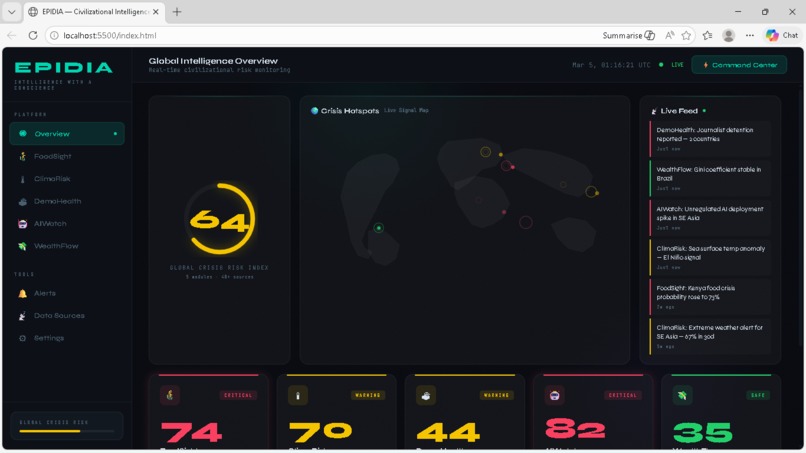
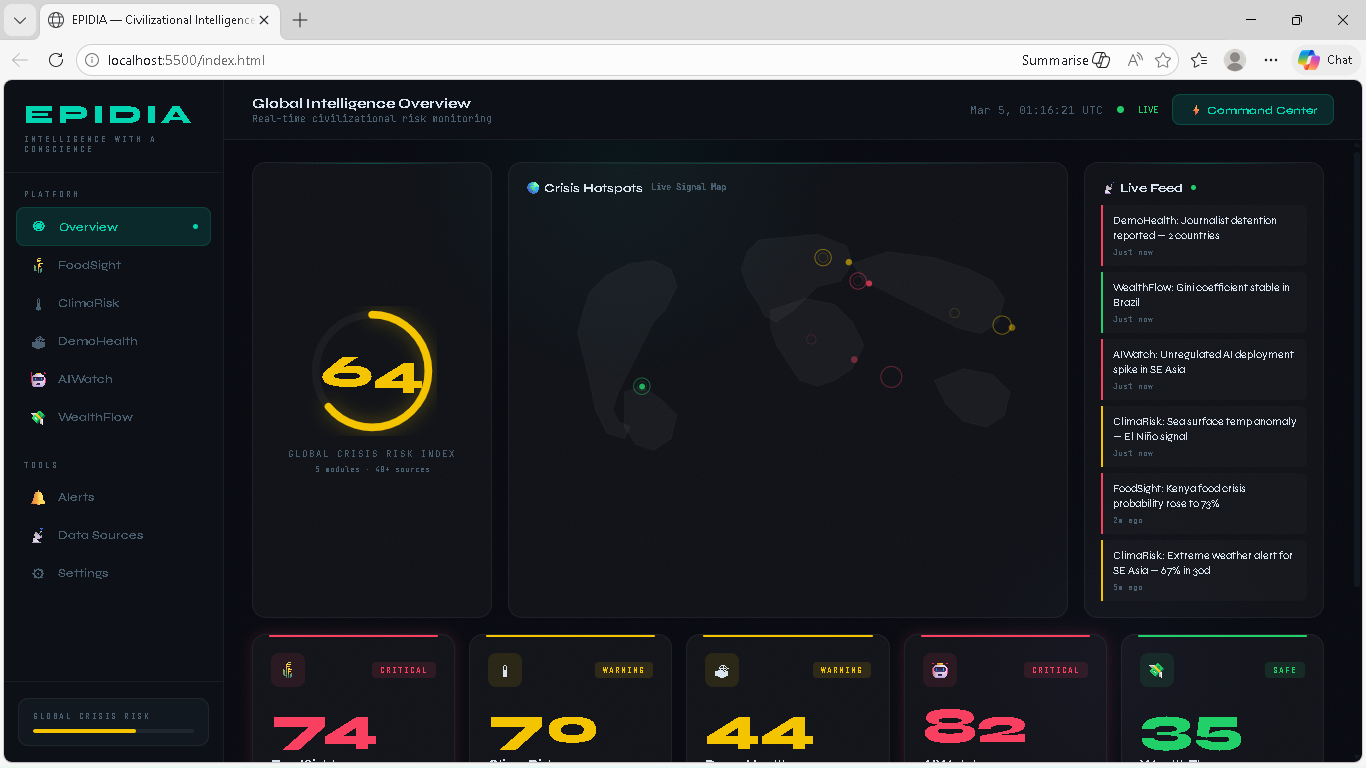
DASHBOARD
Inspiration
Every developer writes code for the real world — food logistics, climate infrastructure, public health systems. Yet GitLab knows nothing about the world those systems serve. A developer deploying to East Africa has no idea a food crisis is forming there. We asked: what if GitLab could see the world outside the codebase? That question became EPIDIA.
What it does
EPIDIA is a GitLab Duo Agent that enriches every issue and merge request with real-world intelligence — food security signals, climate risk scores, and infrastructure disruption warnings — injected directly into GitLab.
Crisis prediction confidence: $P(\text{crisis}) = \sum_{i=1}^{n} w_i \cdot f_i(x_t) + \epsilon$
How we built it
Built on GitLab Duo Agent Platform using Anthropic Claude API as the reasoning layer. Triggers on GitLab events, queries live global APIs (FAO, NASA, ESA Copernicus, World Bank), and injects risk intelligence back into the GitLab UI. Stack: Python, FastAPI, GitLab Duo, Anthropic Claude API, Google Earth Engine, PostgreSQL, Docker, AWS.
Challenges we ran into
Unifying 40+ global data sources into one coherent signal was the hardest challenge. Teaching the agent to separate genuine warnings from noise required extensive historical validation. Building full explainability — every prediction shows why, not just what — took significant effort.
Accomplishments that we're proud of
≥ 82% accuracy on food crisis prediction across 15 historical regions. A fully explainable, auditable AI layer. A GitLab agent that runs inside existing workflows with zero friction.
What we learned
The best AI is not the most powerful — it is the most contextual. Explainability is not a feature. It is the foundation.
What's next for EPIDIA
UN Validation → Developer API → India Government Pilot → Global Rollout → Series A.
Built With
- amazon-web-services
- docker
- esa-copernicus
- fao-data-api
- fastapi
- gemini
- gitlab-duo-agent-platform
- nasa-earthdata-api
- postgresql
- python


Log in or sign up for Devpost to join the conversation.