Inspiration
Health misinformation is usually treated as a simple true-or-false problem. We wanted to look at a different question:
What happens to a health idea after it enters culture?
Health narratives can spread, get repeated by different people, lose qualifiers, become more certain, drift away from scientific evidence, and eventually begin influencing behavioral intention.
We built Epi Meme Ology to make that process visible.
Instead of only asking whether a claim is true or false, our system asks:
- How widely is this narrative spreading?
- How many independent people are repeating it?
- How is the wording changing?
- How closely does it match scientific evidence?
- Is it beginning to influence what people say they will do?
Our goal is to help public-health researchers identify which emerging health narratives deserve closer attention.
What it does
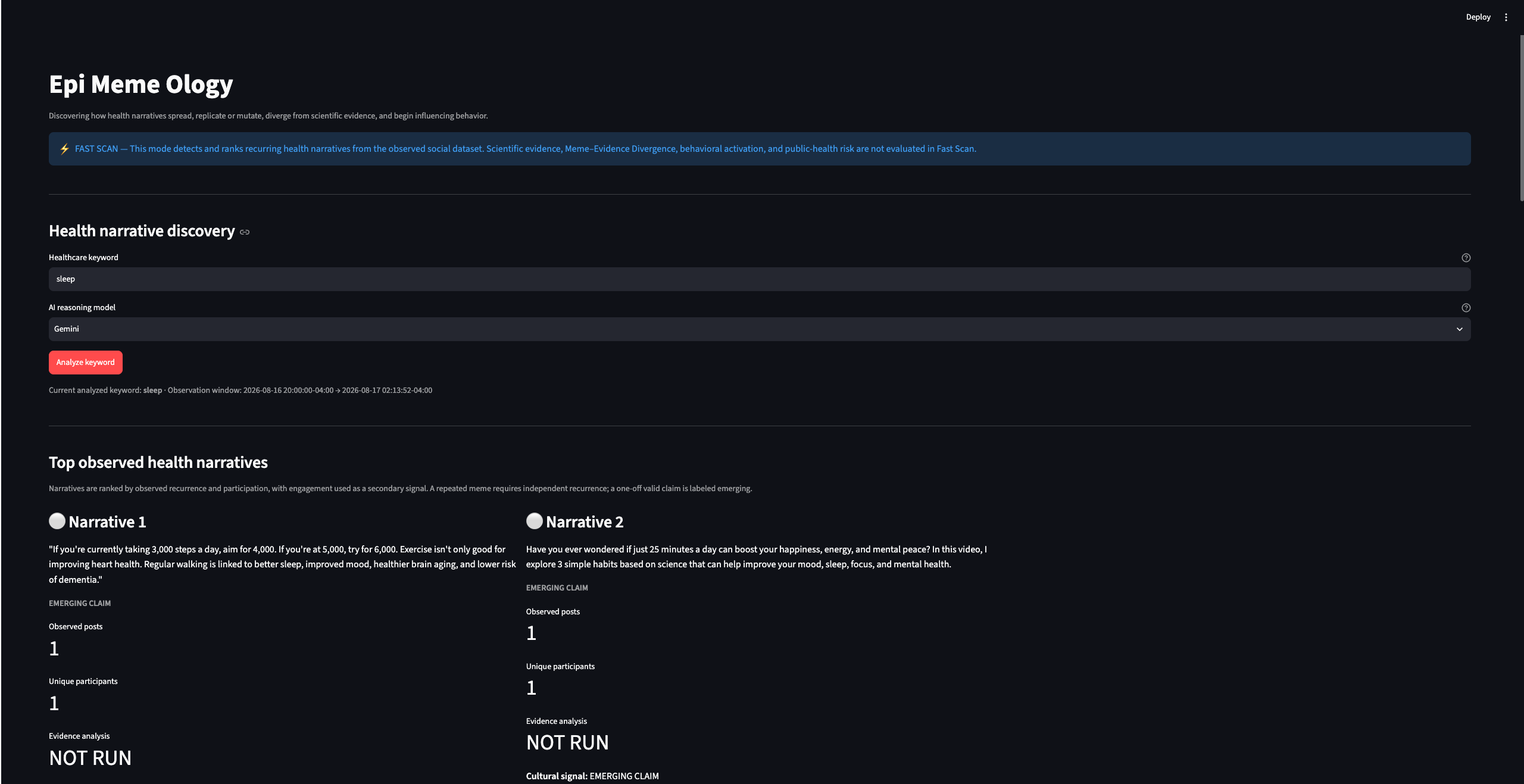
Epi Meme Ology is a social-listening and scientific-evidence analysis platform for health narratives.
A user enters a health-related keyword. The system searches social-media data, identifies evidence-checkable health claims, groups similar claims into narrative families, and measures how strongly each narrative is recurring.
For each narrative, the platform can analyze:
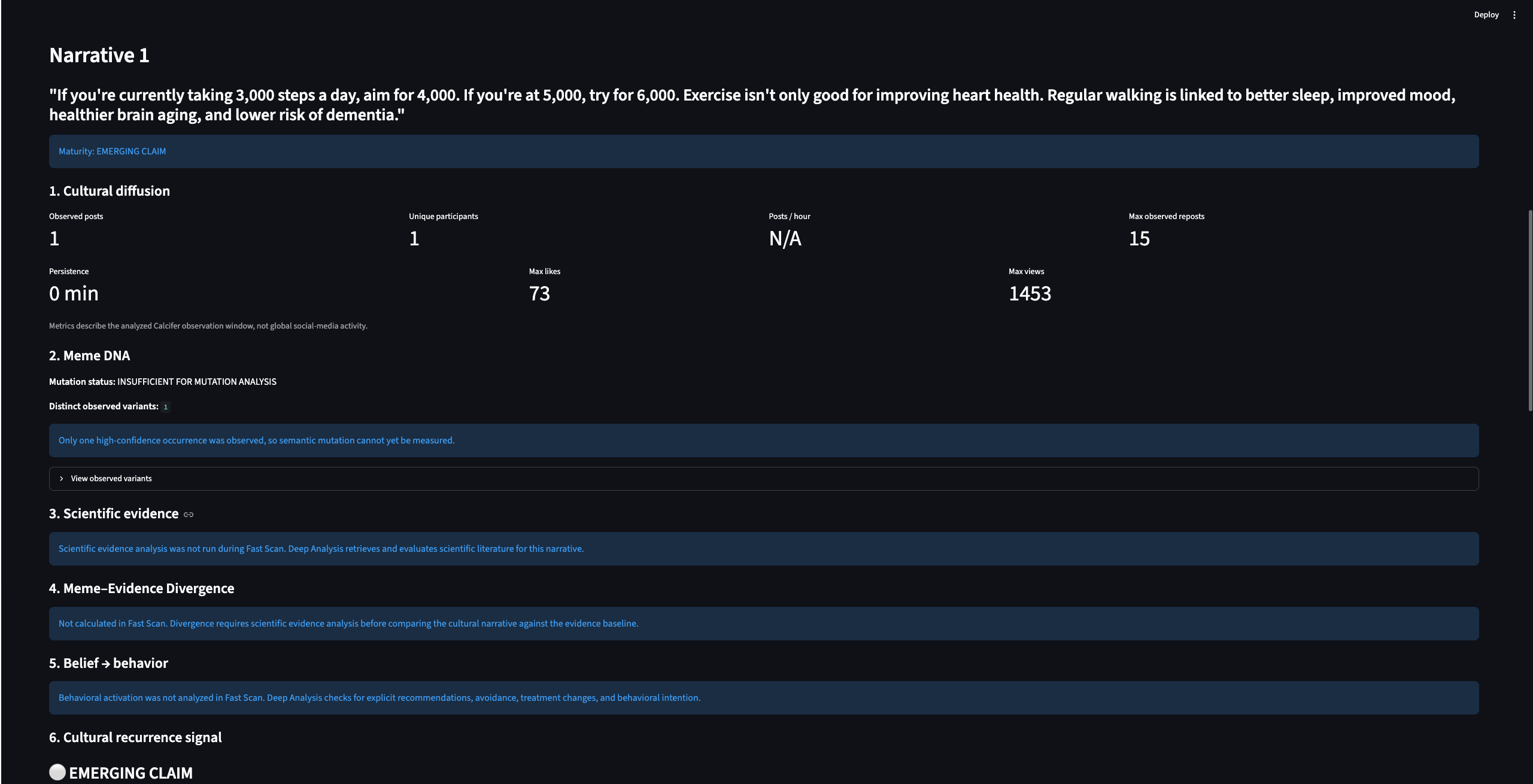
- cultural diffusion and recurrence,
- number of unique participants,
- velocity and persistence,
- semantic differences between observed narrative variants,
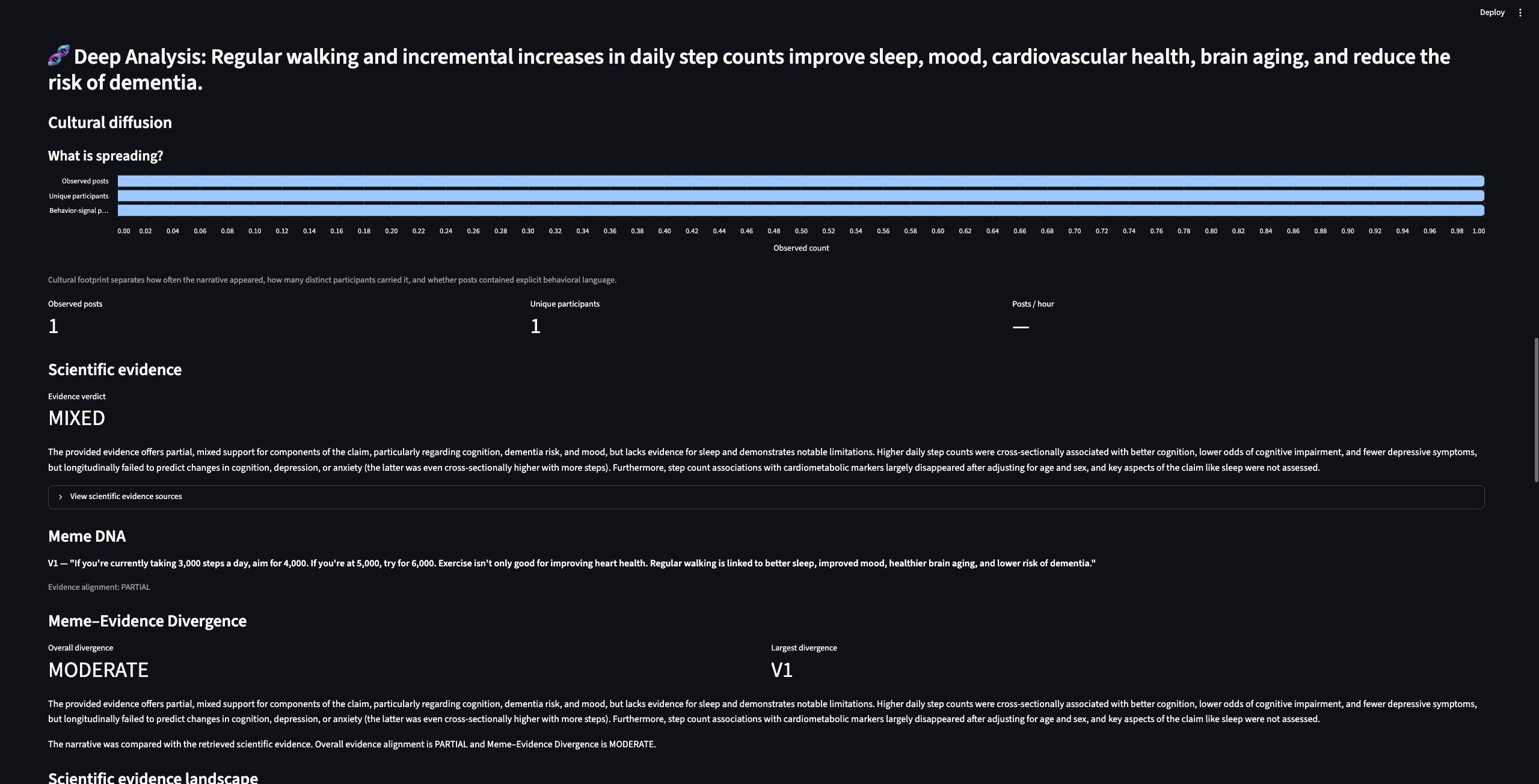
- relevant scientific literature,
- Meme–Evidence Divergence (MED),
- explicit behavioral-intention signals,
- and a transparent public-health prioritization state.
The system separates cultural prominence from scientific validity. A narrative can spread widely without being scientifically supported, and a scientifically supported idea can also receive little cultural attention.
Epi Meme Ology is designed to help users understand not just what health narratives exist, but how they move from culture → mutation → evidence → behavior.
How we built it
We analyzed approximately 5 million social-media observations from the Calcifer Twitter firehose dataset.
For the cultural discovery layer, we use DuckDB to query Parquet files directly. We deduplicate tweet snapshots, filter for English-language health claims, and use deterministic rules to identify claims that are specific enough to be checked against evidence.
We then use Sentence Transformers (all-MiniLM-L6-v2) to generate semantic embeddings. These embeddings help us merge closely related claims into narrative families and measure semantic differences between observed variants.
For deeper analysis, the system:
- extracts a canonical health proposition,
- generates scientific-literature search queries,
- retrieves papers using the Europe PMC REST API,
- ranks papers by semantic relevance,
- uses an LLM to synthesize the supplied scientific evidence,
- calculates a Meme–Evidence Divergence state,
- detects explicit behavioral-intention language,
- and applies a deterministic prioritization rubric.
We built multi-provider AI routing using Gemini through OpenRouter, Groq, and Ollama, allowing fallback between providers.
The application is built with Python and Streamlit, with data analysis and visualization using tools including DuckDB, Pandas, scikit-learn, Sentence Transformers, and Altair.
Challenges we ran into
One major challenge was separating broad health discussion from a specific, evidence-checkable health claim. A keyword such as "vaccine" or "sleep" produces large amounts of unrelated conversation, so we created deterministic filtering rules before semantic clustering.
Another challenge was correctly interpreting social-media metrics. The dataset can contain multiple snapshots of the same tweet with cumulative engagement counters, so simply summing reposts or likes would overcount activity. We deduplicated posts by tweet ID and retained the latest observed version.
Scientific evidence retrieval created another challenge: a paper can be semantically relevant to a claim without actually supporting it. We therefore separated relevance retrieval from evidence assessment and designed the evidence layer to distinguish association from causation.
We also wanted to avoid creating an opaque misinformation score. Instead, we kept diffusion, mutation, evidence, behavior, and prioritization as separate dimensions so the system remains interpretable.
Accomplishments that we're proud of
We built an end-to-end system that connects large-scale social-media analysis with scientific-literature retrieval.
We are especially proud that Epi Meme Ology:
- analyzes millions of social observations without requiring a traditional database,
- discovers recurring narrative families rather than relying only on keyword matching,
- separates cultural prominence from scientific validity,
- measures semantic differences between narrative variants,
- retrieves scientific literature dynamically,
- detects explicit behavioral-intention signals,
- supports multiple LLM providers,
- and uses transparent deterministic rules for final prioritization rather than relying on an unexplained AI-generated score.
We also created two complementary views of the system: a detailed single-narrative case study and a generalized live analyzer capable of discovering new health narratives from keywords.
What we learned
The biggest lesson was that health misinformation is not only an evidence problem. It is also a diffusion and transformation problem.
As narratives are repeated, their language can change. Uncertainty can disappear, associations can become causal claims, and claims can become increasingly absolute.
We also learned that semantic embeddings and LLMs are most useful when they have clearly defined roles. Embeddings help answer "Are these narratives related?", while scientific evidence is needed to answer "What does the research actually support?"
Finally, we learned the importance of interpretability. AI can help structure and synthesize information, but critical decisions are easier to trust when the underlying cultural, scientific, and behavioral signals remain visible.
What's next for Epi Meme Ology
The next step is moving from a hackathon prototype toward continuous public-health narrative monitoring.
Future improvements include:
- tracking narrative families across days and weeks,
- building a persistent semantic index for faster search,
- modeling chronological narrative mutation,
- improving scientific evidence grading,
- adding geographic and community-level diffusion analysis,
- supporting additional social-media and scientific data sources,
- and validating the prioritization framework with public-health researchers.
Our long-term vision is a public-health intelligence system that helps researchers understand not only what people are saying, but how health narratives evolve between culture, evidence, and behavior.
Built With
- analysis
- api
- data
- duckdb
- embeddings
- europe
- gemini
- github
- groq
- health
- llms
- natural-language-processing
- ollama
- openrouter
- pandas
- parquet
- pmc
- public
- pyarrow
- python
- rest
- scikit-learn
- streamlit
- transformers

Log in or sign up for Devpost to join the conversation.