-
-
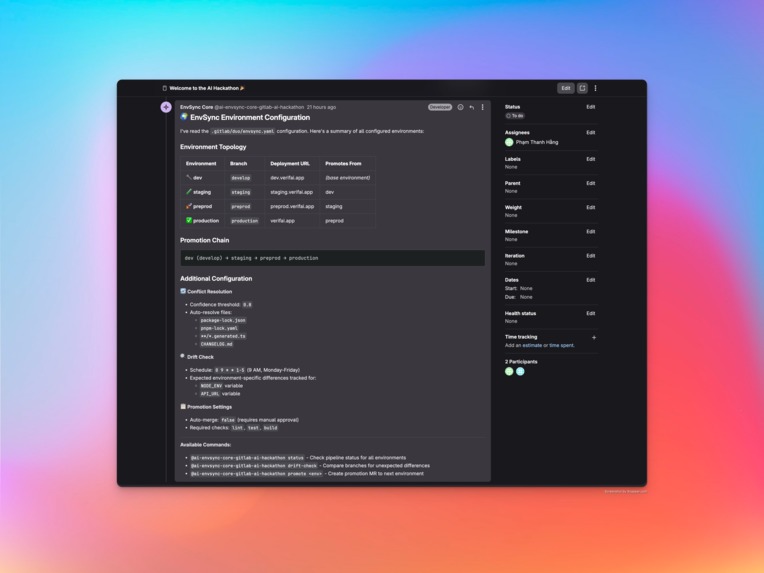
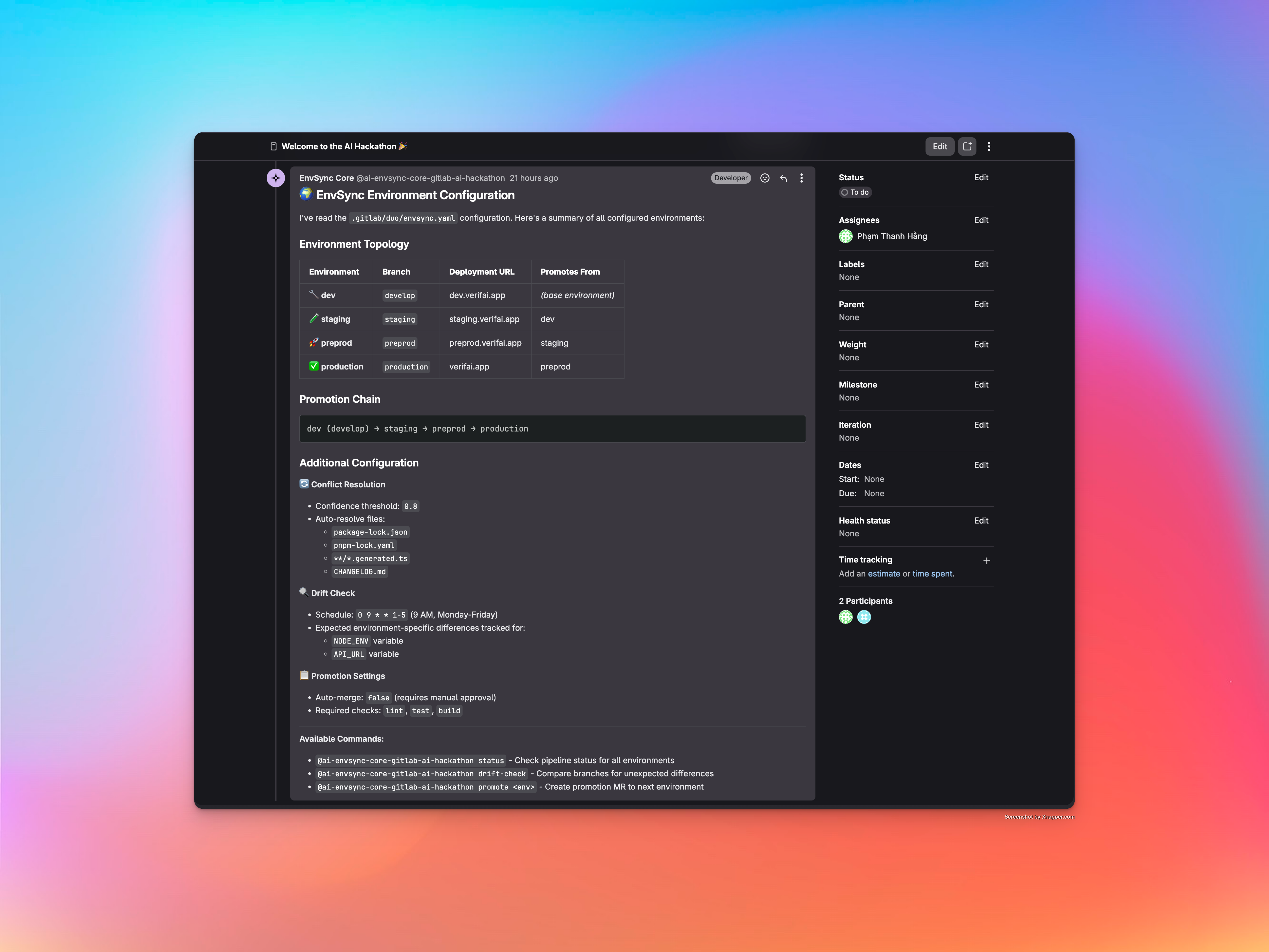
Environment Configuration
-
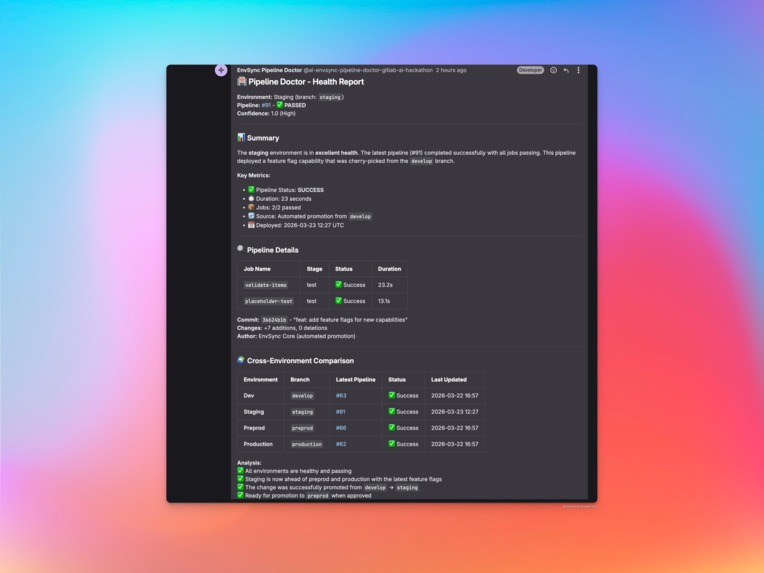
Status report
-
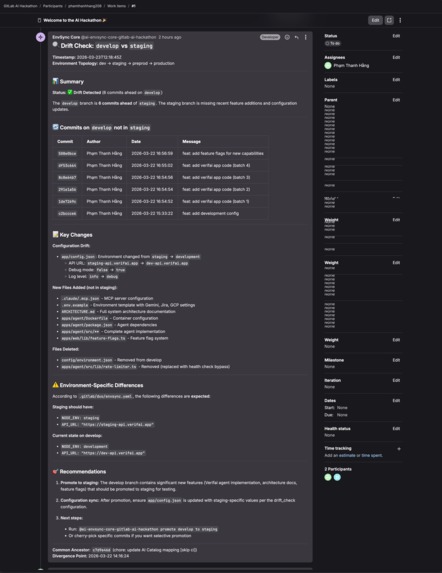
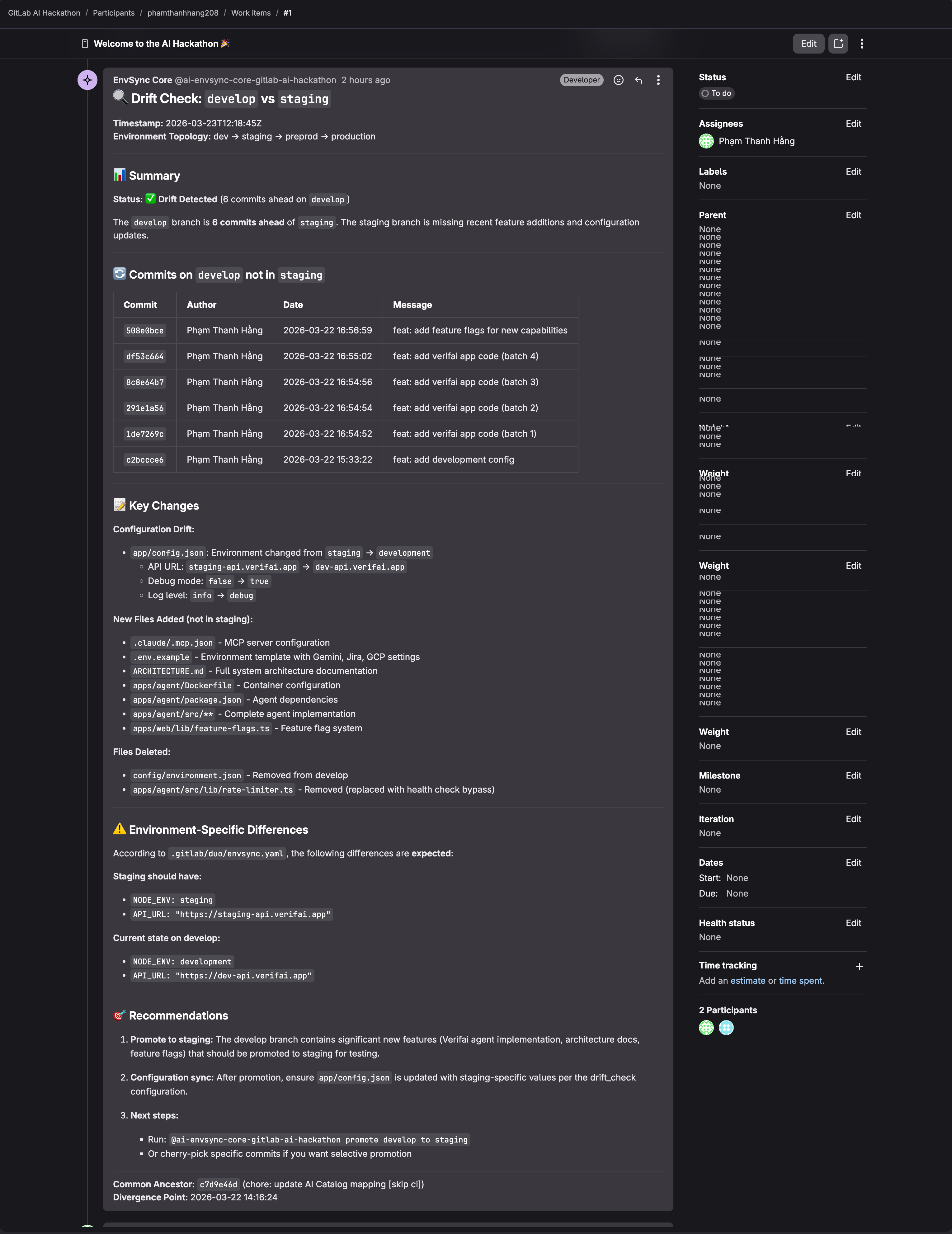
Dift-check
-
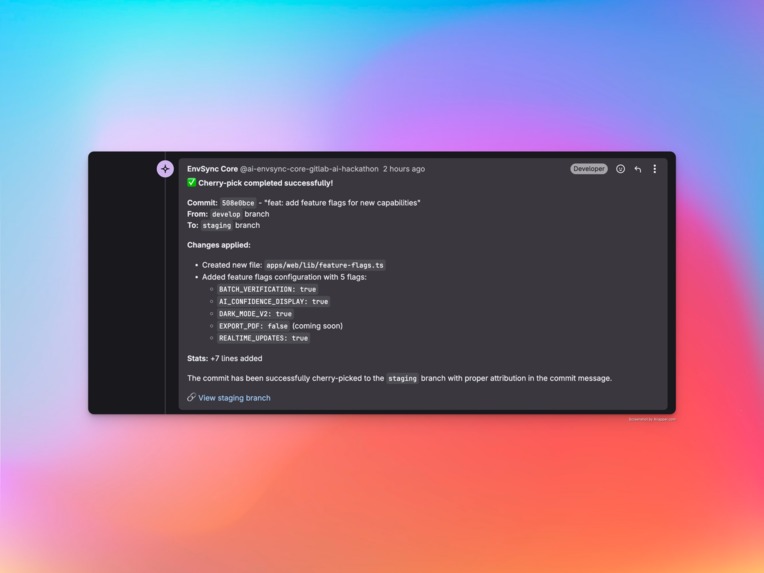
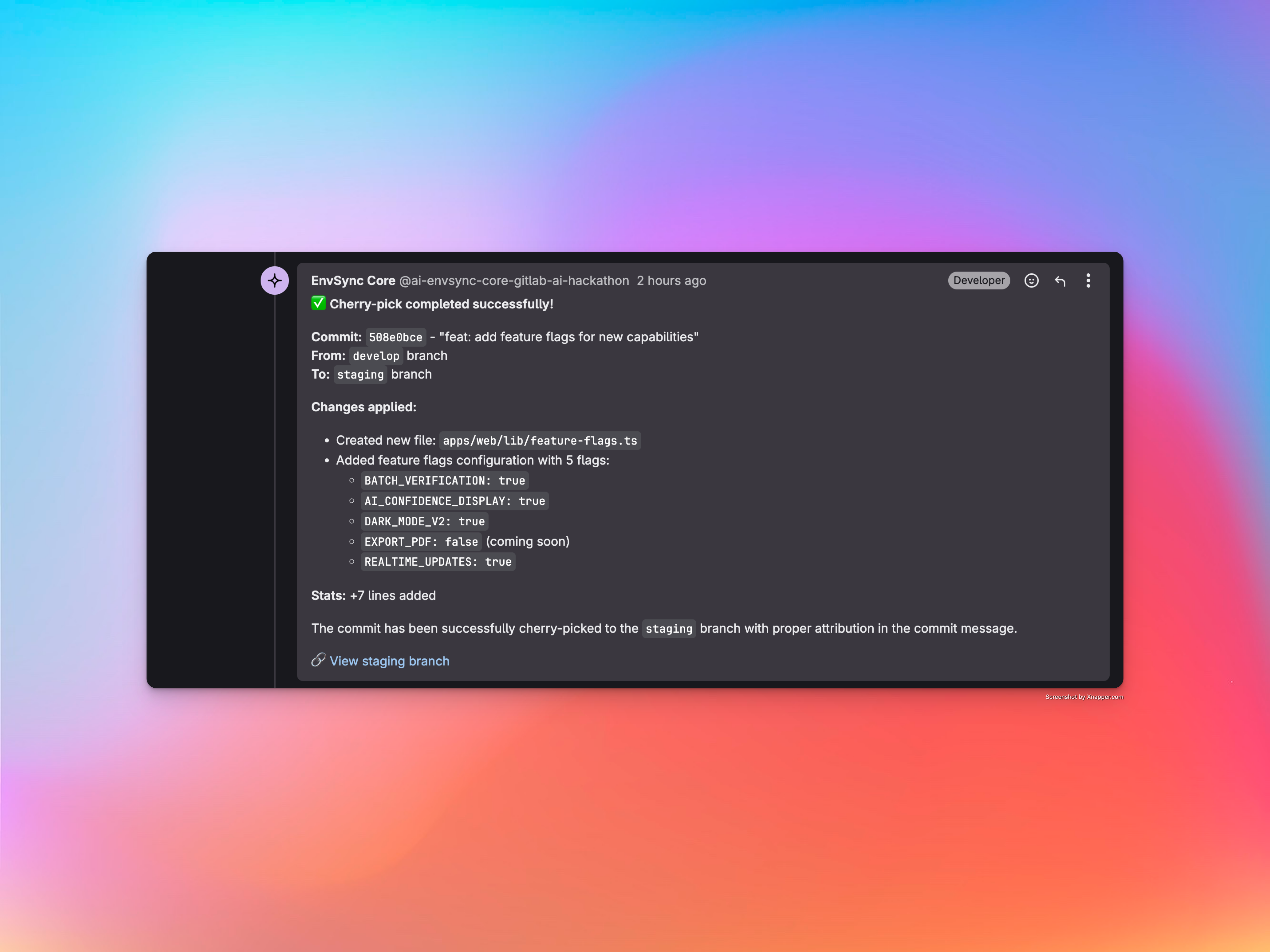
Cherry-pick
-
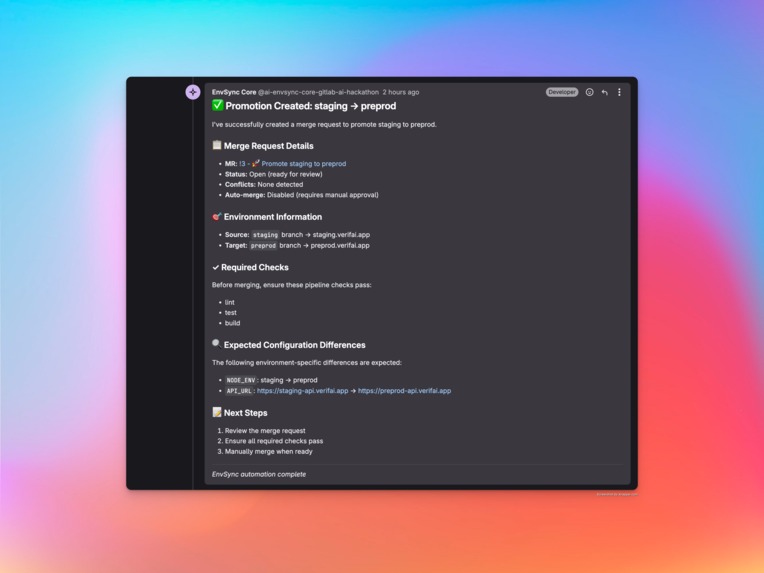
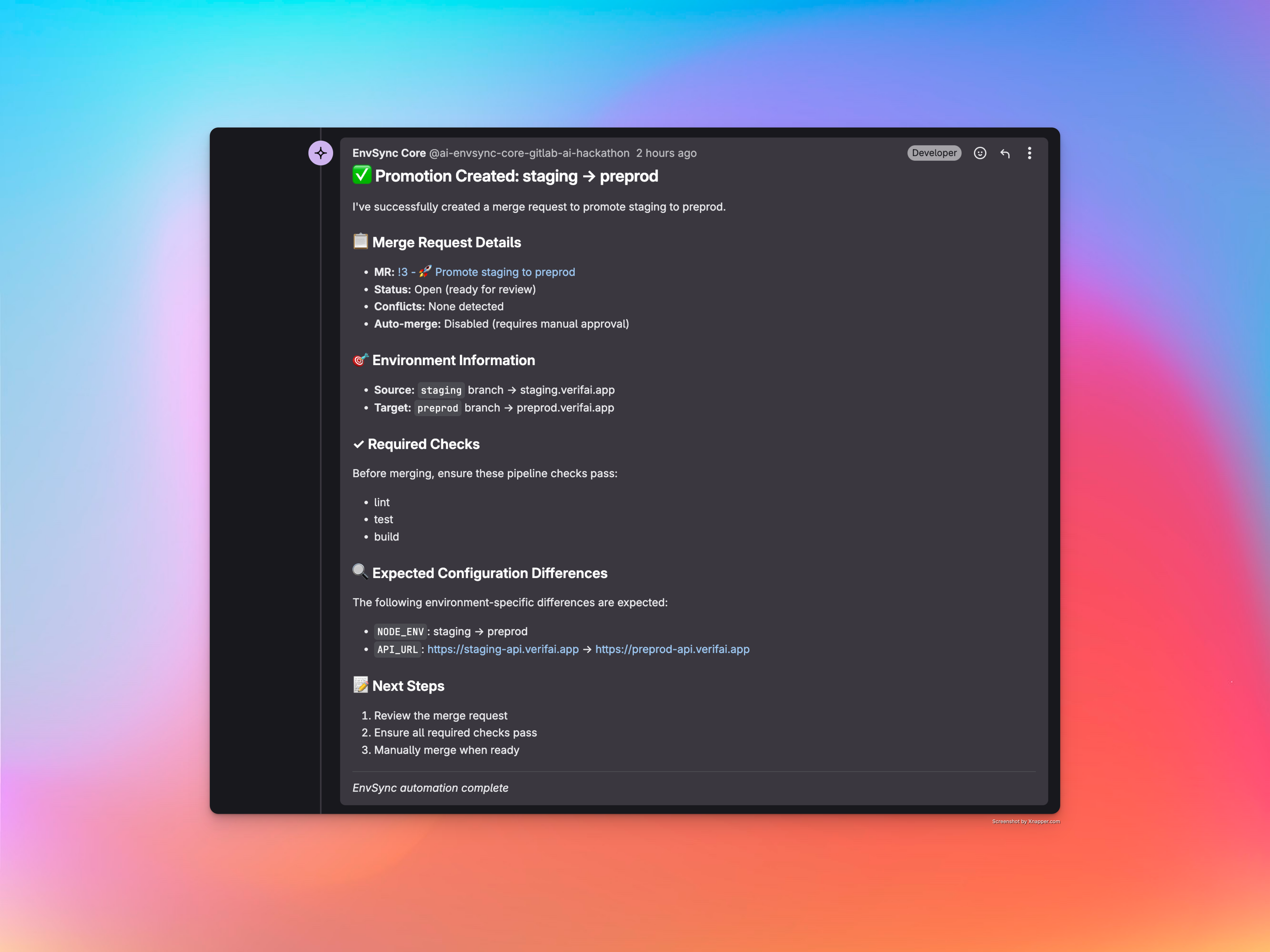
Promotion from staging to preprod
-
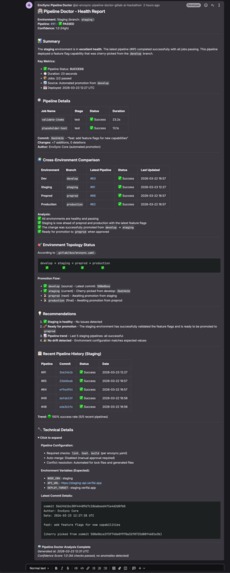
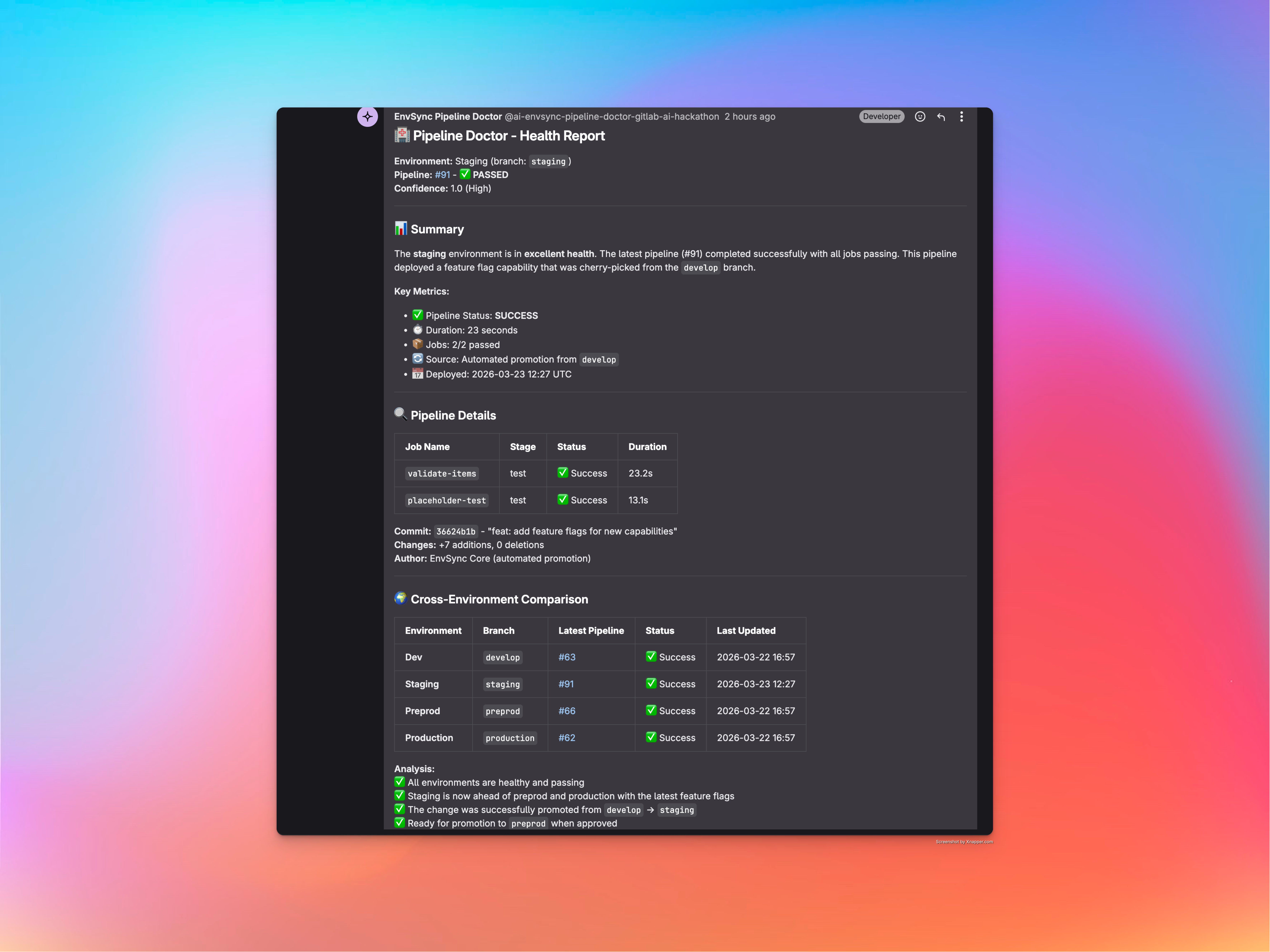
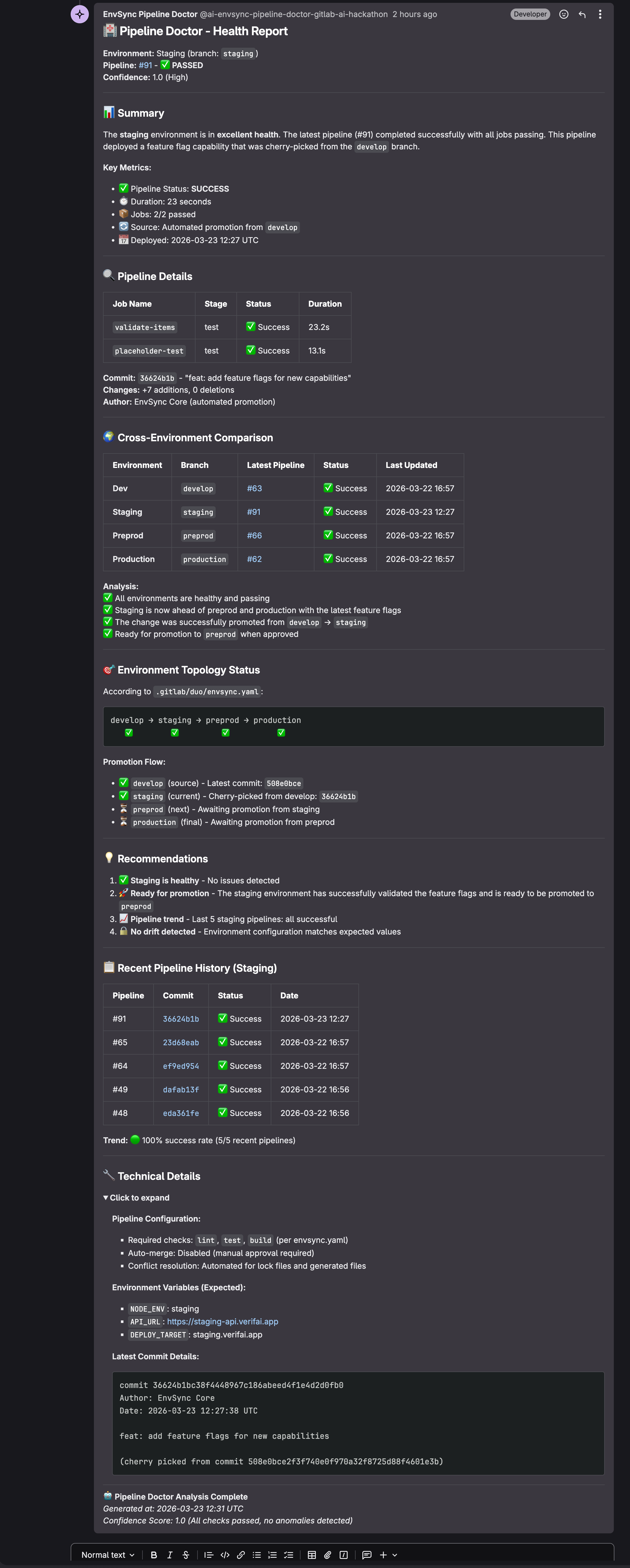
Pipeline Doctor - Health Report
Inspiration
Every team managing multiple environments (dev, staging, preprod, production) hits the same pain: cherry-picks get lost between branches, configs silently drift, and when a pipeline breaks on staging, someone has to manually SSH around to figure out if it's the code or the environment. We wanted to solve this entirely within GitLab — no external tools, no scripts, no dashboards to check. Just @mention a flow in any issue or MR and let it handle the rest.
What it does
EnvSync provides a suite of GitLab Duo Flows and an Agent that orchestrate code across environment branches:
- EnvSync Core —
@envsync statusshows pipeline health across all environments.drift-checkcompares branches for unexpected differences (also runs on schedule via CI).cherry-pickmoves specific commits between branches with three-tier intelligent conflict resolution.promotecreates merge requests along the promotion chain.rollbackreverts to a last known-good deployment with safety gates. - Pipeline Doctor — Automatically triggers on pipeline failure (via CI
on_failurejob), performs cross-environment triage by comparing logs and configs across branches, and posts a root cause diagnosis with confidence scores — all without anyone typing a command. - Rollback Guardian — Pre-rollback safety validator that checks deployment history, scans for irreversible database migrations, and produces a risk assessment before any rollback proceeds.
- Conflict Resolver — Dedicated conflict analysis flow with three tiers: auto-resolve safe files (lockfiles, generated code), AI-proposed merges with confidence scores for human approval, and manual flagging with context for complex conflicts.
- EnvSync Assistant — Read-only Duo Chat agent for querying environment topology, pipeline status, and drift without triggering any actions.
Everything is configured through a single envsync.yaml file that defines your environment topology, promotion chain, expected differences, conflict resolution rules, and rollback policies. Multi-project support lets you orchestrate across multiple repos with --all-projects flags.
How we built it
We built it entirely on the GitLab Duo Agent Platform (Flow track). Each flow is a YAML configuration with inline system prompts that guide Claude to use GitLab's built-in tools — get_repository_file, gitlab_api_get, create_commit, create_merge_request, create_issue_note, etc. No external APIs, no custom scripts.
The key architectural decisions:
- Runtime config discovery — flows read
envsync.yamlviaget_repository_file, making the same flow work for any project - Dynamic project context —
get_projectdiscovers project ID at runtime, eliminating hardcoded values and enabling forks - CI integration — Pipeline failure auto-triage and scheduled drift checks use GitLab CI jobs as reliable trigger mechanisms
- Component separation — Specialized flows for conflict resolution and rollback safety, each with prompts optimized for their specific task
Prompt engineering was critical: XML-tagged context injection for environment topology, structured chain-of-thought for log analysis, and explicit tool-use patterns that force the LLM to take action rather than just generate text.
Challenges we ran into
- Flow scoping — We initially built a separate demo project (Verifai) but discovered flows are scoped to the group where they're published. We had to restructure everything into the hackathon sandbox.
- Context discovery — The flow didn't know which project it was running in, causing it to ask users for project IDs. We iterated through several versions before landing on
get_projectwith no arguments + dynamic ID resolution. - Invalid inputs — Using
context:project_urlandcontext:issue_urlcaused silent failures. The fix was using onlycontext:goaland embedding project context in the system prompt. - Trigger engineering — GitLab Duo Flow event triggers are still evolving. We solved auto-triggering through CI
when: on_failurejobs that post structured comments, bridging the gap between CI events and flow activation. - Conflict resolution confidence — Calibrating the confidence threshold for Tier 2 vs Tier 3 conflict resolution required testing across diverse conflict types. We settled on 0.8 as the default with per-project configuration.
- Runner queue times — Shared runners during the hackathon meant 5–10 minute waits, making rapid iteration challenging.
Accomplishments we're proud of
- It actually works. Eight real commands across four flows that take real action — not a chatbot, but an orchestration engine. (Here's a working example on our project)[https://gitlab.com/gitlab-ai-hackathon/participants/35525051/-/work_items/3].
- Auto-triage pipeline failures — Pipeline Doctor fires automatically when any pipeline fails, performs cross-environment comparison, and posts a diagnosis before anyone even notices the failure.
- Three-tier conflict resolution — Cherry-picks don't just fail on conflicts anymore. Safe files auto-resolve, the AI proposes merges for medium-complexity conflicts, and complex ones get flagged with full context for human review.
- Rollback with safety gates — Rollback Guardian scans for irreversible migrations and blocks dangerous rollbacks. Protected environments require explicit confirmation.
- Multi-project orchestration — One command to check pipeline status, drift, or cherry-pick across your entire microservice fleet.
- Zero external dependencies — Everything runs on GitLab's built-in tools. Drop
envsync.yamlin any project and you're done.
What we learned
- GitLab Duo Flows are powerful but require careful prompt engineering — the LLM needs explicit project context and strong instructions to use tools instead of just generating text responses.
- Specialized flows beat monolithic ones — separating conflict resolution and rollback safety into dedicated components with focused prompts produced far better results than cramming everything into one flow.
- The
ambientenvironment type is perfect for background automation triggered by comments. - CI jobs as trigger bridges (
when: on_failure,$CI_PIPELINE_SOURCE == "schedule") fill the gap where platform-native event triggers aren't yet available. - Iterating on flow YAMLs through tag → pipeline → test cycles taught us to keep flows simple (single component beats multi-component chains for reliability).
What's next for EnvSync
- Auto-rollback on critical failure — When Pipeline Doctor detects a critical regression with high confidence, optionally trigger an automatic rollback (with
auto_rollback_on_failure: true) - Conflict resolution learning — Track which AI-proposed resolutions get accepted vs rejected to improve confidence calibration over time
- Environment health dashboard — A persistent tracking issue that auto-updates with environment health metrics on every scheduled check
- Branch protection automation — Automatically adjust branch protection rules based on environment risk levels
- GitLab native event triggers — Migrate from CI job bridges to platform-native
triggers:when GitLab Duo Flows support them natively
Built With
- gitlab

Log in or sign up for Devpost to join the conversation.