-
-
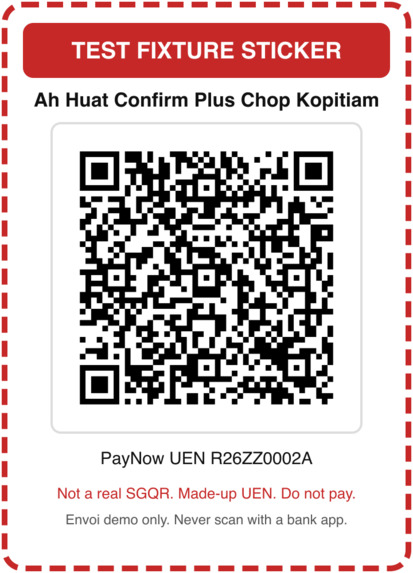
Try the mock SGQR
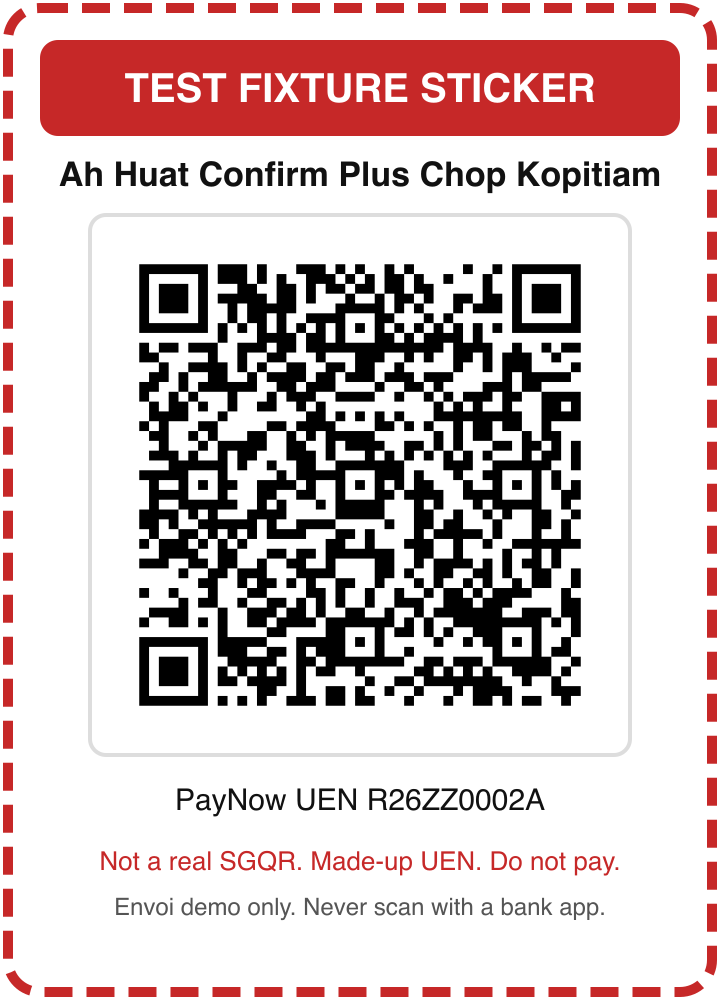
Inspiration
Many tourists come to Singapore with a card and a little cash. At shopping malls, a card works fine. But the places worth visiting, hawker stalls and hidden gems, often take only cash or QR payment through SGQR. When a visitor from the UK, the US or Australia sits down at a hawker stall, the menu is often only in Chinese or in Singlish (Singapore's own English), and their card is not accepted. The stall has an SGQR sticker, but PayPal is not on SGQR, so most of these visitors end up paying in cash or walking away. On the other side of the counter, many stalls confirm a payment by ear, with a spoken "$3 received" from a machine, and have no simple view of what they sold that week. And more and more visitors now plan their trips with a personal AI assistant, yet no assistant can order from a hawker stall. We built Envoi for all of them: the visitor who wants to order and pay with what they already have, their AI assistant that wants to help, and the stall that wants that order and a clear record of it.
Why Envoi, when Wise exists
Wise can pay a PayNow QR code and reaches far more stalls than we do, and Google Lens can translate a menu, but paying and translating are only part of what a visitor needs at a hawker stall. Before paying, they have to read a menu that is often only in Chinese, choose dishes they have never heard of, agree a price across a language barrier and tell the stall what they want. Other apps translate the menu, explain the dish or move the money; Envoi does all three in one flow, in the browser, with the PayPal the visitor already has (PayPal reports 440 million active accounts).
AI translates each local dish, says what to expect and builds an order within a budget using only the shop's own menu. Envoi then prices the exact order from that menu, so nobody keys in a number they heard in a language they do not speak, and the visitor approves it in PayPal themselves. After they have paid, the order appears in large text in the stall's language so the stall knows what to make, and the merchant sees every paid order with PayPal's fee and net on their end.
Bring your own AI. In the age of personal agents, a shop that AI assistants cannot read is invisible. Envoi has its own MCP endpoint, so any assistant that supports MCP can connect with a revocable token, read a shop's menu and build the order. Wise and Google Lens offer nothing like this. The visitor gets a one-time link and still approves the payment themselves. We tested this with Claude Code and Muse, and the user paid the link in sandbox. A reference buyer agent also runs on the visitor's own machine and refuses any item the menu did not return.
However, I do acknowledge that the trade-off is real: the shop pays PayPal's fee, and Envoi only works at enrolled shops. Envoi is for the visitor who would otherwise walk past, pointing and guessing, and for the stall that wants that order.
What it does
Envoi lets that visitor pay the shop in person with PayPal (SGD or USD), or optionally PYUSD on Solana devnet for visitors who hold PYUSD. The money goes straight to the shop's own PayPal, never through Envoi.
- Scan: Envoi reads the stall's existing SGQR sticker and identifies the enrolled shop. Like any onboarding process, an unenrolled merchant's SGQR stays unpayable with PayPal, and the visitor gets a card in the stall's language to show the stall instead.
- Ask Envoi: our AI assistant explains unfamiliar dishes, translates the menu and builds an order within a budget. It reads menus through Envoi's own MCP endpoint and asks when one phrase could mean two items.
- Approve: Envoi prices the order from the shop's published menu. The visitor sees the exact total and who gets paid, then approves it in PayPal.
- Show the stall: after Paid, the order appears in large text in English, Chinese, Malay or Tamil, and can be read aloud, so the stall knows what to make.
Bring your own AI. Envoi's MCP endpoint gives an outside assistant the same reads Ask Envoi uses: find a shop, read its published menu, and create a one-time link to a priced order. Each assistant gets its own revocable token, limited to 60 requests per 10 minutes. The link works once and expires after 10 minutes. The assistant cannot pay, approve a payment or read a receipt. For visitors who prefer to keep things local, a reference buyer agent runs on their own machine over the same endpoint, refuses any item or quantity the menu did not return before making a call, and never sees the link's token.
For merchants. Shops keep their existing SGQR and add no hardware.
- Menu setup: AI drafts the menu from the shop's public web page, and the merchant confirms every row before anything publishes. If anything is missing, or they only have a physical menu, they can input manually.
Fees, COMPLETE HONESTY Hawker orders are small, and on a small order a fixed fee hurts. PayPal's standard rate for a payer with an overseas PayPal account in Singapore is 4.40% + S$0.50, which is S$0.70 on a S$4.50 plate of chicken rice, about 16% of the sale. However, Envoi's use case leverages PayPal's micropayment rate, 6.00% + S$0.08, built for exactly this kind of order: on that same plate the fee is S$0.35, about half. It costs less on every order under about S$26, which covers most of what a hawker stall sells. Envoi's
/for-shopscalculator puts both side by side: a stall types in a typical order and sees what it keeps, what PayPal takes on the standard rate, and what it would take on the micropayment rate, with every rate linked to PayPal's own fees page. Envoi adds no fee of its own and never claims to be cheaper than cards. The micropayment rate needs PayPal's approval, it then applies to every sale, and whether a food stall qualifies is not yet confirmed, so we show it as an option to apply for, not a promise. - Sales desk: PayPal's fee and net for each order.
- AI weekly summary: in English, Chinese, Malay or Tamil.
- Ask your orders: the merchant types one sentence to filter and sort the orders table.
- Copilot: reads the shop's sandbox PayPal records through PayPal's hosted MCP server and can propose a refund. The refund is only sent when the merchant taps Confirm.
- Missed-visitor count: when a visitor scans a stall that is not on Envoi yet, the scan is counted anonymously. If that stall later signs up, it sees how many visitors tried to pay it.
US shops too. A merchant in the United States can join and take PayPal in USD. The case there is not a payment gap. It is AI assistants that can find the shop and order from its menu, a menu explained in the visitor's language(in this case Chinese tourists or Indian tourists, and a PayPal balance that can earn PayPal's PYUSD rewards. PayPal offers those rewards to US businesses and not yet to Singapore ones. That is PayPal's offer, and Envoi leverages that.
How we built it
- Next.js 16 and React 19 on Node 24, with Drizzle ORM on Neon Postgres, deployed on Render.
- PayPal Orders for checkout, with server-side capture verification. PayPal's hosted MCP server powers the merchant copilot.
- The Vercel AI SDK with OpenAI models, and the official MCP SDK for Envoi's own
/mcpendpoint. - zxing-wasm reads the QR, Kernel's hosted browser powers web menu import, and Solana Kit handles the PYUSD path.
The rule we built around
AI is only ever a reader and a drafter. No model sets a price, approves a payment or moves money.
- Every price comes from the shop's published menu.
- Any item the model names that is not on the menu is dropped.
- A translation never changes a price or adds an item.
- The weekly summary model writes a template with placeholders, and Envoi fills in every figure from its own records.
- The copilot refuses any reply that names an amount Envoi has not checked.
- A person approves every payment.
Challenges
- Giving AI a PayPal account safely. The merchant copilot reads real PayPal records through PayPal's hosted MCP server. We filter every result to that one shop and strip the payer's name, email and account id before the model sees it. PayPal's write tools never reach the model. A refund only happens when the merchant taps Confirm.
- Menu photo import ships turned off. No vision model met our accuracy bar in four rounds. Web menu import ships instead, and the merchant confirms every row. Might try Meta's SAM 3.1 in the future for accurate readings.
- The US buyer problem is weaker. As a Singaporean, im unable to identify physically US shops that utilizes QR payment and does not take cards, so the US case rests on the merchant's reasons, not on a visitor who cannot pay.
What we learned
Pre-registered evaluations keep us honest:
- Ask Envoi scored 24 of 25 across languages, with zero wrong basket links.
- It scored 10 of 10 on budget cases, with nothing off the menu and nothing over budget.
- The copilot passed 7 of 7 sandbox questions with no invented amounts.
Each of these is a single run on test shops, not a measure of real buyers.
What's next
- The product is live, but our PMF remains uncertain. The value add is definitely there, it is simply a game of marketing.
- Approval for PayPal's micropayment rate for small orders.
- Food tours, night markets and hotel concierges sending visitors a ready-made order link.
Test environment: PayPal sandbox test money only. No real money moves.
Built With
- drizzle-orm
- kernel
- model-context-protocol
- neon
- next.js
- node.js
- openai
- paypal
- paypal-mcp
- postgresql
- pyusd
- react
- render
- solana
- tailwindcss
- typescript
- vercel-ai-sdk
- zod
- zxing
