Inspiration
The inspiration for this project stemmed from the need to make environmental data more accessible and actionable. By leveraging cutting-edge technology, we aimed to simplify the process of extracting meaningful insights from vast datasets, empowering users to make informed decisions.
What it does
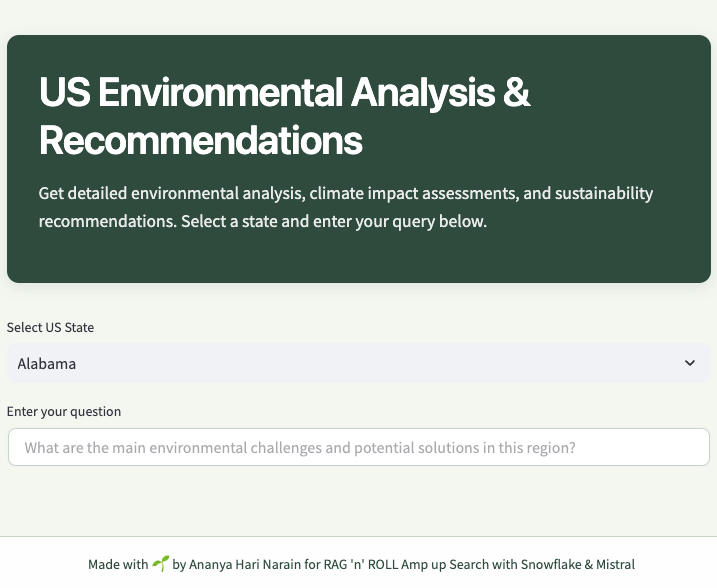
The Environmental Dashboard provides state-specific insights using a Retrieval-Augmented Generation (RAG) system powered by the Mistral-Large-2 model. Users can select a state to dynamically filter relevant documents, ensuring faster and more precise responses. The app covers data from NASA, federal documents, and other environmental resources.
How we built it
The app was built using: Streamlit: For the interactive dashboard interface. Snowflake: To store and query large datasets efficiently. Mistral-Large-2: As the core language model for generating intelligent responses. Python: For backend logic and integration.
The system dynamically filters data chunks based on state labels, optimizing the query process for speed and relevance.
Challenges we ran into
One of the main challenges involved finding a dataset to create the actual Snowflake Cortex; this involved parsing relevant documents and creating a custom dataset.
Accomplishments that we're proud of
Creating a user-friendly interface that simplifies complex data analysis.
What we learned
How to efficiently manage and query large datasets with Snowflake.
What's next for Environmental Dashboard
Expanding the dataset to include global environmental data. Incorporating more advanced filtering and visualization options. Exploring multimodal capabilities by integrating satellite imagery and geospatial data. Optimizing the app for broader use cases, such as climate research and policy development.
Built With
- mistral
- python
- snowflake
- streamlit


Log in or sign up for Devpost to join the conversation.