-
-
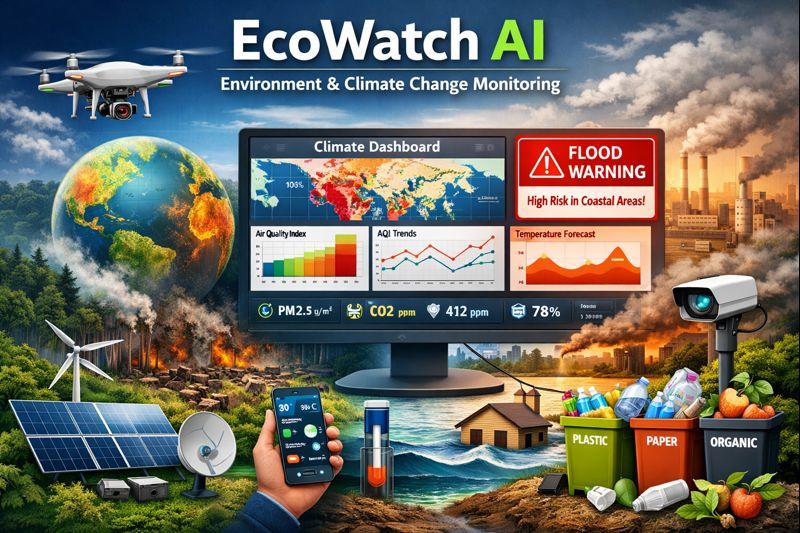
This image represents an AI-powered Environment and Climate Change monitoring system.
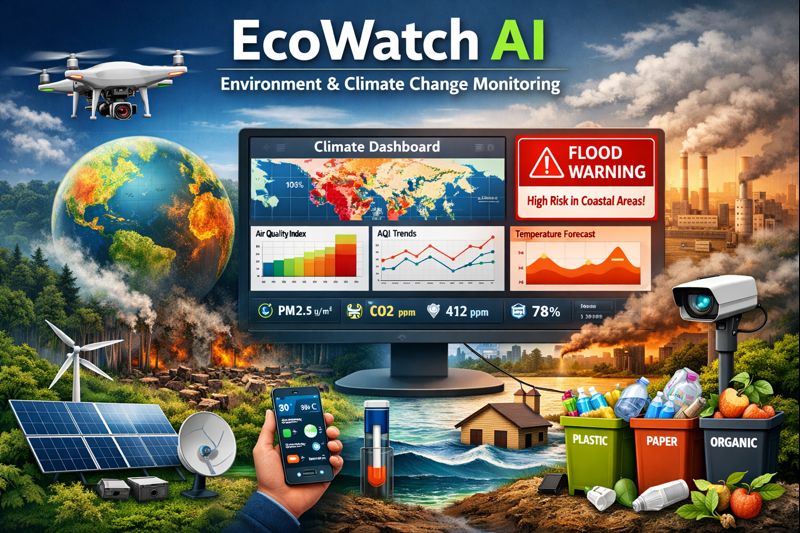
Inspirationlimate change is no longer a future threat—it is a present reality. Rising air pollution, unpredictable rainfall, and frequent floods directly affect human health, agriculture, and livelihoods. While large amounts of environmental data are available, it often remains unused or inaccessible to common people and local authorities.
This inspired us to build EcoWatch AI, a platform that transforms raw environmental data into actionable insights using Artificial Intelligence, helping communities and decision-makers respond faster to climate risks.
🧠 What We Learned
Through this project, we gained hands-on experience in:
Applying machine learning to real-world climate and environmental data
Understanding how AI can support sustainability and social good
Working with data preprocessing, feature engineering, and prediction models
Collaborating as a team under strict hackathon time constraints
Designing solutions with ethical and environmental responsibility in mind
We also learned that even a simple, well-focused AI model can create meaningful impact when applied correctly.
🛠️ How We Built the Project
EcoWatch AI was built in the following steps:
Data Collection We gathered publicly available datasets related to air quality, temperature, humidity, rainfall, and pollution levels.
Data Processing The raw data was cleaned, normalized, and structured for model training. Missing values were handled using statistical methods such as mean and median imputation:
AI Model Development We trained machine learning models to identify patterns and predict environmental risk levels. The model estimates pollution severity using:
System Design A simple user-friendly interface displays real-time insights, alerts, and predictions, making complex data understandable for non-technical users.
Testing & Validation The system was tested with historical data to verify prediction accuracy and reliability.
⚠️ Challenges We Faced
Limited clean datasets: Environmental data often contained missing or inconsistent values
Time constraints: Building, training, and testing within hackathon hours was challenging
Model accuracy vs simplicity: Balancing performance while keeping the system lightweight
Real-world variability: Climate patterns are complex and not always predictable
Despite these challenges, iterative testing and teamwork helped us overcome obstacles and deliver a functional prototype.
🌱 Impact & Future Scope
EcoWatch AI demonstrates how AI can be used not just for profit, but for planetary well-being. In the future, we aim to:
Integrate real-time IoT sensors
Add early-warning notifications
Expand predictions to floods, heatwaves, and droughts
Partner with local bodies for real-world deployment
“Small data-driven actions today can protect the planet for generations tomorrow.” 🌏
Built With
- css
- preprocessing


Log in or sign up for Devpost to join the conversation.