-
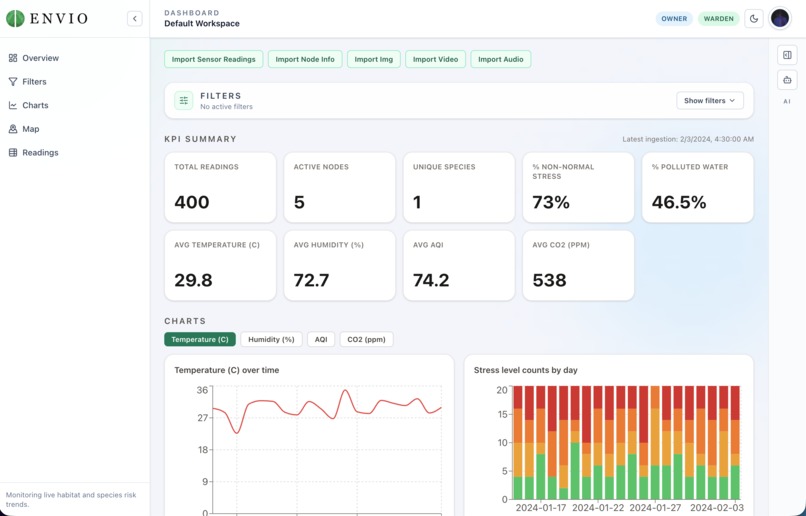
Dashboard Graphs
-
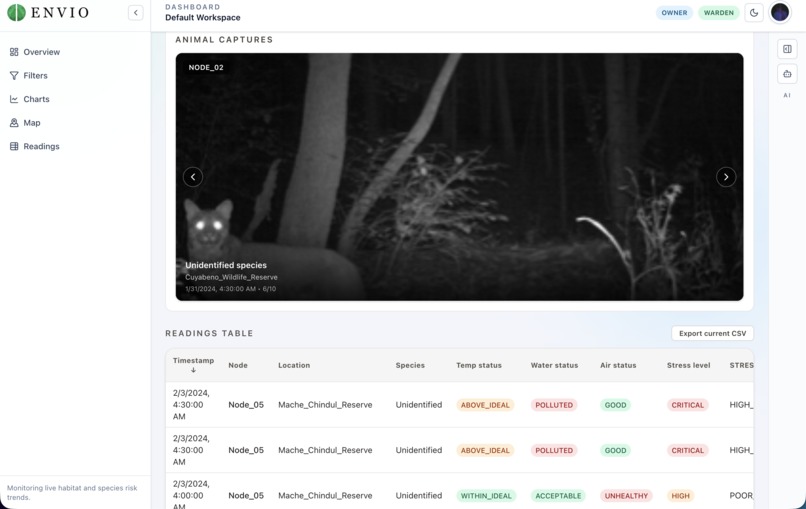
Dashboard Data
-
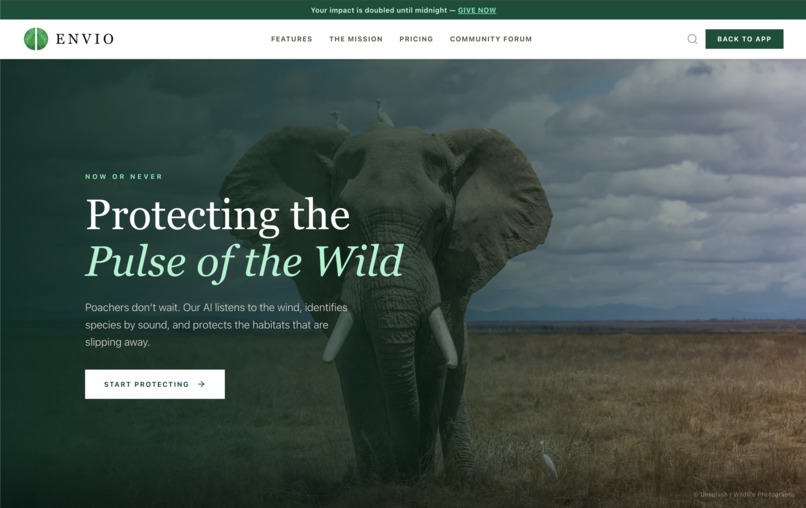
Home Page


Inspiration
Our team comes from a background in Automated Environmental Monitoring Research. In real field work, we saw a repeated problem: collecting data was possible, but turning that raw data into clear ecological insight took too much manual effort and time.
That pain point inspired ENVIO. We wanted a platform that helps biology and conservation researchers move from "data collection" to "decision-making" much faster, with AI support and collaborative workflows.
What it does
ENVIO is an AI-assisted environmental monitoring platform that combines sensor and wildlife media analysis in one workspace.
It enables teams to:
- Import and manage sensor readings, node metadata, images, audio, and video.
- Analyze species and environmental context using Gemini-powered interpretation.
- View KPI summaries, trends, top species, map activity, and capture carousels.
- Collaborate in shared workspaces with role-based access:
- Editing access for operational collaboration.
- Viewing access for read-only collaboration without Gemini/import/export actions.
How we built it
We built ENVIO as a full-stack web application with:
- A structured ingestion pipeline for multiple environmental data types.
- A backend analysis layer that enriches data with AI-derived species context.
- A dashboard layer for KPIs, charts, map intelligence, and table views.
- Workspace and invitation systems for collaborative analysis.
- Access-control logic for plan tiers, trial flows, and permission boundaries.
We also improved analytics consistency by making species-focused indicators depend on the correct data source (NodeImage.species) where biodiversity observations are captured.
Challenges we ran into
- Data model alignment: species data appeared across different tables, and some metrics were initially sourced from the wrong one.
- Workspace context resolution: invited users could default into their own workspace instead of the shared workspace.
- Permissions complexity: balancing tier-based capability rules with workspace-role privileges required careful access logic.
- Schema rollout reliability: introducing collaboration tables required safe handling for environments where schema updates were not fully applied.
- UI consistency: dark mode initially did not propagate correctly to every dashboard component.
Accomplishments that we're proud of
- Delivered a complete end-to-end environmental intelligence dashboard.
- Implemented working invite-by-email collaboration with role-based permissions.
- Added accurate species analytics by grounding chart/KPI logic in
NodeImage.species. - Built practical access behavior for real use cases:
- Scout users do not get Gemini chat access.
- Scout users invited as editors can still perform imports.
- Improved dashboard UX with a more modern Workspace section and consistent theming.
What we learned
We learned that environmental software quality depends on more than model output. Real impact comes from:
- Correct data provenance for every metric.
- Clear and predictable permission boundaries.
- Smooth multi-user collaboration flows.
- Fast feedback loops between field data and actionable insight.
We also learned that trust in AI tools increases when users can verify where each insight comes from in the data model.
What's next for ENVIO
Next, we plan to:
- Expand advanced biodiversity analytics and trend forecasting.
- Add stronger collaborative controls (workspace switching, invitation lifecycle management, and auditability).
- Improve explainability for AI outputs so researchers can see rationale and confidence signals.
- Continue optimizing import and processing workflows for larger field deployments.
- Integrate richer reporting exports for grant, policy, and conservation program needs.
Built With
- auth0
- date-fns
- google-gemini-api-(@google/generative-ai)
- javascript
- leaflet-+-react-leaflet
- next.js-16
- node.js
- prisma-orm
- prisma-postgres-(postgresql)
- react-19
- recharts
- resend-api
- stripe
- tailwind-css-4
- ypescript
- zod


Log in or sign up for Devpost to join the conversation.