-
-
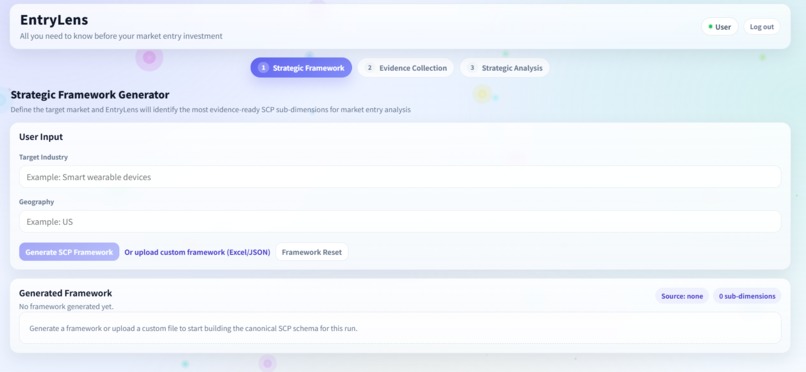
Tab1 Panel
-
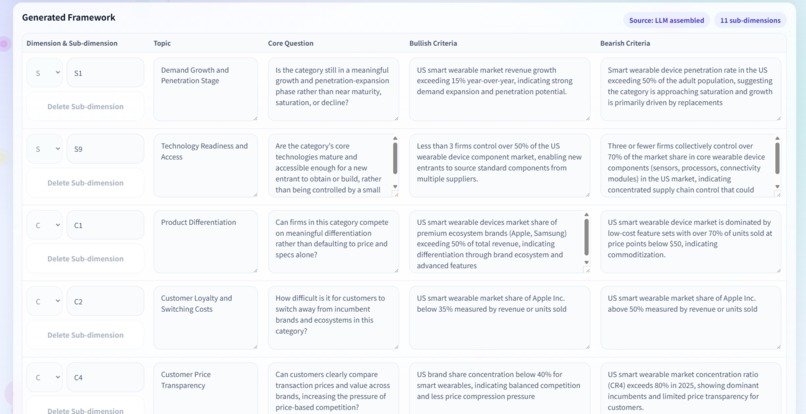
Tab1 SCP Freamwork
-
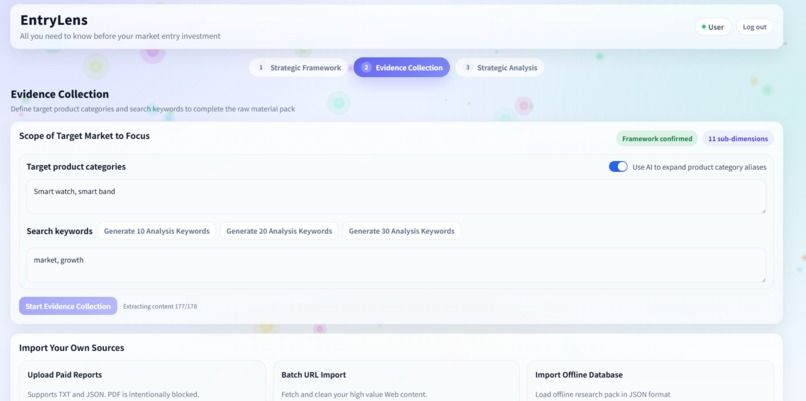
Tab2 Panel
-
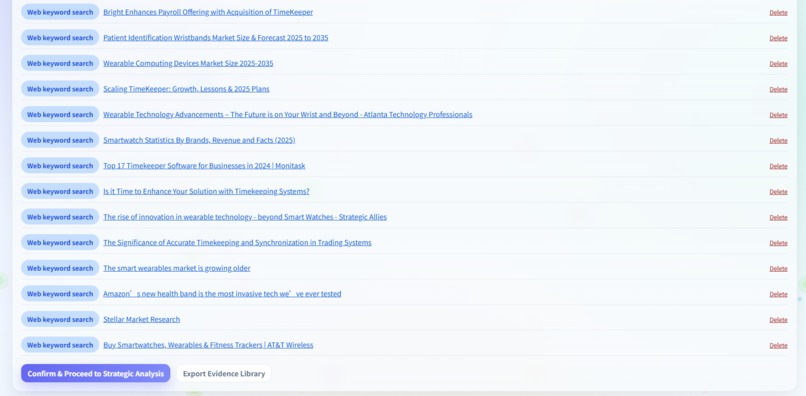
Tab2 Evidence Library
-
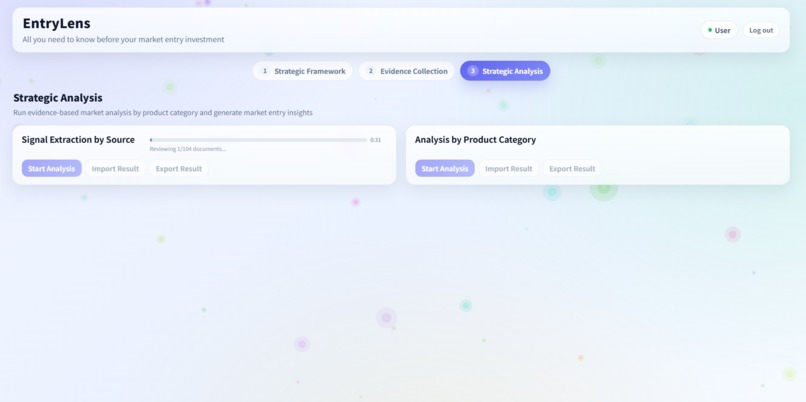
Tab3 Panel
-
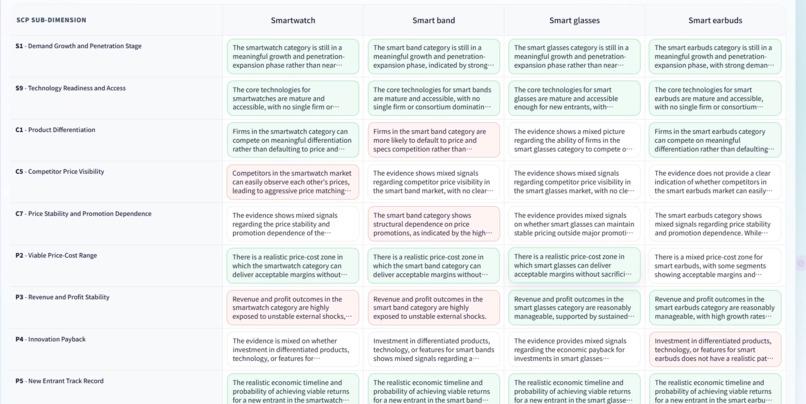
Tab3 Market-entry Insight


About EntryLens
EntryLens is a strategic market-entry analysis platform developed by a former McKinsey Associate Partner and built on Amazon Nova. It is designed for companies that need structured market-entry judgment but do not have the budget, internal capability, or time to run consulting-grade research. Instead of relying on vague desk research, secondhand reports, or intuition, EntryLens combines classic SCP strategy theory with AI-driven evidence synthesis to help users understand market dynamics and make better entry decisions.
EntryLens follows a 3-step workflow, organized into three tabs.
Tab 1: Strategic Framework Generator
- What it does: Tab 1 turns a target industry and geography into a locked SCP decision framework that guides all downstream work. Nova does not generate the framework from a blank prompt. Instead, the system starts from a universal SCP mother library and runs a two-stage consensus process. In Stage 1, four independent Nova calls vote on each candidate sub-dimension’s applicability, and only dimensions with sufficient support survive. In Stage 2, four additional grounded Nova calls generate measurable bullish and bearish criteria for each surviving dimension, and outputs are accepted only when both sides converge through semantic and numeric consensus.
- Business value: Before any evidence is collected, the user already has a disciplined, decision-ready framework instead of an open-ended research question.
Tab 2: Evidence Collection
- What it does: Tab 2 builds the evidence base for analysis. Nova expands each target product category into realistic search aliases so retrieval is not limited to the user’s exact wording. The system then runs a multi-stage evidence refinement pipeline: it retrieves URLs, fetches content, removes weak or unusable pages, filters low-quality extracted text, deduplicates near-duplicates at both title and content level, and scores surviving documents against the confirmed SCP framework using embedding-based relevance matching. Automated web results, imported paid reports, batch URL inputs, and offline packs all flow into one normalized evidence library.
- Business value: Turns messy market research collection into a cleaned, deduplicated, framework-scored evidence base that is ready for strategic analysis.
Tab 3: Strategic Analysis
- What it does: Tab 3 provides two complementary analysis views. The Source View identifies document-level must-to-know evidence with exact quote traceability. Each document is split into numbered evidence segments, Nova runs four independent extraction passes, and only items that repeatedly survive consensus are retained. This gives users an auditable map of what matters in each source. The Product View answers a different question: for each product category and SCP sub-dimension, the system scores short document segments against framework anchors, ranks the most relevant evidence, and asks Nova to generate one scoped market-entry summary on that bounded evidence set. The output can be bullish, bearish, or mixed, but it is always tied back to the confirmed framework and the selected evidence.
- Business value: Gives decision-makers both an auditable evidence map with substantial depth and product-level market-entry insights, supporting the final investment decision and making the market-entry judgment easier to inspect, trust, and defend.
Commercialization
EntryLens is designed to work across industries and geographies. It supports both public web retrieval and proprietary research imports, and adapts to each use case through its framework-generation process. That makes it relevant to B2B scenarios such as investment due diligence, category expansion, and corporate market-entry planning. The commercial model can support both annual SaaS subscriptions and project-based engagements.
Built With
- amazon-bedrock-(amazon-nova)
- aws-sdk
- brave-search-api
- cheerio
- express.js
- json
- node.js
- vanilla-html/css/javascript
- xenova-transformers

Log in or sign up for Devpost to join the conversation.