Inspiration:
Before a team ships a product, sends technology, or borrows an artwork across a border, someone has to answer the same questions: what does it cost to land, which rules apply, who is on the other side, and what is still unknown? Today that means reading federal regulations, tariff tables and sanctions lists, object by object. I built Entrepôt to perform the first read of any trade transaction and show the source behind each piece of analytic or regulatory data.
What it does:
Entrepôt is a decision-support tool for international trade.
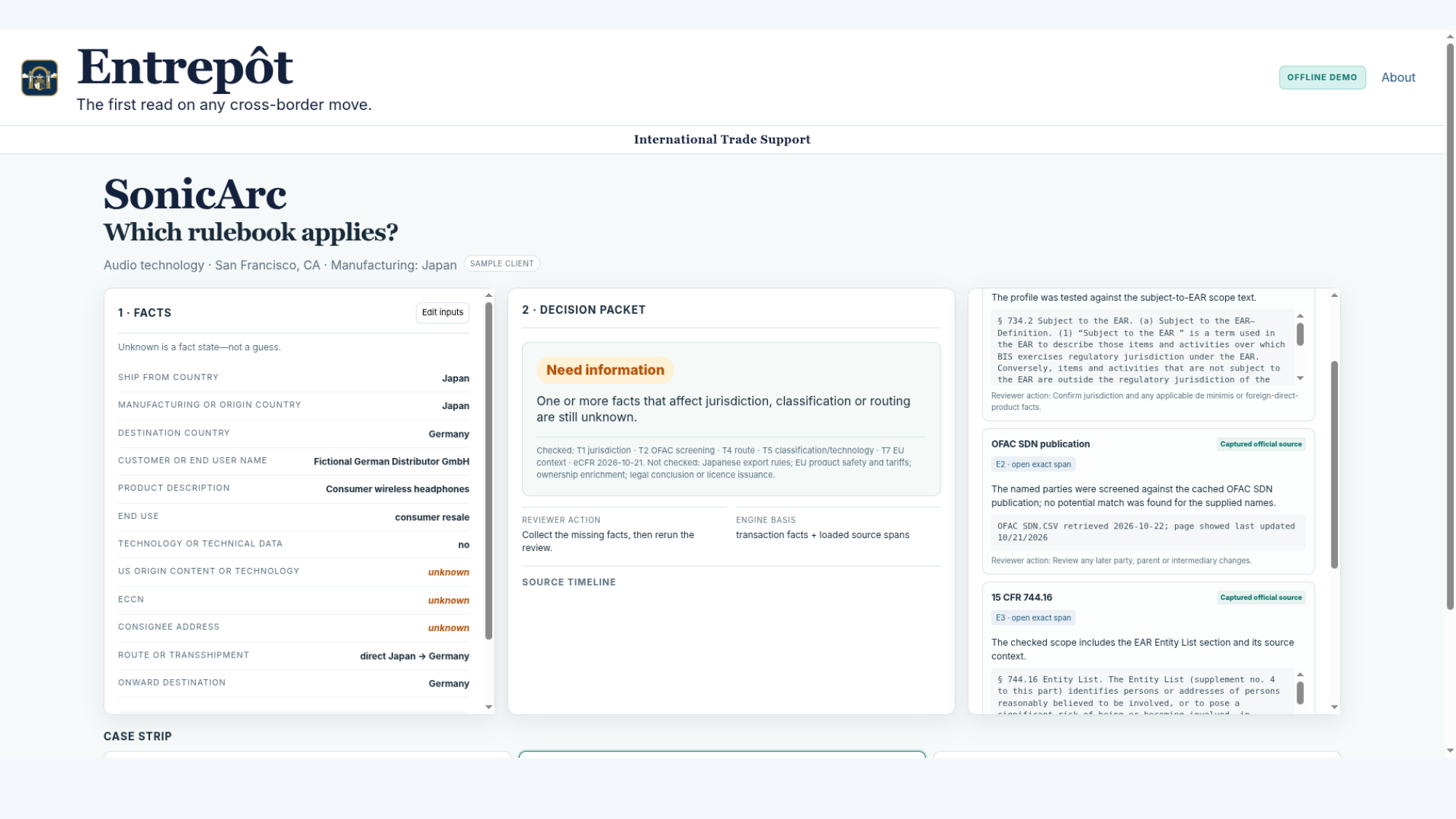
A team enters the product information, source location, receiving location, and other known facts. Entrepôt then puts two things together in one view:
- the official trade facts that may affect the move—such as tariff treatment, listed controls, sanctions or export-control signals, and cited market data; and
- the missing facts and the next human review step.
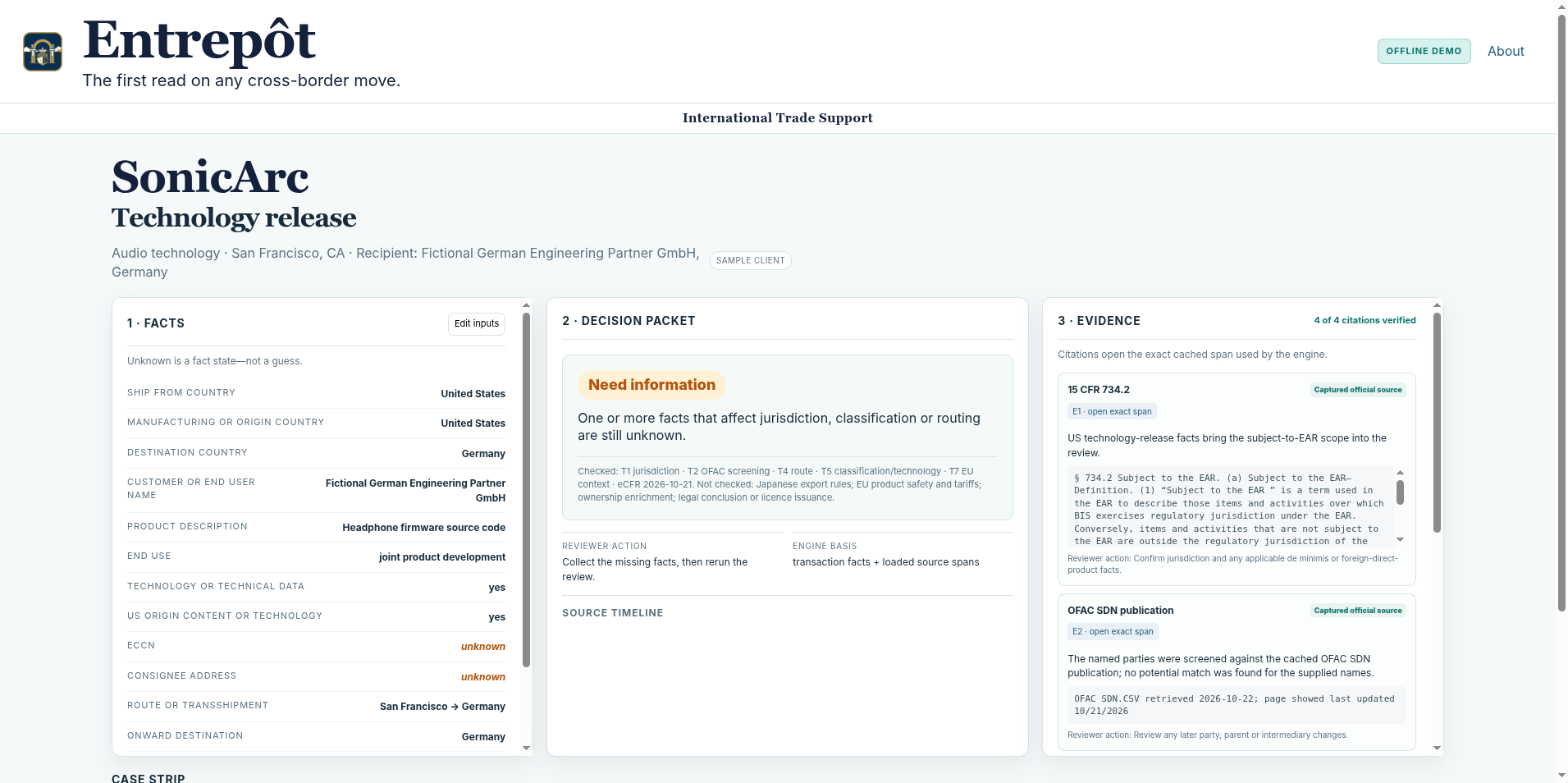
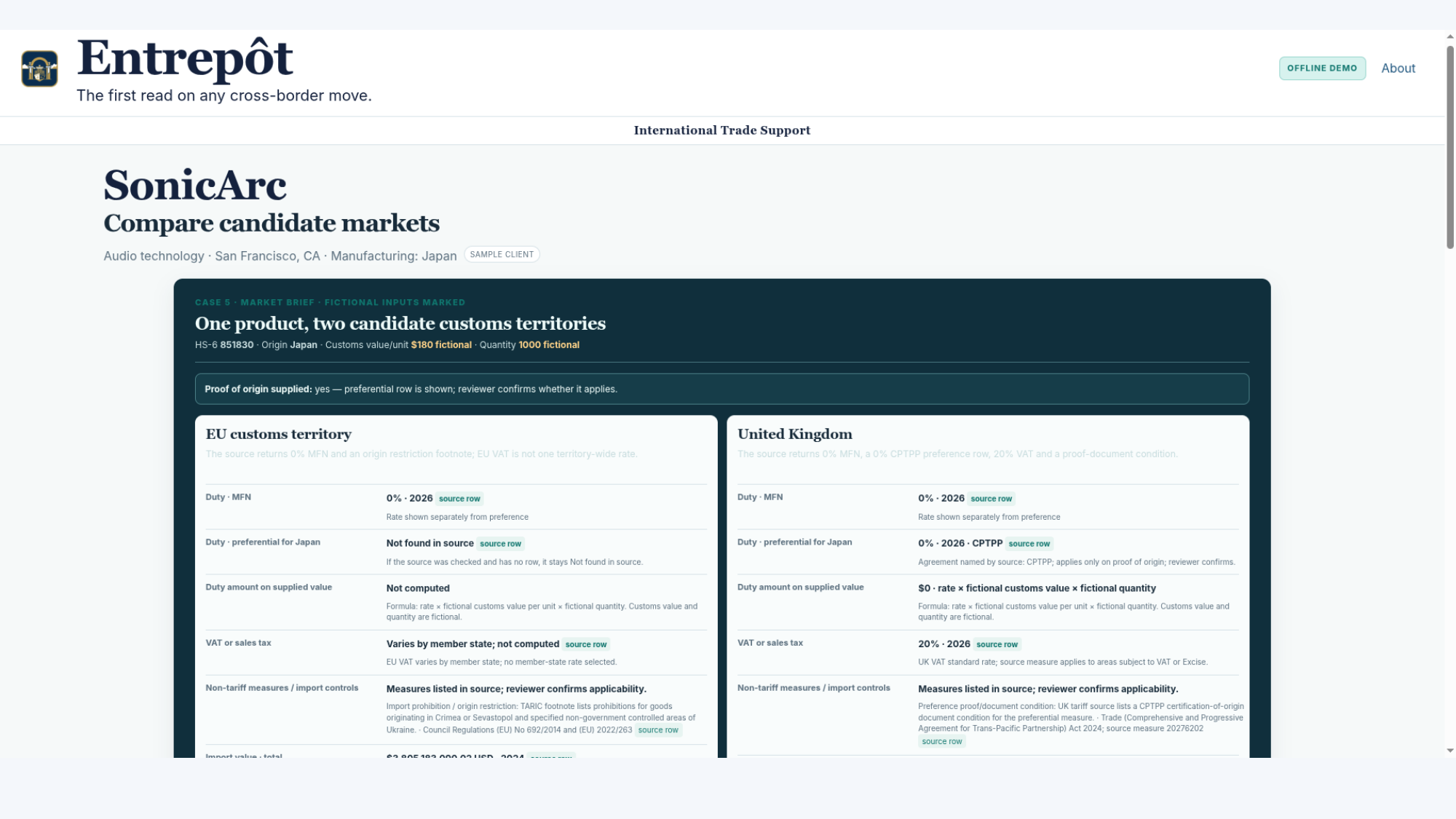
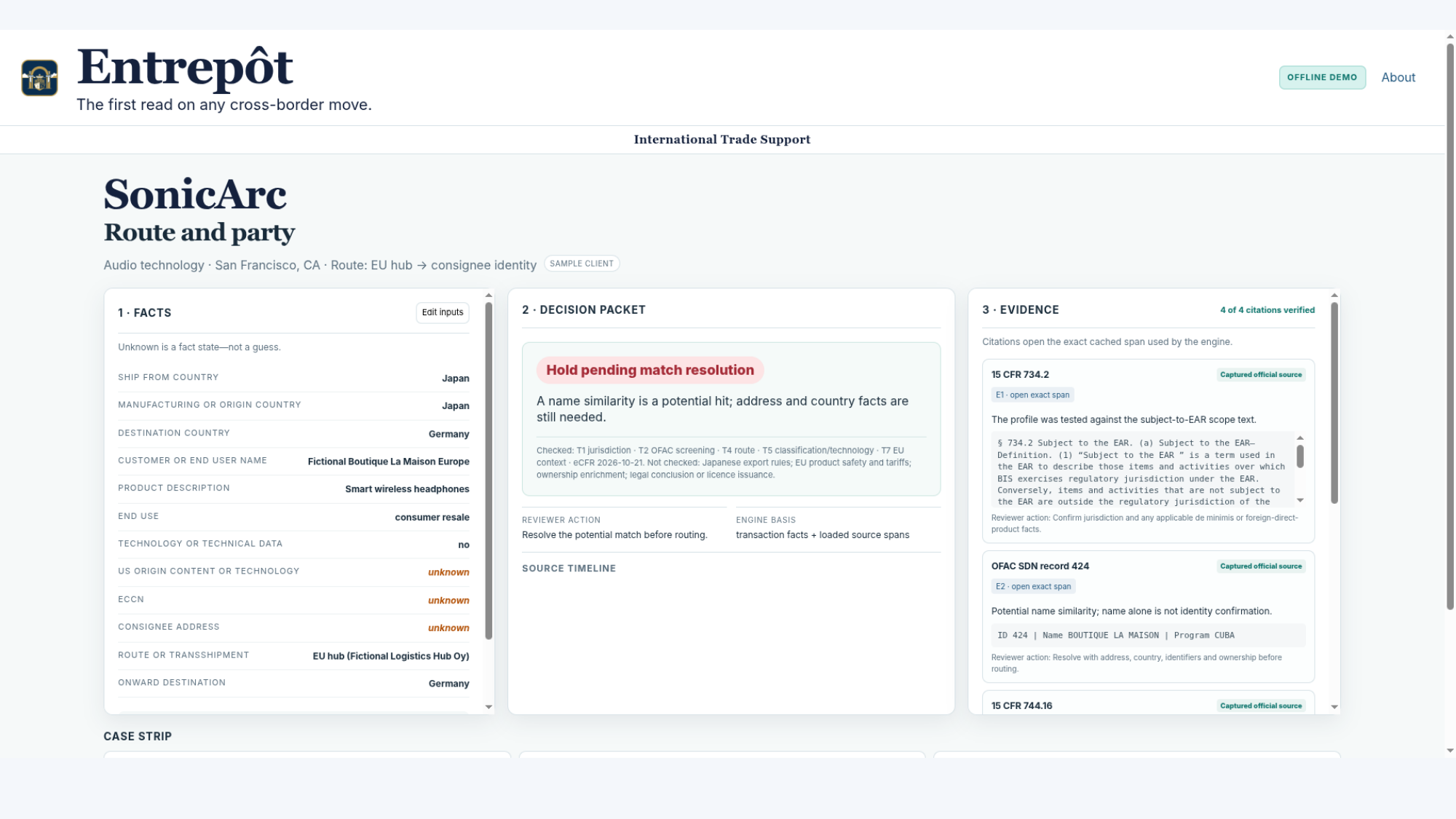
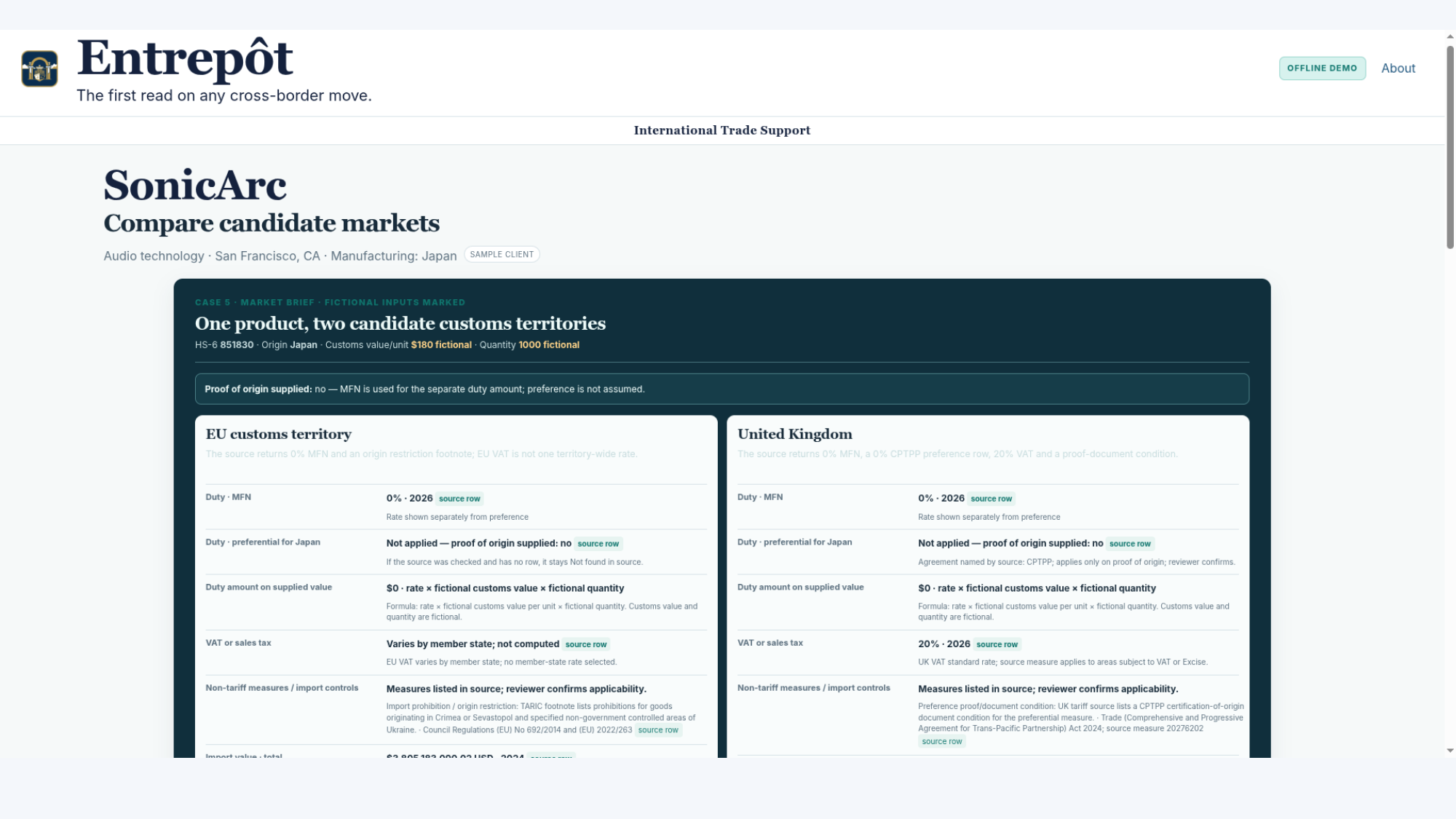
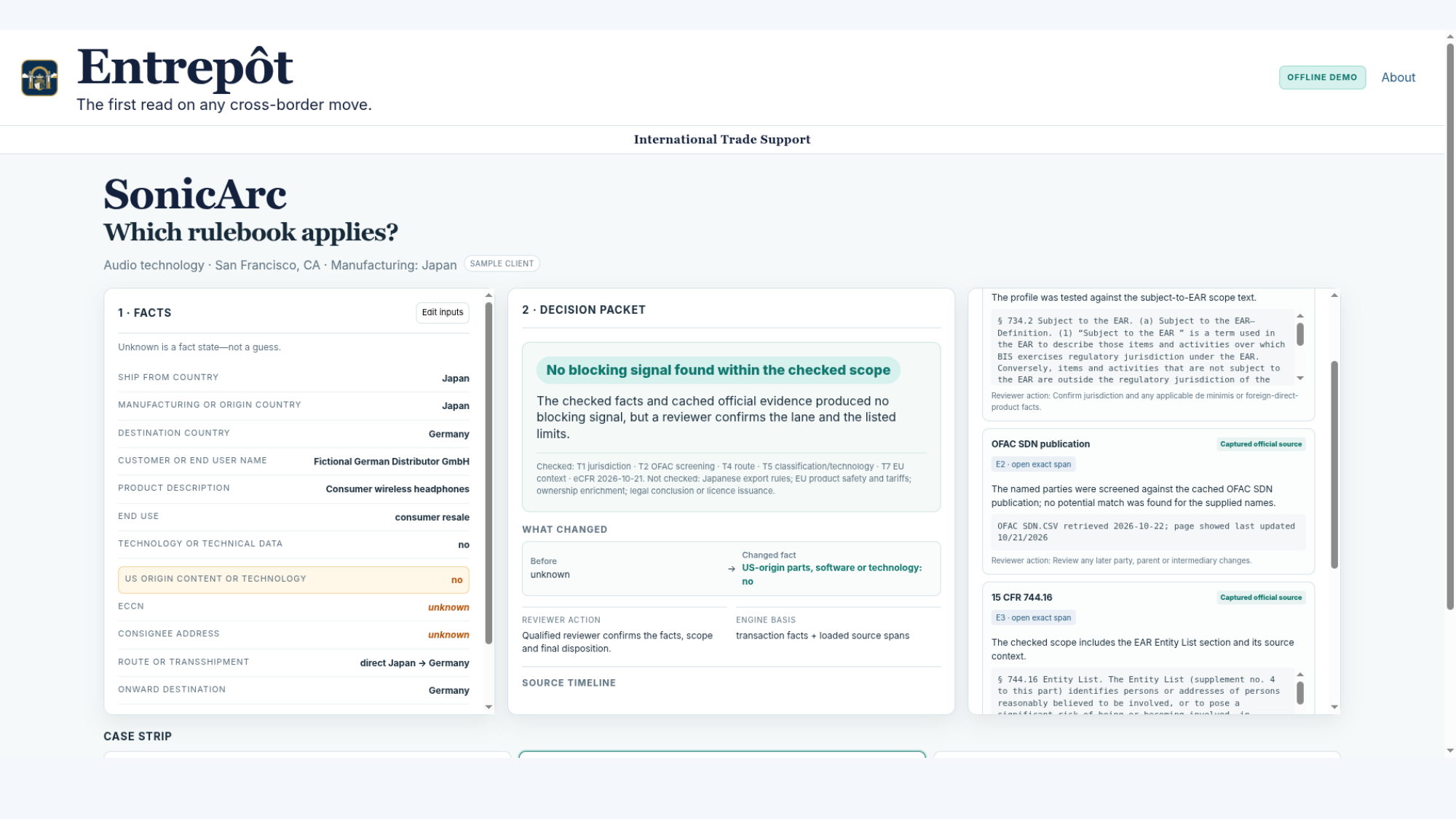
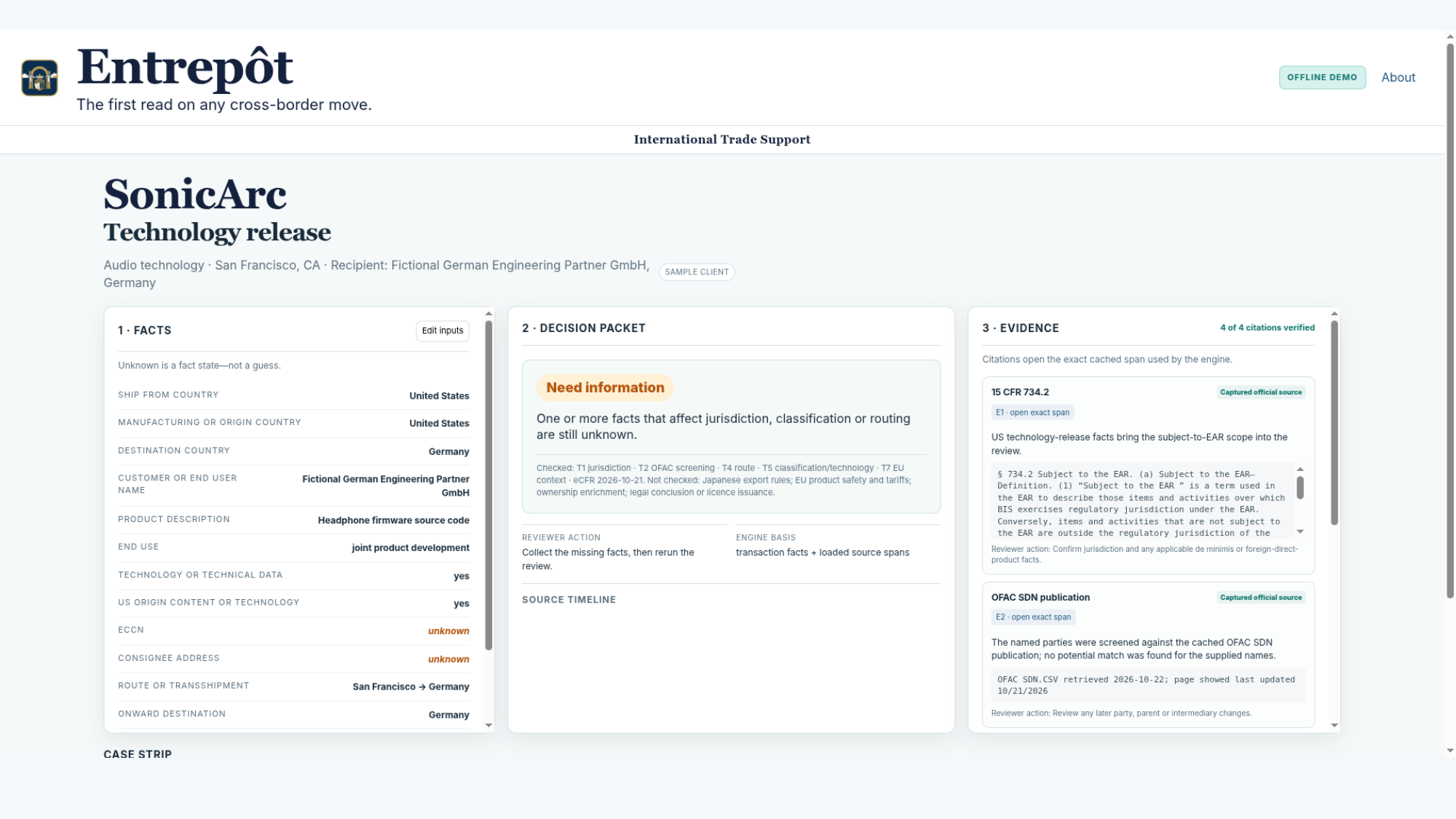
Every sourced result points back to an exact evidence span. If the public sources do not establish something, Entrepôt shows “Need information,” “Not found in source,” or “Not computed” instead of guessing. That makes the reasoning auditable and keeps uncertainty visible.
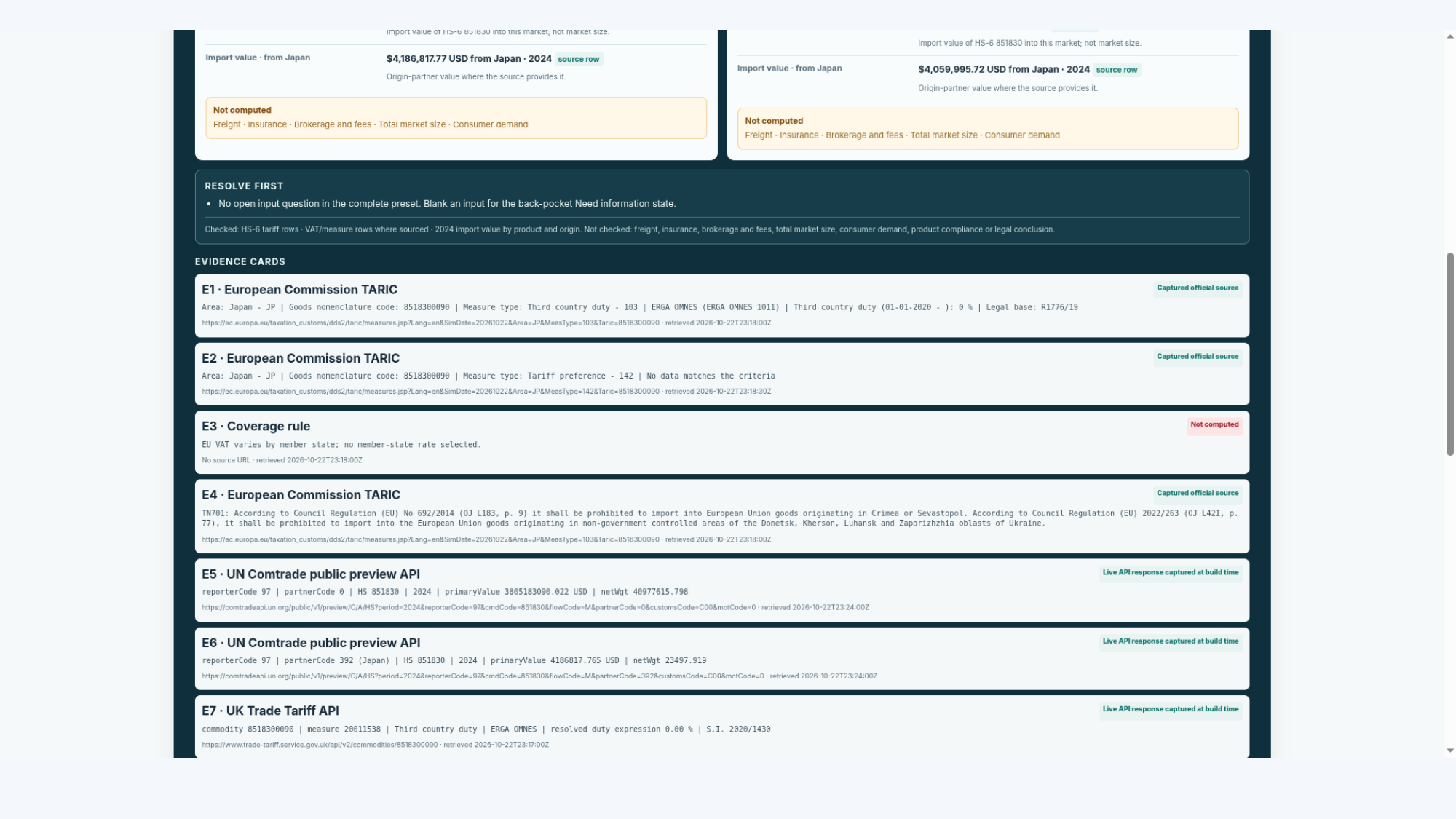
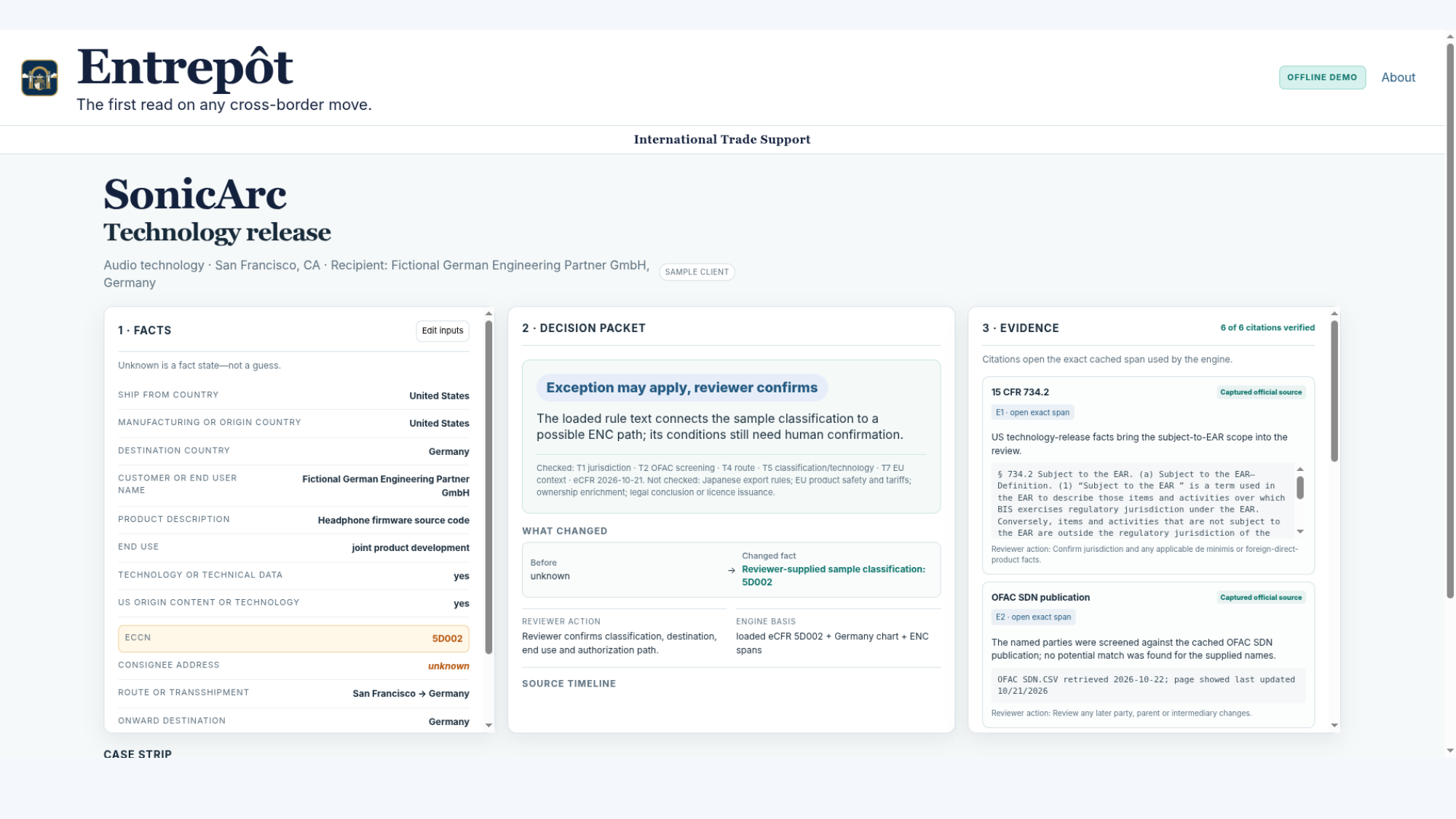
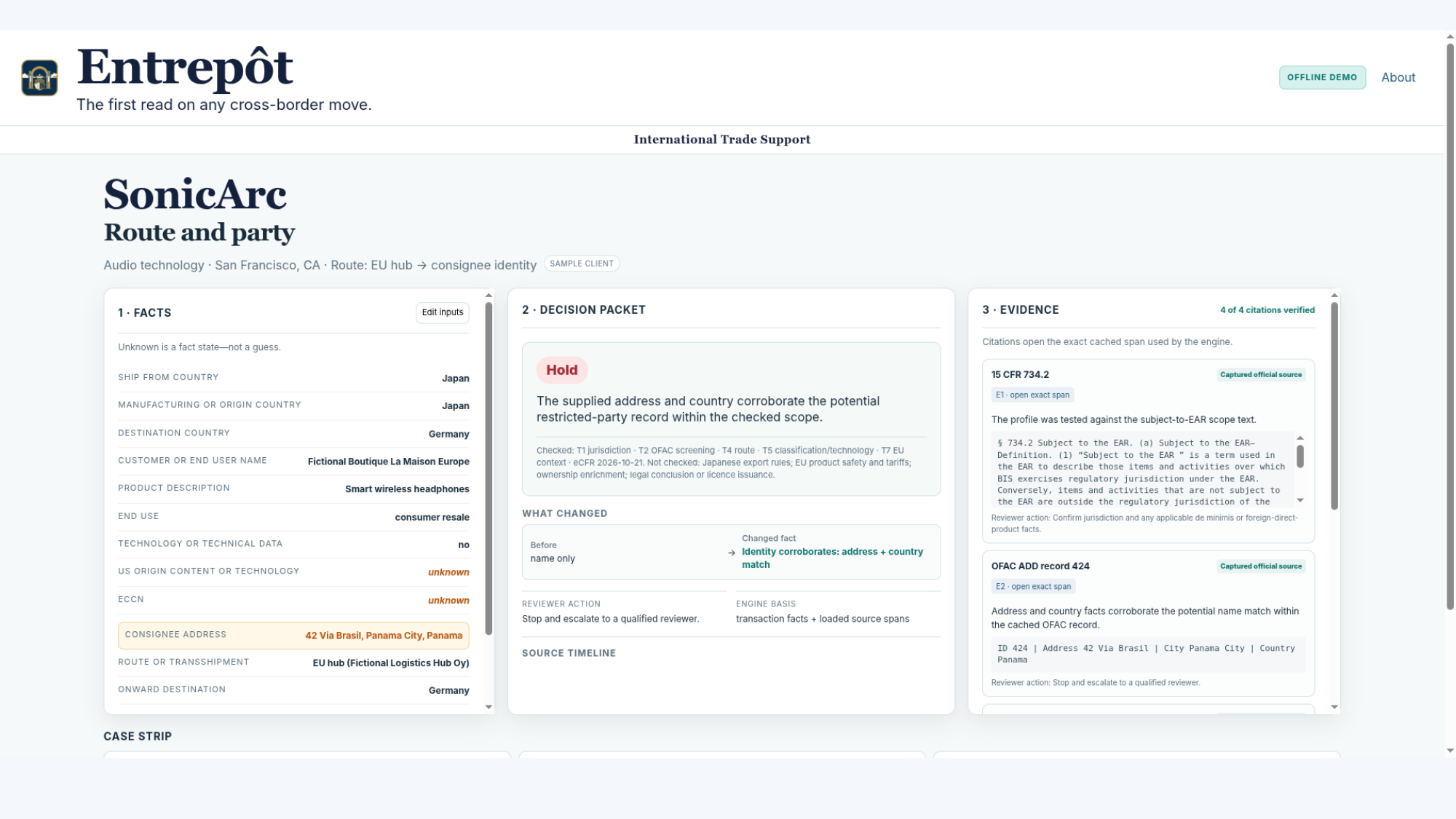
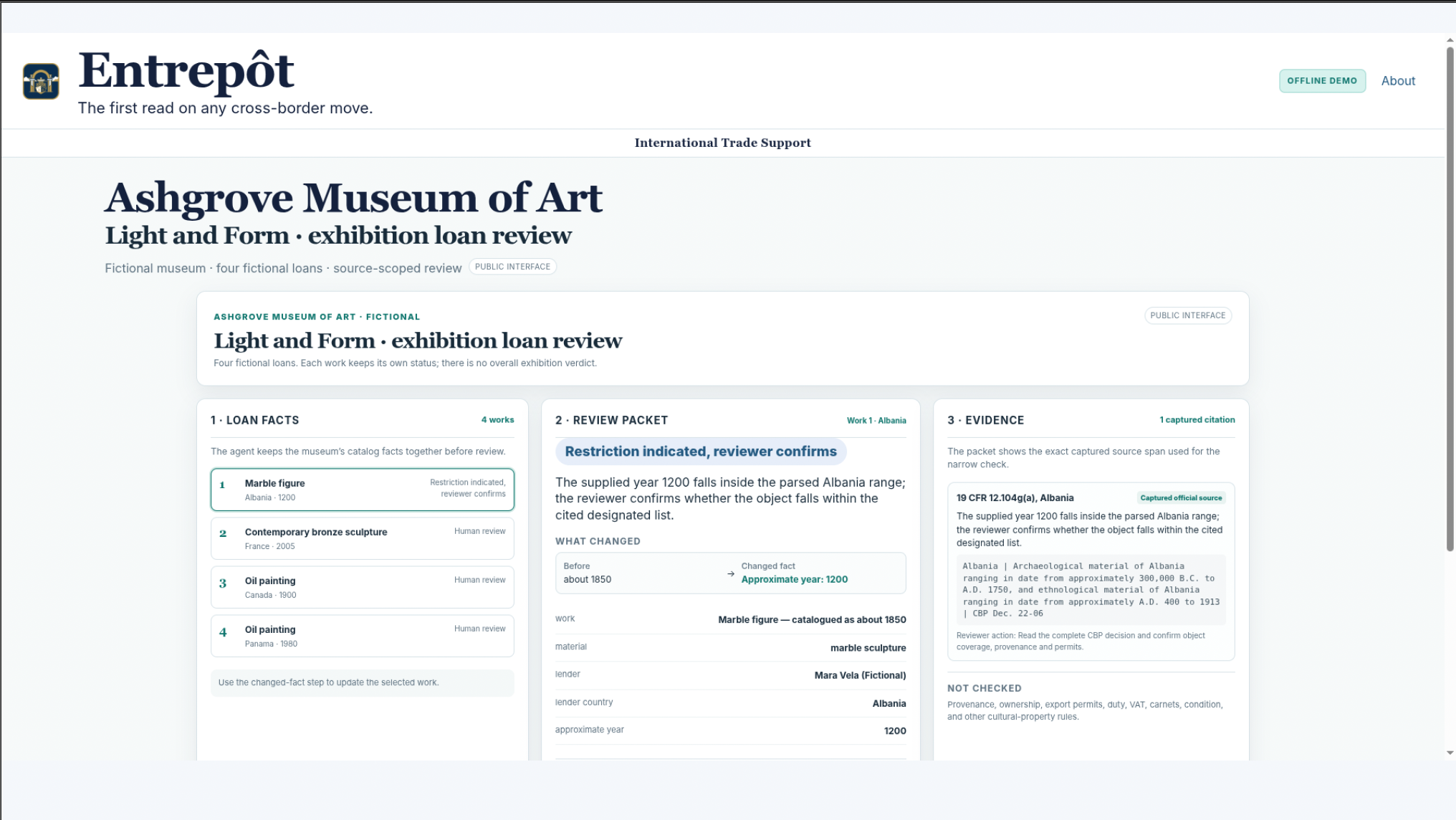
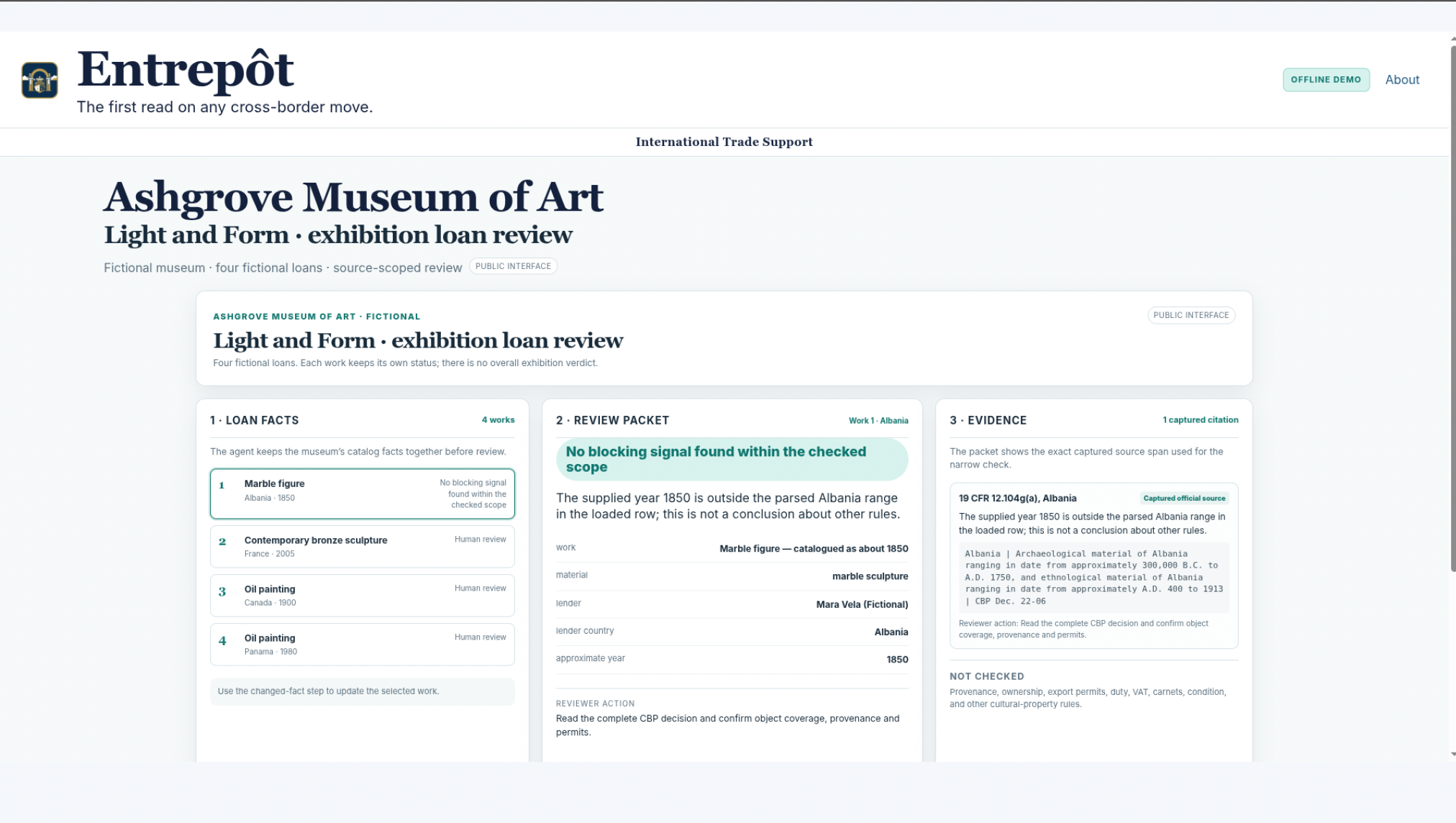
The demo shows this through three cases: a SonicArc origin review, a technology-release review where an ECCN fact changes the path, and an exhibition-loan review where party and routing facts matter. It also includes a SonicArc market brief comparing two candidate customs territories for Japanese-made headphones, showing duty, tax, listed measures, and import value side by side without calling one market better.
Every answer links to the exact text it came from, with the source, retrieval time and a verified citation. Entrepôt never says an object or shipment is lawful, cleared or approved. A qualified person decides.
How I built it:
A deterministic rules engine decides every status in code. Source documents are loaded from public data with a manifest (URL, retrieval time, checksum), and every citation is verified as an exact span of the loaded text. The demo runs offline from saved fixtures. An evidence graph links each finding to its source, and an “unknown” state is built into the engine. The interface has a public view and a separate presenter view.
Data sources (all public)
- eCFR: 15 CFR Parts 734, 738, 740, 744, 746 and 774, and 19 CFR 12.104g
- Treasury OFAC Sanctions List Service
- eCFR / BIS Title 15 XML — export-control jurisdiction, EAR/CCL context, licensing and ECCN evidence.
- U.S. Treasury OFAC Sanctions List Service — SDN list records and address/country evidence.
- EUR-Lex — EU dual-use regulation, CELEX 32021R0821.
- European Commission TARIC — EU customs-territory tariff and import-control rows for HS-6 851830 / tariff line 8518300090.
- UK Trade Tariff API — UK MFN duty, CPTPP preference and proof-document condition, VAT, and measure rows for 8518300090.
- UN Comtrade public preview API — 2024 import value for HS-6 851830, both total and Japan-partner values for the EU customs territory and UK.
The demo does not use live calls while running, and it does not use a private API key for these responses. Each captured source is stored with its URL, retrieval time, SHA-256, and evidence text. Reuse terms for TARIC, the UK API, Comtrade, OFAC, and EUR-Lex remain items for human review rather than legal reuse opinions.
Limitations: This demo covers a narrow set of cases, territories, products, and captured public sources. Its demo path is offline and therefore uses fixtures captured at build time rather than live lookups. It does not cover every HS code or market, and a source may not provide every requested value.
Built With
- pine