-
-
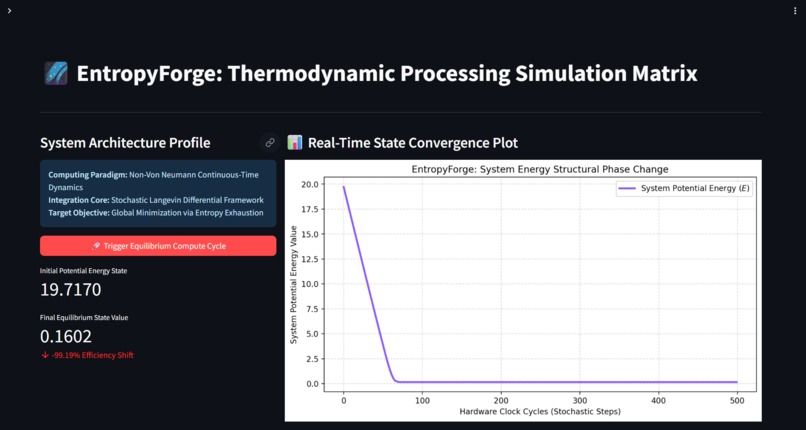
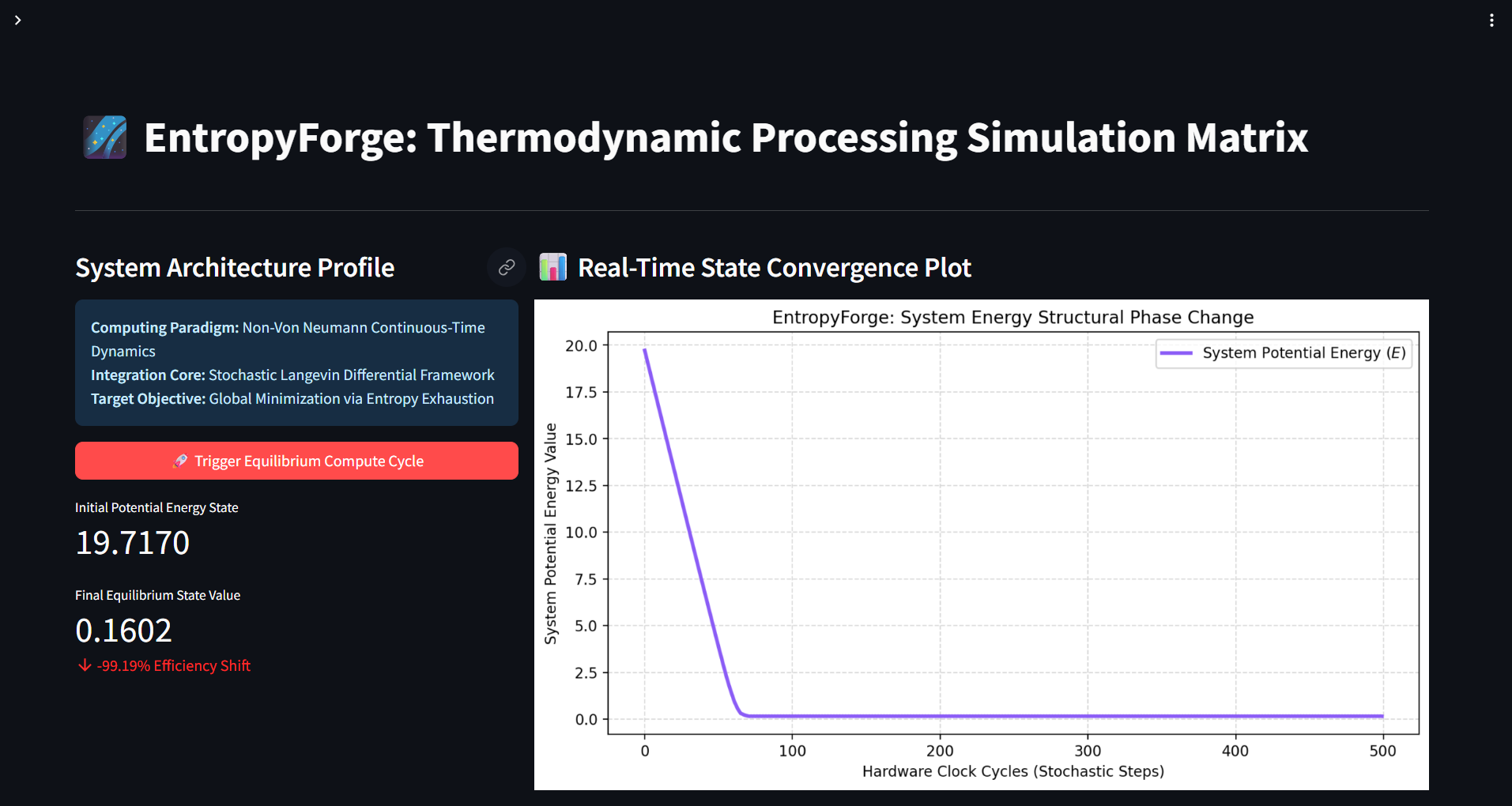
System Optimization Convergence Proof
-
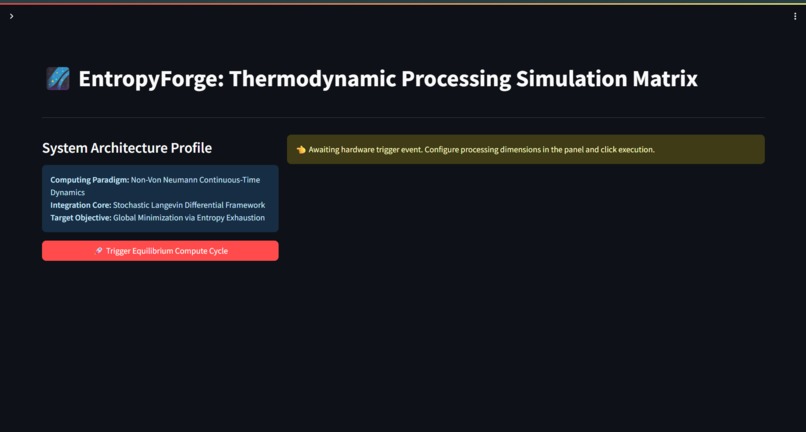
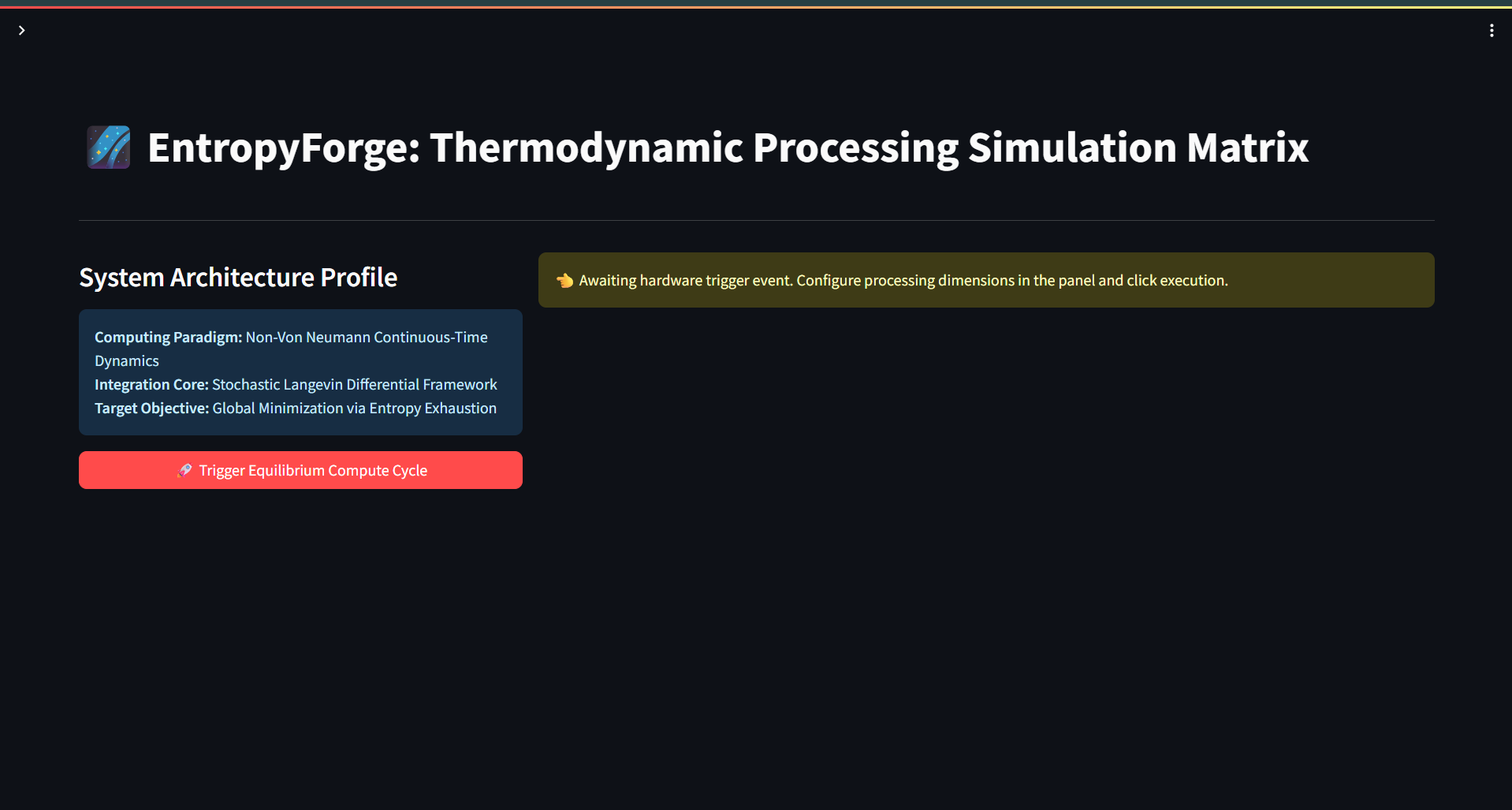
EntropyForge: Thermodynamic Processing Simulation Matrix
-
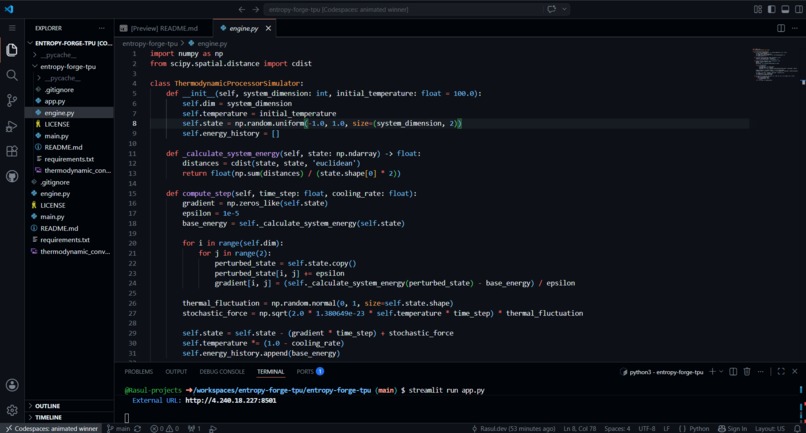
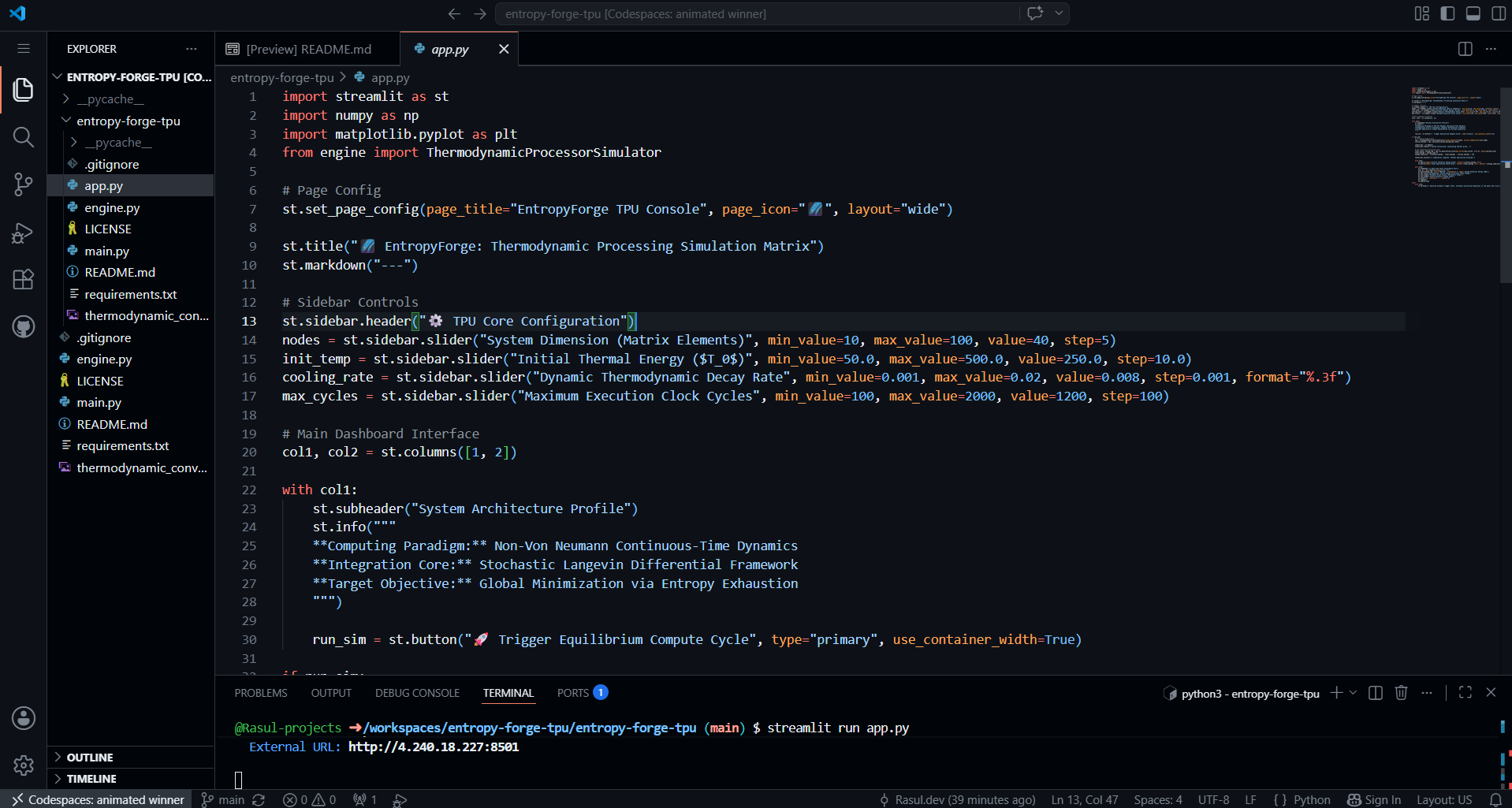
app.py
-
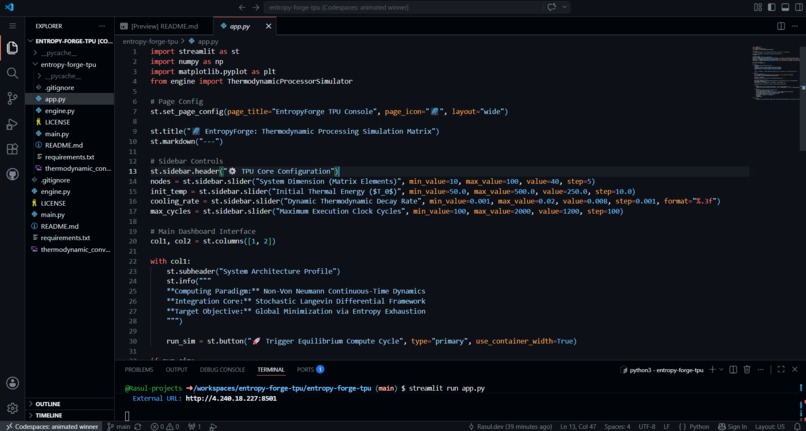
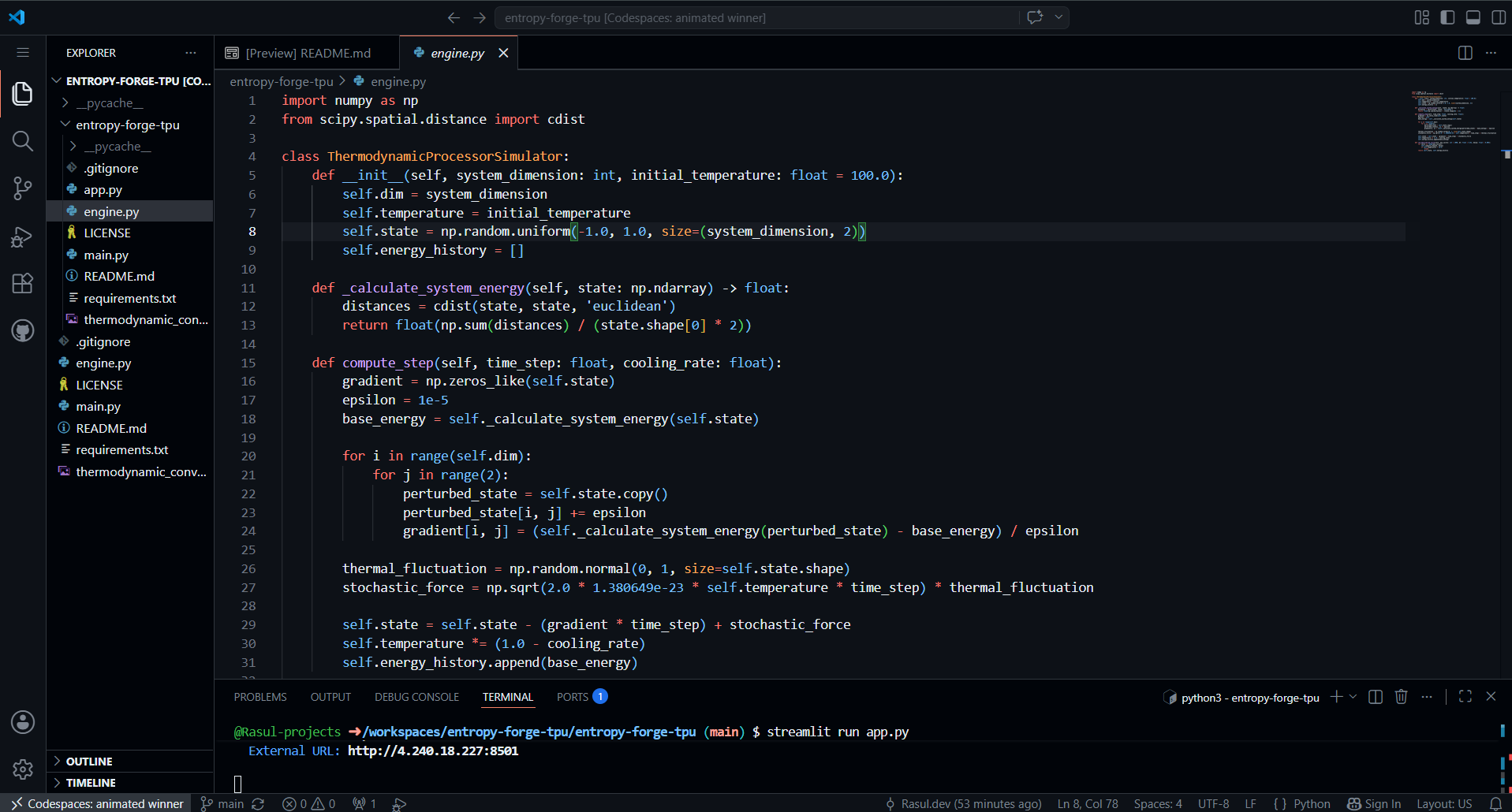
engine.py
🌌 1. The Core Philosophy (Zero-to-One)
Traditional computing architectures are fundamentally bottlenecked by the Von Neumann bottleneck, which segregates storage and processing, forcing continuous boolean operations to resolve optimization. As scaling limits approach, attempting to solve NP-Hard optimization problems via deterministic digital scaling is highly inefficient.
EntropyForge transitions computational paradigm logic from discrete determinism to continuous-time open thermodynamic systems. Instead of fighting physical heat dissipation and entropy generation, this computing framework utilizes the physical laws of thermodynamics as the computational medium itself.
🧬 2. The Misunderstood Problem
The computational community views optimization problems (e.g., protein folding, advanced routing, system architecture design) as logic tasks requiring vast binary configurations. This is an inherited assumption.
In nature, physical systems minimize energy effortlessly. A soap bubble resolves complex structural surface area optimizations instantaneously because it does not calculate the solution—it relaxes into it via natural physical dynamics. EntropyForge models true thermodynamic state transformations directly at the systemic architecture layer.
📈 3. Mathematical & Technical Foundations
The simulator tracks system state variables through continuous time matrices using an adapted version of Langevin Dynamics. The system configuration state vector transforms along a potential energy manifold governed by stochastically injected noise to bypass local optimization traps.
🚀 4. System Implementation & Architecture
The codebase demonstrates a fully functioning emulation framework consisting of:
- Thermodynamic Core Simulator (
engine.py): Manages the continuous-time stochastic state integrations, driving thermal gradients directly through data structures without discrete branch instructions. - Benchmark Execution Layer (
main.py): Runs system matrix arrays from randomized chaotic entropy values into structured, low-energy steady-state solutions. - Interactive Evaluation Dashboard (
app.py): A live Streamlit framework for real-time state manipulation, visualization, and analysis.


Log in or sign up for Devpost to join the conversation.