-
-
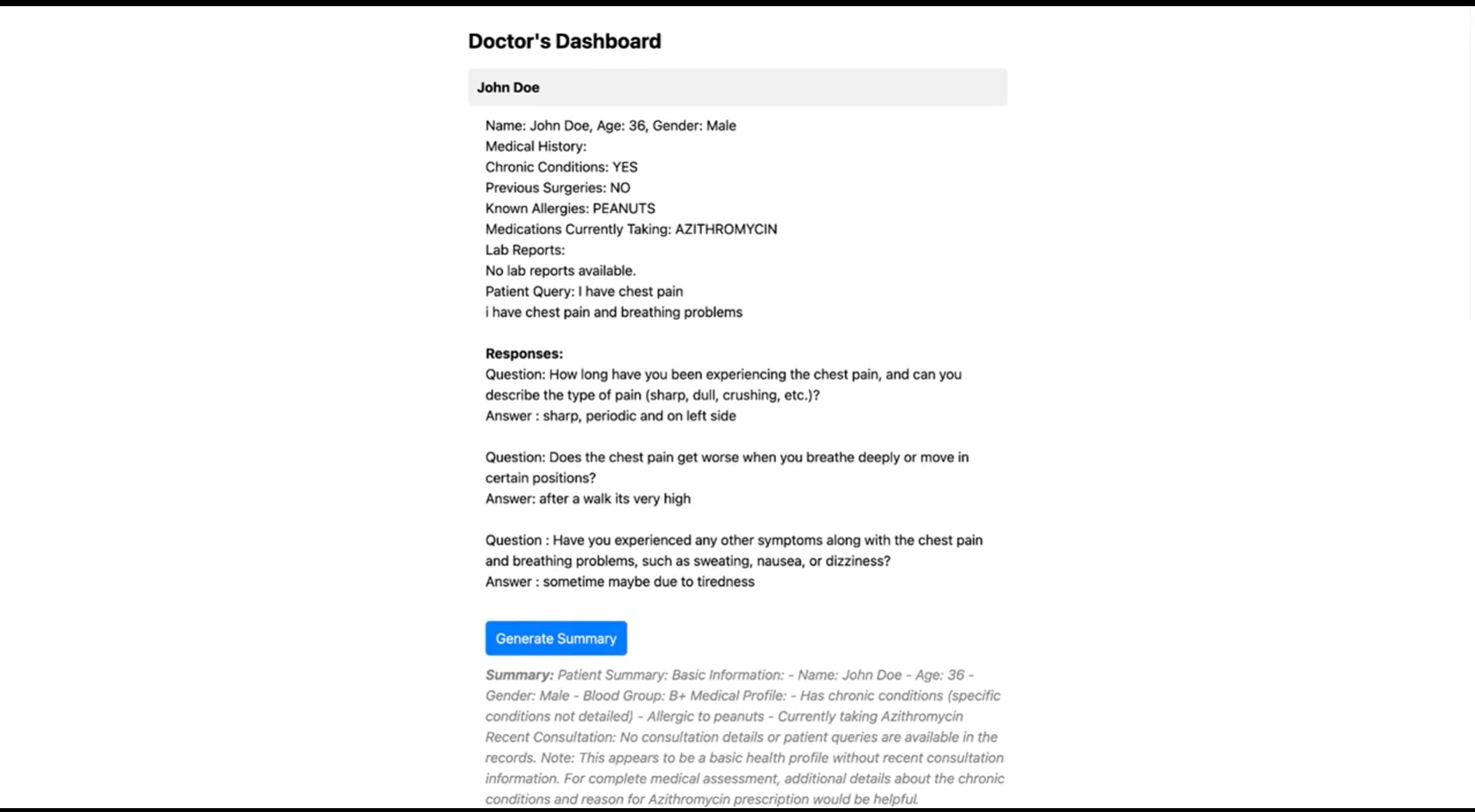
Snapshot from the website
Inspiration
The idea of FirstHelp blooms from the lack of availability of the the appropriate healthcare advices in second and third world countries. Even in the first world countries like the united states, the hassle of getting an appointment is evident. In such a scenario, we propose the use of FirstHand, an AI based product that facilitates the telemedicine and early stage diagnostics and information gathering in order to alleviate the workload of the doctors and thus helping them giving their valuable times. It is neither an AI to replace a doctor, nor it can. Its just here to assist them during the whole lifecycle of patient treatment.
What it does
FirstHand is an AI-based web application that upon account creation gather crucial medicinal informatics and provides two primary features.
An AI based telemedicine chat interface in order to help the individuals with trivial or minimal attention requiring problems a quick lifestyle change or basic quick-remedies. The telemedicine service can ask questions pertaining to the symptoms before reaching a final conclusion and also suggest emergency care and tests if found necessary.
The FirstHand also offers a platform to ease the Doctor's workload by asking the patients prior questions regarding their complaints in order to reduce the trivial workload for the doctors. The platform also provides the feature where the doctors can query the previous medical records of the patient present in the dataset using a natural language prompt in order to better understand his background for effective diagnoses of the underlying medical conditions.
How we built it
Development of the AI-telemedicine: The development of the AI telemedicine is done using 2 main components, Google's Gemini and NLX. The development began with the fine-tuning of a Gemini-1.5-flash on a red-teamed dataset consisting of more than 20000+ samples. The NLX on the other hand was used to facilitate the development of the conversational chat interface.
Development of the Early-diagnostics systems and querying system: The early diagnostics systems was developed using the Claude-3.5-Sonnet. The developed system uses the data captured in the MongoDB and the symptoms to answer the questions about the patients on the Doctor's portal.
Challenges we ran into
One of the main challenges we ran into during the project was to integrate the fine-tuned gemini-1.5-flash API endpoint as an intelligence layer in the NLX. This made us led the development of the serverless function on the cloud that servers as an endpoint for an endpoint of the gemini-1.5-flash fine-tuned model.
Accomplishments that we're proud of
Apart from accomplishment of solving the problem mentioned above, the overall complacence that we felt was to initiate and ideate about something related to the sensitive topic of the using medicinal data to create end-products which is always in nitty gritty of the technicalities, but has the scale of impacting a large number of lives.
What we learned
We learned how the independence of the mirco-services are deployed in a way they achieve the harmonicity. This project expanded our overall understanding of various tech-stacks and increased our grasping and adaptability powers.
What's next for FirstHelp
We are expanding FirstHelp into a fully backend-less, blockchain-powered platform where prescriptions are cryptographically signed, shared via QR codes, and verified on-chain. I’m also adding smarter AI support for doctors suggesting potential issues, medication recommendations, and one-click prescribing while maintaining patient privacy. The goal is to create a trustless, end-to-end healthcare workflow that saves time, reduces errors, and makes care more accessible, all while exploring how AI and Web3 can meaningfully intersect in real-world applications.


Log in or sign up for Devpost to join the conversation.