


ENTROPY — Multi-Paradigm AIGC Forensic Vision Platform & Physical Investigation Workstation
Inspiration
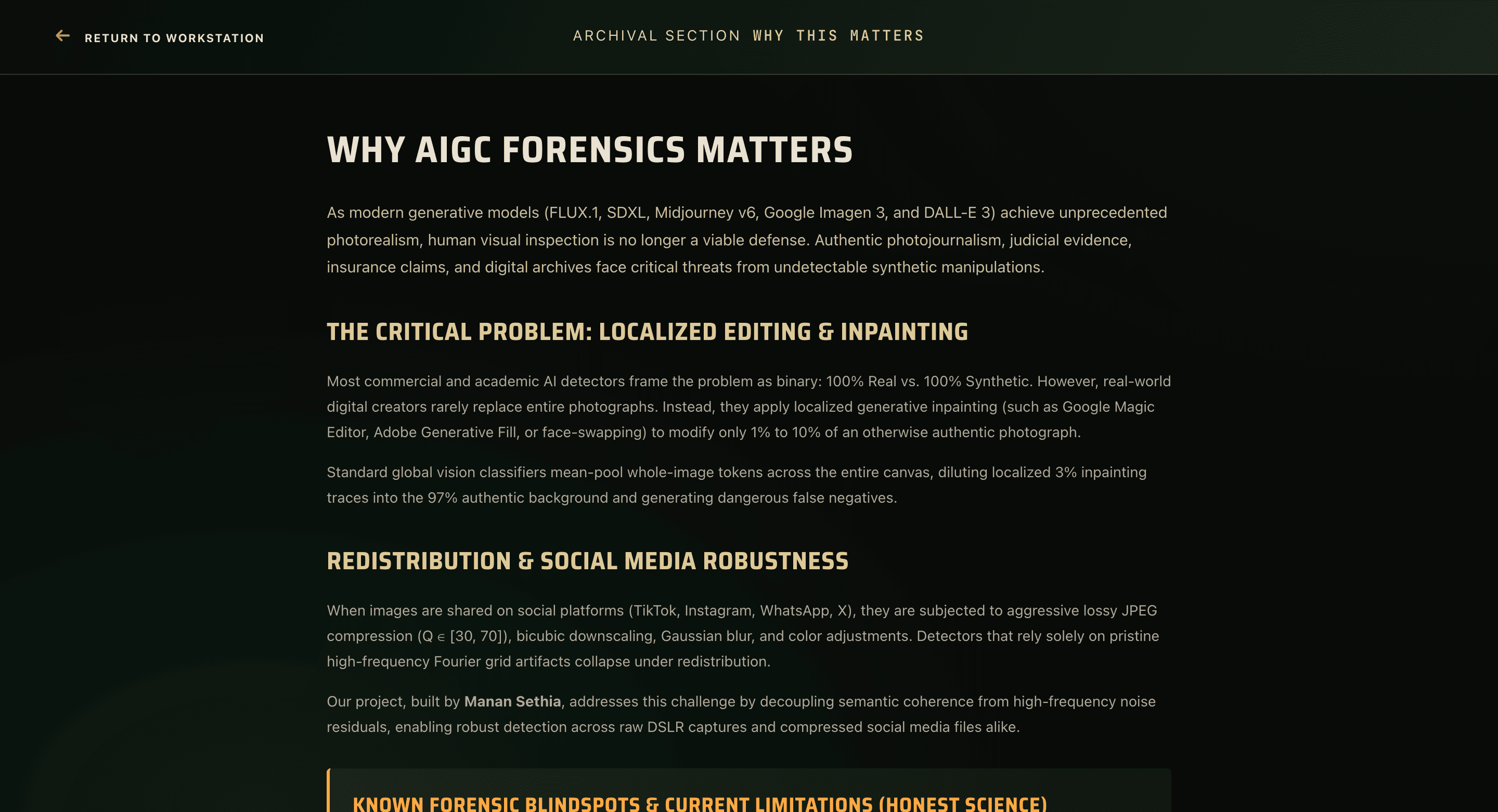
Modern AI image generators like FLUX.1, Midjourney v6, SDXL, and DALL-E 3 have gotten so good that the human eye can no longer tell what is real and what is fake. When looking at existing AI detectors, we noticed three big problems:
- Most detectors only say "Real" or "Fake": In the real world, people rarely replace an entire image. They use tools like Photoshop Generative Fill or Google Magic Editor to edit just 2% to 5% of an authentic photo (like changing a face, removing an object, or adding a weapon). Standard detectors look at the whole image and miss these small edits completely.
- Social media breaks existing tools: When an image is shared on TikTok, Instagram, or WhatsApp, it gets compressed, resized, and blurred. Detectors that rely on fragile pixel patterns break immediately.
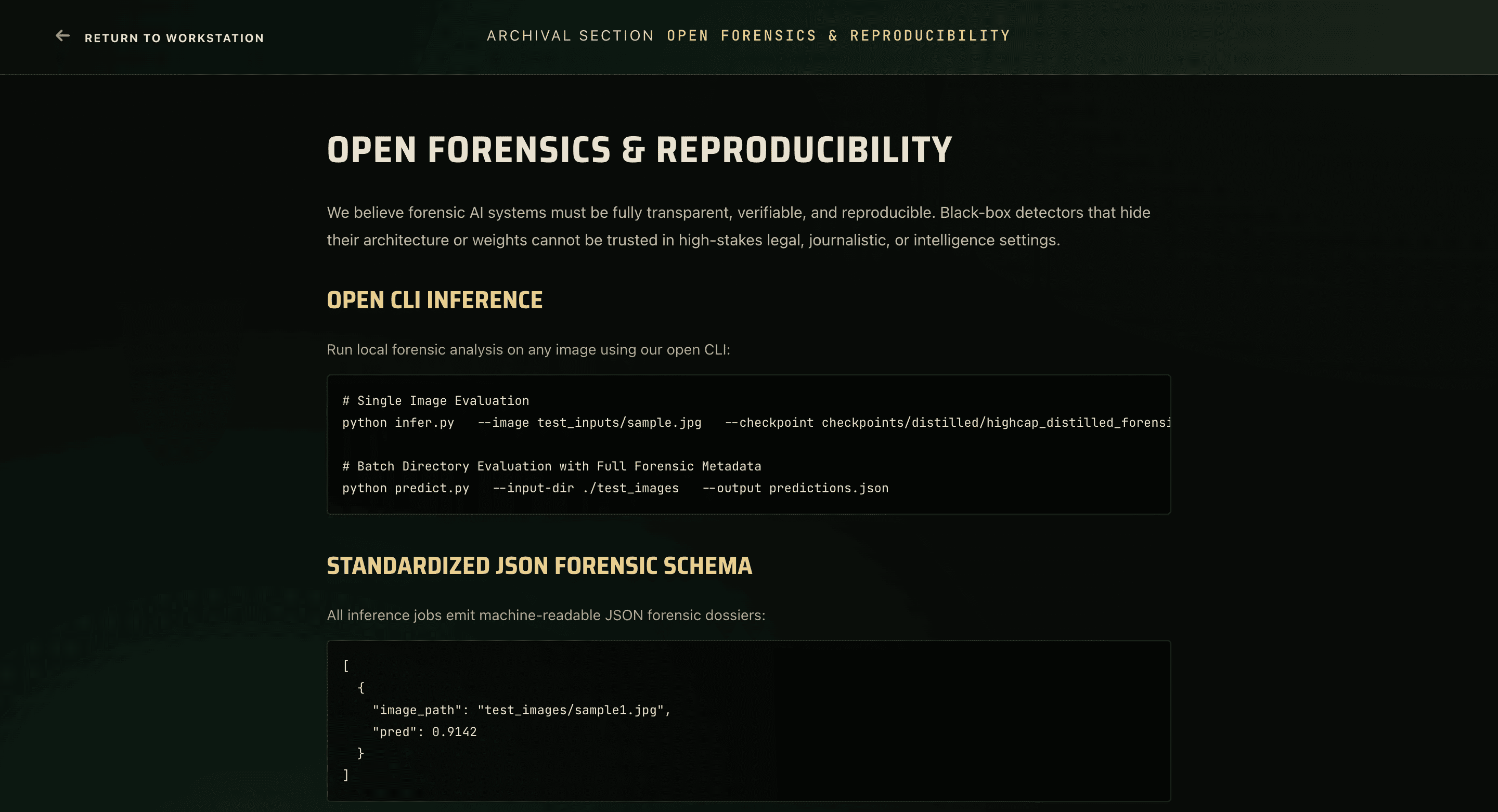
- Zero explanation: Giving a single number like "85% Fake" isn't useful for journalists, researchers, or platforms. People need to see where the image was changed and why. We built ENTROPY to solve these problems by creating a forensic platform that accurately detects full AI images, spots localized partial edits, highlights the exact manipulated areas with heatmaps and bounding boxes, and survives real-world compression.
What it does
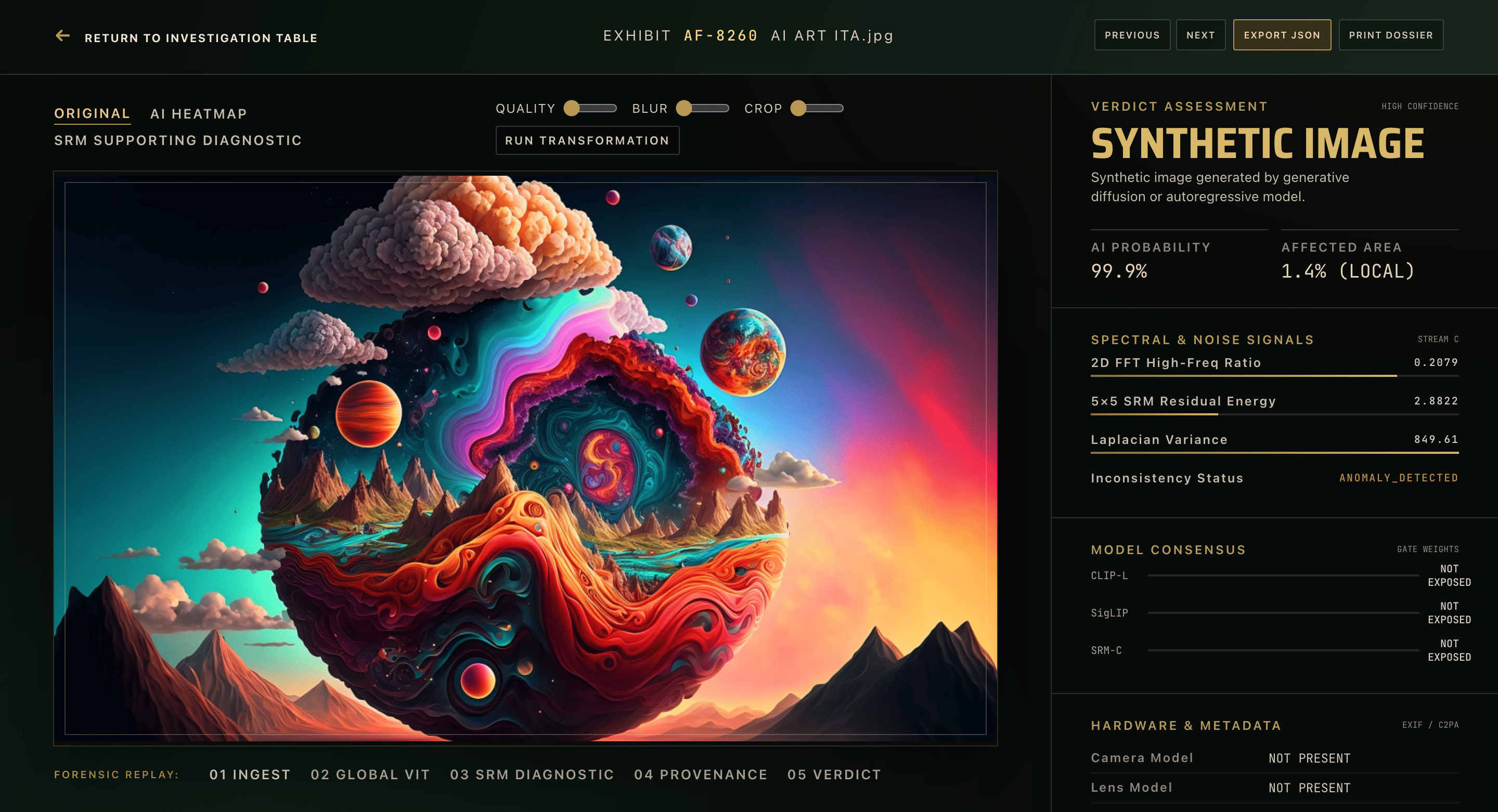
3-Way Classification: Categorizes images into three clear verdicts:
- REAL: Authentic camera photograph.
- PARTIAL-AI: An authentic photo with localized AI inpainting, generative fill, or face edits.
- FULL-AIGC: 100% synthetic AI generation.
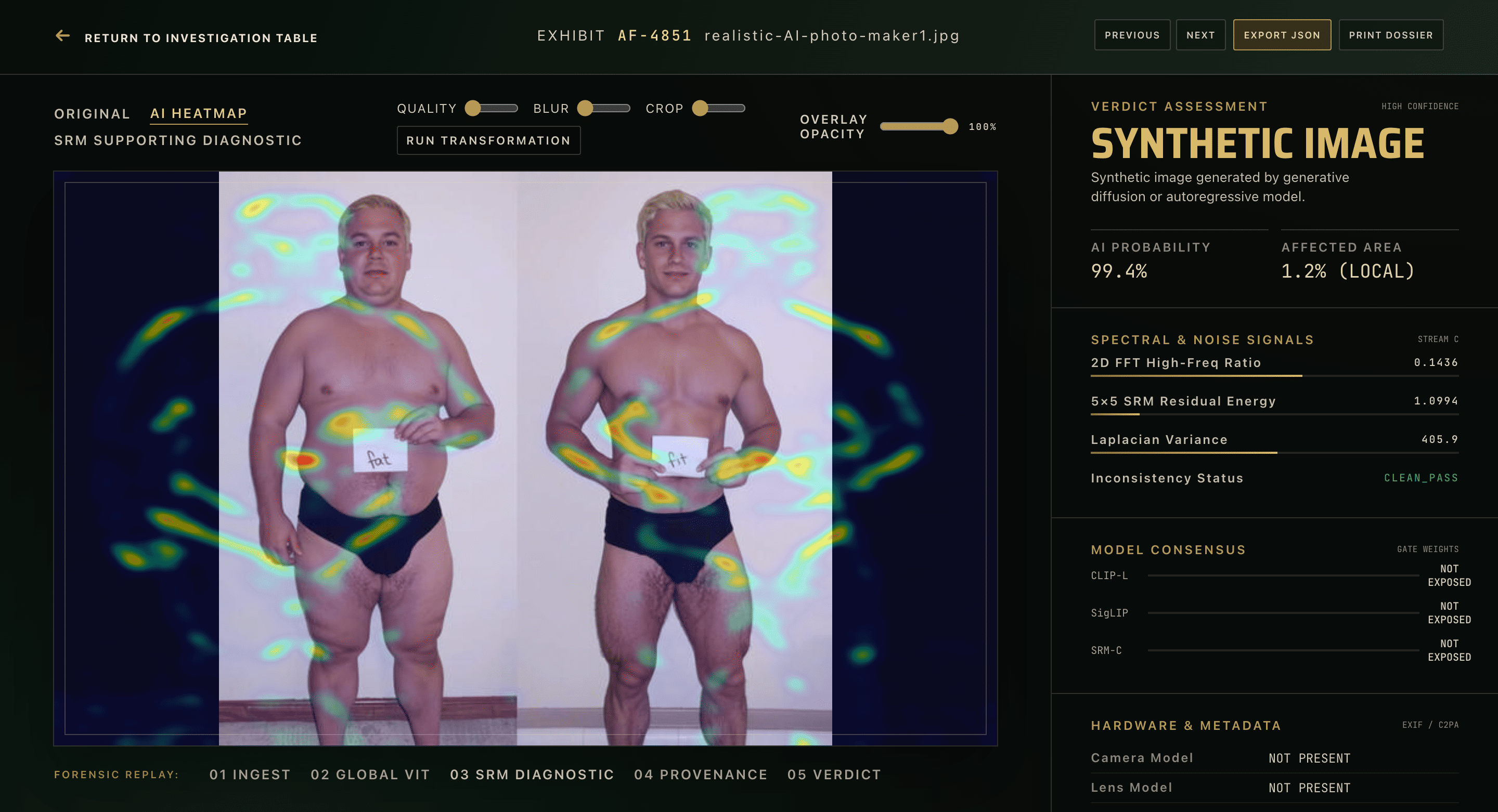
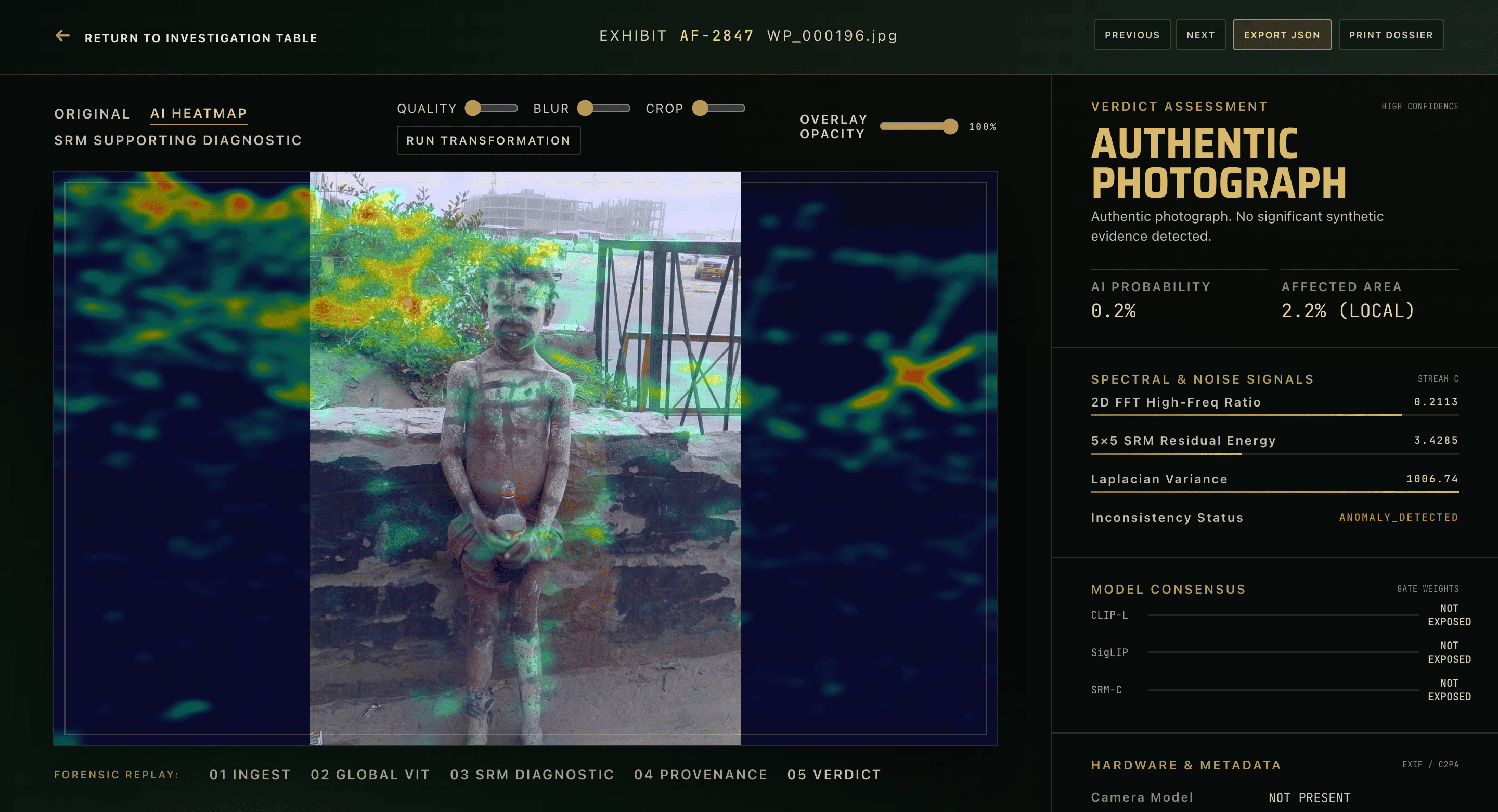
- Heatmap & Bounding Boxes: Generates a spatial heatmap showing exactly which parts of the image were generated or modified, and draws bounding boxes around the edited regions.
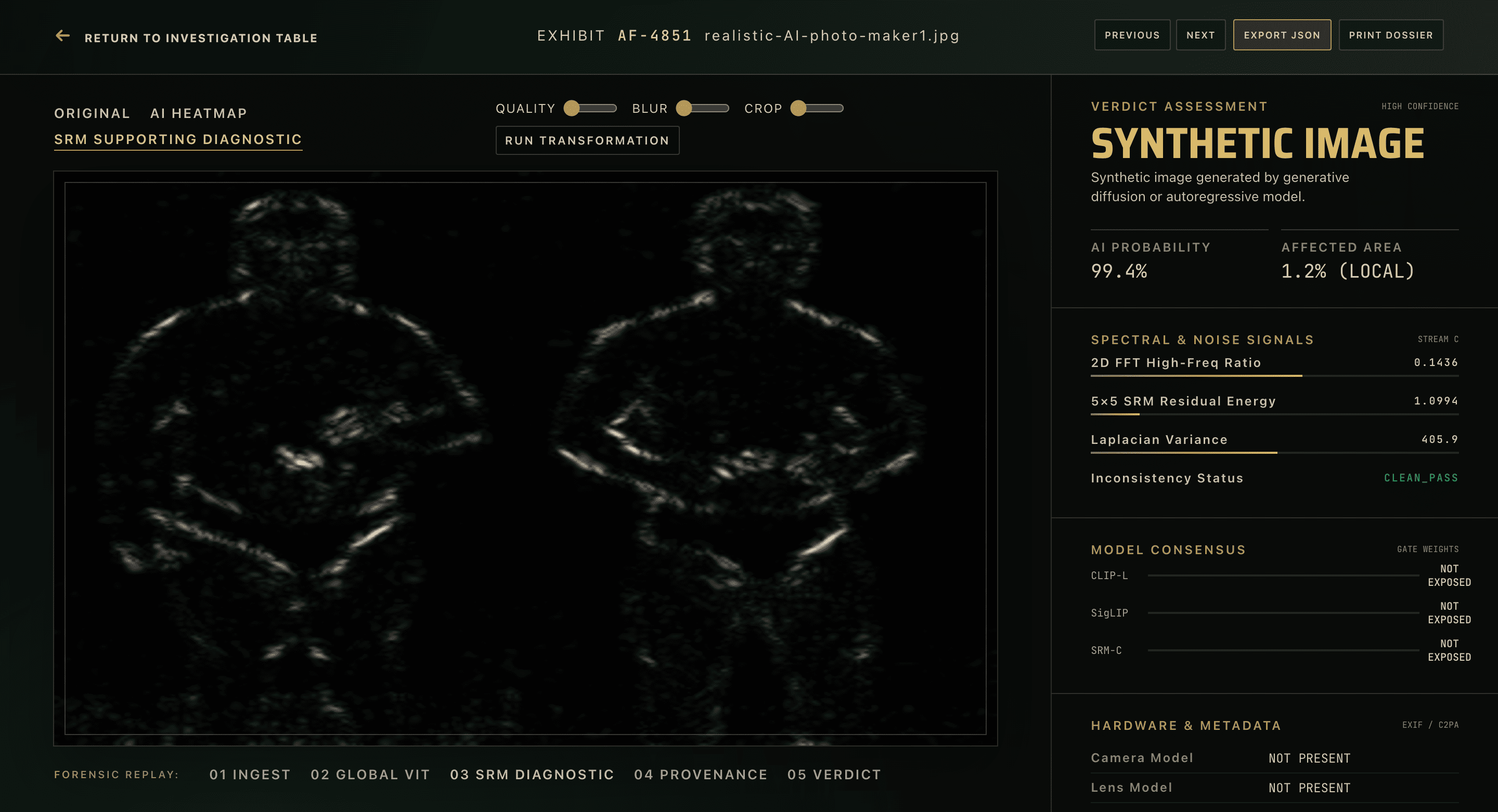
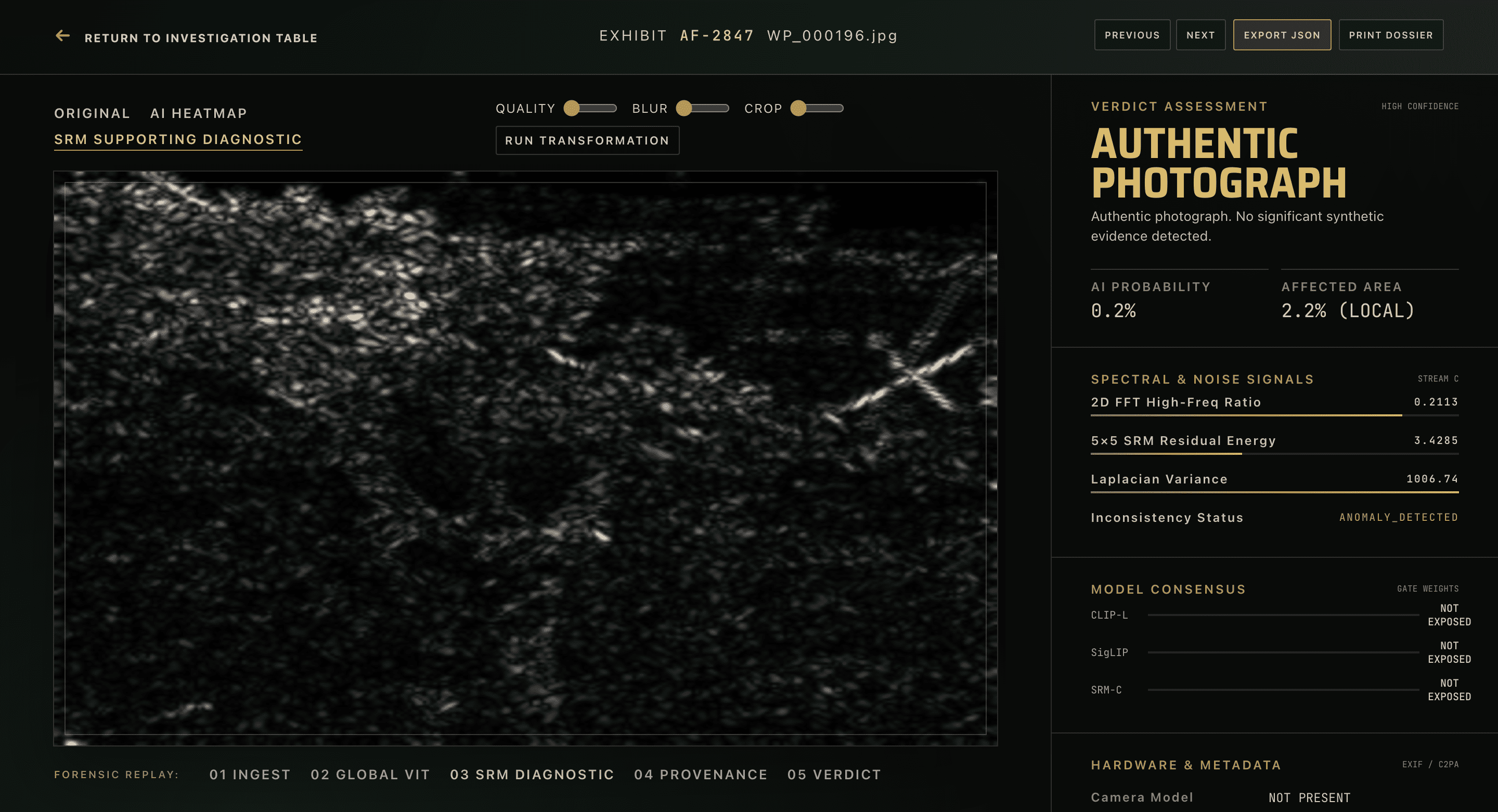
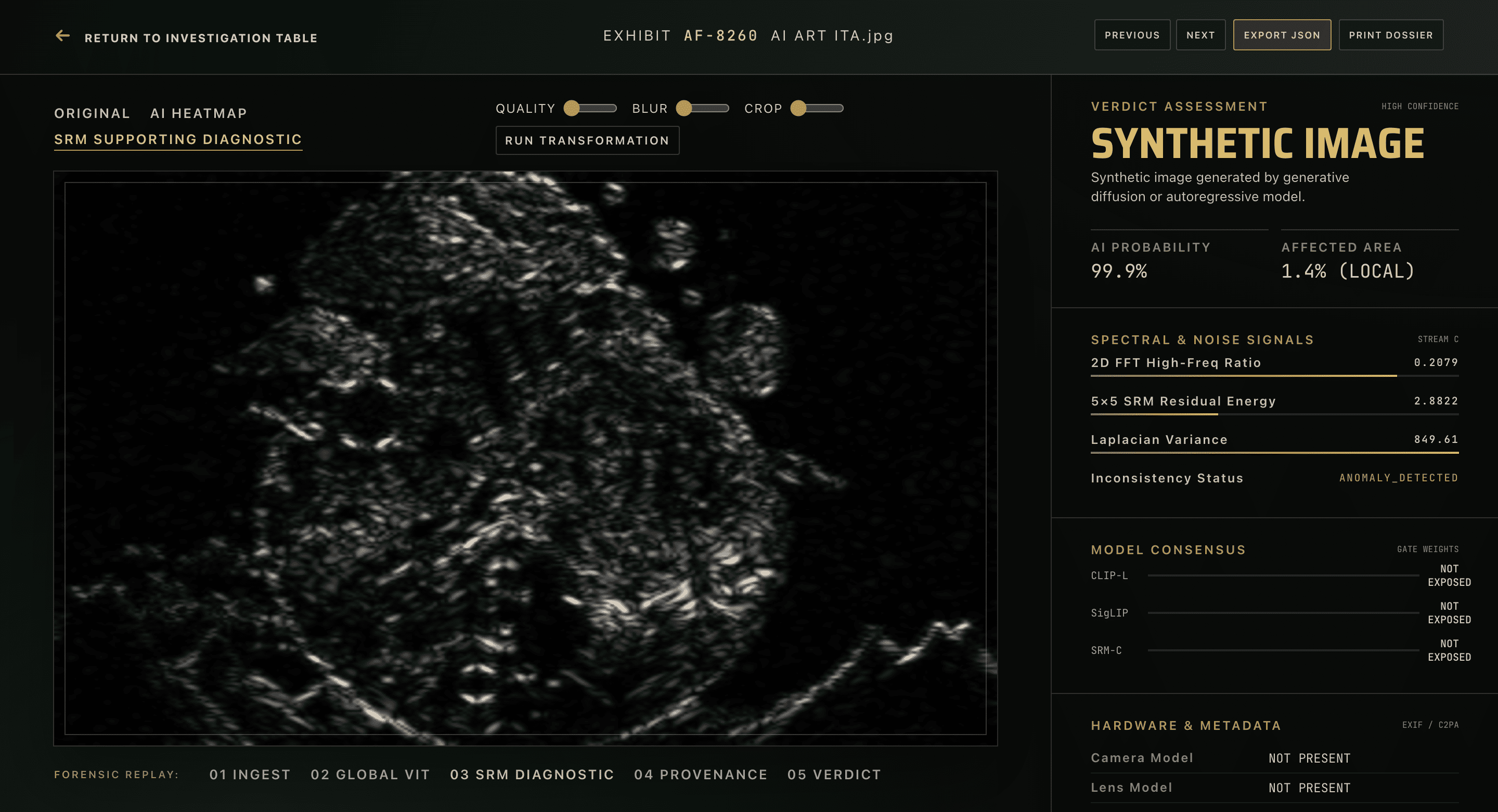
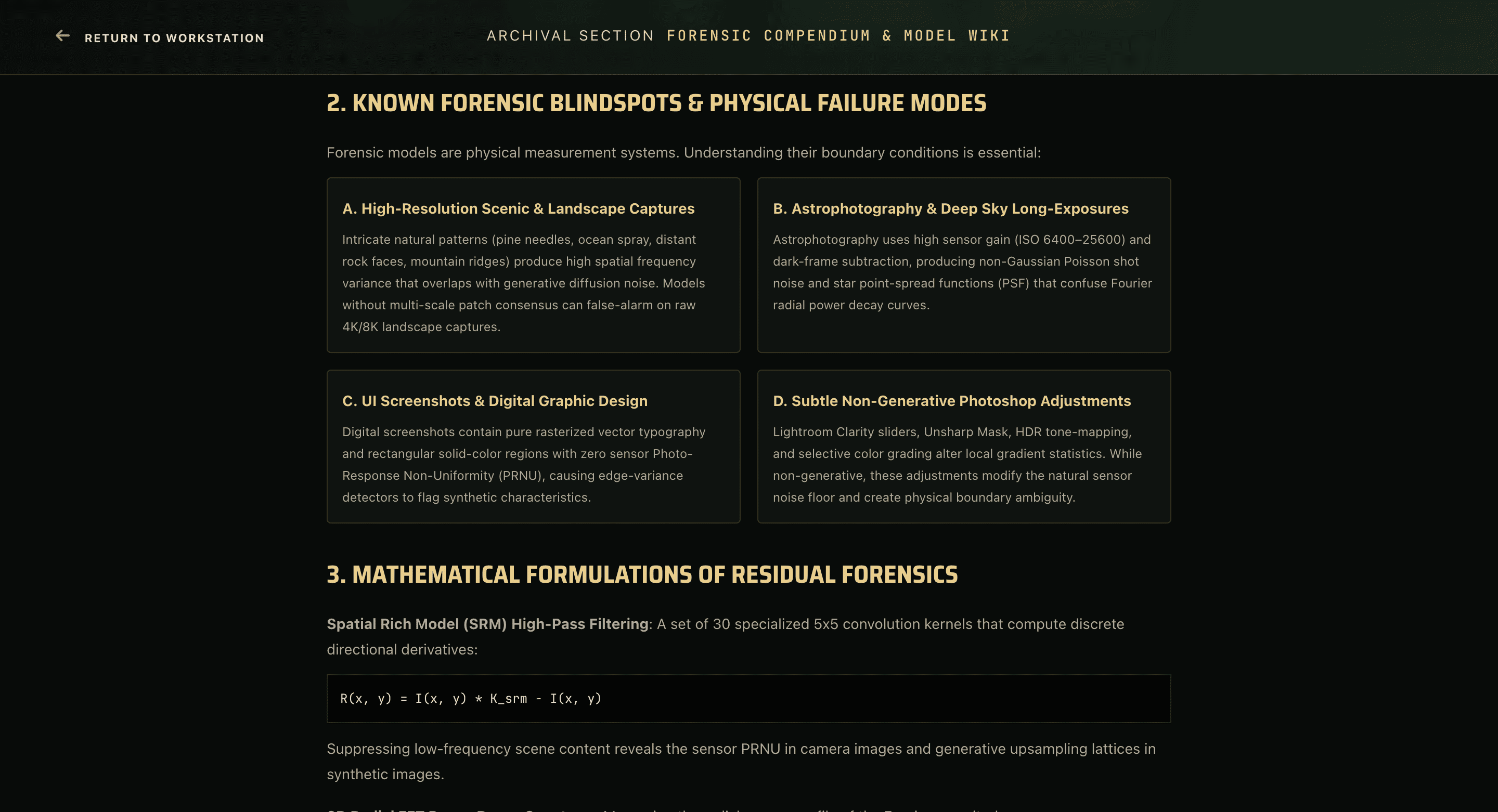
- Noise & Frequency Analysis: Analyzes camera sensor noise patterns (PRNU) and Fourier frequency decay to catch generative upsampling artifacts.
- Image Provenance: Reads EXIF, camera metadata, and C2PA Content Credentials to trace image history.
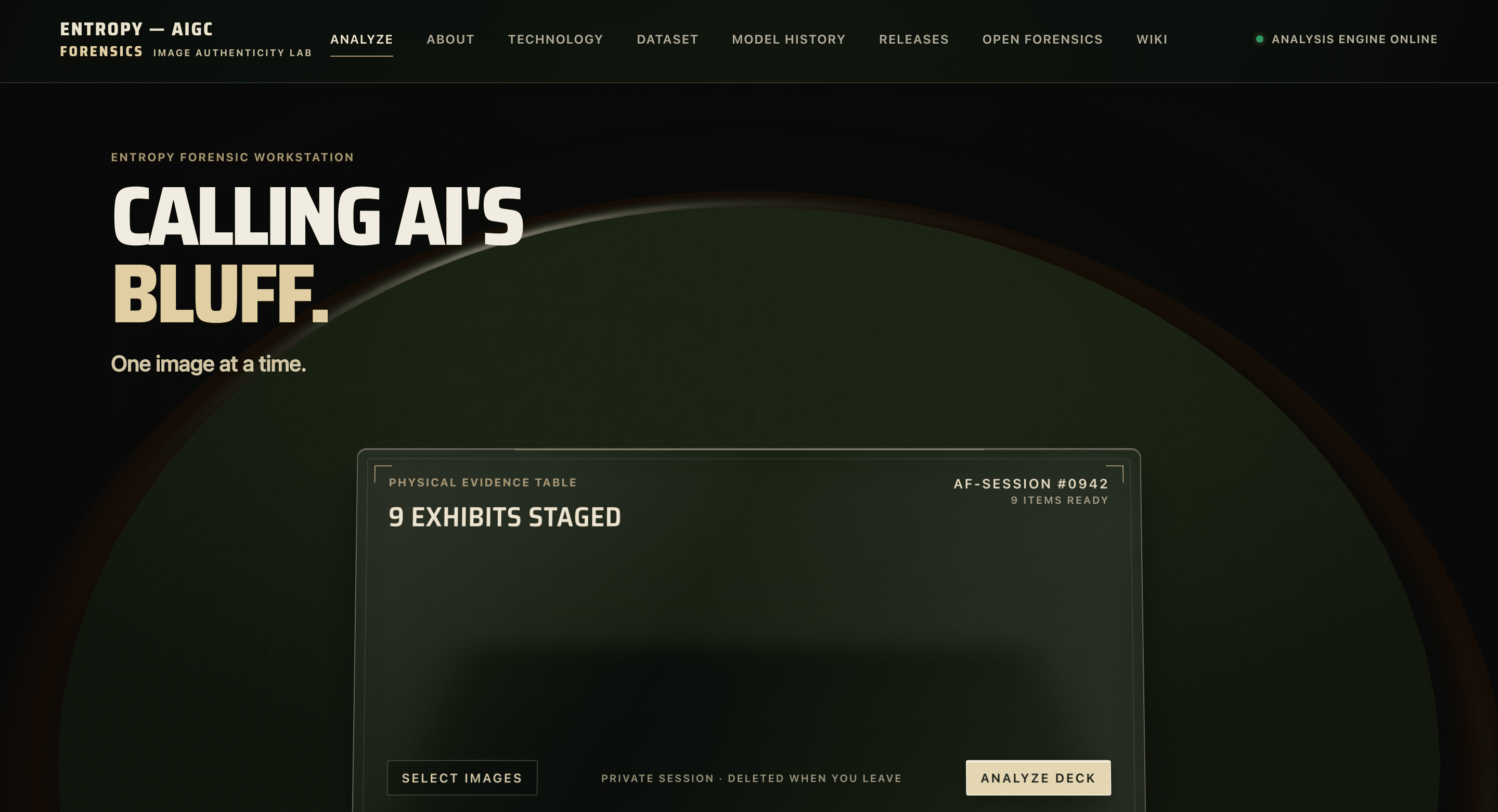
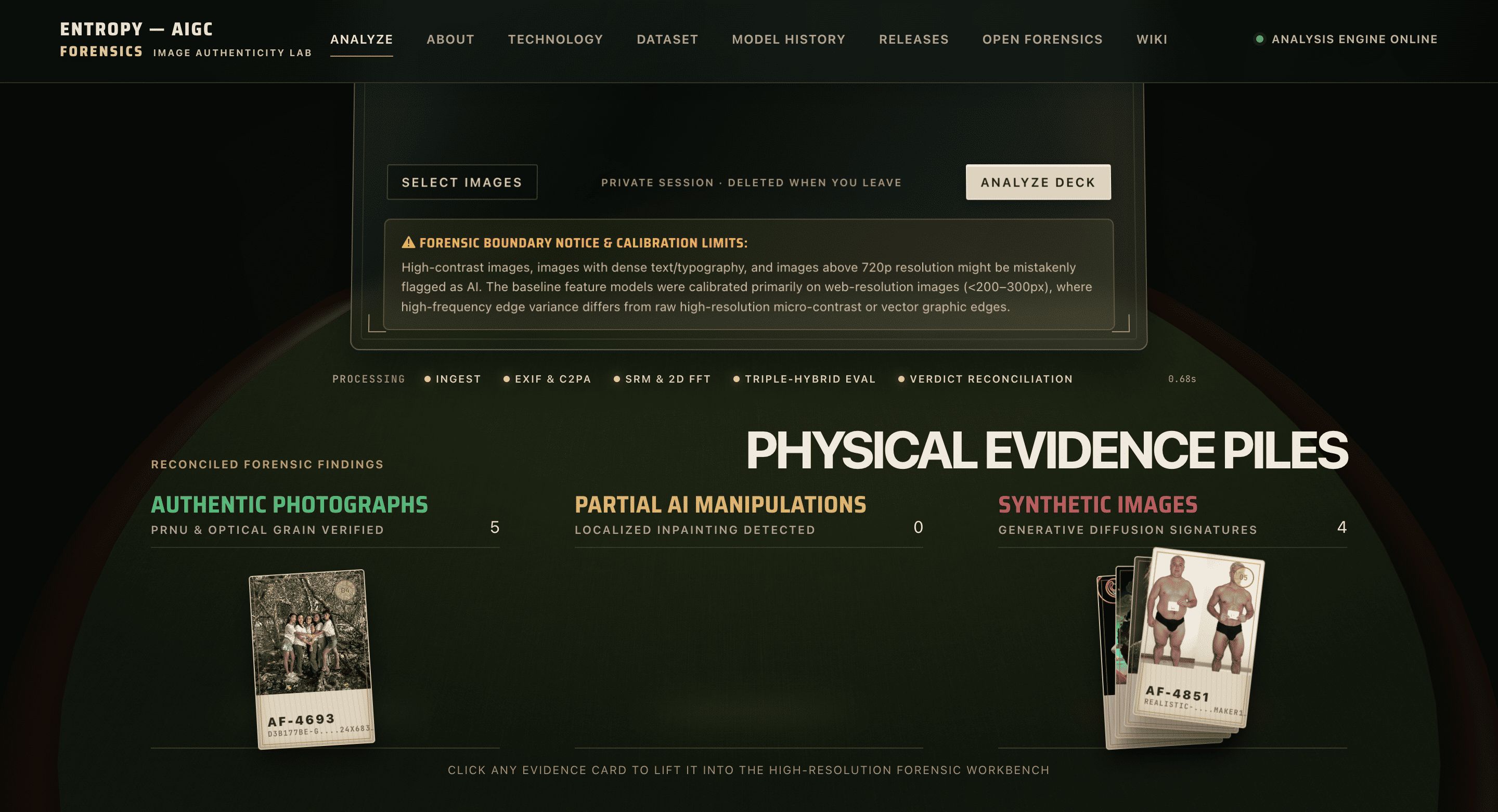
- Interactive Web Desk: A web application featuring a physical desk layout with 3D cards, real-time laser scanning, and instant inspection.
How I built it
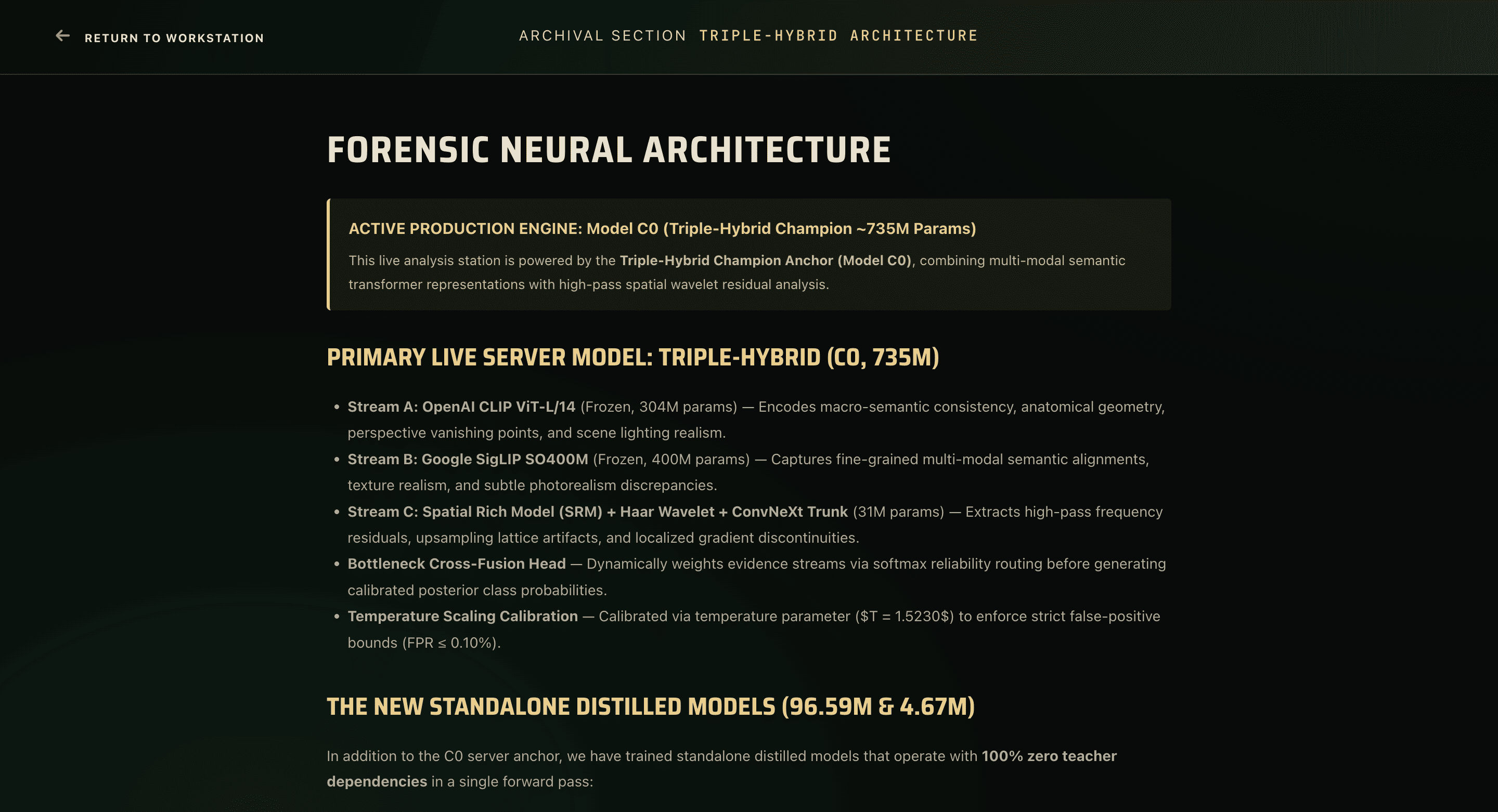
- Multi-Stream AI Architecture:
- CLIP (ViT-L/14): Looks at overall scene semantics, lighting consistency, and natural anatomy.
- SigLIP (SO400M): Checks fine-grained textures and photorealism details.
- ConvNeXt + SRM Noise Filter: Strips away the image content to look directly at the underlying pixel noise and mathematical residuals.
- Learned Gating Router: Automatically decides whether to trust semantic features or noise patterns depending on how heavily compressed the image is.
- Knowledge Distillation:
- I trained a large multi-expert system across 11 specialist models.
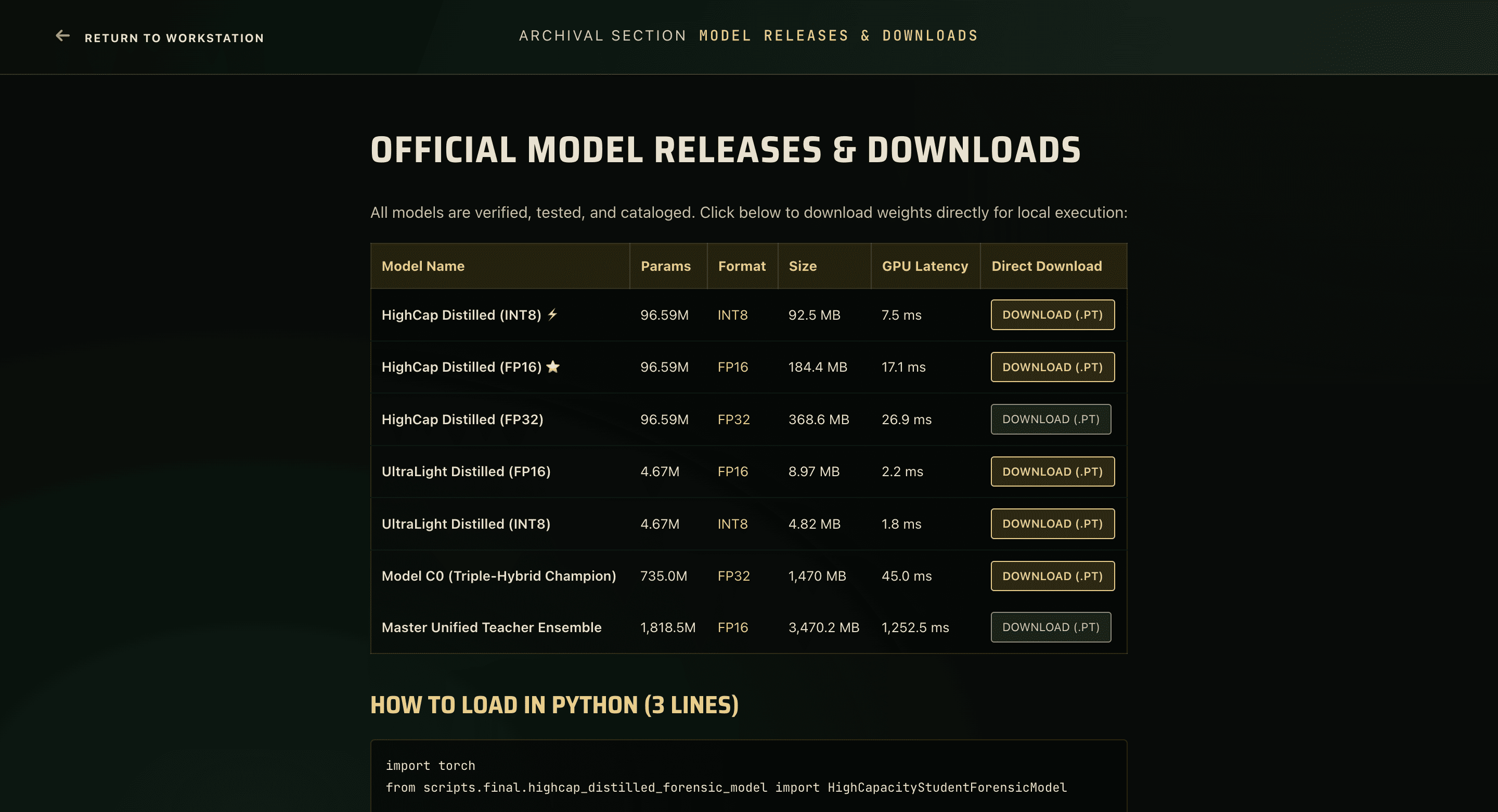
- I then distilled all that knowledge into a single standalone model (96M parameters) that runs in just 17 milliseconds on a GPU (73x faster) with zero extra dependencies.
- Dataset & Training:
- Trained on an audited dataset of over 103,000 images across Midjourney v4/v5/v6, FLUX.1, SDXL, Stable Diffusion 1.5/2.1/3, DALL-E 2/3, Google Imagen, Firefly, StyleGAN, and real DSLR camera photos.
- Strictly balanced image resolutions from thumbnails up to 4K/8K to prevent the model from cheating on image sharpness.
- Cryptographically isolated all test benchmarks so the model never saw evaluation data during training.
- Full-Stack Application:
- Backend: Python, PyTorch, and FastAPI.
- Frontend: HTML5, WebGL / Three.js, and vanilla JavaScript.
Challenges I faced
- Models Cheating on Resolution: Early on, the model learned that high-resolution photos were real and low-resolution photos were fake. I had to rebuild my dataset with resolution tiers so both real and fake images had equal distributions of sizes.
- Portrait False Alarms: Sharp skin pores in authentic DSLR studio portraits produced high-frequency noise that tricked basic filters into thinking they were AI. I trained a dedicated portrait specialist to learn the difference between natural skin texture and generative artifacts.
- Spotting Tiny Partial Edits: When someone edits only 3% of an image, standard neural networks drown out the edit with the 97% real background. I added coordinate-aware cross-attention and mask-based Dice loss so the model specifically focuses on small edited patches.
- Speed & Server Costs: My initial multi-expert system was 1.82B parameters and took over 1.2 seconds per image. Through knowledge distillation, I compressed it down to a 184MB standalone model that runs in 17ms while cutting false alarms on real photos in half.
Accomplishments that we're proud of
- Building a True 3-Way Forensic Detector: Successfully created a model that does not just force a binary Real/Fake choice, but accurately detects localized inpainting edits and draws clear bounding boxes around manipulated regions.
- Achieving a 73x Speedup with Standalone Distillation: Distilled an entire 11-teacher multi-expert system (1.82B parameters) down into a single 96M parameter standalone model running at 17 milliseconds on a GPU with zero external dependencies.
- Slashing Real-Photo False Alarms by 50%: Solved the portrait false-alarm trap, ensuring studio-lit DSLR photos and sharp natural skin pores are not mistakenly flagged as synthetic.
- Designing an Interactive Investigation Desk: Built a custom WebGL physical desk with 3D card physics, dynamic lighting, and real-time laser inspection that turns raw model outputs into an intuitive forensic workspace.
- Enforcing Strict Data Integrity: Audited and curated a 103,000+ image dataset with cryptographic benchmark isolation, guaranteeing the model generalized to real-world images without cheating or data leakage.
What I learned
- Pure deep learning alone is not enough—combining classical noise filters with vision transformers makes detection much more resilient to compression.
- Knowing where an image is fake is much more valuable than just getting a single confidence score.
- Model distillation and INT8 quantization can deliver huge speedups (up to 167x) with almost no drop in accuracy.
What's next for ENTROPY
- Video AI Detection: Extending my spatial engine to detect AI-generated videos from Sora, Runway Gen-3, and Kling.
- Mobile, Browser Extension and IoT Edge device: Running the lightweight 4.8MB INT8 model directly inside the browse, on mobile devices or on an IoT device for instant on-device verification.
- C2PA Integration: Adding automated cryptographic signing so authenticated photos can be permanently certified against tampering.


Log in or sign up for Devpost to join the conversation.