-
-
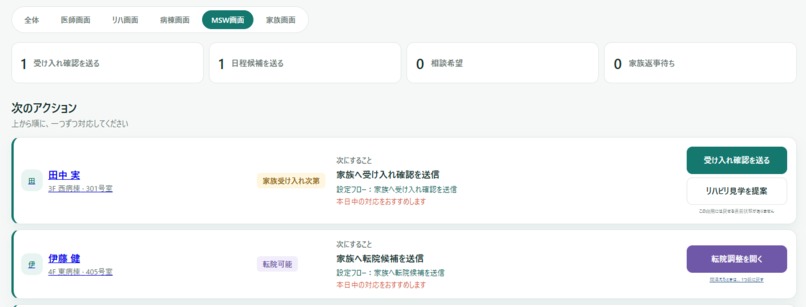
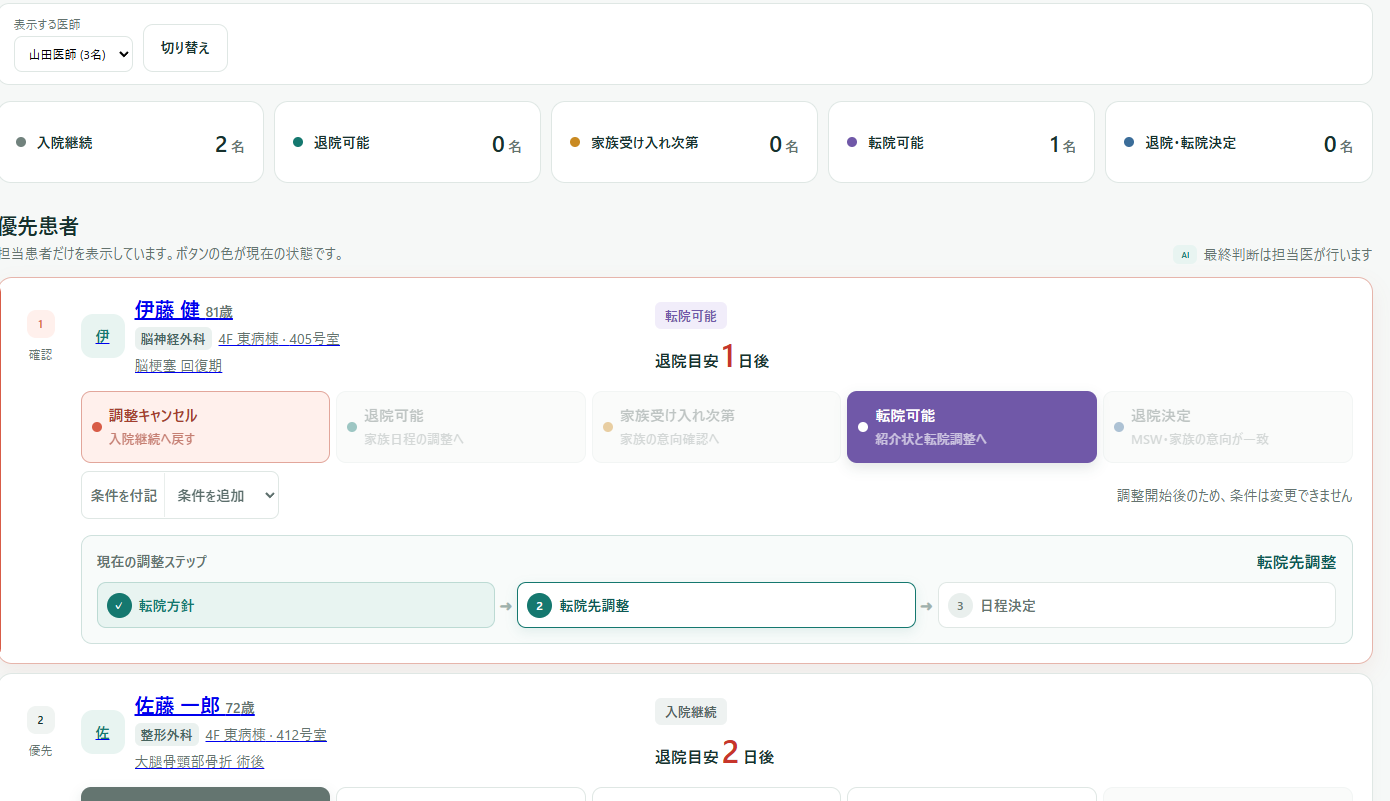
Doctors can instantly identify which patients require attention.
-
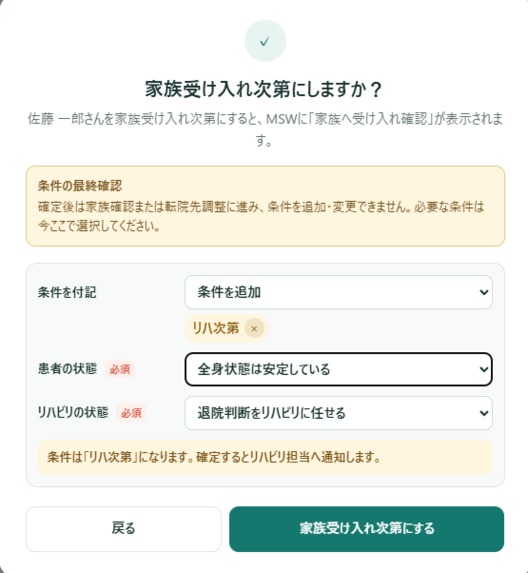
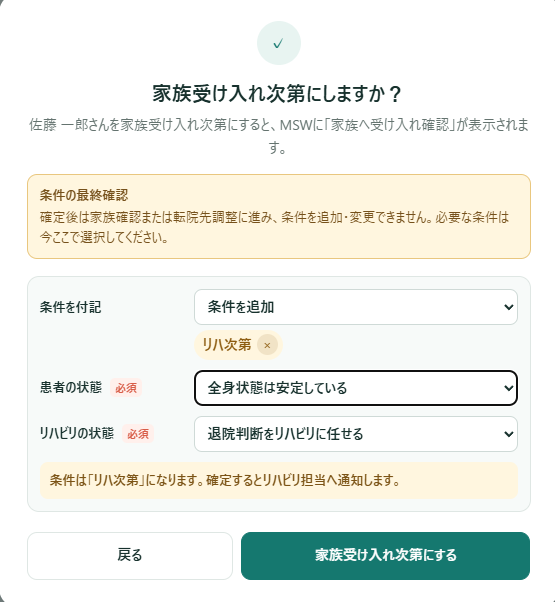
Flexible decision-making supports real-world conditions, such as family readiness and rehabilitation progress.
-
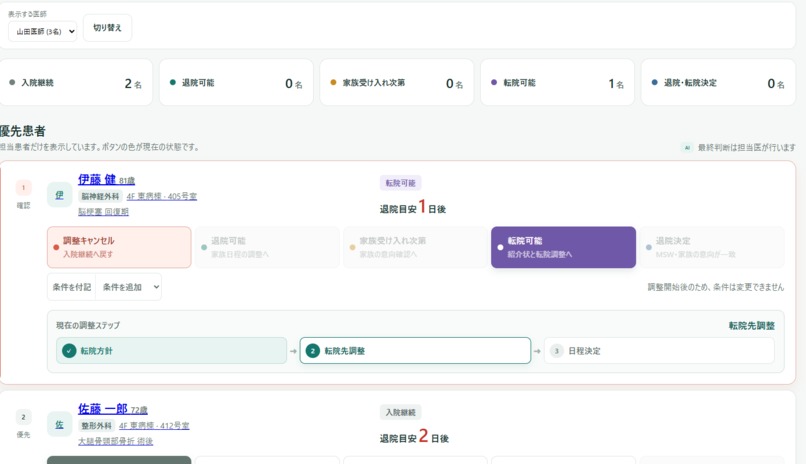
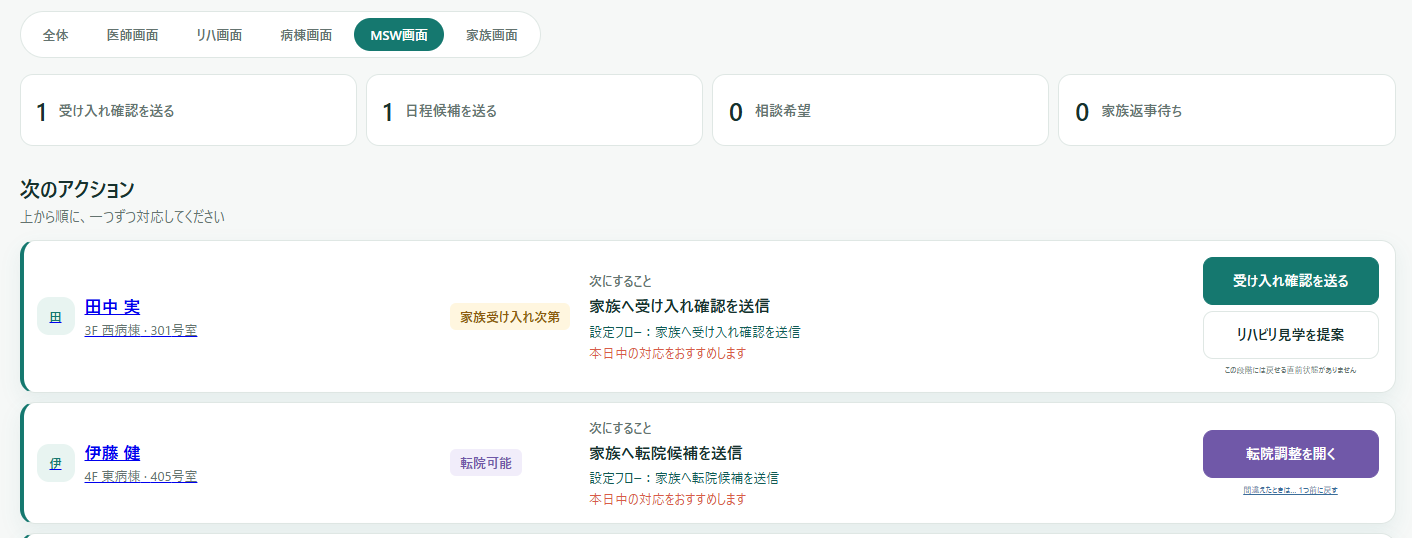
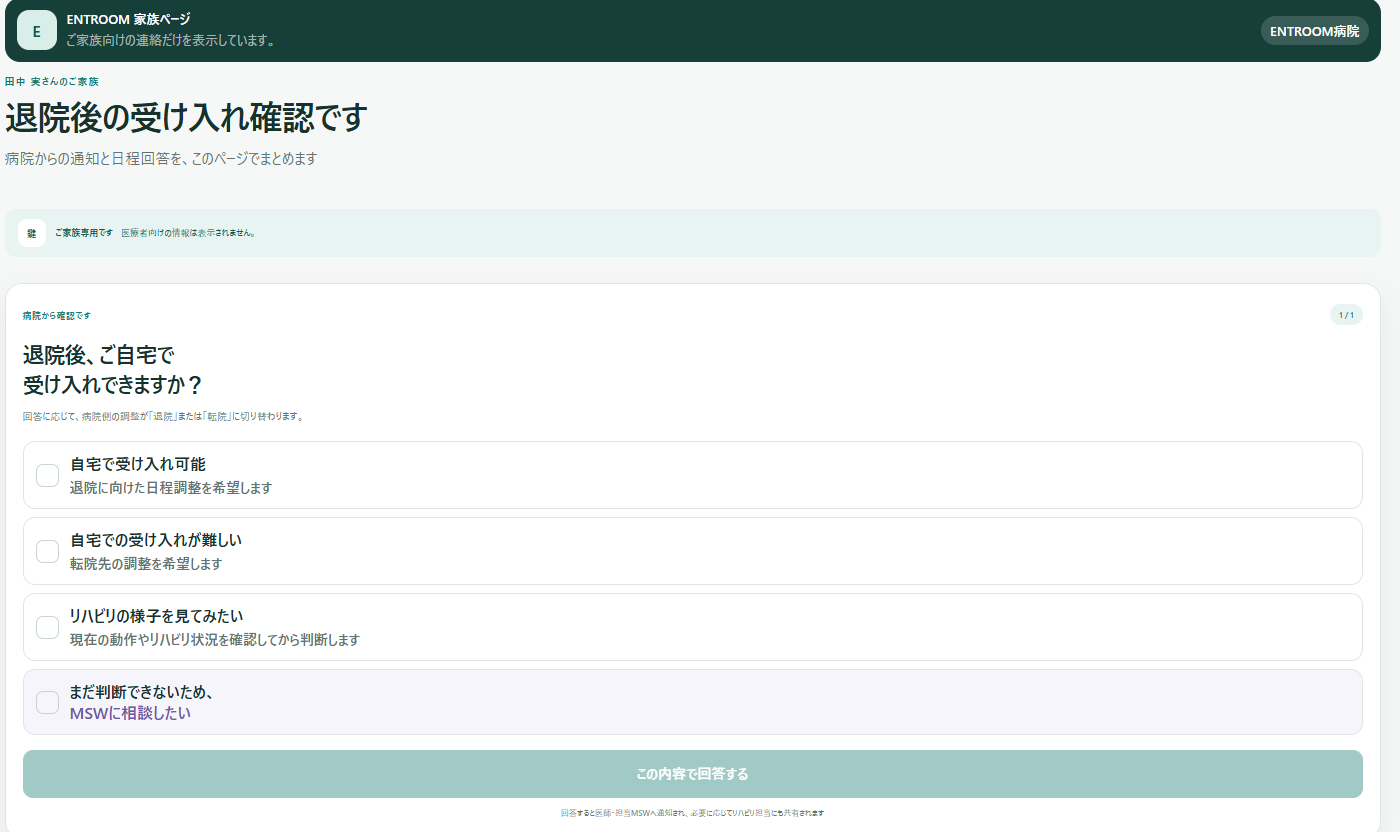
The social worker dashboard offers an intuitive UI and flexible case management.
-
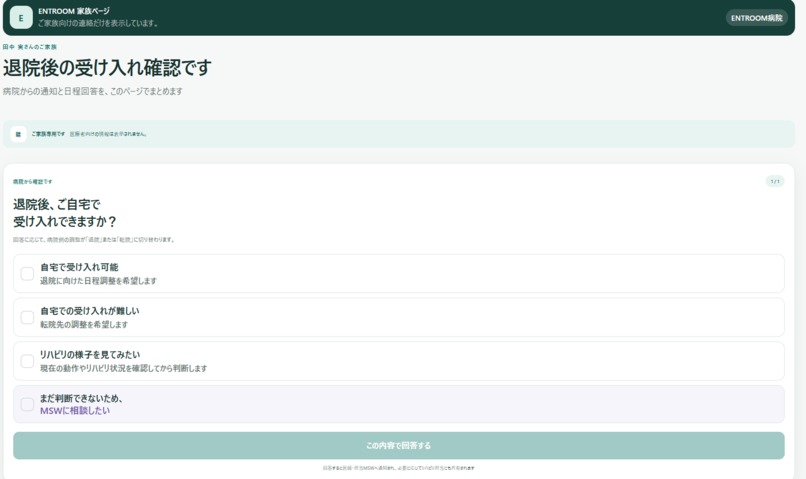
Sample emails show exactly what patients will receive.
-
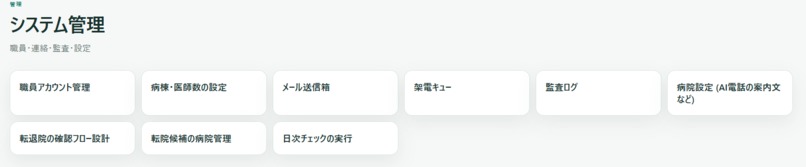
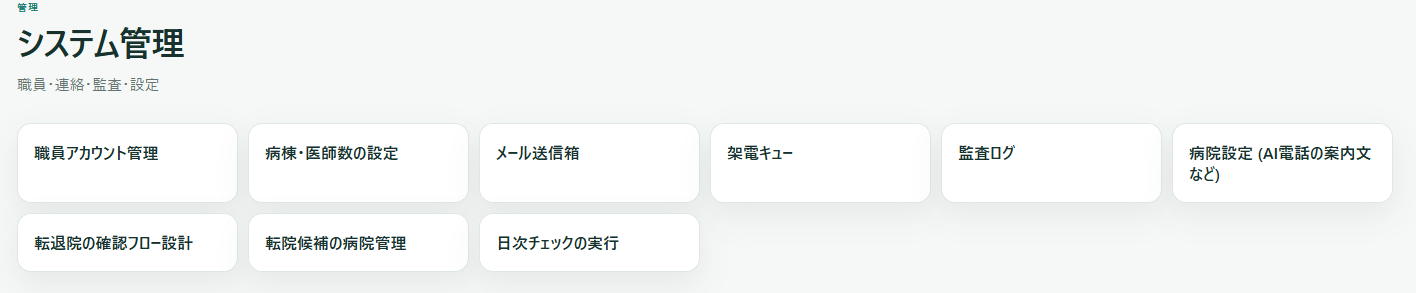
The settings screen allows detailed configuration of wards, physicians, workflows, and more.
-
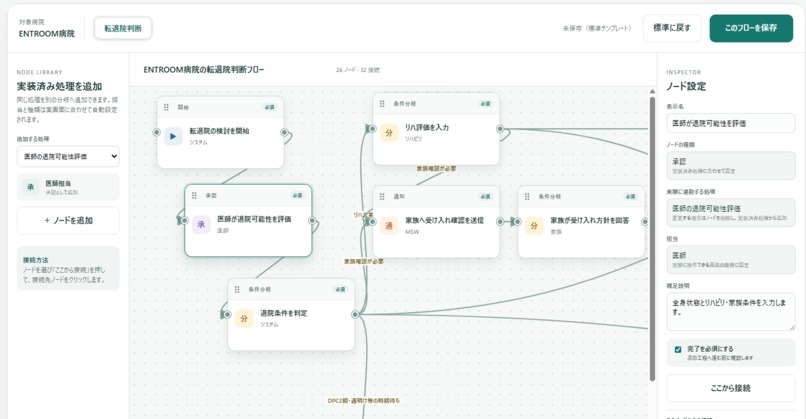
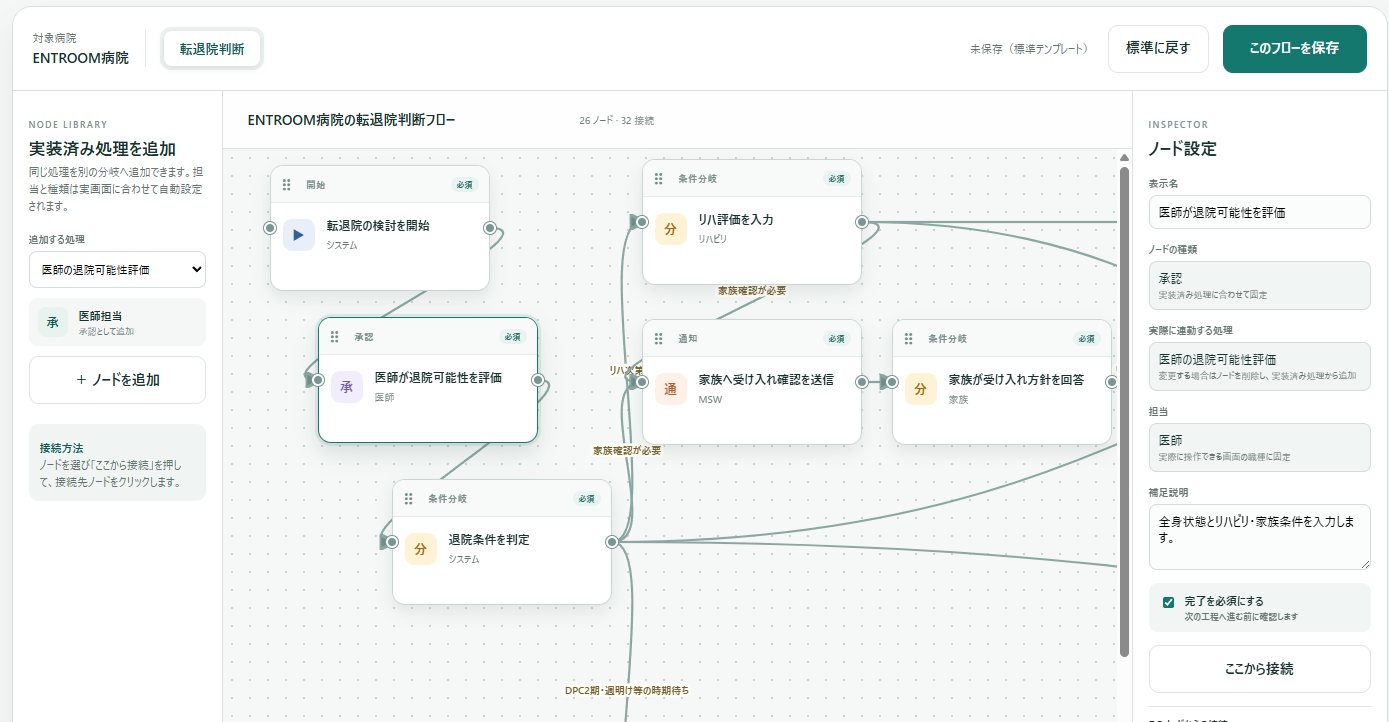
Node-based design enables no-code workflow creation tailored to each clinical setting.
Inspiration
Hospital discharge is not a single decision. It is a chain of conversations among physicians, rehabilitation teams, ward staff, medical social workers, receiving hospitals, and patient families — and in Japan, most of that coordination still happens over the phone.
We do not treat the phone as a legacy habit to eliminate. According to a 2025 survey by Japan's Ministry of Health, Labour and Welfare, in 37.1% of co-resident caregiving households, the primary caregiver and the person receiving care are both aged 75 or older. Asking these families to learn a new web or email workflow does not reduce their burden — it adds to it. The phone is the one interface families already know and trust, so discharge support has to work through the phone, not around it.
The weight of all that calling falls on medical social workers and families. Social workers spend their days on phone coordination where every counterpart follows different procedures, while families are repeatedly asked to relay and reconcile information between professionals. ENTROOM AI started from a physician's clinical experience with that gap: the people closest to the patient often become the least supported information carriers.
What it does
ENTROOM AI is a shared discharge and transfer coordination workspace, built on four principles:
- No information burden on families
- Less internal communication overhead inside the hospital
- Fine-grained, hospital-level control through node-based workflows
- A clear, readable UI
Every role sees a focused view of the same patient timeline, including the target date, current blockers, decisions, and the next responsible action. Physicians record decisions the way they actually make them in clinical practice — discharge-ready, transfer-ready, "depends on family," "depends on rehab" — and each flexible decision is handed directly to the next responsible role. Social workers see only the communication and coordination needed next: candidate discharge dates to send, transfer dates to rearrange, replies still pending — all in one screen. And when a patient's condition or a family's preference changes, the workflow can step back one stage instead of forcing a restart.
Families do not need another hospital account. They can open a QR-based mobile page or simply answer a natural, AI-assisted phone call. The OpenAI Realtime API speaks from the physician's assessment, rehabilitation findings, and hospital-specific guidance — for example, confirming whether the morning of the 25th or the afternoon of the 26th works better for pickup — and the family's answer is recorded once, becoming a confirmed date and a next action visible to the whole care team. For live voice workflows, Twilio SIP connects calls to the OpenAI Realtime API; local judging uses a safe simulation queue, so no external call or email is sent.
Hospitals are not identical, so ENTROOM AI also includes a no-code, node-based workflow editor. Administrators can arrange confirmation, approval, notification, and branching steps at hospital level — down to which role owns each step, the order of approvals, and what is explained to families. The editor validates every graph and binds each node to a real application action and responsible role, preventing a visually valid but operationally unsafe workflow.
How we built it
The application uses Next.js, React, TypeScript, Drizzle ORM, and PostgreSQL, with PGlite providing a zero-setup local database. Production-oriented integrations include AWS Cognito, SES, ECS Fargate, RDS, CloudFront, EventBridge, Twilio SIP, and the OpenAI Realtime API.
The application was built mostly with Codex: programming for the submitted version — the role-based UI, AI calling, node control, and AWS architecture — was done almost entirely in Codex with GPT-5.6 during Build Week. We used Codex to translate physician-described clinical workflows into explicit state transitions, identify edge cases across five staff roles, design the runtime-safe node model, implement UI iterations, and turn workflow risks into tests. Important decisions developed through this work included preserving human clinical judgment, separating communication automation from medical decisions, and fixing each configurable runtime action to the professional role that actually owns it.
GPT-5.6 was used inside Codex for Build Week implementation, reasoning, debugging, testing, and verification. The OpenAI Realtime API is the separate runtime voice integration. This distinction lets the repository honestly document the Codex development workflow while showing how OpenAI technology supports both the build process and the live experience.
Challenges we ran into
The hardest challenge was making a complex clinical process configurable without making it ambiguous. A free-form diagram can look convincing while pointing to actions the product cannot execute. We solved that by validating reachability, cycles, branching rules, node limits, and fixed runtime responsibilities before a workflow can be saved.
We also had to reduce family friction without weakening privacy. QR access, short-lived task-focused interactions, simulated local communications, audit history, and immediate removal of no-longer-needed contact details were designed around that concern.
Accomplishments that we're proud of
- A working, role-based coordination product rather than a static prototype
- Family phone and web paths that ask families to learn nothing new
- Clinical decision states that mirror how physicians actually decide — including "depends on family" and "depends on rehab"
- Hospital-specific, no-code node control with runtime safety constraints, plus one-step-back reversibility
- A readable UI for high-pressure, multi-role work
- 53 passing workflow and validation tests, plus a clean TypeScript type check
- A production-oriented path for authentication, messaging, voice, database, audit, and scheduled jobs
What we learned
AI is most useful in this setting when it strengthens communication rather than pretending to replace a clinician — or a social worker. ENTROOM AI is not designed to reduce social workers. It hands routine calls and schedule coordination to AI so that the time regained can go to the work only humans can do: building relationships with other hospitals and running discharge coordination conferences — work that also increases patient referrals and hospital revenue. We also learned that customization needs guardrails: hospital teams need local control, but every configurable step must remain traceable to a real action, owner, and audit record.
What's next for ENTROOM AI
Next steps are a controlled hospital pilot, electronic medical record and FHIR integration, production evaluation of the Realtime voice workflow, multilingual family communication, accessibility testing, and formal security, privacy, and clinical-operational review. Discharge coordination is one of the most phone-bound workflows in healthcare — and that is exactly why we believe it is where digital transformation can start.
Built With
- amazon-cloudfront
- amazon-rds-relational-database-service
- amazon-ses
- aws-cognito
- aws-ecs-fargate
- aws-eventbridge
- codex
- drizzle-orm
- gpt-5.6
- next.js
- openai-realtime-api
- pglite
- postgresql
- react
- sip
- twilio
- typescript


Log in or sign up for Devpost to join the conversation.