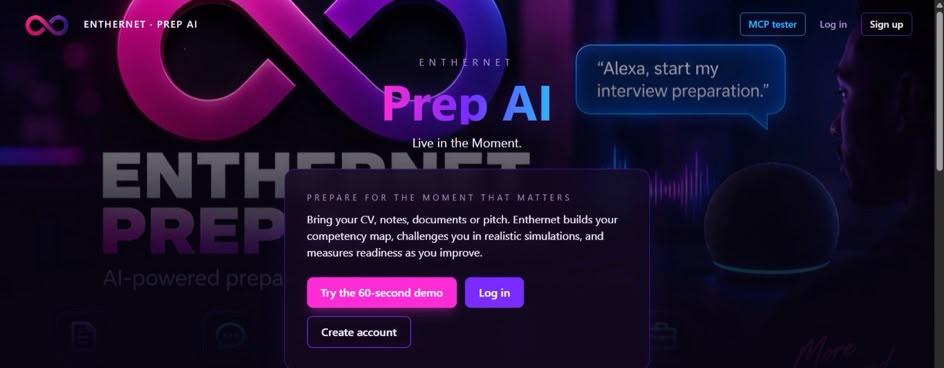

Enthernet Prep AI
Live in the Moment.
Inspiration
Important moments rarely fail because people have no information.
A candidate may have studied the job description. A founder may know the pitch deck. A student may understand their notes. A developer may know the technology.
The real question is:
Can they retrieve, explain, defend, and apply that knowledge when the moment actually arrives?
Enthernet Prep AI was built around that problem.
Instead of creating another AI assistant that simply answers questions, I wanted to build an AI system that challenges the user, evaluates their performance, discovers weaknesses, and adapts the next challenge accordingly.
The core philosophy became:
Do not tell users they are ready. Measure whether they are ready.
That became Enthernet Prep AI, an agentic readiness engine for interviews, technical assessments, pitches, exams, presentations, and other high-pressure moments.
What it does
A user provides preparation material such as a CV, job description, notes, technical documentation, or pitch material.
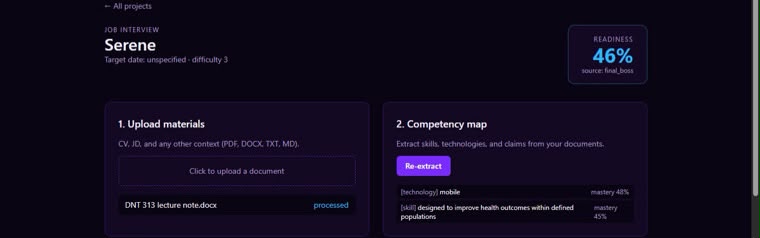
Prep AI turns that material into a structured understanding of what the user needs to know.
From there, specialized AI agents can:
- extract important concepts and claims
- build a competency map
- generate targeted questions
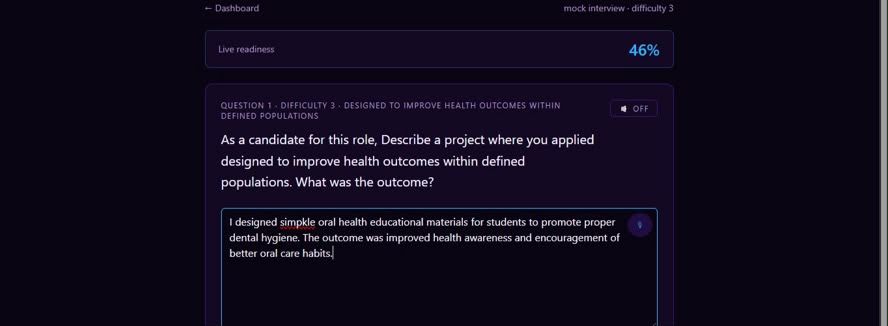
- conduct realistic interview-style conversations
- evaluate answers
- generate contextual follow-up questions
- detect weak knowledge areas
- adapt question difficulty
- track mastery
- measure readiness over time
Instead of:
Upload document → Ask AI questions
Prep AI follows a continuous loop:
Material → Knowledge → Challenge → Response → Evaluation → Weakness Detection → Adaptive Challenge → Readiness
The goal is not to produce better AI answers.
The goal is to produce a better-prepared person.
Alexa+ Experience
Prep AI is being designed as a conversational experience where preparation can move beyond a traditional browser interface.
A user can enter a live preparation session and interact with an AI interviewer naturally through conversation.
For example:
User: Start my technical interview.
Prep AI selects a relevant topic from the user's competency map and begins questioning them.
The user's response is evaluated for factors such as:
- accuracy
- completeness
- relevance
- conciseness
- evidence usage
- consistency
The system can then generate a follow-up question based on the answer rather than following a static questionnaire.
If the user demonstrates mastery, the difficulty increases.
If weakness is detected, Prep AI drills deeper into that area.
This creates an adaptive preparation experience instead of a scripted interview simulator.
Model Context Protocol (MCP) Integration
Enthernet Prep AI implements a self-hosted Model Context Protocol (MCP) server using Streamable HTTP.
Rather than depending on a specific voice assistant, the MCP server exposes the preparation engine through a standardized interface that compatible clients can use.
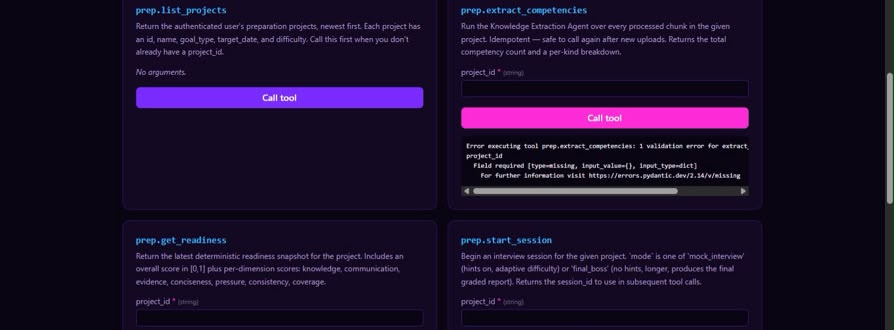
The server provides seven preparation tools:
- "prep.list_projects" — Retrieve preparation projects.
- "prep.extract_competencies" — Extract competencies from preparation materials.
- "prep.get_readiness" — Retrieve the current readiness assessment.
- "prep.start_session" — Begin a preparation session.
- "prep.next_question" — Generate a targeted question.
- "prep.submit_answer" — Evaluate an answer and update preparation progress.
- "prep.finish_session" — Complete the session and return its final results.
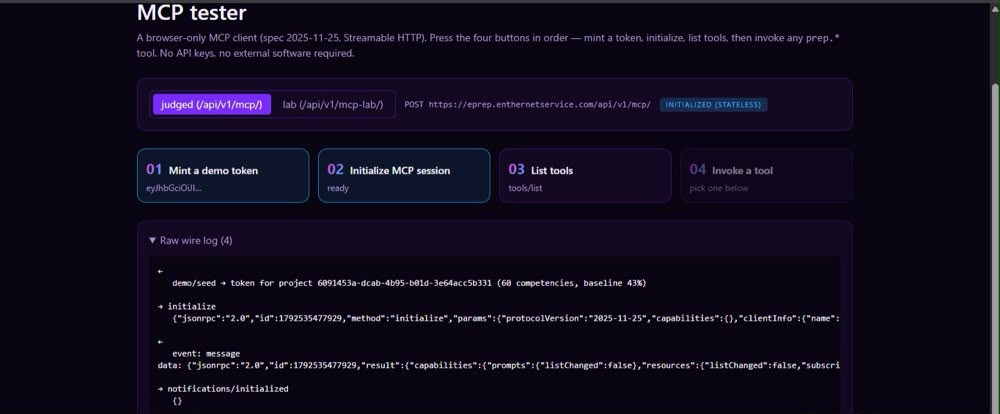
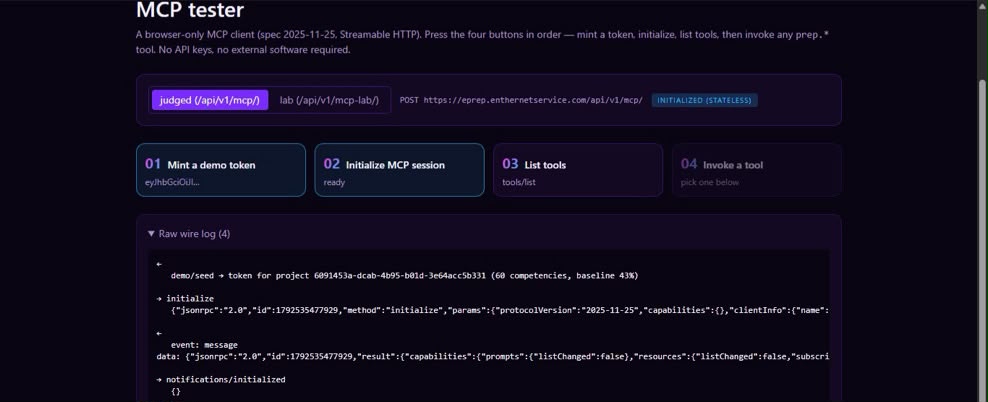
To demonstrate the integration, I developed a browser-based MCP client that connects to the server, performs protocol initialization, discovers available tools, invokes preparation operations, and displays structured responses.
This provides a working integration demonstration without requiring access to preview-only Alexa+ developer tools.
MCP Tester: https://eprep.enthernetservice.com/mcp-tester
MCP Endpoint: https://eprep.enthernetservice.com/api/v1/mcp/
The long-term objective is to make this same preparation engine available through compatible conversational and voice interfaces, including Alexa+ when the necessary developer access becomes available.
Agentic Architecture
Prep AI separates responsibilities across specialized agents rather than relying on one large prompt.
The architecture includes roles for:
- orchestration
- document understanding
- knowledge extraction
- questioning
- coaching
- evaluation
- weakness detection
- mastery tracking
- adaptive planning
- contradiction detection
- session summarization
- security and privacy controls
Shared state allows agents to work from the same knowledge, session history, mastery map, weakness map, and preparation goal.
This means the next interaction can depend on what happened previously.
A simplified runtime looks like:
User → Conversational Interface → Orchestrator → Knowledge Retrieval → Examiner → User Response → Evaluation → Weakness Detection → Adaptive Planner → Next Challenge
Readiness Engine
Prep AI does not treat completing a quiz as proof of readiness.
Performance is evaluated across multiple dimensions and accumulated across sessions.
This creates a changing readiness model showing:
- areas of mastery
- weak concepts
- inconsistent answers
- improvement over time
- recommended next preparation activity
The important question becomes:
If the moment happened right now, how ready are you?
Pressure Mode
Knowing something in a relaxed environment is different from retrieving it under pressure.
Prep AI therefore supports preparation patterns designed around realistic constraints, including:
- limited thinking time
- timed responses
- immediate follow-up questions
- increasing difficulty
- contradiction challenges
- concise-answer requirements
The aim is not artificial stress for its own sake.
It is to make the real moment feel familiar.
Final Boss
The highest preparation level is designed as a complete simulation.
During this session there are no hints or corrections.
The system dynamically selects questions, follows weaknesses, checks contradictions, adjusts difficulty, and evaluates the entire session before presenting the final readiness analysis.
How I built it
Enthernet Prep AI uses a modular architecture that separates the user interface, backend services, preparation agents, evaluation logic, persistence, and external integrations.
The frontend is built with Next.js, React, TypeScript, and Tailwind CSS.
The backend uses Python and FastAPI, with specialized components for document processing, competency extraction, questioning, evaluation, coaching, weakness detection, and adaptive planning.
PostgreSQL and pgvector support persistent application data and vector-based retrieval. Redis and MinIO are included in the infrastructure stack.
The MCP integration uses the Python MCP SDK and Streamable HTTP to expose seven preparation tools to compatible clients.
The AI provider architecture includes a deterministic mock provider and optional integrations for OpenAI and Amazon Bedrock. Deterministic evaluation allows reproducible assessment results, while configured language models can enhance question phrasing and feedback.
Docker Compose provides a reproducible development environment, and the hosted application uses Nginx and HTTPS.
The repository includes automated tests covering the preparation workflow, MCP integration, provider adapters, and other backend components.
The system is designed so that the same preparation engine can serve the browser application and external MCP clients without duplicating its core logic.
Challenges
One of the largest challenges was deciding what an AI preparation system should actually measure.
Generating interview questions is relatively easy.
Determining whether somebody is genuinely becoming more prepared is much harder.
That required separating concepts such as correctness, completeness, relevance, consistency, evidence usage, mastery, and readiness instead of collapsing everything into a single arbitrary AI score.
Another challenge was preventing the architecture from becoming one enormous prompt pretending to be an agent system.
Prep AI therefore uses specialized responsibilities and explicit state so that questioning, evaluation, weakness detection, and adaptive planning remain independently understandable and testable.
The conversational experience created another challenge: a voice interaction must remain useful even without the visual context available on a dashboard.
That pushed the system toward short prompts, natural follow-ups, persistent session state, and interactions that make sense conversationally.
What I learned
Building Prep AI reinforced an important lesson about agentic systems:
More agents do not automatically create more intelligence.
Agents are useful when responsibilities, state, tools, boundaries, and evaluation criteria are explicit.
I also learned that adaptive systems need measurable feedback loops.
Without evaluation and state updates, an "adaptive AI" is often just generating different prompts.
Prep AI instead treats every interaction as evidence that can update the user's preparation model.
What's next
The long-term goal is to expand Prep AI beyond job interviews into a general readiness platform for:
- technical interviews
- certification preparation
- examinations
- startup pitches
- investor meetings
- thesis defenses
- presentations
- sales conversations
- competition judging
The interface may change.
The principle remains the same:
Know it. Prove it. Live in the Moment.
Built With
- alembic
- amazon-bedrock
- amazon-web-services
- docker
- fastapi
- mcp
- minio
- model-context-protocol
- nextjs
- openai
- pgvector
- postgresql
- pytest
- python
- react
- redis
- sqlalchemy
- tailwindcss
- typescript


Log in or sign up for Devpost to join the conversation.