

Inspiration
Academic research increasingly uses AI, but speed creates a new problem: trust.
An AI model can summarize a topic or generate polished academic writing in seconds, but researchers still need to answer harder questions:
Is this source real?
Where did this claim come from?
Does the cited paper actually support the statement?
Can the evidence be traced back to the original document?
What sources were included, excluded, or questioned during the research process?
We built Enthernet Pinch AI around the idea that AI-assisted research should remain traceable, reviewable, and defensible.
Instead of building another chatbot that generates an answer and hides the process behind it, we wanted a research workspace where the path from a research question to the final draft remains visible.
Our guiding principle became:
Pinching the internet for credible answers.
And underneath that is an even stricter philosophy:
Search broadly. Verify carefully. Keep the evidence visible.
What it does
Enthernet Pinch AI is an evidence-first AI research workspace designed to support students, lecturers, researchers, and academic writers through an end-to-end research workflow.
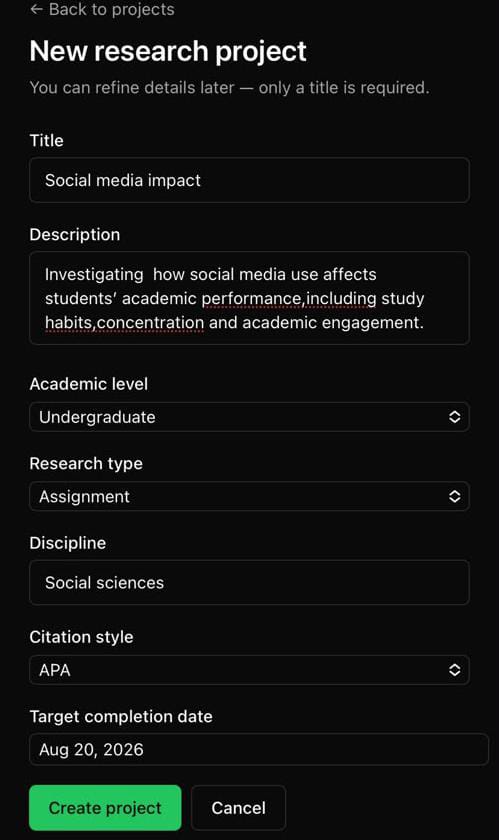
A researcher can create a private research project and define details such as academic level, discipline, research type, methodology, citation style, and research question.
From there, Pinch AI helps move the project through several connected stages.
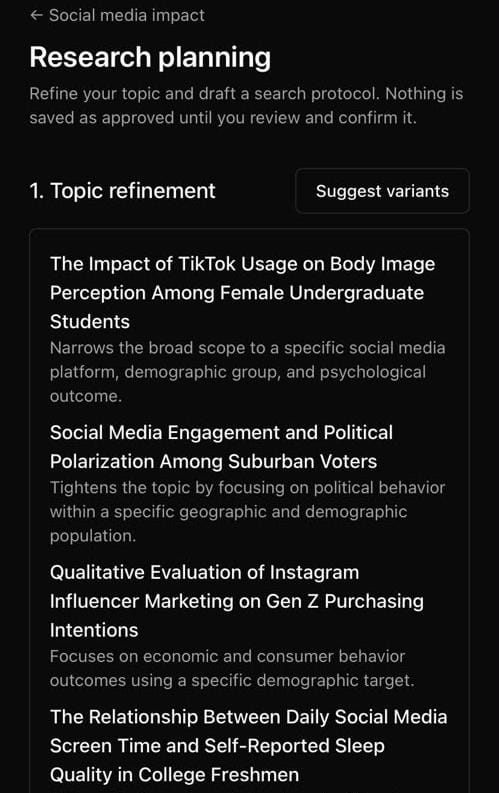
Research planning
Using Gemini, the platform can help refine a rough topic and generate a structured research protocol containing:
Research questions
Objectives
Keywords
Boolean search queries
Inclusion criteria
Exclusion criteria
Database selections
Date ranges
Language filters
The researcher reviews and approves the protocol before it becomes part of the downstream workflow.
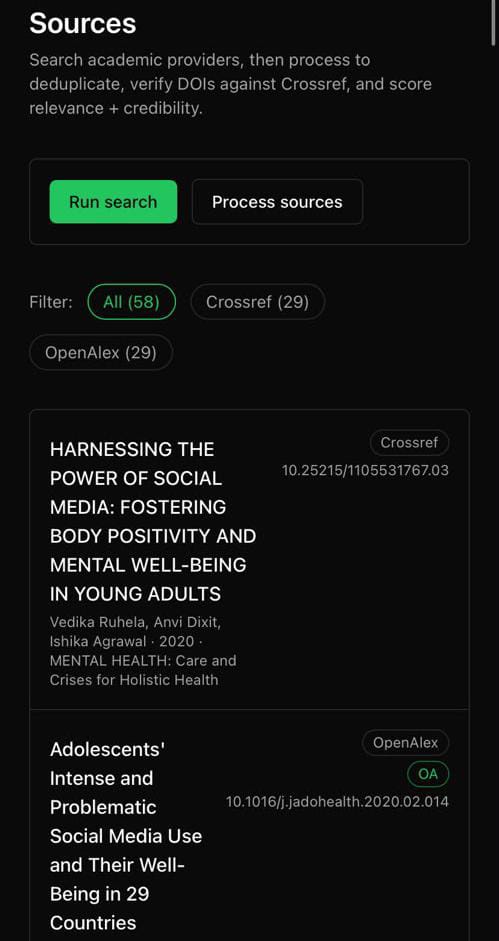
Academic source discovery
Pinch AI searches real scholarly data providers including:
OpenAlex
Crossref
Semantic Scholar
Results are normalized into a common source format and processed for:
Cross-provider deduplication
DOI and metadata verification
Publication-status checks
Relevance scoring
Credibility scoring
This means the research workflow begins with real academic records rather than references generated from an LLM's memory.
Document ingestion
Researchers can upload PDF documents directly into a project.
Pinch AI:
Validates uploaded PDFs
Generates SHA-256 hashes
Prevents duplicate uploads
Extracts text page by page
Stores page-level text separately
Records extractor and provenance information
Evidence extraction
Gemini then helps identify structured claims from uploaded documents, including:
Objectives
Methodology
Samples
Variables
Findings
Limitations
Recommendations Claims retain their associated document, page number, supporting passage, evidence type, and confidence assessment so the researcher can inspect where the information originated.
Literature matrix The extracted evidence and discovered academic sources are organized into a literature matrix.
Researchers can review: Authors Publication year DOI Journal Source type Relevance Credibility Objectives Methodology Findings Limitations Recommendations
Each source can be marked as: Included Excluded Undecided
Researchers can also record reasons for exclusion and preserve their own edits when the matrix is regenerated.
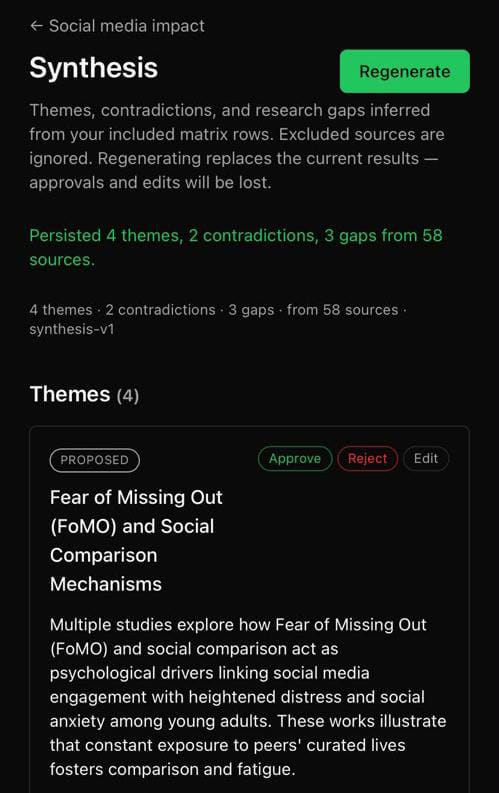
Research synthesis
Pinch AI can analyze the research corpus to propose: Major themes Contradictions between studies Research gaps
These are presented as reviewable research artifacts rather than silently becoming part of the final output.
Researchers can approve, reject, or edit synthesis items.
Evidence-grounded drafting
The Writing Agent can generate academic sections from selected project evidence.
Instead of allowing the model to invent arbitrary references, Pinch AI uses controlled citation keys connected to actual project sources.
Drafts are versioned so regeneration does not simply destroy previous writing.
Citation-support assessment
Pinch AI also contains a Citation Verification Agent that evaluates how well cited evidence appears to support statements in generated drafts.
Assessments can include: Strongly supported Partially supported Weak support Contradicted Unresolved
The goal is not to replace researcher judgment, but to surface places that deserve additional review.
Research exports
Projects can currently produce research artifacts including: Literature matrix CSV BibTeX Section DOCX Full-project DOCX Research-defence PowerPoint presentations
The PowerPoint export is assembled deterministically from project data, approved synthesis items, verified draft sections, and real project sources rather than asking an LLM to invent a presentation during export.
How we built it
Enthernet Pinch AI uses a full-stack architecture designed to keep AI reasoning separate from deterministic research and application logic.
Frontend
The research workspace is built with: Next.js React TypeScript Tailwind CSS
The interface includes separate workflows for projects, planning, sources, documents, evidence claims, literature matrices, synthesis, drafts, and exports.
Backend
The API is built with: Python FastAPI Pydantic SQLAlchemy Alembic
Research data is stored in PostgreSQL, with pgvector available for vector-based capabilities.
AI Google Gemini powers the specialized AI agents used throughout the platform.
Instead of relying primarily on unrestricted text responses, agents use structured Pydantic output schemas.
This allows application logic to validate AI-produced fields before storing or using them downstream.
The current agent architecture includes: Research Planning Agent Evidence Extraction Agent Synthesis Agent Writing Agent Citation Verification Agent
Each AI operation produces an AgentRun receipt containing information such as: Agent name Task type Model Prompt version Status Timing Structured input/output metadata
This provides an audit trail for AI-assisted operations.
Academic data providers
Source discovery integrates: OpenAlex Crossref Semantic Scholar
Each provider has its own adapter, but their results are normalized into a common source representation before entering the research workflow.
Infrastructure
The backend runs in Docker with: PostgreSQL Redis Nginx HTTPS Structured application logging
Redis is also part of the architecture for durable background-job processing as the platform continues to harden for broader beta usage.
Production health monitoring and error observability are also being incorporated into the deployment workflow.
Challenges we ran into
Preventing fabricated academic references
One of the hardest parts of the project was deciding what AI should not be trusted to do.
Simply asking an LLM to write a literature review with citations can produce convincing but incorrect references.
We therefore designed the workflow so source discovery happens through real academic providers and citations resolve back to project sources.
The lesson was simple: AI generation needs deterministic boundaries around it.
Normalizing several scholarly databases
OpenAlex, Crossref, and Semantic Scholar represent papers differently.
They use different fields, metadata structures, identifiers, publication types, and availability information.
We had to build a normalization layer before deduplication, verification, scoring, and later research stages could work consistently.
Preserving provenance
A normal chatbot can forget how an answer was produced as soon as it sends the response.
Academic research cannot work that way.
We had to design database models for: Search runs Agent runs Audit logs Documents Document pages Evidence claims Literature matrix entries Synthesis items Draft sections Citations Verification results
That made the system significantly more complicated, but also much more defensible.
Working with AI uncertainty
Structured output reduces chaos, but it does not turn an LLM into a deterministic database.
We still have to validate: Source IDs Page ranges Citation keys Confidence values Ownership Project boundaries Structured output fields
We learned to treat model output as proposed data, not trusted data.
Infrastructure
Building the AI features was only part of the work.
Production brought its own collection of deeply traditional problems:
Docker networking PostgreSQL migrations CORS HTTPS Nginx Memory pressure Container resource usage DNS API health monitoring Model deprecations CI compatibility
The glamorous AI application eventually still has to survive Linux.
Accomplishments that we're proud of
We are proud that Enthernet Pinch AI has grown beyond being a paper-search tool into a connected research workflow.
Some of the milestones we are most proud of include:
Integrating three real scholarly data providers
Building cross-provider source normalization and deduplication
Adding DOI and publication metadata verification
Creating relevance and credibility scoring
Building secure PDF ingestion with hashing and page-level extraction
Creating structured evidence claims linked to document pages
Building an editable literature matrix with inclusion and exclusion decisions
Generating themes, contradictions, and research gaps from a research corpus
Building evidence-grounded academic drafting
Adding citation-support assessment
Versioning research artifacts instead of silently overwriting them
Maintaining agent-run and audit trails
Supporting multiple academic citation styles in exports
Generating DOCX, BibTeX, CSV, and research-defence PowerPoint artifacts
Deploying the application as a working beta system
Most importantly, the system now demonstrates the research path we originally wanted:
Question → Search → Evidence → Review → Synthesis → Draft → Citation assessment → Export
What we learned
The biggest lesson was that trustworthy AI is not primarily about making a model more persuasive.
It is about controlling what the system is allowed to claim.
LLMs are extremely useful for: Interpretation Classification Synthesis Drafting Explaining relationships between evidence
But deterministic application logic still needs to control: Authentication Authorization Source ownership Provenance Page boundaries Citation mapping Version history Audit records Exports
We also learned that uncertainty should be exposed rather than hidden.
A weak citation match, missing DOI, conflicting study, or unverified claim should remain visible to the researcher.
The system should help the researcher investigate uncertainty rather than silently convert it into certainty.
What's next for Enthernet Pinch AI
Enthernet Pinch AI is currently moving through beta hardening.
The next stage focuses less on adding flashy features and more on making the evidence chain stronger.
Our priorities include:
Stronger passage-level evidence validation
Tighter researcher-controlled source inclusion
Better corpus-quality filtering
More durable background processing
Improved mobile research workflows
Browser-level end-to-end testing
Secure session and account-recovery systems
Better document-storage and backup infrastructure
Model-usage and cost metering
Researcher feedback workflows
Collaboration features
Carefully implemented subscription and credit billing
Stronger research exports and citation formatting
Improved observability and operational dashboards
The long-term goal is not to automate researchers out of research.
It is to make AI powerful enough to accelerate the work while keeping the evidence visible enough for the researcher to question it, verify it, and defend it.
Built With
- alembic
- crossref
- css
- docker
- fastapi
- gemini
- github
- next.js
- nginx
- openalex
- pgvector
- postgresql
- pydantic
- python
- react
- redis
- scholar
- semantic
- sentry
- sqlalchemy
- tailwind
- typescript


Log in or sign up for Devpost to join the conversation.