-
-
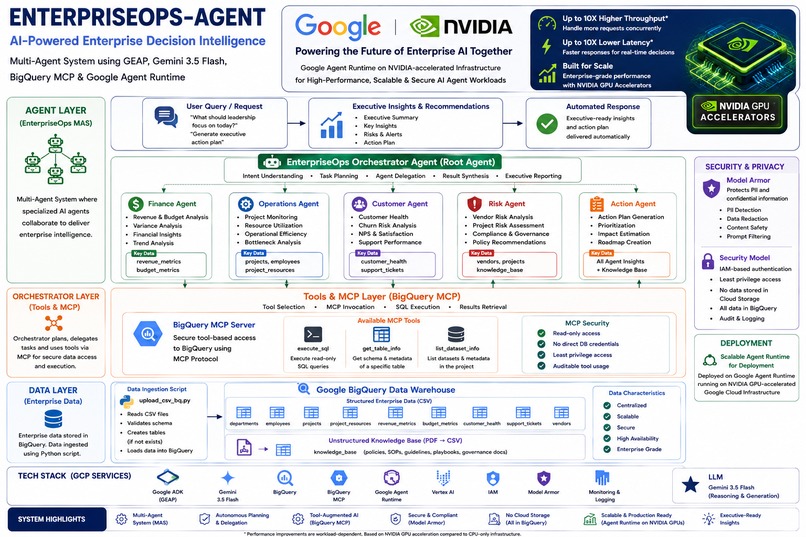
A high level overview of thr project
-
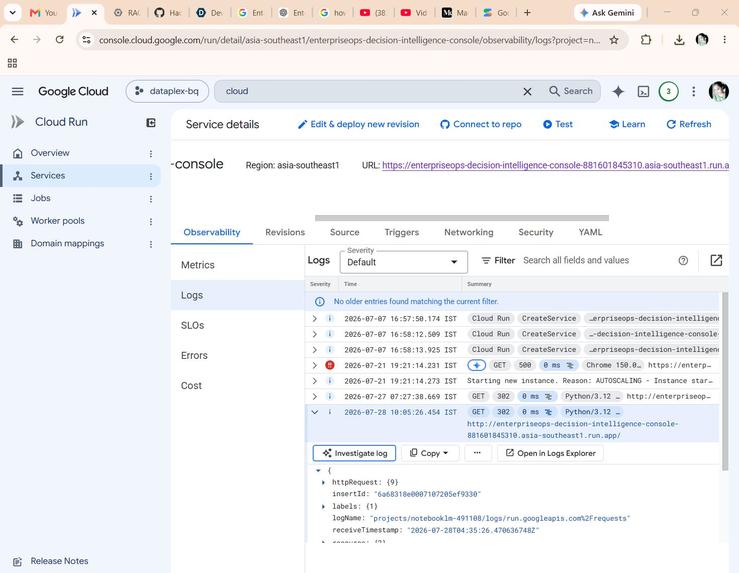
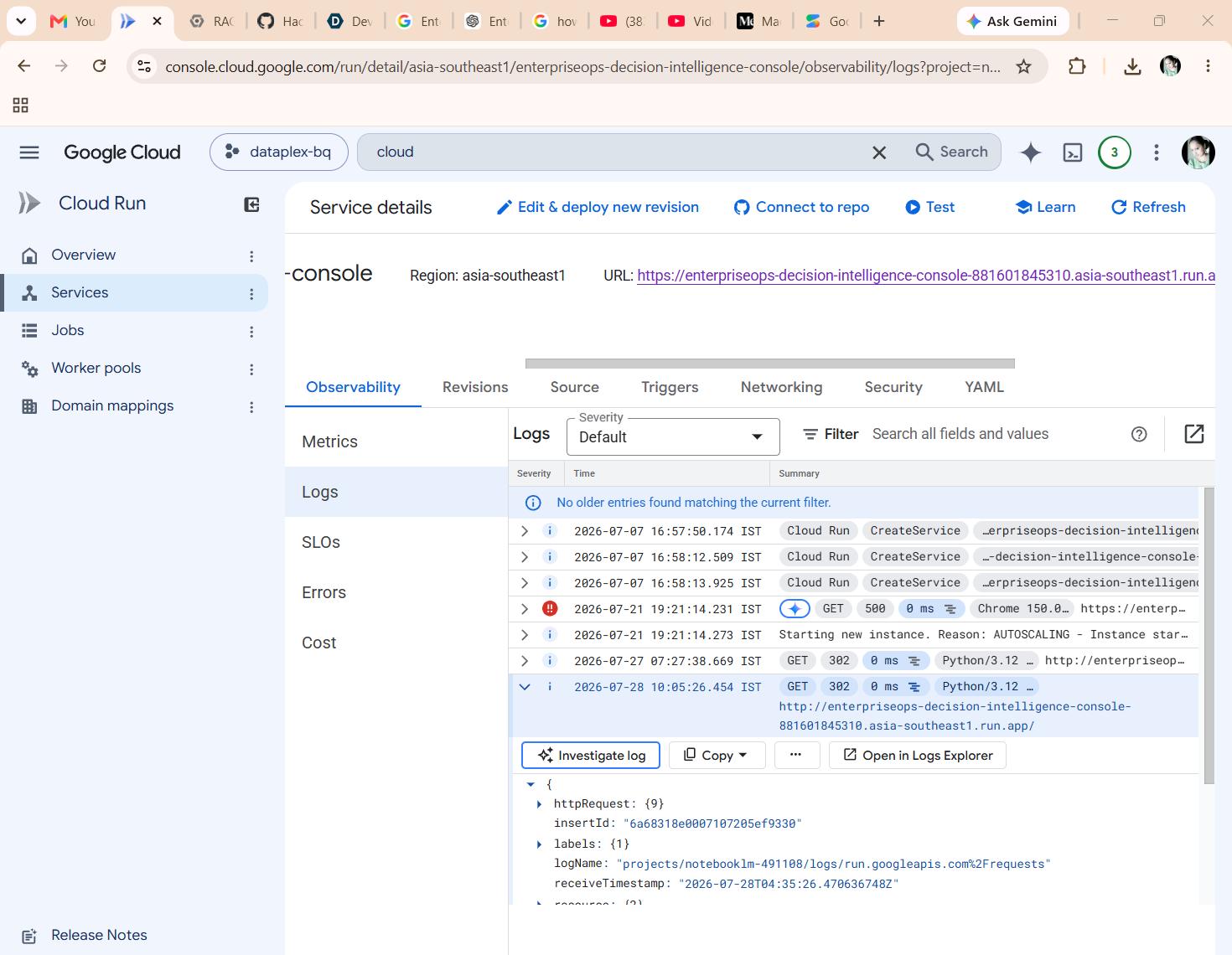
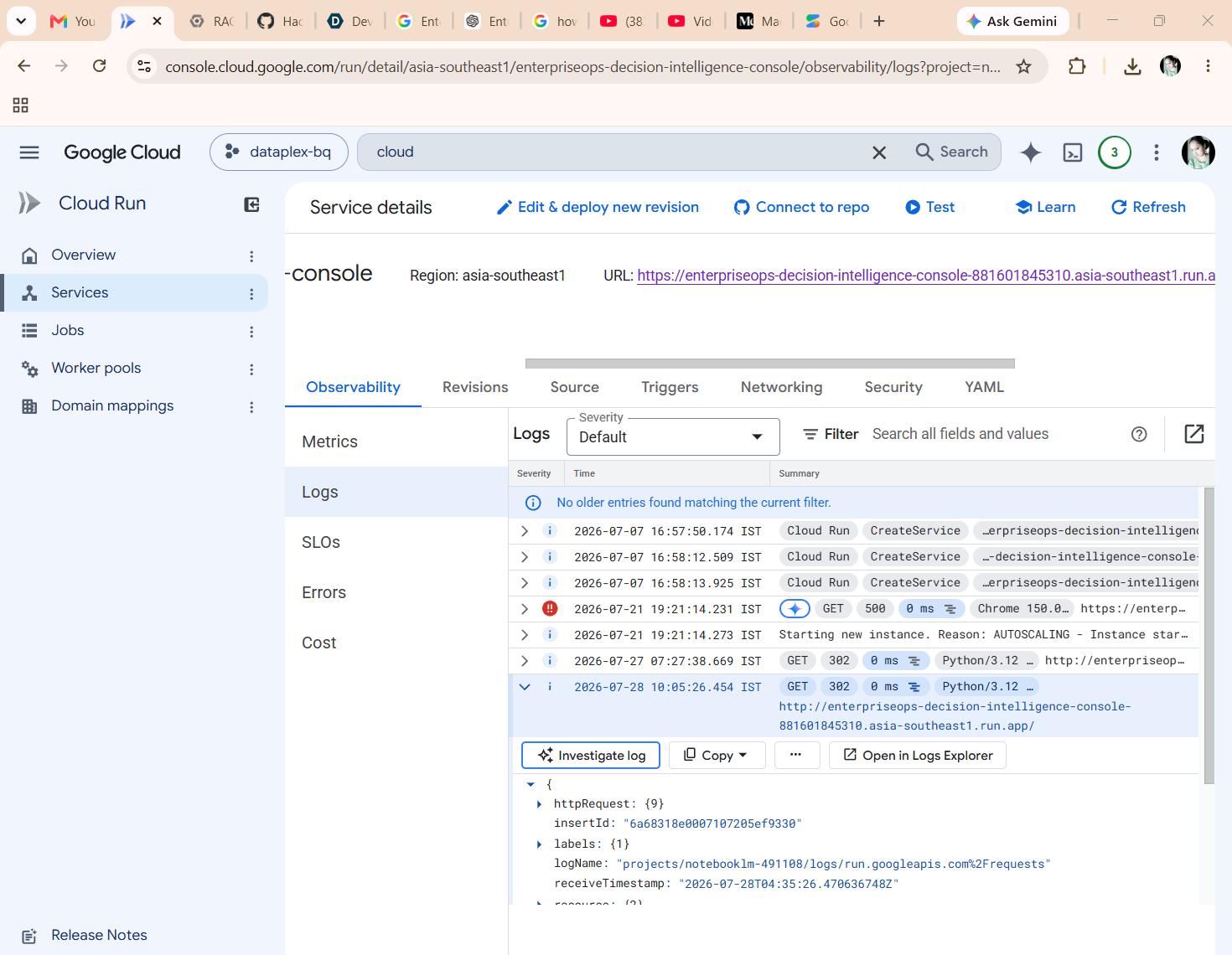
Cloud run deployed proof showing logs and endpoint link
-
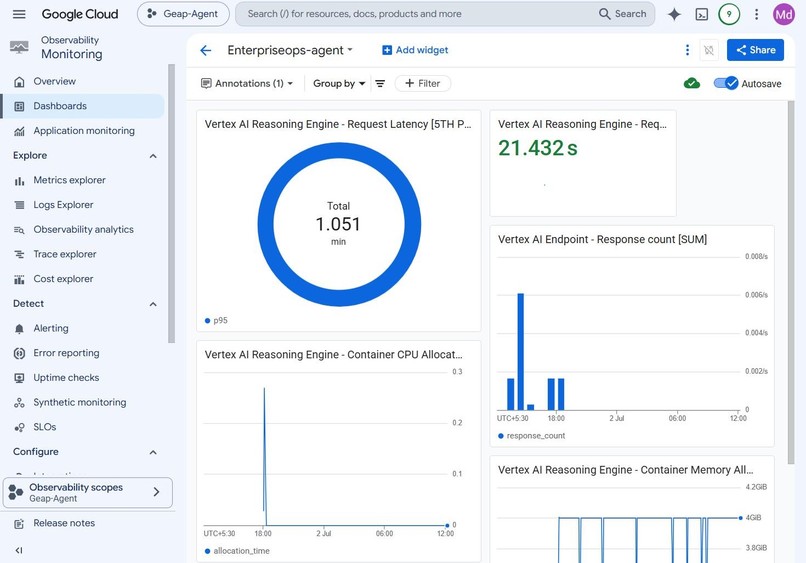
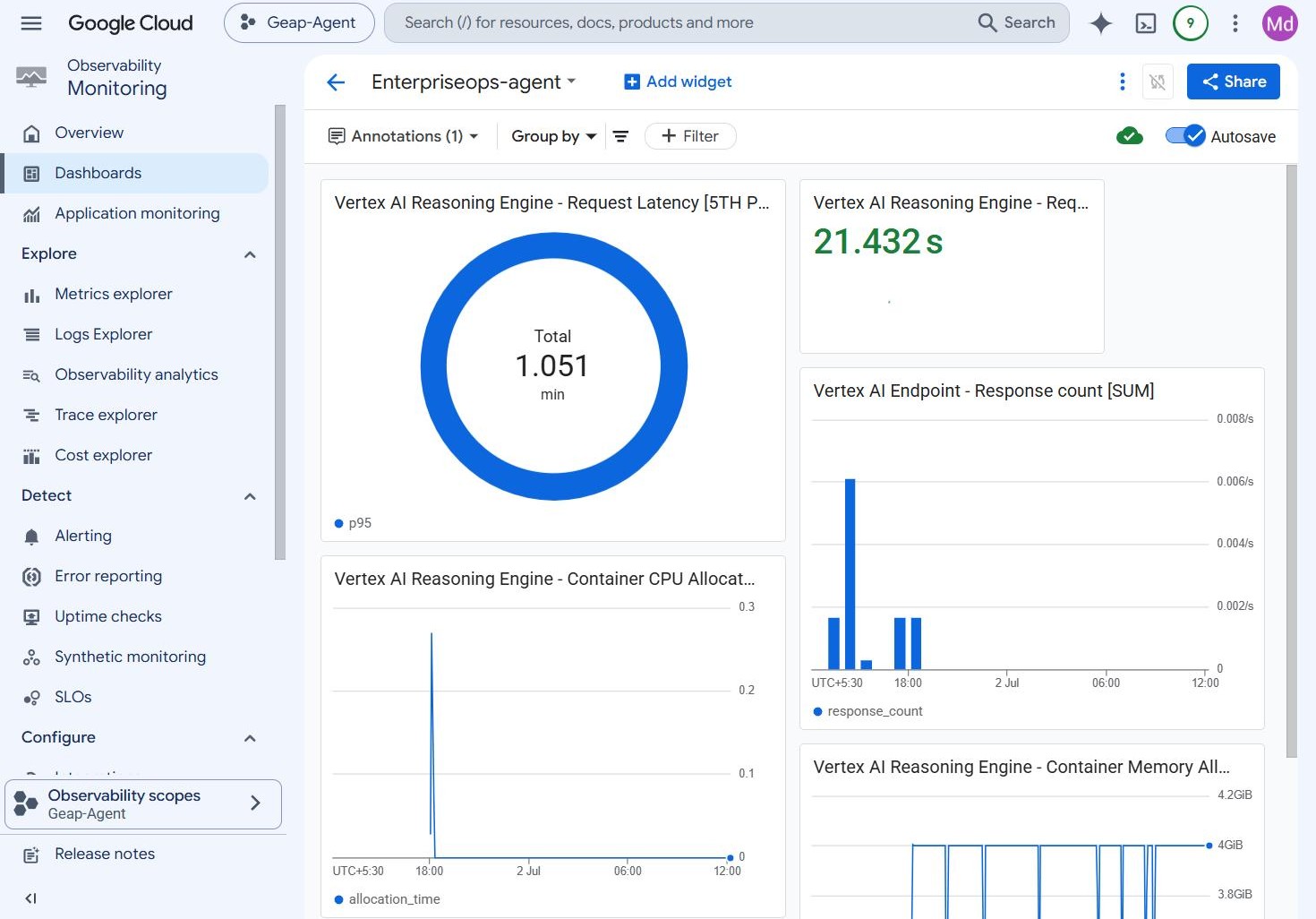
Performance dashboard of GEAP
-
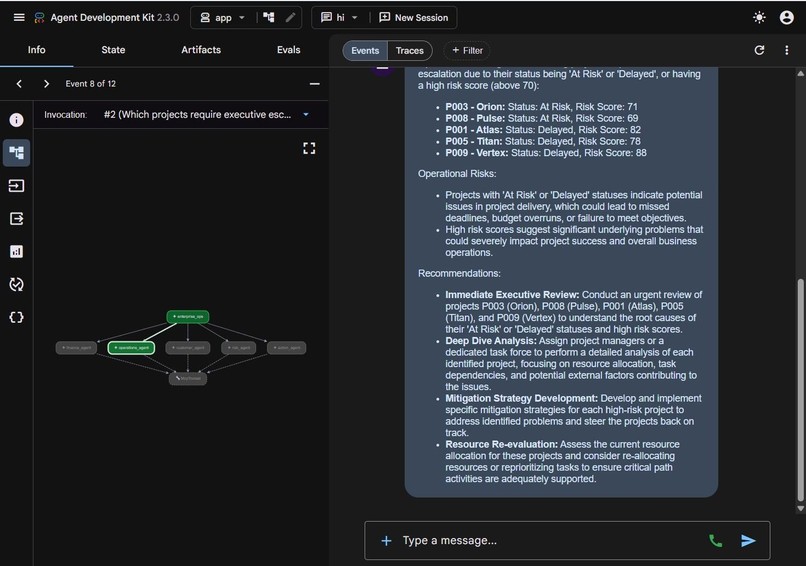
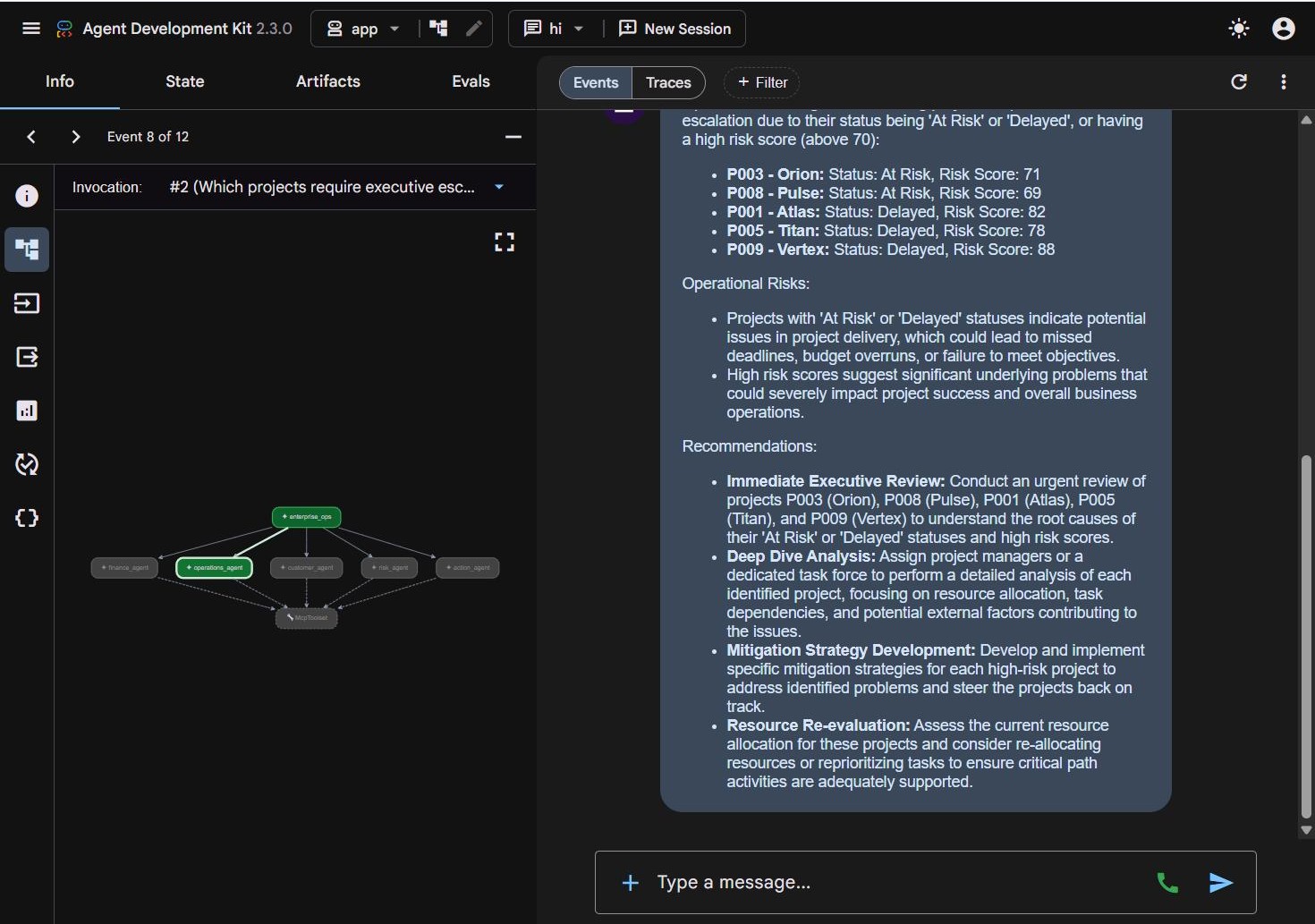
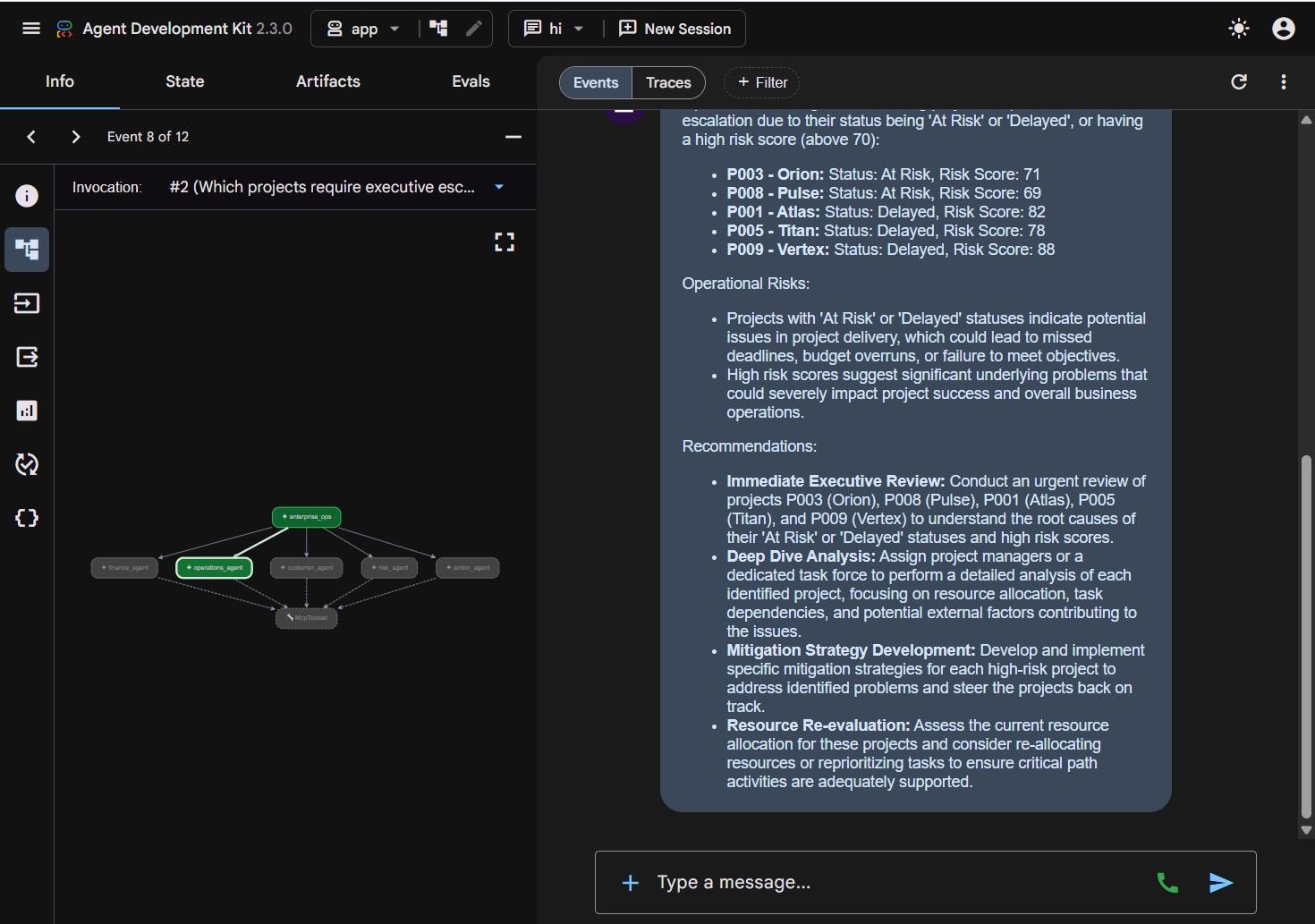
Executive summary generated by MAS
-
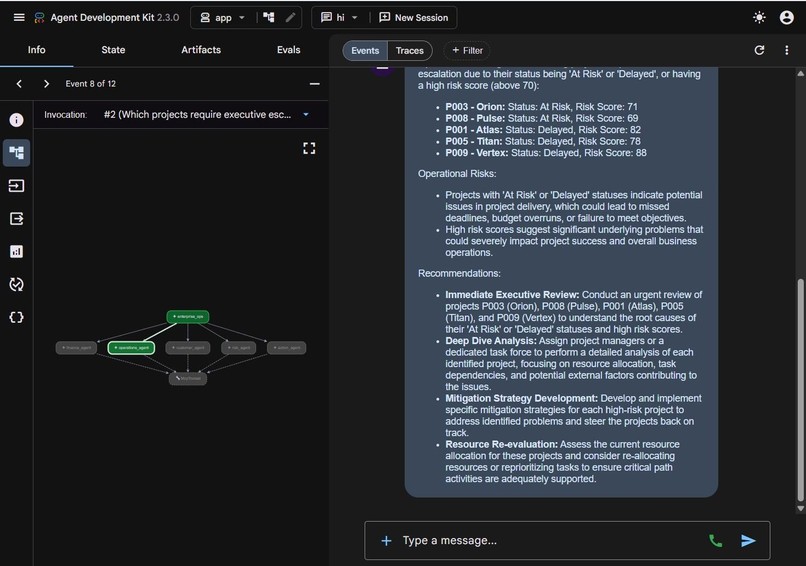
Summary report final regarding project escalation
-
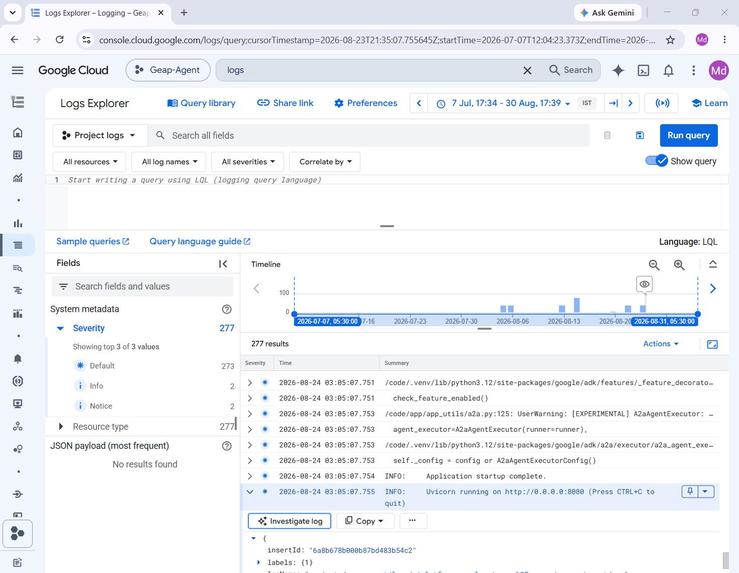
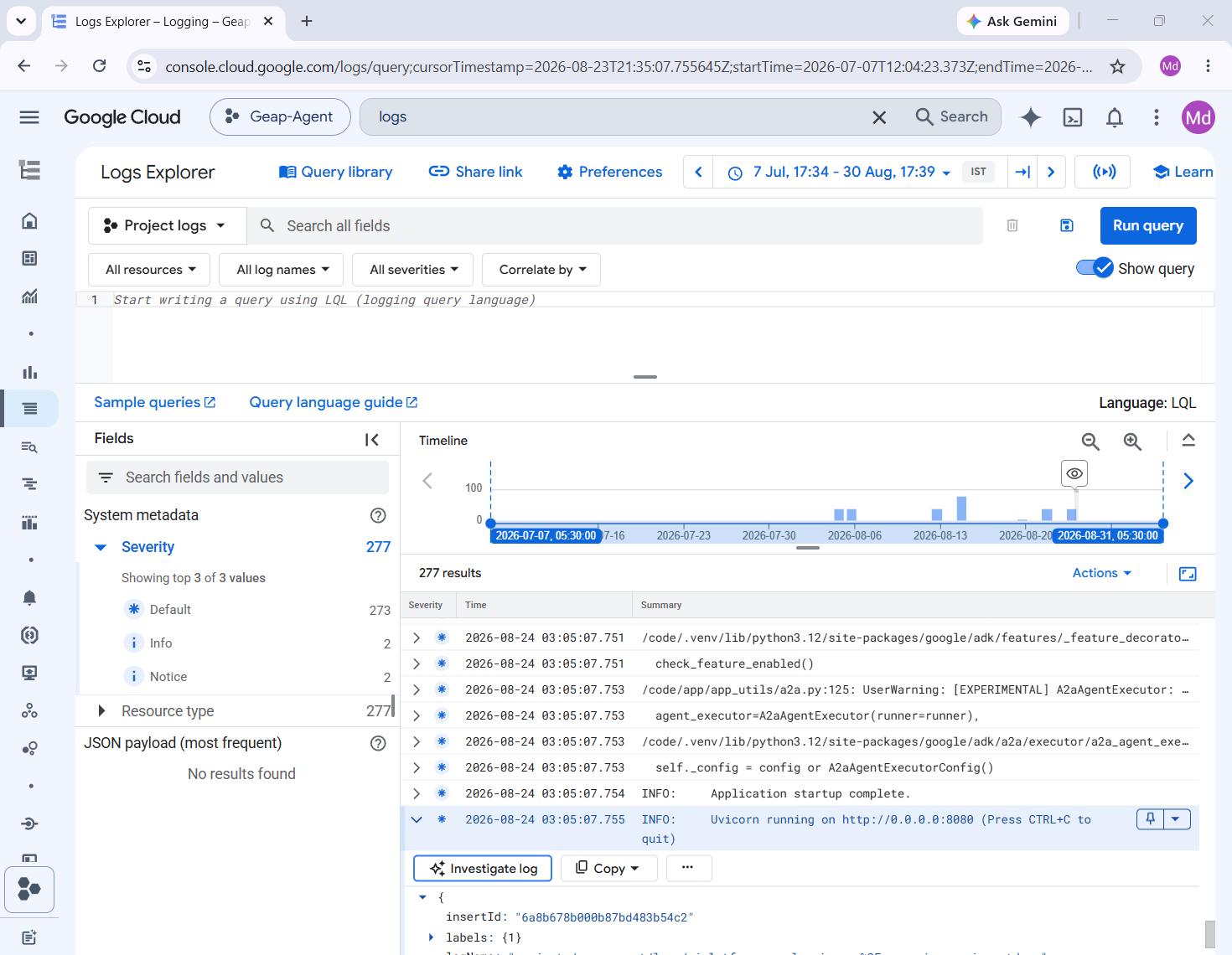
VertexAI logs
-
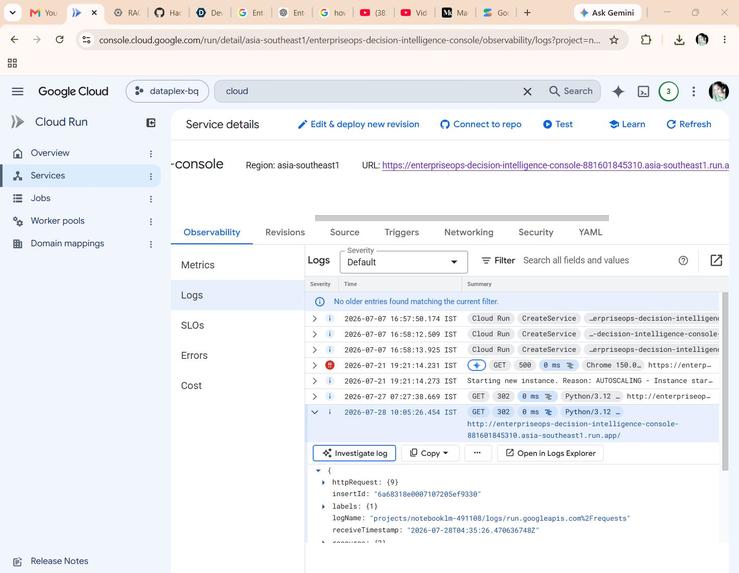
Cloud run deployed proof showing logs and endpoint link
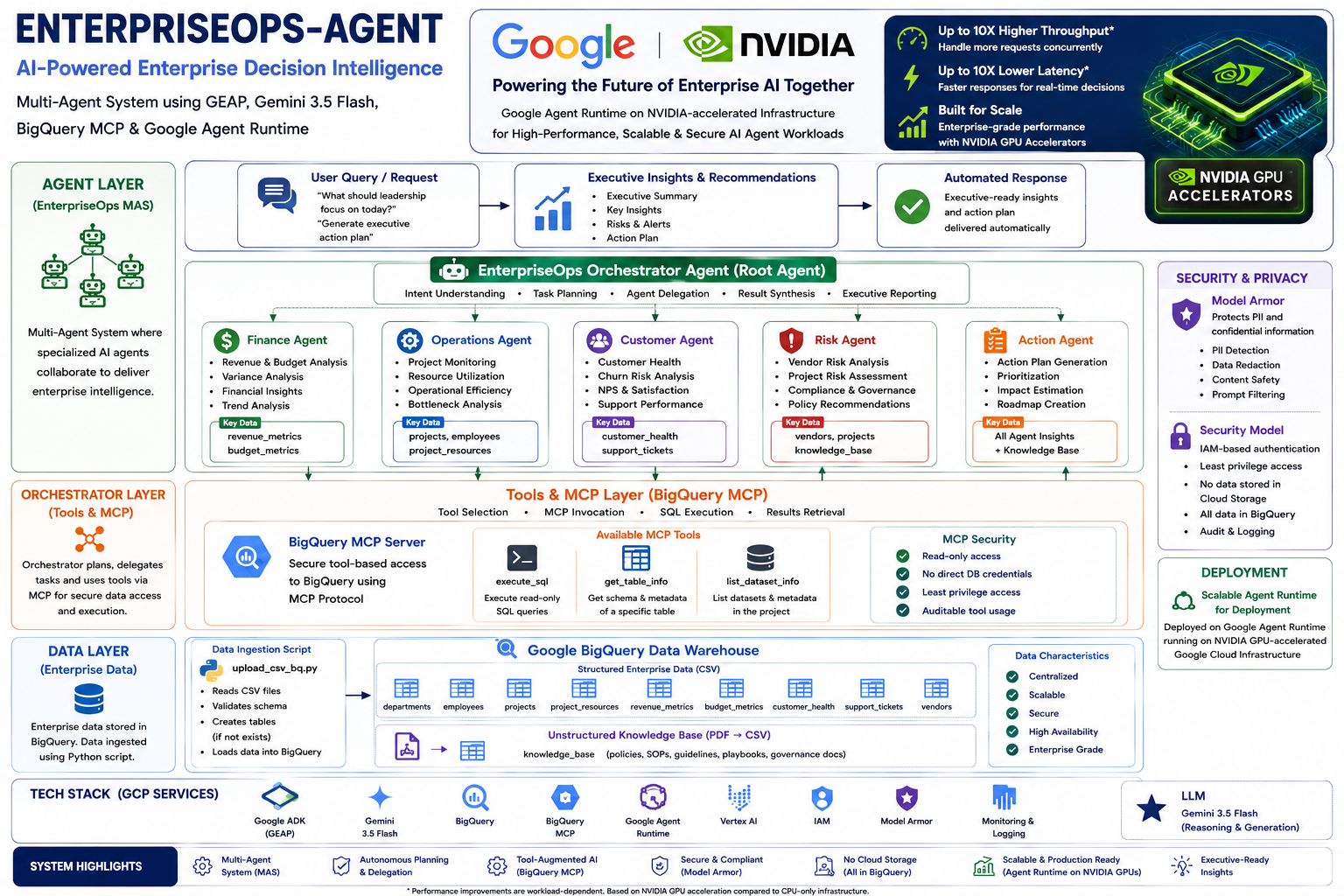
EnterpriseOps-Agent: From Enterprise Data to Better Decisions
Inspiration
The inspiration for EnterpriseOps-Agent came from a common enterprise problem: organizations have plenty of data, but turning that data into timely decisions is often difficult.
Finance, operations, customer support, projects, and risk teams typically look at their own information independently. Leadership then has to bring these pieces together before deciding what needs attention. I wanted to explore whether agentic AI could behave more like an executive team, where specialized AI agents analyze their own domains and collaborate to produce a unified business perspective.
This led to the idea of building EnterpriseOps-Agent — a Multi-Agent System where an EnterpriseOps Orchestrator coordinates Finance, Operations, Customer, Risk, and Action agents to turn enterprise data into actionable executive intelligence.
What it does
EnterpriseOps-Agent acts as an AI-powered digital executive team. It takes business questions from leaders, coordinates specialized AI agents across Finance, Operations, Customer, Risk, and Action, retrieves relevant enterprise data from BigQuery through MCP tools, and converts the findings into executive-ready insights and prioritized recommendations.
It helps organizations:
📊 Understand business and financial performance ⚙️ Identify operational and resource bottlenecks 👥 Detect customer health and churn risks ⚠️ Identify project, vendor, and enterprise risks 🎯 Generate prioritized action plans 🚀 Make faster, smarter, and data-driven decisions
How we built it
I built the solution using Google ADK (GEAP) and Gemini 3.5 Flash.
The architecture follows a hierarchical Multi-Agent approach:
                EnterpriseOps Orchestrator
                          │
      ┌───────────┬───────┼───────┬───────────┐
      ▼           ▼       ▼       ▼           ▼
   Finance    Operations Customer  Risk      Action
    Agent        Agent     Agent   Agent      Agent
      │           │         │       │          │
      └───────────┴─────────┴───────┴──────────┘
                          │
                     BigQuery MCP
                          │
                     BigQuery Data
                          │
                Executive Intelligence
The EnterpriseOps Orchestrator understands the business question and delegates work to the appropriate specialist agents. Each specialist focuses on a particular business domain, while the Action Agent consolidates findings into prioritized recommendations.
For the data layer, I created synthetic enterprise datasets covering departments, employees, projects, resources, revenue, budgets, customer health, support tickets, and vendors. These structured CSV files are ingested into Google BigQuery using a Python ingestion script. A knowledge base is also maintained in BigQuery so that agents can combine structured business information with organizational context.
To connect the agents with enterprise data, I integrated the BigQuery MCP Toolbox. The agents use controlled tools such as execute_sql, get_table_info, get_dataset_info, and list_dataset_info instead of directly accessing the database.
For development and execution, I used Antigravity and the Google Agents CLI to bootstrap, run, test, and iterate on the agent application.
The application is deployed using Google Agent Runtime, providing a scalable runtime for the Multi-Agent application. The deployment benefits from NVIDIA GPU-accelerated Google Cloud infrastructure, supporting responsive AI inference and concurrent agent execution.
Security was also considered as part of the architecture. Google Model Armor is used to help protect PII and confidential enterprise information and mitigate prompt-injection risks.
Challenges we ran into
One of the biggest challenges was designing the Multi-Agent workflow without making it unnecessarily complex. Adding more agents does not automatically make a system more intelligent. I had to define clear responsibilities and determine how the orchestrator should delegate work.
Another challenge was connecting the AI agents to enterprise data securely. Instead of allowing unrestricted database access, I used BigQuery MCP tools to create a controlled interface between the agents and the data layer.
Working with enterprise-style synthetic data was another challenge. The datasets needed enough relationships across departments, projects, customers, finances, and risks to support meaningful cross-functional questions.
Deployment was also an important learning experience. Moving from local agent execution to Google Agent Runtime required understanding the runtime structure, configuration, service-account permissions, and deployment workflow.
Finally, I had to think beyond simply getting an answer from the model. The system needed to produce useful business recommendations grounded in actual data, while incorporating security and Responsible AI considerations.
Accomplishments that we're proud of
We're proud of building EnterpriseOps-Agent into a production-oriented Multi-Agent AI platform rather than a traditional chatbot. Some of our biggest accomplishments include:
🤖 Designed a Hierarchical Multi-Agent System where an EnterpriseOps Orchestrator coordinates five specialized agents (Finance, Operations, Customer, Risk, and Action).
🛠️ Successfully integrated BigQuery MCP Toolbox to enable secure, tool-based SQL execution using execute_sql, get_table_info, get_dataset_info, and list_dataset_info.
☁️ Built a complete Google Cloud-native architecture using Google ADK (GEAP), BigQuery, Model Armor, and Google Agent Runtime.
🚀 Deployed the application on Google Agent Runtime, leveraging NVIDIA GPU-accelerated Google Cloud infrastructure for scalable, low-latency agent execution.
🔒 Implemented Google Model Armor to help protect PII and confidential enterprise information while strengthening Responsible AI practices.
📊 Created a realistic enterprise data ecosystem with structured business datasets and a knowledge base to demonstrate cross-functional business reasoning.
💡 Transformed complex enterprise questions into executive-ready summaries, risk assessments, and actionable recommendations through collaborative AI agents.
Beyond the technical implementation, we're especially proud of demonstrating how agentic AI can function as a digital executive team, helping organizations make faster, smarter, and more data-driven decisions.
What we learned
Building this project helped me understand that creating an agentic system is very different from simply connecting an LLM to a prompt.
I learned how to design specialized agent responsibilities, define an effective orchestrator–sub-agent relationship, and decide when an agent should use tools rather than rely on model knowledge.
I also gained practical experience with MCP-based tool integration, BigQuery data access, agent execution through the Agents CLI, and deployment through Google Agent Runtime.
Most importantly, I learned that good agentic architecture requires clear boundaries. Each agent needs a focused responsibility, access to the right tools, and instructions that prevent it from inventing information outside the available data.
What's next for EnterpriseOps-Agent
The architecture is intentionally modular. Future versions could introduce additional agents for procurement, supply chain, HR, cybersecurity, or sustainability and connect the platform to live enterprise systems.
The larger vision is to evolve EnterpriseOps-Agent from an enterprise analytics assistant into a proactive AI decision-intelligence platform that continuously identifies emerging risks and opportunities and helps leadership act before problems become critical.
This project has been my exploration of how Multi-Agent AI, enterprise data, MCP, cloud deployment, and responsible AI can come together to solve a practical business problem.


Log in or sign up for Devpost to join the conversation.