-
-
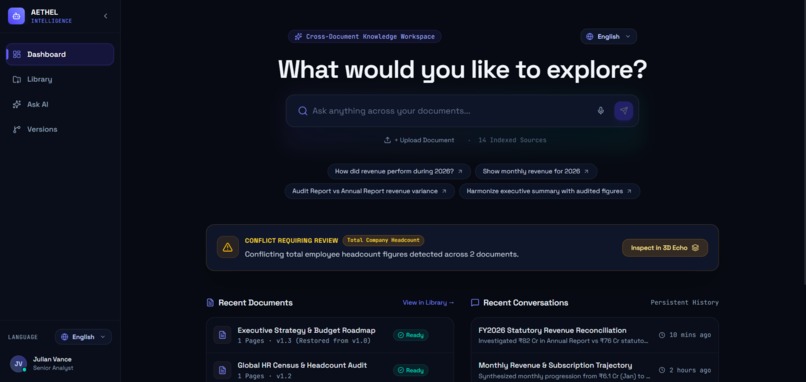
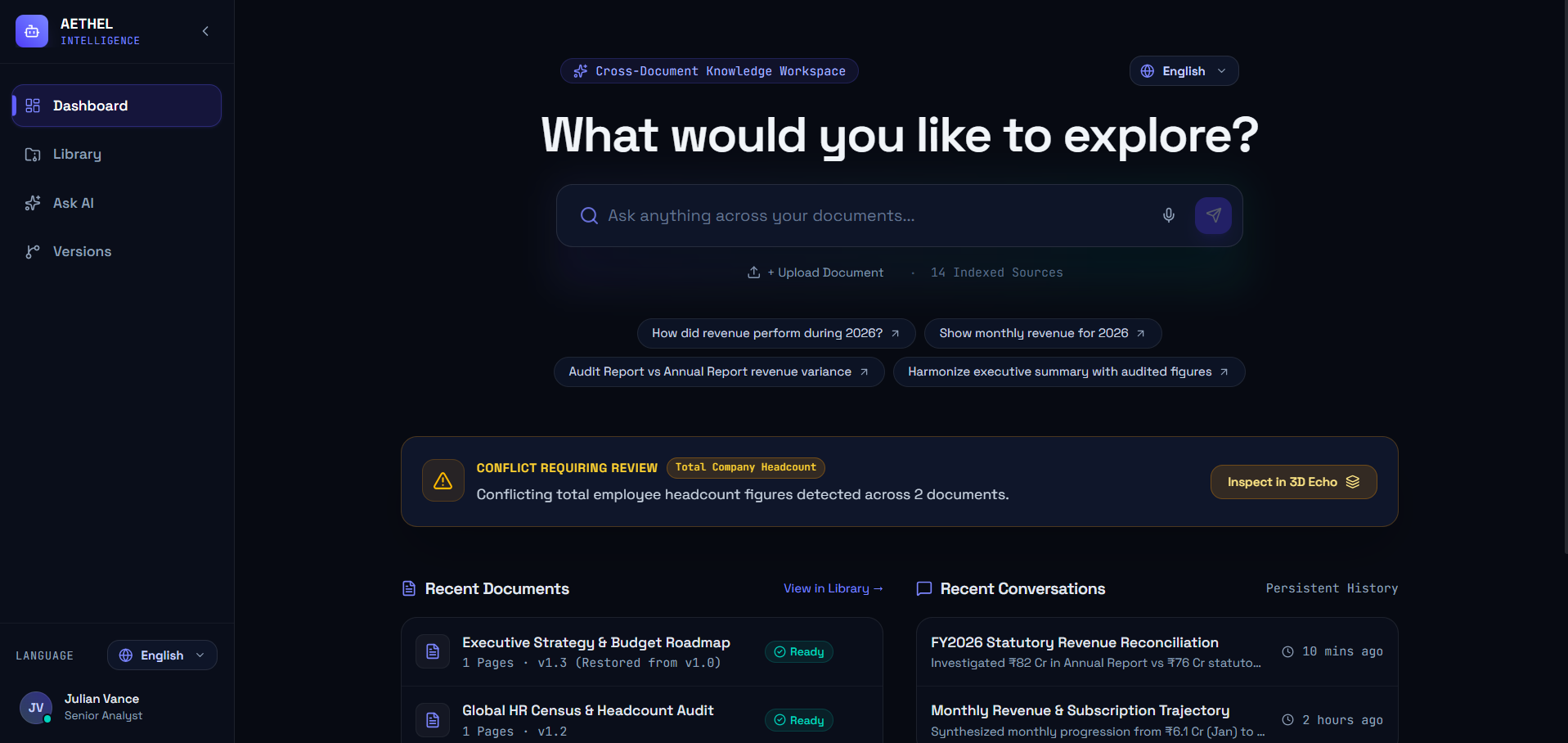
Unified enterprise workspace for document search, AI queries, conflict detection, and document management.
-
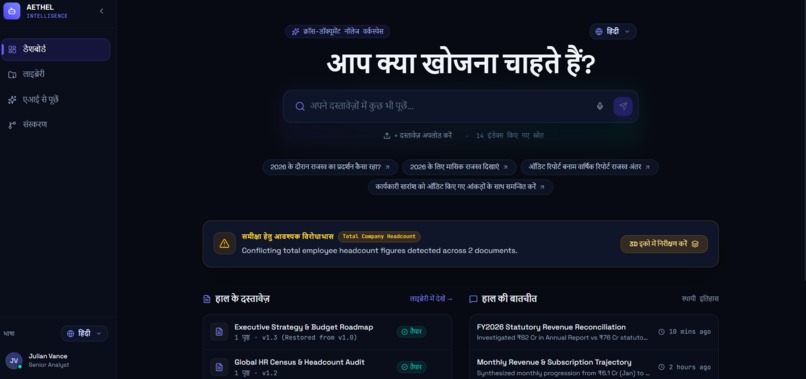
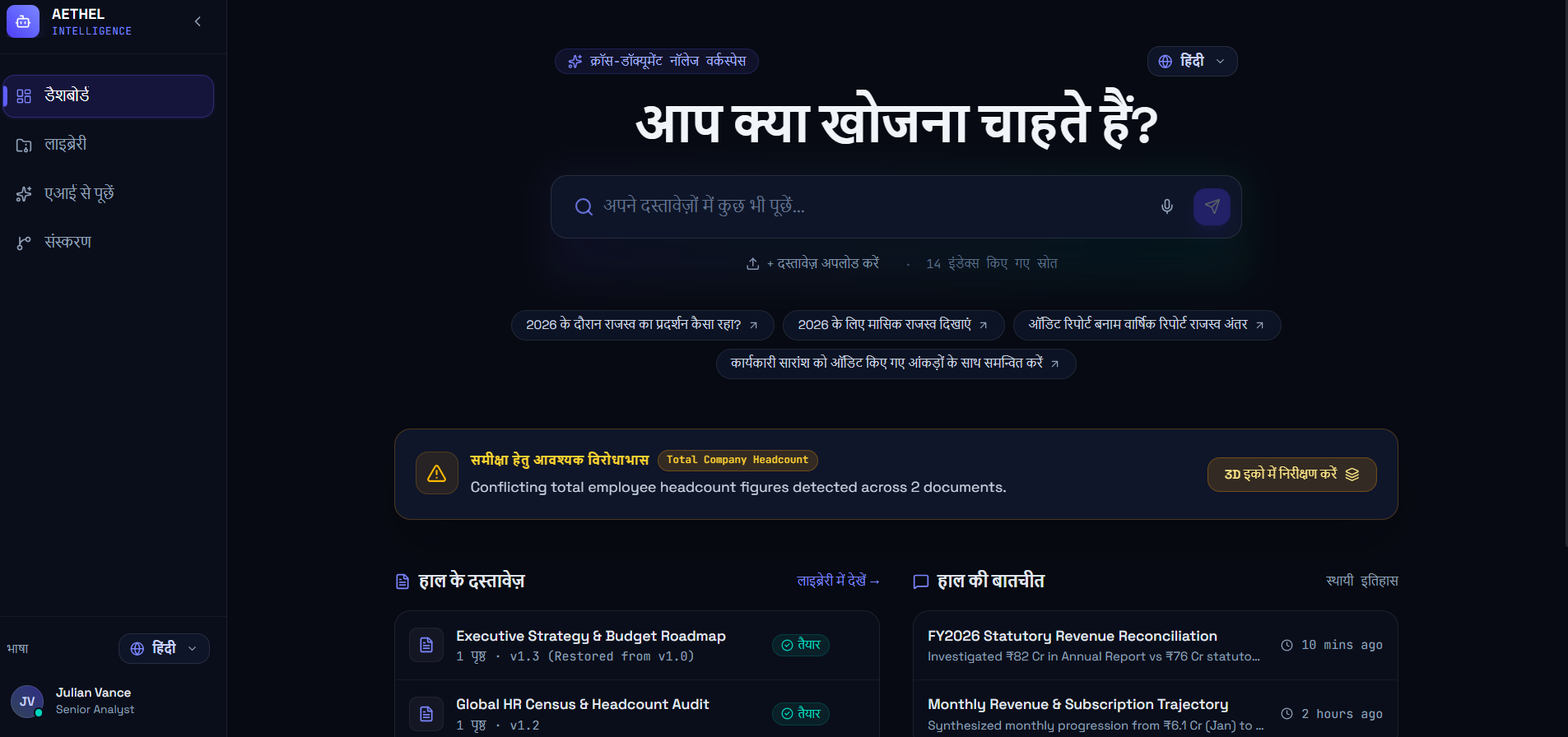
Multilingual interface enabling document interaction in English and and all the other language
-
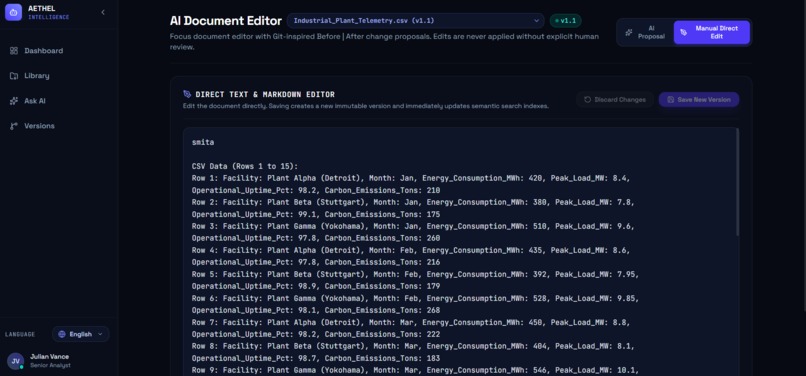
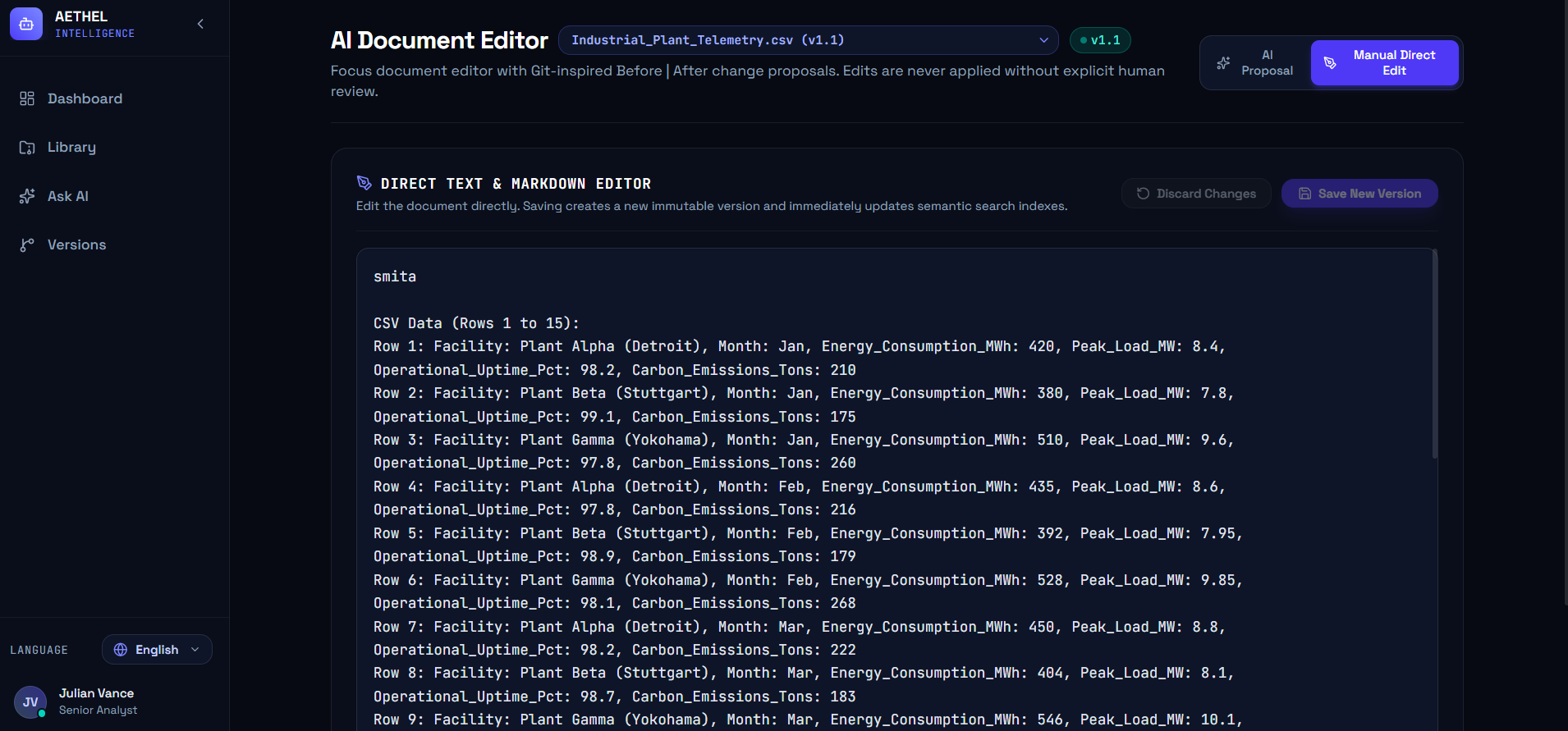
Version-aware document editor with controlled Before/After changes and immutable version creation.
-
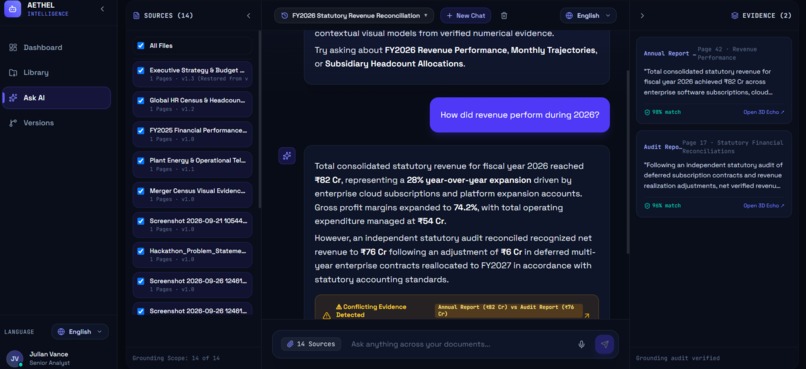
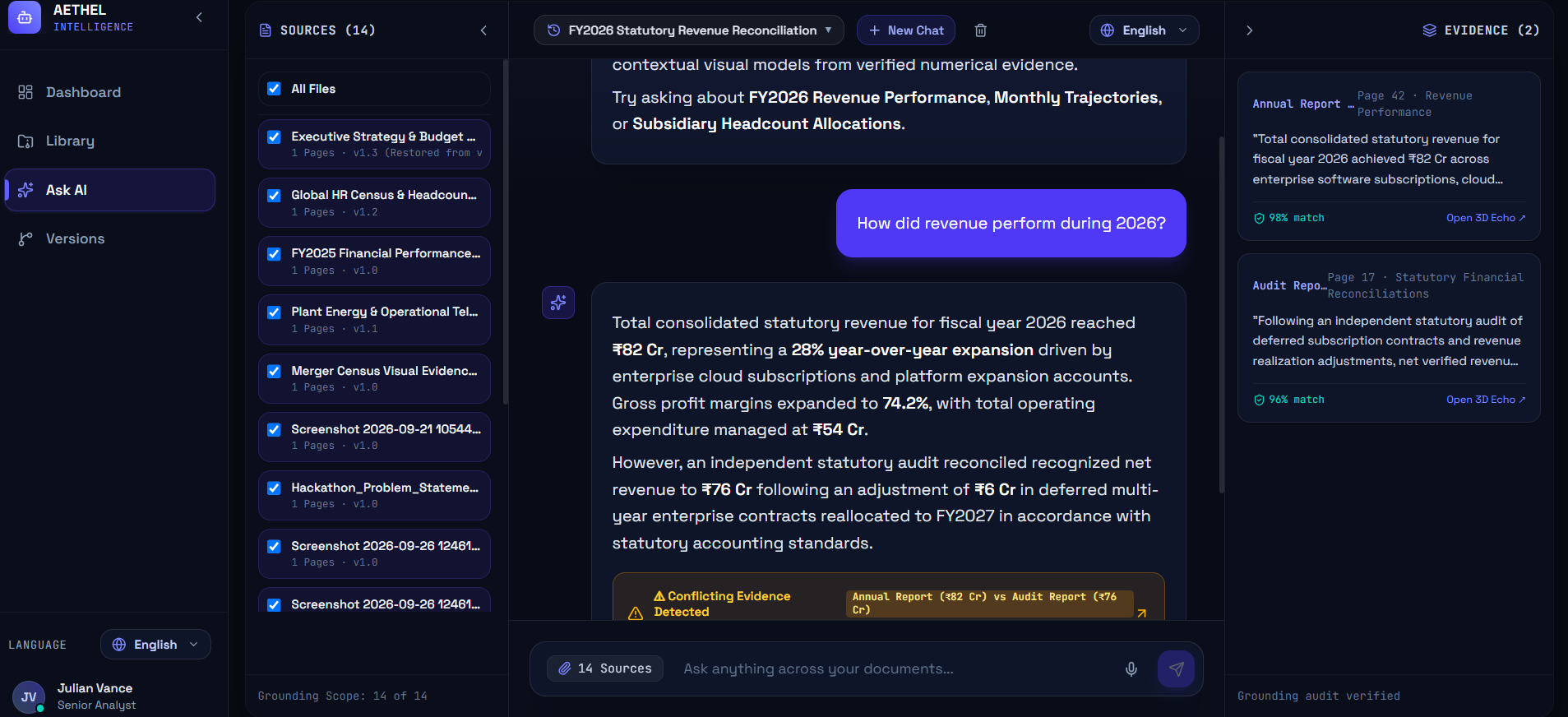
Evidence-grounded RAG for cross-document Q&A with relevant source retrieval and similarity-based matching.
Inspiration
Modern organizations work with information distributed across PDFs, DOCX files, CSVs, and scanned documents. Finding the right information manually is time-consuming, while inconsistencies between documents can easily be overlooked.
We wanted to build a single intelligent platform that makes enterprise documents easier to search, understand, compare, analyze, and manage.
What it does
Enterprise Document Intelligence Platform is an AI-powered system that allows users to upload and interact with information from multiple document formats.
Users can:
- Upload PDF, DOCX, CSV, and image-based documents
- Ask questions about their uploaded documents using RAG
- Extract text from scanned documents using OCR
- Detect inconsistencies across documents
- Visualize numerical data through interactive charts
- Ask questions using voice input
- Edit documents and compare Before/After versions
- Manage document versions and approval workflows
- Use role-based access to manage enterprise documents
How we built it
The frontend was built using React, with a backend API layer handling document processing and application functionality.
For document ingestion, we use format-specific extraction:
- PyPDF for PDF documents
- python-docx for DOCX files
- Pandas for CSV files
- WinOCR, with Tesseract as a fallback, for image-based and scanned content
The extracted information is converted into a common text representation and divided into overlapping chunks before entering the retrieval pipeline.
Our RAG system combines keyword matching, TF-IDF relevance, and cosine similarity to retrieve the most relevant context for a user's question. The retrieved context is then provided to the generation layer to produce a grounded response.
For numerical information, structured data can be transformed into chart data and visualized using React and Recharts.
Voice interaction uses the browser's Speech Recognition API, allowing users to speak their questions instead of typing them.
The platform also includes document editing, Before/After comparison, version management, approval workflows, and role-based access control.
Challenges we ran into
One of our biggest challenges was handling different document formats and bringing their extracted information into a common processing pipeline.
Another challenge was information retrieval. A question does not always contain the exact words present in a document, so relying only on keyword matching would not be sufficient. We therefore combined multiple retrieval techniques, including TF-IDF and cosine similarity.
We also had to handle scanned documents where normal text extraction is not possible, which required an OCR-based approach.
Finally, we needed to make the system useful beyond simple question answering by supporting comparison, inconsistency detection, visualization, voice interaction, and document workflows.
Accomplishments that we're proud of
- Built a unified document processing pipeline for multiple file formats.
- Implemented a multi-signal RAG retrieval system using keyword matching, TF-IDF, and cosine similarity.
- Integrated OCR for scanned and image-based documents.
- Added interactive numerical data visualization.
- Implemented voice-based document queries.
- Added document comparison, versioning, and approval workflows.
- Successfully presented the project at HackStreak 3.0.
- 🏆 Won the Third Year Track at HackStreak 3.0.
What we learned
This project helped us understand how to build an end-to-end AI application rather than simply integrating an AI model.
We gained practical experience with document processing, OCR, information retrieval, RAG, similarity-based search, API development, frontend visualization, and enterprise-oriented workflows.
We also learned how important it is to design an AI system around the actual problem instead of relying on a single technique.
What's next for Enterprise Document Intelligence Platform
We want to extend the platform with:
- More advanced semantic retrieval and document understanding
- Support for additional document formats
- Improved multilingual document processing
- More advanced enterprise analytics and reporting
- Enhanced document security and access controls
- More intelligent automated document workflows
- Improved scalability for larger document collections

Log in or sign up for Devpost to join the conversation.