NEXUS — AI Executive Chief of Staff
Inspiration
Modern professionals spend a significant part of their day managing information rather than acting on it. Important decisions are buried in emails, commitments are made during meetings and forgotten afterward, deadlines exist in different task systems, and calendars often become overloaded. Although many productivity tools can summarize or organize this information, they rarely understand how these pieces are connected or proactively ensure that work gets completed.
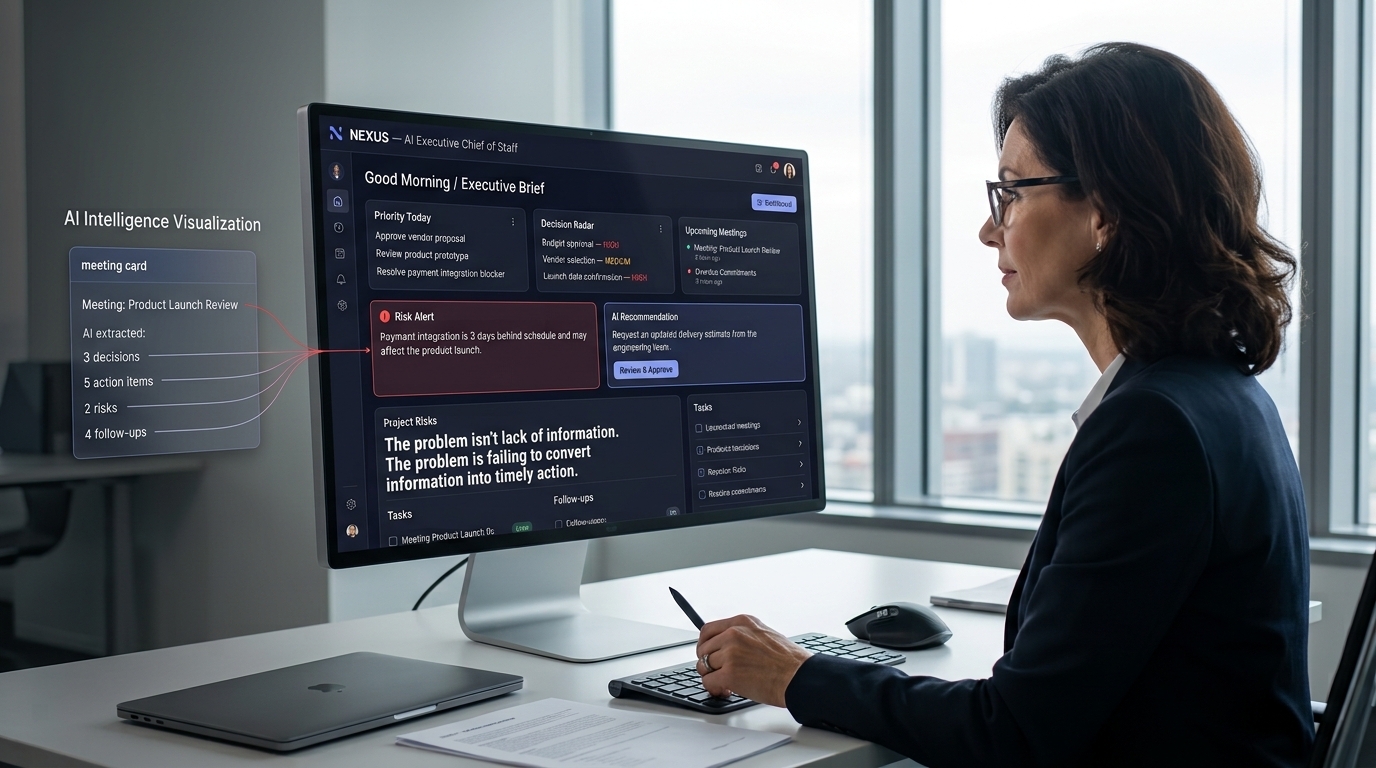
This inspired us to build NEXUS, an AI-powered Chief of Staff that acts as an intelligent execution layer across meetings, emails, calendars, tasks, decisions, and priorities. Instead of waiting for a user to ask what needs to be done, NEXUS continuously analyzes work signals, identifies important decisions, detects risks and missed commitments, prioritizes actions, and recommends or executes follow-ups with human approval.
Our goal is simple: move from information overload to intelligent action.
What We Learned
Building NEXUS taught us that creating a useful AI agent is much more than connecting an LLM to a chatbot. The real challenge is giving AI enough context to understand relationships between different events and make reliable decisions.
We learned how to:
- Extract structured information such as tasks, deadlines, commitments, decisions, people, dependencies, and risks from unstructured conversations and emails.
- Build an AI-driven prioritization system instead of simply sorting tasks by deadline.
- Design multi-agent workflows where specialized agents handle emails, meetings, calendars, tasks, risks, and context.
- Maintain persistent work context so that the AI can connect today's events with previous meetings and decisions.
- Implement human-in-the-loop controls so that sensitive actions require user approval.
- Design proactive workflows where the system detects problems and recommends actions instead of waiting for user instructions.
- Evaluate AI outputs for reliability, relevance, and consistency.
A key insight was that the most valuable AI assistant is not necessarily the one that generates the most content, but the one that reduces the number of things the user has to remember and manually coordinate.
How We Built It
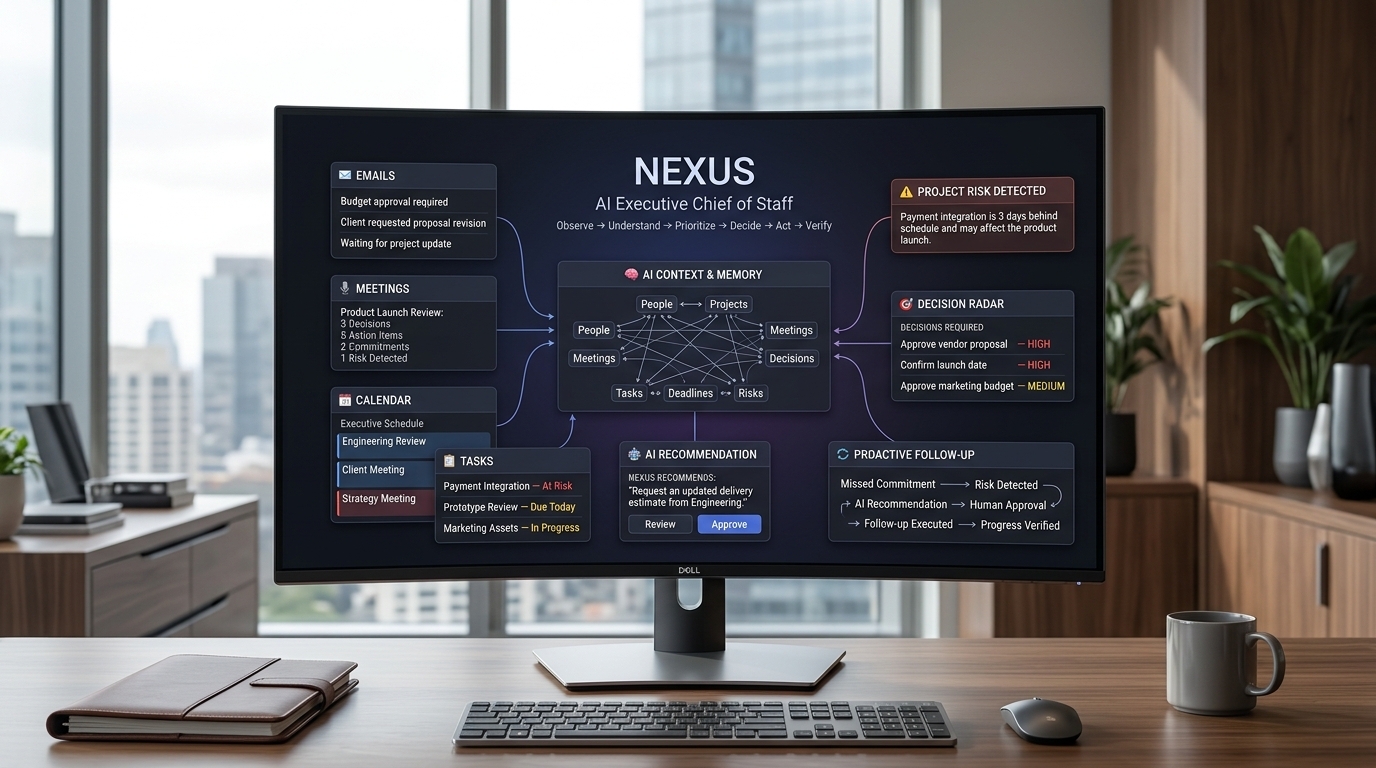
NEXUS is designed around an agentic architecture consisting of multiple specialized AI components coordinated by a central Chief of Staff Agent.
The system follows the workflow:
[ \text{Observe} \rightarrow \text{Understand} \rightarrow \text{Prioritize} \rightarrow \text{Decide} \rightarrow \text{Act} \rightarrow \text{Verify} ]
Information from emails, meeting transcripts, calendars, tasks, and documents is first collected through an ingestion layer. An AI context and memory layer then extracts entities, commitments, decisions, deadlines, dependencies, and relationships.
Specialized agents process this information:
- Meeting Agent — extracts decisions, action items, commitments, and risks.
- Email Agent — identifies actionable messages, pending decisions, and required responses.
- Task Agent — creates, tracks, and prioritizes tasks.
- Calendar Agent — identifies conflicts, meeting overload, and preparation requirements.
- Risk Agent — detects overdue commitments, blockers, and potential deadline failures.
- Context Agent — retrieves relevant historical information and connects related events.
- Action Agent — performs approved actions such as drafting follow-ups, creating tasks, or scheduling activities.
The central Chief of Staff Agent coordinates these components and determines what requires the user's attention.
NEXUS also uses a priority model that considers more than just deadlines:
[ P = w_uU + w_iI + w_dD + w_sS + w_rR ]
where (U) represents urgency, (I) impact, (D) dependency, (S) strategic importance, and (R) risk.
This allows NEXUS to distinguish between a low-value task that is merely due today and a decision that is currently blocking an entire project.
A Key Example
Suppose a meeting contains the statement:
"Ravi will complete the prototype by Friday, and Qusay will review it before Monday."
NEXUS converts this conversation into structured commitments and establishes the dependency between them.
If Friday arrives and Ravi has not completed the prototype, NEXUS recognizes that Qusay's review is now at risk. Instead of simply displaying an overdue task, it can proactively notify the user and recommend sending a status request.
With user approval, NEXUS can draft and send the follow-up.
This creates a continuous loop:
[ \text{Conversation} \rightarrow \text{Commitment} \rightarrow \text{Task} \rightarrow \text{Monitoring} \rightarrow \text{Risk Detection} \rightarrow \text{Follow-up} ]
Challenges We Faced
One of our biggest challenges was context management. Information is distributed across different sources, and understanding a single task may require information from a meeting, an email, and a calendar event.
Another challenge was reliable prioritization. A simple deadline-based system cannot understand business impact or dependencies, so we designed a more contextual priority mechanism.
We also had to consider AI autonomy and safety. An assistant that can send emails, schedule meetings, or modify tasks must not act blindly. We therefore incorporated human-in-the-loop approval for actions that could have significant consequences.
Finally, we faced the challenge of making the system proactive without becoming intrusive. NEXUS must identify meaningful events and surface them at the right time without overwhelming the user with unnecessary notifications.
Our Vision
NEXUS is designed to evolve from a productivity assistant into an AI execution partner.
The long-term vision is not to build another chatbot that users have to constantly interact with. It is to build an intelligent system that understands the user's goals, remembers organizational context, identifies what matters, and safely drives execution forward.
Accomplishments That We're Proud Of
One of our biggest accomplishments is transforming the idea of an AI assistant from a reactive chatbot into a proactive execution system. NEXUS does not simply wait for a user command; it continuously connects information from meetings, emails, calendars, tasks, and decisions to understand what needs attention.
We are particularly proud of building the concept around a complete execution loop:
[ \text{Observe} \rightarrow \text{Understand} \rightarrow \text{Prioritize} \rightarrow \text{Act} \rightarrow \text{Verify} ]
Some of our key accomplishments include:
- Building a central AI Chief of Staff architecture that coordinates multiple specialized agents.
- Designing intelligent extraction of tasks, commitments, decisions, deadlines, dependencies, and risks from unstructured information.
- Developing a context-aware prioritization approach that considers urgency, impact, dependencies, strategic importance, and risk.
- Creating a Decision Radar that identifies decisions waiting for the user's attention.
- Designing a Proactive Follow-up Engine that detects missed commitments and recommends appropriate actions.
- Connecting related information across meetings, emails, calendars, and tasks through a persistent work-memory layer.
- Incorporating human-in-the-loop approval, allowing NEXUS to remain proactive while keeping important decisions under human control.
- Designing an executive dashboard that focuses on what actually matters, rather than overwhelming users with raw information.
The accomplishment we are most proud of is the shift in mindset behind NEXUS: the system is not designed to help users manage more information; it is designed to help them manage fewer things manually.
What We Learned
Building NEXUS taught us that developing an effective AI agent requires much more than integrating a large language model.
1. Context is everything
An email, meeting, or task in isolation often has very little meaning. The real intelligence comes from understanding the relationships between them.
For example, a missed task becomes significantly more important when NEXUS knows that another person's work depends on it and that the dependency affects an upcoming deadline.
2. AI should prioritize, not just summarize
We learned that generating summaries is relatively easy, but deciding what deserves attention is much more valuable.
NEXUS therefore focuses on questions such as:
"What is blocking progress?"
"Who is waiting for a decision?"
"Which commitment is at risk?"
"What should happen next?"
3. Proactivity requires responsibility
An autonomous system can be powerful, but unrestricted autonomy can create unnecessary risks. We learned the importance of designing appropriate boundaries between AI recommendations and AI actions.
This led us to introduce different levels of autonomy, with sensitive operations requiring human approval.
4. Multi-agent systems require orchestration
Instead of asking one AI model to perform every task, we learned how specialized agents can work together. A Meeting Agent can understand conversations, a Risk Agent can identify problems, and an Action Agent can execute approved tasks, while the Chief of Staff Agent coordinates the overall workflow.
5. The best AI experience can be invisible
A successful Chief of Staff should not constantly interrupt the user. It should surface information when it is meaningful and remain quiet when no action is required.
This taught us an important principle:
The goal of an AI assistant is not to create more notifications. It is to create better decisions.
What's Next for NEXUS
Our hackathon prototype is the foundation for a much larger AI executive operating system.
1. Deeper Enterprise Integrations
We plan to connect NEXUS with platforms such as:
- Gmail / Outlook
- Google Calendar / Microsoft Calendar
- Slack / Microsoft Teams
- Jira
- Notion
- Trello
- GitHub
- CRM platforms
This would allow NEXUS to understand an organization's complete workflow instead of operating on isolated data sources.
2. Advanced Organizational Memory
The next version will develop a richer Organizational Knowledge Graph connecting:
[ People \leftrightarrow Projects \leftrightarrow Decisions \leftrightarrow Tasks \leftrightarrow Meetings \leftrightarrow Documents ]
This would allow users to ask questions such as:
"Why is Project X delayed?"
"Who is waiting for my approval?"
"When did we decide to change the launch date?"
"What commitments did I make this month?"
NEXUS could answer using the organization's historical context rather than relying only on the current conversation.
3. Predictive Risk Detection
Instead of waiting until a deadline is missed, NEXUS will predict potential failures.
For example:
⚠️ 78% probability of project delay
"Three dependent tasks are behind schedule, and the critical-path task has not started."
This moves NEXUS from reactive management to predictive management.
4. Increasingly Autonomous Execution
Future versions will support controlled autonomous workflows.
For example:
[ \text{Detect Problem} \rightarrow \text{Analyze Impact} \rightarrow \text{Generate Plan} \rightarrow \text{Request Approval} \rightarrow \text{Execute} \rightarrow \text{Verify} ]
Over time, low-risk repetitive tasks could become fully autonomous, while high-impact decisions would continue to require human approval.
5. Personalized Executive Intelligence
NEXUS will learn how each user works.
It could understand:
- Preferred meeting times
- Communication style
- Decision-making patterns
- Important projects
- Typical response times
- Priority preferences
- Delegation patterns
The goal is for NEXUS to become increasingly useful without requiring users to repeatedly explain their preferences.
6. Team-Level Chief of Staff
Our long-term vision goes beyond assisting one individual.
NEXUS could become an AI Chief of Staff for entire organizations, helping teams coordinate projects, detect organizational bottlenecks, monitor strategic objectives, and ensure that important decisions are translated into execution.
The Bigger Vision
We envision a future where professionals don't spend their time remembering what happened, who needs a response, which task is overdue, or what decision is pending.
Instead, NEXUS continuously handles the coordination layer while humans focus on strategy, creativity, leadership, and high-value decisions.
NEXUS
From Information Overload to Intelligent Action.
Built With
- fastapi
- human-in-the-loop
- knowledge-graph
- large-language-models
- machine-learning
- natural-language-processing
- python
- react
- rest-api
- semantic-search
- sql
- typescript

Log in or sign up for Devpost to join the conversation.