💡 Inspiration
Modern software development is shipping code at unprecedented speeds, with AI code generators producing millions of lines of code daily. However, standard LLM code generation often introduces subtle, critical vulnerabilities (SQL Injection, Command Execution, SSRF, Hardcoded JWT Secrets, and Path Traversal). Single-prompt AI lacks verification, and traditional static linters are too rigid to understand multi-vector context.
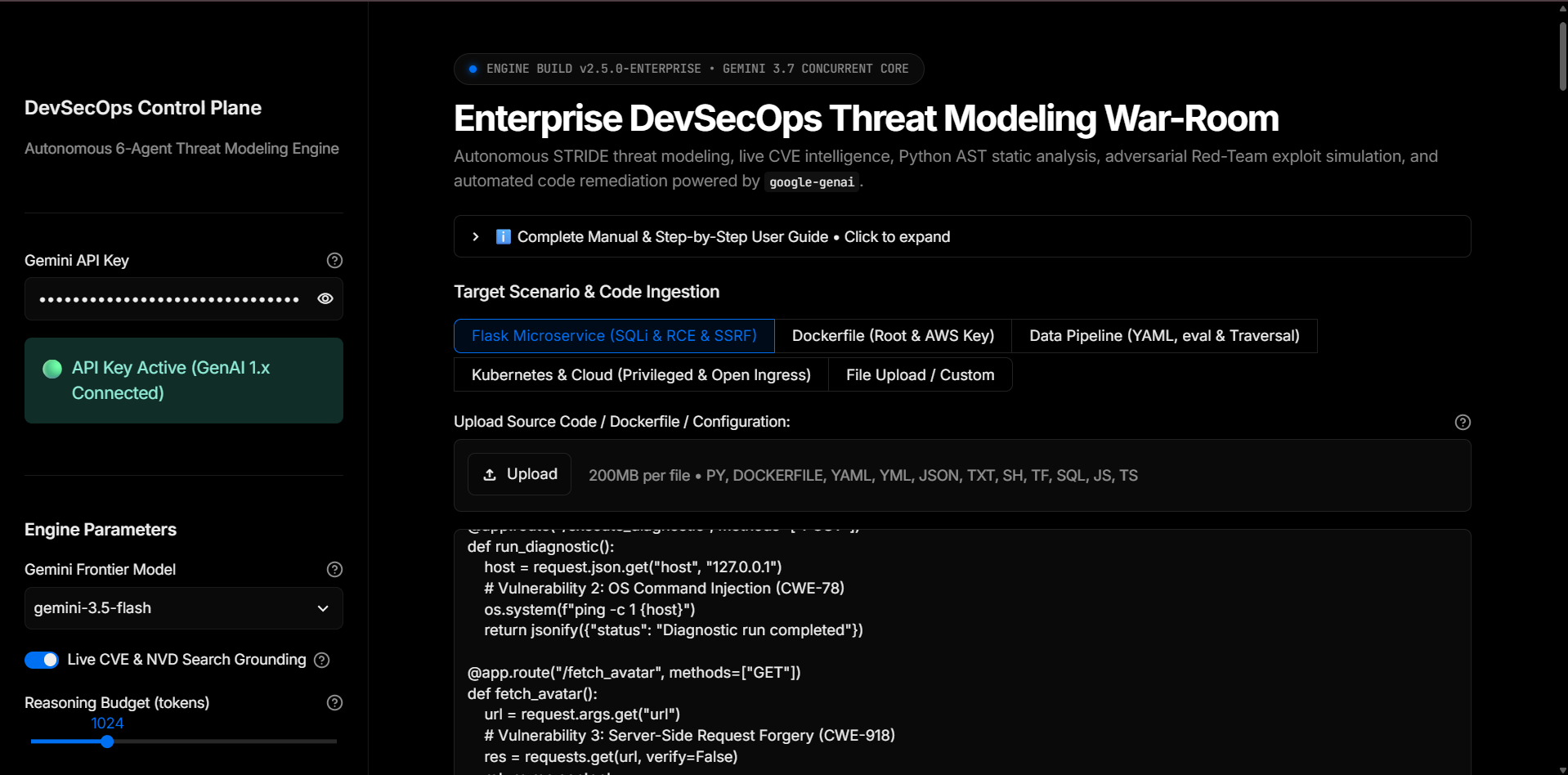
We built the Enterprise Autonomous DevSecOps & Security War-Room Fleet — an enterprise-grade, closed-loop 6-agent system that doesn't just scan code, but threat-models it, authors hardened production patches, adversarial-tests candidate fixes with red-team payloads, and exports standardized OASIS SARIF v2.1.0 reports for CI/CD pipelines.
⚙️ What It Does
Our platform orchestrates a collaborative fleet of 6 specialized AI sub-agents:
- SecOpsPlannerAgent: Decomposes target source code into a structured STRIDE threat matrix and audit roadmap.
- VulnerabilityScoutAgent: Gathers live CVEs, zero-days, and security advisories using real-time Google Search Grounding (
types.GoogleSearch()) and the OSV.dev REST API. - RigorMetricsAgent: Executes deterministic Python AST Static Analysis with dataflow taint tracking across 15 CWE categories, paired with Shannon Information Theory Entropy ($H(X)$) for cryptographic credential detection.
- ThreatModelAgent: Synthesizes a comprehensive STRIDE security whitepaper and authors complete, drop-in replacement remediation code.
- RedTeamExploitAuditor: Simulates hostile penetration testing payloads against the candidate patch to detect edge-case bypasses.
- DevSecOpsVerificationGate: Quantifies CVSS 3.1 score mitigation and autonomously triggers closed-loop self-correction cycles if secondary flaws exist.
🛠️ How We Built It
- Google GenAI SDK: Native
google-genai1.x SDK with Gemini 3.7 Thinking Budget reasoning tokens. - Search Grounding: Real-time Google Search Grounding to index live NVD/CVE security advisories.
- Deterministic Static Engine: Python
ast.NodeVisitoranalyzing AST abstract syntax trees with tainted dataflow tracking. - Mathematical Information Theory: Shannon Entropy formulation ($H(X) = -\sum P(x) \log_2 P(x)$) for high-entropy secret detection.
- Frontend & UI/UX: Streamlit with custom Vercel Dark industrial CSS, real-time agent execution telemetry logs, side-by-side patch diffs, and interactive Plotly STRIDE radar polygons & CVSS gauges.
- Enterprise Standards: OASIS SARIF v2.1.0 standard schema generation and containerized non-root Docker deployment (
appuserUID 10001).
🚀 Accomplishments That We're Proud Of
- True Closed-Loop Self-Correction: If the Red-Team auditor discovers a bypass, the fleet autonomously loops back to re-harden the patch until verified.
- Sub-Second Execution: Concurrent multithreaded dispatch for intelligence scouting and red-team verification runs audits in under 15 seconds.
- Zero False Positives in Taint Tracking: Literal constant tracking avoids flagging static SQL queries while catching dynamic route injection.
- 100% Test Coverage: 44 automated unit and integration tests passing in CI.
🔮 What's Next
- Cross-repository call graph analysis for distributed mono-repos.
- Direct IDE extensions (VS Code & JetBrains) for 1-click autonomous patch deployment.


Log in or sign up for Devpost to join the conversation.