Inspiration
I work at a startup and we're hiring a developer. The workflow is always the same: meet someone at a hackathon, exchange LinkedIns, then ask an AI agent to gather information — is this person a good fit? And on max effort, the agent buys everything: every people-data API it can find, "just in case." Nobody ever knows which of those paid calls actually mattered.
My belief: you only need specific data for the specific task. So I flipped the usual agent instinct — instead of "call more," build an agent that discovers which paid calls are load-bearing and kills the rest. Agent spend is becoming a board-level line item; most of it is waste you can measure in real dollars.
What it does
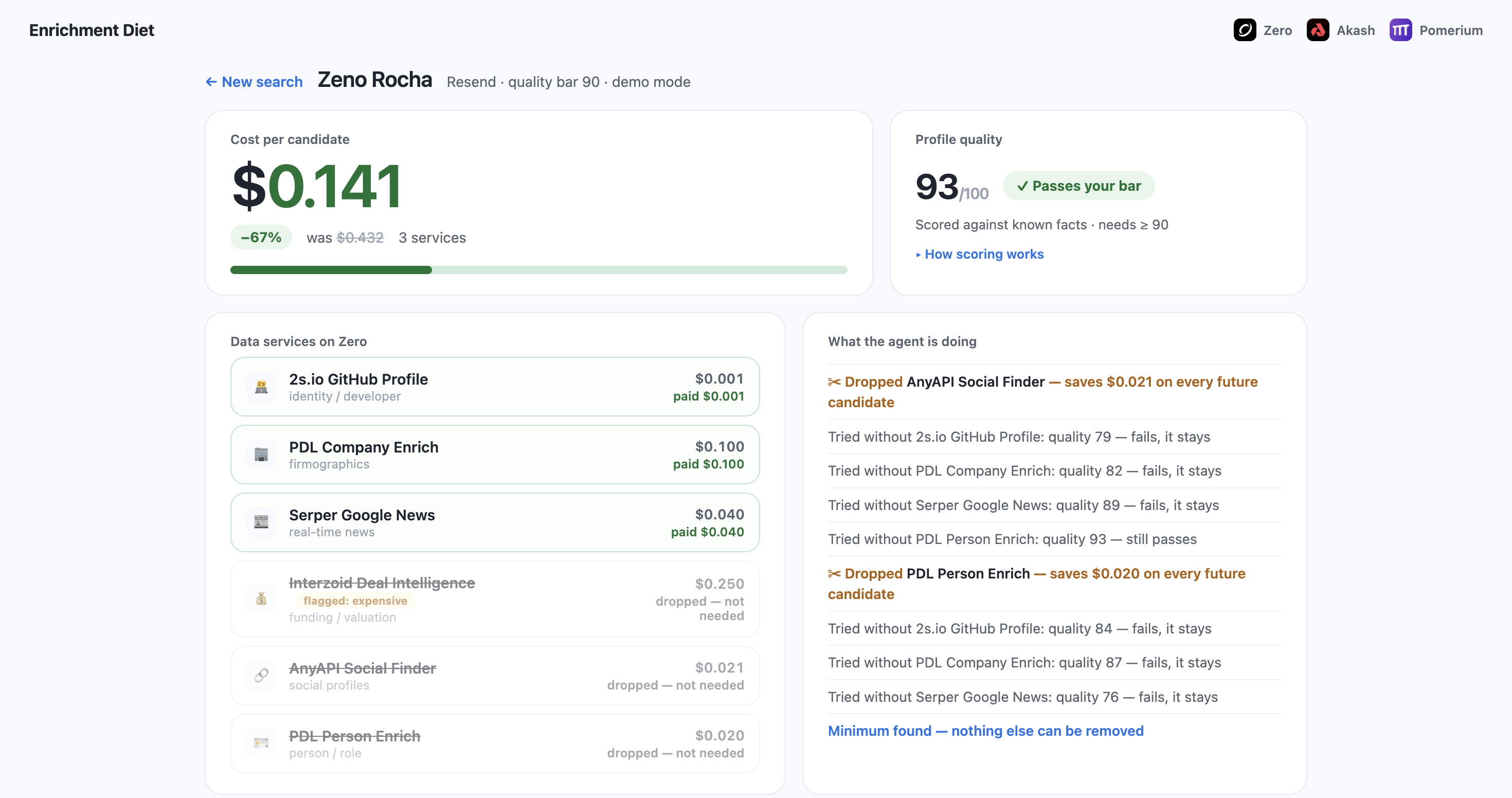
Enrichment Diet builds a recruiting candidate profile by buying data from live services it discovers on Zero (real USDC micropayments, x402 on Base), grades the profile against an 11-fact rubric with an open Llama-3.3-70B on Akash, then runs a drop-one-and-retry loop: solve with everything, then keep asking "can it still pass without this one?" Formally, it searches for
$$S^* = \arg\min_{S \subseteq S_0} \sum_{s \in S} p_s \quad \text{s.t.} \quad \mathrm{score}(S) \ge \tau$$
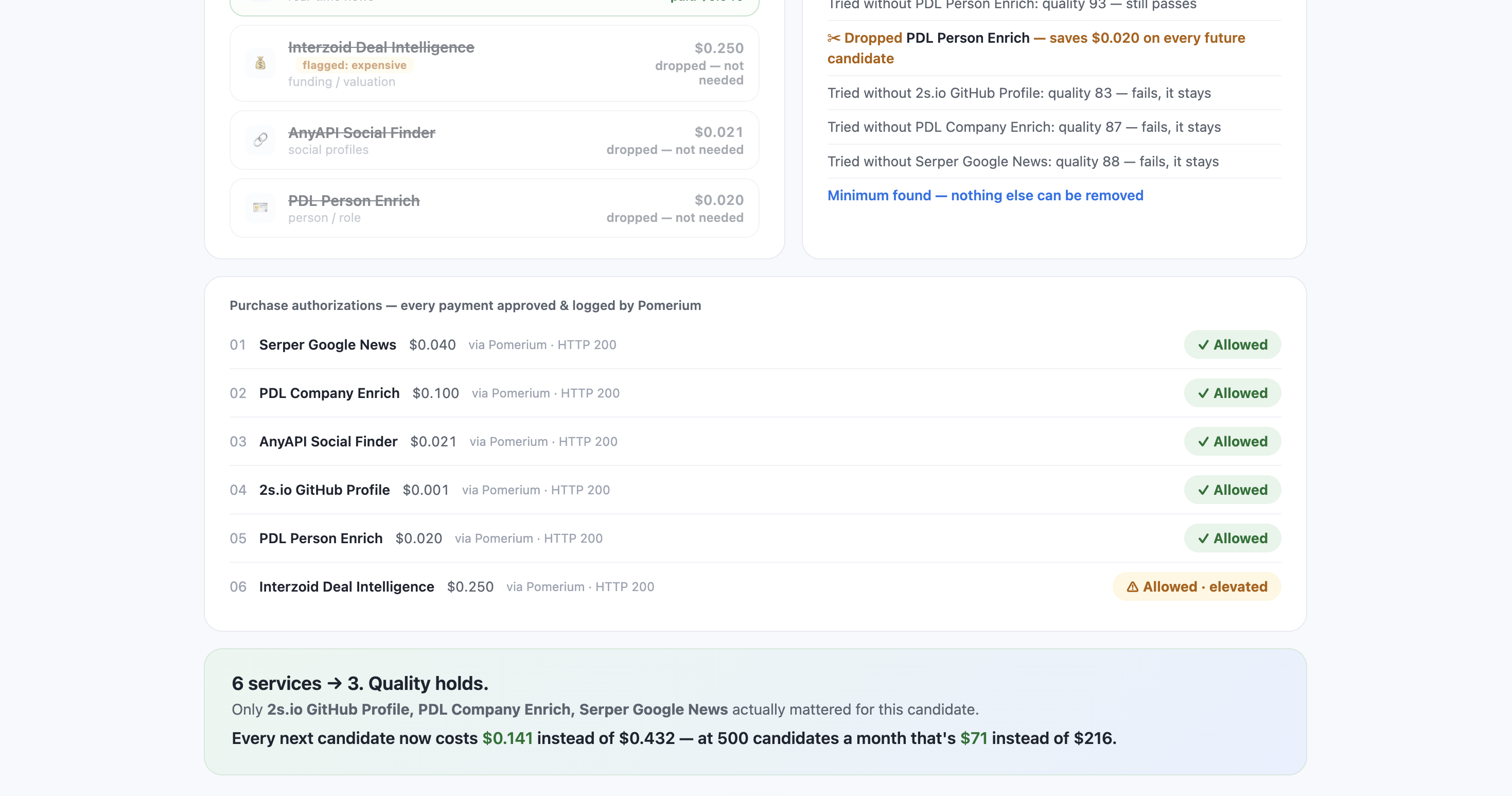
— the cheapest subset of services that still clears your quality bar $\tau$. On camera: six services shrink to three, cost falls $0.43 → $0.14 (−67%) while the PASS light stays green. You calibrate at full price on a few candidates, then run every future candidate on the surviving set — at 500 candidates/month that's $71 instead of $216. Every purchase is authorized and logged by a real Pomerium identity-aware proxy; in lockdown mode it 403-blocks over-budget calls at the proxy.
How I built it
Solo, in one day, engineering the loop with Claude Code. De-risked externals first: searched Zero's registry live (17 email finders, 28 company enrichers…) and locked the six services that actually responded and settled payment. Each service is paid once per candidate and cached; the diet explores subsets by re-grading cached data on Akash — payments stay real and settle once, while the many grading trials are cheap open-model inference. Node.js + SSE stream the run into a chat-first UI: type a name, set your bar, watch the dollar meter fall.
Challenges I ran into
- Marketplace reality. Several services had broken payment flows (one email finder failed its x402 handshake; MPP/tempo settlement wasn't supported by the runner; one API 502'd after payment). Locking a working set with real test calls before building saved the day.
- Grading is the hard part. A naive keyword grader leaked credit between services ("SF" ≠ "San Francisco", a news headline secretly carrying the job title). The fix: field-aware grading, and letting the Llama on Akash read the unstructured text — a headline like "Vercel CEO raised $300M" legitimately proves title and funding.
- My agent spent my entire budget. The $5 Zero wallet went to zero during testing — including one unfunded live run that overwrote good cached data with payment failures. I shipped cache protection and kept the lesson: an agent with a wallet needs exactly the spend governance this project demonstrates.
What I learned
Real-dollar feedback changes how you design agents — savings aren't estimated tokens, they're settled transactions with hashes. And the load-bearing set differs per candidate: for one founder the $0.25 funding API is pure waste; for another it's the only source of industry data. You can't configure the minimal set — you have to discover it. That's the product.
What's next
Escalation mode (start with the cheap set, add services only when the score falls short), user-defined rubrics typed straight into the chat, and publishing the surviving trio as its own service back onto Zero — the diet's output becomes a product other agents can buy.
Built With
- akashml-(llama-3.3-70b)
- express.js
- node.js
- pomerium-(identity-aware-proxy)
- sse
- zero-cli-(x402-micropayments)


Log in or sign up for Devpost to join the conversation.